
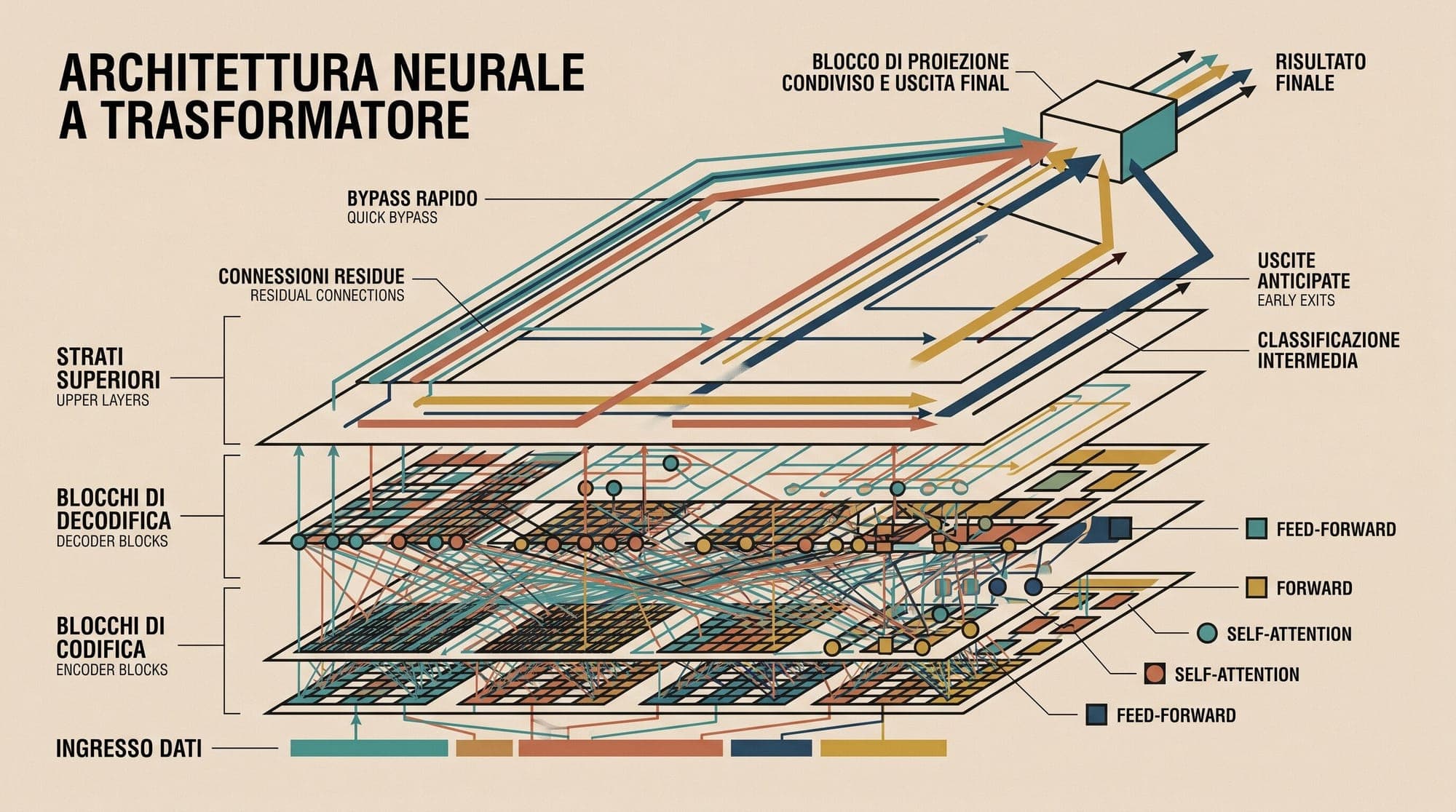
LayerSkip and Self-Speculative Decoding: How Layer Dropout and Shared Early Exits Accelerate LLM Generation
Standard autoregressive large language model (LLM) inference is severely bottlenecked by memory bandwidth. In transformer decoders, generating a sequence of tokens requires loading all model parameters from High Bandwidth Memory (HBM) to on-chip SRAM separate times. While speculative decoding mitigates this bandwidth tax by using a smaller draft model to propose candidate tokens verified in parallel by a larger target model, standard dual-model architectures introduce significant operational complexity: maintaining two independent model weight sets in VRAM, managing separate Key-Value (KV) caches, and handling tokenizer discrepancies.
Introduced by researchers at Meta AI in LayerSkip: Enabling Early Exit Inference and Self-Speculative Decoding (ACL 2024), LayerSkip eliminates the need for auxiliary draft models entirely. By combining a layer dropout training recipe with a shared early exit loss, LayerSkip enables a single transformer checkpoint to execute both draft generation and target verification within a single unified memory and computation space.
The Autoregressive Bottleneck and Layer Redundancy
In autoregressive token generation, the arithmetic intensity (FLOPs performed per byte of memory transferred) during batch-1 decoding is roughly 1 FLOP/byte. The GPU compute units remain idle for most of the decoding cycle while waiting for multi-gigabyte weight matrices to stream across the memory bus.
Speculative decoding, formalized by Leviathan et al. (2023) and Chen et al. (2023), addresses this bottleneck by decoupling token proposal from token verification. A draft engine produces speculative tokens in fast steps, which the target model evaluates simultaneously in a single forward pass containing positions. Because computing tokens in parallel requires transferring the target model's weights only once, the target model amortizes memory bandwidth across the entire accepted draft prefix.
However, traditional speculative decoding introduces severe systems overhead:
- Memory Footprint: Running a 70B target model with an 8B draft model requires storing both weight sets simultaneously in GPU VRAM, increasing memory consumption by 11% to 15%.
- Dual KV Caches: The serving engine must allocate and update two isolated KV caches throughout the conversation history.
- Draft Quality Mismatch: When the draft model is trained independently or with a different architecture, distribution shifts degrade draft acceptance rates on domain-specific workloads.
Layer analysis of modern transformers reveals that many intermediate tokens do not require all layers to resolve their final classification. Simple tokens (e.g., syntax punctuation, common subwords, copied entities) reach maximum probability mass in the first 25% to 50% of layers, while only complex semantic reasoning requires the full depth of the network.
The Three Pillars of LayerSkip
LayerSkip restructures the transformer to natively support variable-depth execution without adding auxiliary heads, adapters, or separate draft models. It relies on three foundational components:
1. Curricular Layer Dropout
Directly cutting an unadapted transformer at layer yields poor accuracy because upper layers depend strictly on the precise activation trajectories formed by the preceding stack. To make intermediate layers resilient to layer skipping, LayerSkip introduces layer dropout during continual pre-training or fine-tuning.
Instead of dropping layers uniformly, LayerSkip applies a depth-scaled dropout schedule where earlier layers are dropped less frequently than later layers. Formally, for a model with layers (), the dropout probability for layer at training step is defined as:
Where:
- is the maximum layer dropout probability (typically set between 0.2 and 0.5).
- scales the dropout probability linearly with layer depth, ensuring layer 0 is never dropped while layer reaches .
- is a time-dependent curriculum function that ramps dropout from 0 to 1 over the initial training iterations.
During the forward pass, layer applies a Bernoulli mask . If , the layer computation is bypassed entirely:
Because lower layers build the foundational syntactic and semantic representations necessary for all downstream predictions, keeping their dropout rate low stabilizes optimization while forcing upper layers to act as refinement steps rather than mandatory dependencies.
2. Shared Early Exit Loss
To allow intermediate layers to produce valid token logits without auxiliary projection parameters, LayerSkip shares the final Root Mean Square Normalization (RMSNorm) and unembedding matrix (lm_head) across all layers.
Given hidden state at layer , the early exit prediction is computed directly as:
Where is the frozen or shared unembedding matrix and is vocabulary size.
During training, the total objective is a weighted summation of cross-entropy losses computed at every layer exit:
The per-layer loss weight is normalized such that . LayerSkip uses an exponential or linear layer-weighting scheme:
Where controls the penalty bias toward later layers. This supervision forces lower-layer activations into the same geometric representation space as the final output layer, allowing the model to generate coherent next-token predictions directly from layer .
3. Self-Speculative Decoding
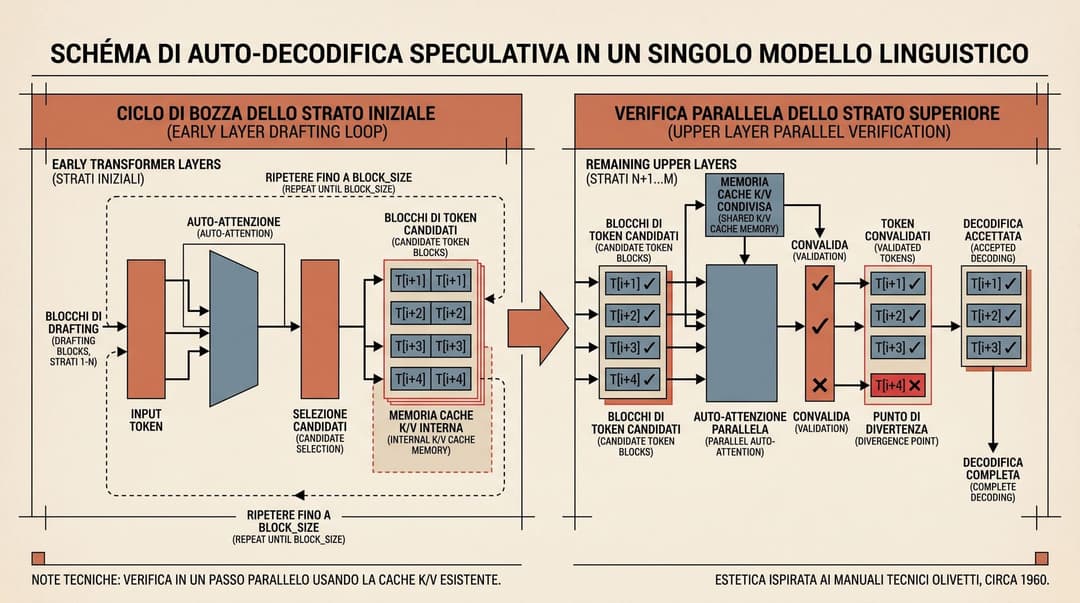
With intermediate layers trained to output calibrated next-token distributions, inference operates as an integrated speculative loop executed on a single weight tensor:
- Draft Phase (Early Layers ): The model runs only the first layers autoregressively for iterations, using the shared
lm_headto generate draft tokens . - Verification Phase (Remaining Layers ): The candidate tokens are evaluated in a single forward pass across the remaining layers.
- Acceptance and Correction: The generated logits from the final layer verify the draft tokens using standard greedy matching or speculative sampling. If token is rejected, the target model's corrected token replaces it, and draft generation resumes from the new accepted boundary.
+-------------------------------------------------------------------------+
|                    Single Transformer Checkpoint                        |
|                                                                         |
|  [ Layer 0 ... Layer E ]  ===> (Shared lm_head) ===> Draft Tokens (K)   |
|          |                                                  |           |
|     KV Cache (0..E)                                         |           |
|          |                                                  v           |
|  [ Layer E+1 ... L-1 ]    <====================== Verification Step     |
|          |                                                              |
|     KV Cache (E+1..L-1)                                                 |
|          |                                                              |
|          +================> Exact Output Token Stream                   |
+-------------------------------------------------------------------------+
Memory and Cache Reuse Mechanics
The primary systems advantage of LayerSkip over classical speculative decoding lies in hardware resource utilization:
Zero Additional Model Parameters
Methods such as Medusa (Cai et al., 2024) attach multiple non-autoregressive decoding heads to the final transformer layer, while EAGLE (Li et al., 2024) adds an auxiliary autoregressive decoder layer. These additions require specialized fine-tuning and introduce extra parameters. LayerSkip introduces exactly zero additional parameters, reusing the base model's native weights and unembedding matrix.
Unified KV Cache Management
In standard speculative decoding with separate draft and target models, the serving runtime must manage two distinct KV caches with different head counts and hidden dimensions. In LayerSkip:
- For draft layers , the KV cache entries written during drafting are reused directly during the verification phase.
- The verification pass only needs to compute and write KV entries for the remaining layers .
- If draft tokens are accepted, their KV cache entries for all layers are already in place; if rejected, the engine simply rolls back the cache pointers to the last valid token index.
Activation Forwarding
Because the draft phase computes full hidden states at layer , these intermediate activation tensors can be retained in SRAM or local VRAM. When verification begins for the proposed tokens, the runtime can start execution directly at layer by consuming the cached , eliminating redundant computation of layers during verification.
Architectural Comparison
Comparing LayerSkip against existing inference acceleration paradigms highlights key structural differences:
- Standard Speculative Decoding: Employs two independent models (adding 5% to 20% extra parameter overhead for draft model weights) and maintains two isolated KV caches. It offers zero activation reuse due to divergent architectures, lacks early-exit capability, and requires independent pre-training pipelines.
- Medusa and EAGLE: Attaches auxiliary multi-token prediction heads or lightweight autoregressive layers to the primary model (adding 1% to 5% extra parameter overhead). It manages one primary KV cache alongside auxiliary head states, provides limited activation reuse, cannot operate in early-exit mode without running the full forward pass, and requires post-hoc head fine-tuning.
- LayerSkip: Operates entirely within a single unified model checkpoint (introducing 0% additional parameter overhead) and manages a single multi-layer KV cache. It enables full activation forwarding (hidden states from layer directly seed layer during verification), natively supports standalone early-exit execution, and is trained via an integrated layer-dropout and shared-unembedding loss recipe.
Empirical Benchmarks and Speedup Profiles
According to the evaluations published by Elhoushi et al. (Meta AI, 2024) and documented on Hugging Face, LayerSkip demonstrates consistent throughput gains across model scales:
- Llama 2 and Llama 3 Performance:
- On code generation benchmarks (HumanEval, MBPP), LayerSkip with (exiting at half depth for drafting) achieves 1.82x to 2.16x wall-clock speedup with zero degradation in exact-match accuracy under greedy speculative decoding.
- On open-ended summarization (CNN/DailyMail) and dialogue benchmarks, speedups range between 1.34x and 1.78x, depending on batch size and context length.
- Standalone Early Exit Accuracy:
- When deployed in low-power or compute-capped environments without verification (early exit only), a Llama-3-8B model trained with LayerSkip retains up to 78% of its full-depth accuracy when exiting at layer 16 of 32, compared to under 22% accuracy for an unmodified baseline model evaluated at the same layer.
- Memory Savings:
- Because no secondary model is loaded into VRAM, total memory allocation for a 70B parameter deployment remains bounded strictly by the target model's parameter count plus a single KV cache allocation, enabling speculative acceleration on memory-constrained single-GPU nodes.
Implementation Considerations and Limitations
Deploying LayerSkip in production environments requires specific architectural considerations:
- Continual Pre-Training Overhead: Applying LayerSkip to an existing foundation model requires continual pre-training (typically 1% to 5% of original pre-training tokens) or domain-specific fine-tuning with the layer-dropout and multi-exit loss objective enabled.
- Early Exit Layer Tuning (): The optimal exit layer depends on task entropy. For deterministic tasks (e.g., code syntax, JSON generation), setting or yields high draft acceptance rates (). For high-entropy tasks (creative writing, multilingual translation), setting provides better draft fidelity and avoids verification thrashing.
- Kernel Integration: Realizing the full 2x speedup requires custom inference kernels (e.g., in TensorRT-LLM, vLLM, or SGLang) that support early-exit slicing, in-place KV cache pointer rollback, and cross-layer activation reuse.
Sources
- LayerSkip: Enabling Early Exit Inference and Self-Speculative Decoding (arXiv:2404.16710) - Mostafa Elhoushi, Akshat Shrivastava, Diana Liskovich, Basil Hosmer, Bram Wasti, Liangzhen Lai, et al., Meta AI / ACL 2024.
- Faster Text Generation with Self-Speculative Decoding (Hugging Face Blog) - Official Hugging Face implementation and checkpoint release for LayerSkip Llama models.
- Fast Inference from Transformers via Speculative Decoding (arXiv:2211.17192) - Yaniv Leviathan, Matan Kalman, Yossi Matias, Google Research (2023).
- Accelerating Large Language Model Decoding with Speculative Sampling (arXiv:2302.01318) - Charlie Chen, Sebastian Borgeaud, Alireza Ghaffarkhah, Samuel Stanton, et al., DeepMind (2023).
- Medusa: Simple LLM Inference Acceleration with Multiple Decoding Heads (arXiv:2401.10774) - Tianle Cai, Yuhong Li, Zhengyang Geng, Hongwu Peng, Jason D. Lee, Deming Chen, Tri Dao (2024).
- EAGLE: Speculative Sampling Requires Rethinking Feature Uncertainty (arXiv:2401.15077) - Yuhui Li, Fangyun Wei, Chao Zhang, Hongyang Zhang (2024).
