
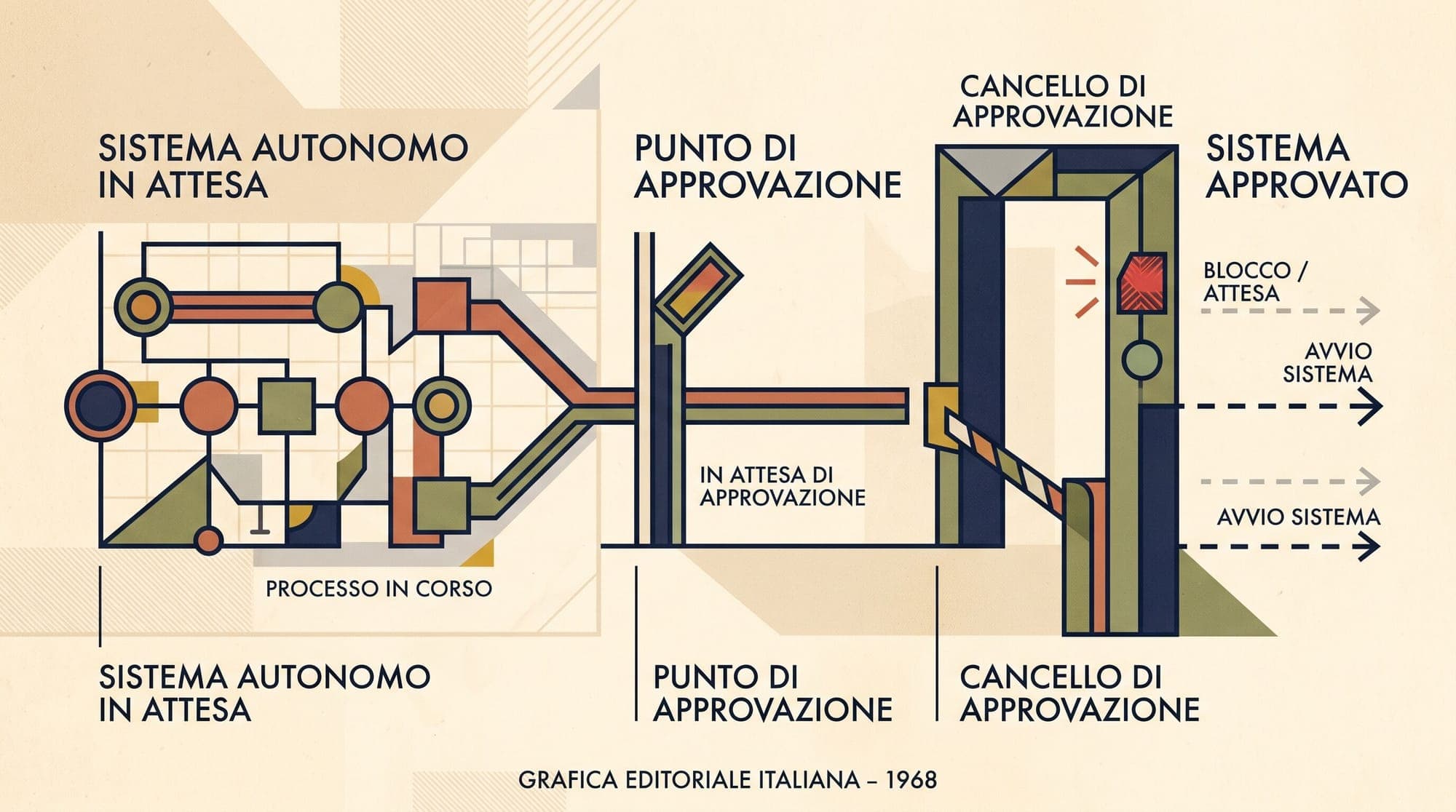
Deploying autonomous AI agents into production environments exposes a fundamental tension between system velocity and operational safety. While read-only tasks such as data extraction and document summarization carry minimal operational blast radius, agents equipped with write-access tools (database mutations, API transactions, cloud infrastructure provisioning, and outbound communications) introduce severe operational risks. Hallucinations, prompt injections, and logical drift can trigger irreversible side effects.
Mitigating these hazards requires Human-in-the-Loop (HITL) architectures. Rather than treating human oversight as an ad-hoc prompt constraint, production systems implement formal structural boundaries where proposed actions are decoupled from execution, state is persisted across asynchronous delays, and explicit authorization policies govern tool dispatch.
The Principle of Separated Proposal and Execution
A central failure mode in naive agent implementations is the direct coupling of LLM output to tool execution. When an agent generates a tool call, the runtime immediately executes the function and feeds the output back into the context window. Under this model, any adversarial prompt injection or planning error results in immediate execution.
In their formalization of agent security architectures, researchers from ETH Zurich and collaborating institutions (Beurer-Kellner et al., 2025) established the separation of proposal and execution as a core structural defense. Under this pattern:
- Proposal Phase: The agent reasons over its context, generates a proposed tool call with typed arguments, and emits an intent payload.
- Policy Evaluation: The runtime intercepts the intent payload before dispatch, evaluating it against static permissions, parameter constraints, and dynamic risk scoring.
- Approval Gate: If the action exceeds defined risk thresholds, the execution thread halts, serializes its state, and awaits human verification.
- Execution Phase: Only upon cryptographic confirmation or authenticated human sign-off does the execution engine invoke the underlying tool.
Synchronous Blocking vs. Asynchronous Durable Interrupts
Early prototyping frameworks frequently model human intervention as a synchronous blocking call (such as a CLI input() prompt). In distributed production systems, this approach fails immediately:
- Resource Exhaustion: Holding synchronous worker processes or HTTP connections open while waiting for human review (which may take minutes, hours, or days) consumes memory and socket pools.
- Process Volatility: Any server restart, pod eviction, or deployment terminates the active thread, losing the agent's intermediate reasoning trace and memory.
- Lack of Visibility: Synchronous prompts cannot be easily routed to external notification channels (Slack, email, custom web dashboards) without complex thread locking.
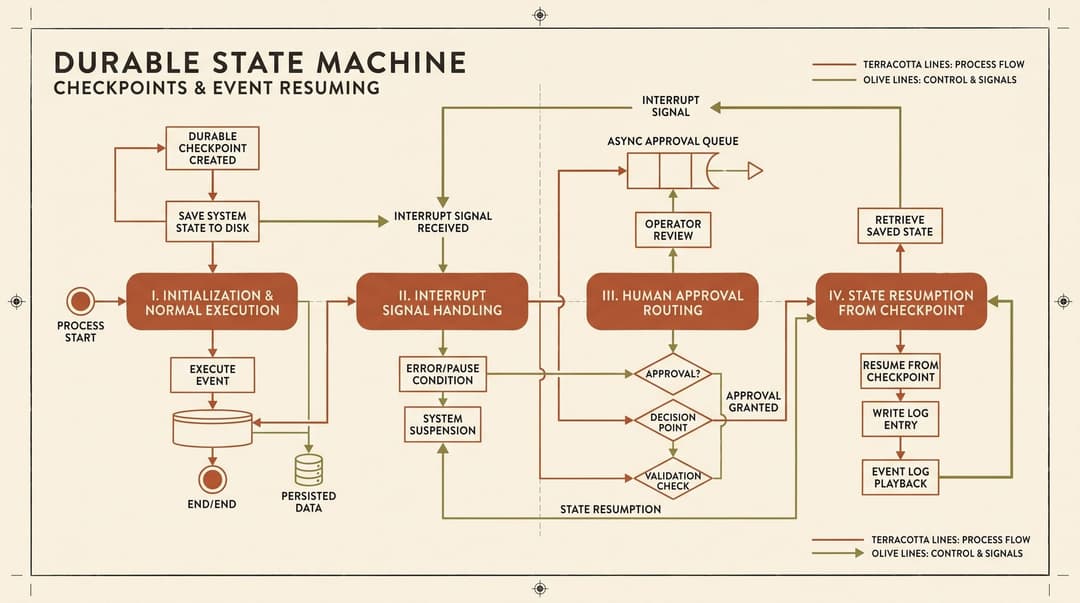
Production architectures solve this through durable execution and checkpointed state machines. Frameworks such as LangGraph Interrupts and Temporal Workflows treat pauses as first-class control-flow primitives.
When an agent encounters a node requiring authorization:
- The runtime invokes an interrupt mechanism (such as
interrupt()). - The entire graph state (conversation history, working scratchpad, variable values, and pending tool metadata) is serialized to persistent storage (e.g., PostgreSQL or MongoDB) indexed by a unique
thread_idandcheckpoint_id. - The execution engine yields compute resources, and the agent run terminates cleanly.
- An external notification system dispatches the approval request via webhook to reviewers.
- When the human responds via an administrative UI or chat interface, the webhook triggers a graph invocation pointing to the stored checkpoint, deserializes the state, injects the human response, and resumes execution.
The Three Modalities of Human Intervention
Human-in-the-loop workflows generally operate across three distinct interaction modalities:
1. Binary Approval Gates
The simplest pattern requires a binary decision: approve or reject. If approved, the runtime dispatches the tool call exactly as formulated by the model. If rejected, the runtime returns an error signal to the LLM indicating that the human operator denied permission, allowing the model to seek an alternative approach.
2. Argument Modification
In many administrative workflows, an agent's proposal is conceptually correct but contains minor parameter errors (e.g., an overly broad SQL WHERE clause, an incorrect recipient email, or an inaccurate dollar amount). Rather than rejecting the entire trace and burning additional inference tokens on a re-prompt, the human reviewer edits the JSON payload directly in the approval UI. The runtime executes the tool with the modified parameters and updates the agent's message history to reflect the sanitized inputs.
3. Context Injection and Steering
When an agent drifts off course or makes invalid assumptions, binary rejection is often insufficient. The reviewer provides targeted natural language critique. The orchestration framework appends this critique as a user message or tool exception, prompting the model to re-evaluate its trajectory with explicit operational guidance.
Permission Tiering and Dynamic Policy Engines
A robust agent architecture does not gate every operation behind human review. Subjecting low-risk operations to manual sign-off creates reviewer fatigue and destroys agent efficiency. Organizations implement tiered access control layers:
| Tier | Action Type | Examples | Authorization Requirement |
|---|---|---|---|
| Tier 1: Read-Only | Idempotent queries, web search, document parsing | SQL SELECT, Vector search, GET requests | Autonomous execution |
| Tier 2: Low-Impact Mutation | Reversible, internal operations | Creating draft PRs, writing staging files, internal tagging | Autonomous with audit logging |
| Tier 3: High-Impact Mutation | Irreversible state changes, external side effects | Executing SQL DELETE/UPDATE, sending customer emails, issuing refunds | Mandatory asynchronous human sign-off |
| Tier 4: Privileged Infrastructure | Security configuration, credential rotation, production deploys | Modifying IAM roles, deploying to prod, deleting database tables | Multi-party authorization / Step-up authentication |
Policy engines such as Open Policy Agent (OPA) or identity authorization platforms like Permit.io integrate directly into the agent router. Before invoking a tool, the engine checks the model's intent against user role, environmental attributes, and transaction thresholds.
Stale Context, Idempotency, and Concurrency Hazards
Introducing human response latency into automated workflows introduces specific distributed systems challenges:
The Time-Gap Invalidation Problem
If an agent plans an action based on database state at 10:00 AM, but the human approves the action at 2:00 PM, the underlying data may have changed. Executing a mutation against obsolete state can cause data corruption. Production implementations enforce pre-execution state verification:
- The agent captures an entity version or state hash during the proposal phase.
- The tool executor validates that the current state hash matches the proposal hash before applying mutations.
- If a state conflict is detected, the execution aborts and routes back to the LLM for re-evaluation.
Idempotency Keys
Human reviewers frequently refresh browser tabs, double-click approval buttons, or submit parallel requests. Every generated tool proposal must carry a deterministic, unique idempotency key. The downstream API or database transaction wrapper uses this key to ensure the action executes exactly once regardless of redundant webhook deliveries.
Swarm Deadlocks
In hierarchical multi-agent networks, a parent agent might spawn several child agents that concurrently request human approvals. If the orchestration runtime lacks asynchronous checkpointing, workers block waiting on downstream children, causing cascading timeouts. Decoupling each sub-agent into its own durable thread ensures that pauses in one branch do not starve sibling tasks.
Implementation Blueprint: Building a Checkpointed HITL State Graph
The following Python example demonstrates a durable Human-in-the-Loop workflow using LangGraph and PostgreSQL checkpointing:
from typing import Annotated, TypedDict, Literal
from langchain_core.messages import BaseMessage, HumanMessage, AIMessage, ToolMessage
from langgraph.graph import StateGraph, START, END
from langgraph.graph.message import add_messages
from langgraph.checkpoint.postgres.aio import AsyncPostgresSaver
from langgraph.types import interrupt

class AgentState(TypedDict):
    messages: Annotated[list[BaseMessage], add_messages]
    pending_action: dict | None

def policy_evaluator(action_name: str, args: dict) -> Literal["auto_execute", "require_approval"]:
    high_risk_tools = {"execute_database_mutation", "issue_customer_refund", "send_external_email"}
    if action_name in high_risk_tools:
        return "require_approval"
    return "auto_execute"

async def reasoning_node(state: AgentState):
    # Simulated LLM generation proposing an action
    llm_proposal = {
        "name": "issue_customer_refund",
        "args": {"customer_id": "cust_9812", "amount_cents": 45000, "reason": "Defective hardware"}
    }
    return {"pending_action": llm_proposal}

async def approval_router_node(state: AgentState):
    action = state["pending_action"]
    decision = policy_evaluator(action["name"], action["args"])

    if decision == "require_approval":
        # interrupt() serializes the graph state and pauses execution
        human_review = interrupt({
            "prompt": "High-value transaction approval requested",
            "action": action
        })

        # When resumed, human_review contains the external payload
        if not human_review.get("approved"):
            return {
                "messages": [AIMessage(content=f"Action {action['name']} was rejected by supervisor: {human_review.get('feedback', 'No reason provided')}")],
                "pending_action": None
            }

        # If reviewer edited arguments, apply them
        if "sanitized_args" in human_review:
            action["args"] = human_review["sanitized_args"]

    # Execute approved or low-risk tool
    execution_result = f"Successfully executed {action['name']} with {action['args']}"
    return {
        "messages": [AIMessage(content=execution_result)],
        "pending_action": None
    }

# Build graph
workflow = StateGraph(AgentState)
workflow.add_node("reasoning", reasoning_node)
workflow.add_node("approval_router", approval_router_node)

workflow.add_edge(START, "reasoning")
workflow.add_edge("reasoning", "approval_router")
workflow.add_edge("approval_router", END)
In this architecture, when approval_router executes interrupt(), the worker saves the thread checkpoint and exits. An external FastAPI service receives the approval event from a front-end portal and calls:
# External Webhook Handler
@app.post("/api/v1/agents/{thread_id}/approve")
async def resume_agent(thread_id: str, payload: ApprovalPayload):
    config = {"configurable": {"thread_id": thread_id}}
    async with AsyncPostgresSaver.from_conn_string(DB_URI) as checkpointer:
        app_graph = workflow.compile(checkpointer=checkpointer)
        # Resume the paused thread with human input
        await app_graph.ainvoke(
            Command(resume={"approved": payload.approved, "sanitized_args": payload.sanitized_args}),
            config=config
        )
Summary
Human-in-the-Loop is not a fallback for unreliable models; it is a foundational architectural requirement for deploying autonomous systems into enterprise environments. By decoupling proposal generation from execution, establishing durable asynchronous checkpoints, and enforcing dynamic permission tiers, engineering teams can safely harness autonomous capabilities while maintaining strict operational governance.
Sources
- Design Patterns for Securing LLM Agents against Prompt Injections (Beurer-Kellner et al., 2025)
- LangGraph Documentation: Human-in-the-Loop and Interrupts
- Temporal: Adding Durable Execution to LangGraph Agents
- Permit.io: Human-in-the-Loop for AI Agents: Frameworks and Best Practices
- Auth0: Secure Human in the Loop Interactions for AI Agents with CIBA
