

Large language models are bounded during pretraining by a fixed sequence length, typically between 2,048 and 8,192 tokens. When standard autoregressive transformers attempt to process sequences beyond this pretraining context window, performance degrades immediately. Perplexity rises sharply and the model loses coherence within a few dozen tokens past the training boundary.
Extending this context window by training from scratch on long sequences is computationally prohibitive due to the quadratic scaling of standard attention mechanisms and data distribution constraints. As a result, modern context window expansion relies on mathematical adaptations to positional encodings. Through techniques such as Position Interpolation, Neural Tangent Kernel (NTK)-Aware scaling, YaRN, and evolutionary search frameworks like LongRoPE, models can expand their operational context by orders of magnitude with minimal compute and data overhead.
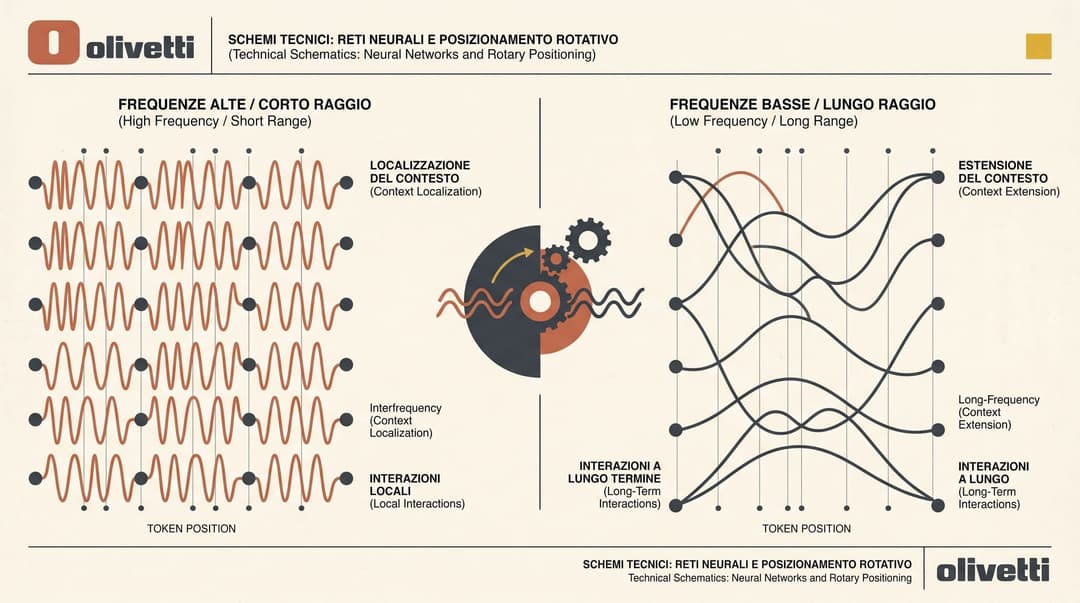
The Mechanics of Rotary Position Embeddings
Most contemporary open-weight and proprietary architectures, including Llama, Mistral, and Qwen, use Rotary Position Embeddings (RoPE). Developed by Su et al., RoPE encodes absolute token positions into query and key representations such that their inner product naturally yields relative position information.
Given a token vector at position , RoPE partitions the -dimensional hidden space into orthogonal two-dimensional planes. For each dimension pair , it applies a rotation matrix parameterized by an angle:
where is the base frequency (historically set to 10,000) and is the token position. The rotation angle for dimension pair at position is .
When a model encounters a token position , the rotation angles exceed all values observed during pretraining. For high-frequency dimensions (where is small and is large), the angle rotates through many full cycles, but for low-frequency dimensions (where is large and is small), the model encounters unseen phase space. This out-of-distribution phase shift disrupts query-key dot products and causes attention scores to collapse.
Position Interpolation
To avoid out-of-distribution rotation angles without retraining from scratch, Chen et al. (2023) at Meta introduced Position Interpolation (PI).
Instead of extrapolating positions linearly beyond , Position Interpolation downscales the input position indices to match the original training range. For a target context window with scale factor , the modified position index is defined as:
The rotation angle for each dimension pair becomes:
By compressing the sequence range into , Position Interpolation guarantees that all rotation angles remain within the bounds seen during pretraining. Chen et al. demonstrated that extending an 8B parameter model from 2,048 to 32,768 tokens () required only 1,000 fine-tuning steps on long documents to stabilize perplexity.
However, uniform position interpolation exhibits a key structural flaw: it compresses all frequencies equally. The distance between adjacent tokens in angle space is reduced from to . For high-frequency components responsible for discerning fine-grained local syntax and immediate token ordering, this compression blurs local distinctions, requiring extensive gradient updates to recover short-context precision.
NTK-Aware Scaling
To address the loss of high-frequency precision, community researcher bloc97 proposed Neural Tangent Kernel (NTK)-Aware scaling. The core intuition derives from NTK theory: deep neural networks learn low-frequency functions more slowly and generalize poorly to out-of-distribution low frequencies, while high-frequency functions generalize well locally but suffer under aggressive interpolation.
Instead of scaling the position index by a constant , NTK-Aware scaling modifies the base frequency of the RoPE formulation:
Under this transformed base, the new per-dimension frequencies become:
This formulation creates a non-uniform scaling dynamic across hidden dimensions:
- For the lowest dimension (, high frequency): , meaning zero interpolation occurs and local token ordering is fully preserved.
- For the highest dimension (, low frequency): the scaling factor approaches , applying full interpolation to long-range positional signals.
NTK-Aware scaling allows models to extrapolate to extended contexts zero-shot (without fine-tuning) with lower perplexity penalties than raw Position Interpolation.
YaRN: Frequency Partitioning and Attention Temperature
While NTK-Aware scaling improves zero-shot behavior, it still applies a continuous scaling curve that introduces subtle phase distortions across intermediate frequencies. In addition, extending context length causes an attention entropy shift: as the number of keys in the softmax denominator grows, attention distributions become either overly diffuse or artificially concentrated on outlier tokens.
Peng et al. (2023) from Nous Research introduced YaRN (Yet another RoPE extensioN), combining two distinct innovations: NTK-by-parts interpolation and attention temperature scaling.
1. NTK-by-Parts Interpolation
YaRN examines the wavelength of each dimension pair relative to the original context window :
The hidden dimensions are partitioned into three distinct regimes based on their wavelength ratio :
- High Frequencies (): The wavelength is short enough to complete multiple full rotations within the original context window. Here, YaRN applies pure extrapolation (no interpolation, scaling ratio 1) to retain exact local token resolution.
- Low Frequencies (): The wavelength is longer than the context window and does not complete a full rotation. Here, YaRN applies pure linear position interpolation (scaling by ).
- Intermediate Frequencies (): A linear ramp function smoothly blends between linear interpolation and extrapolation.
The resulting frequency modulation function is defined as:
2. Attention Temperature Scaling
As sequence length scales by factor , the distribution of attention logits changes. To counteract entropy decay and preserve the original sharpness of attention patterns, YaRN introduces an attention temperature scale factor . The query-key dot product in self-attention is modulated:
Empirical fitting on LLaMA architectures established the relationship:
In implementation, this requires simply multiplying the query and key projections by prior to standard FlashAttention computation, introducing zero operational overhead.
YaRN enables context window extensions up to 128,000 tokens with as few as 400 training steps on 0.1% of the original pretraining dataset, outperforming uniform Position Interpolation across both perplexity and passkey retrieval benchmarks.
Adjusted Base Frequency and LongRoPE
As production foundation models scaled to hundreds of thousands of tokens, pretraining recipes adapted. Rather than applying post-hoc interpolation alone, architectures such as Llama 3 adjusted the initial RoPE base frequency during pretraining and long-context continual pretraining. Increasing from 10,000 to 500,000 (and up to 1,000,000 in CodeLlama) stretches the lowest frequency wavelengths across millions of tokens, naturally flattening the phase curve.
Building on non-uniform scaling, Ding et al. (2024) at Microsoft Research introduced LongRoPE. LongRoPE demonstrated two key insights:
- Non-Uniform Channel Search: Manually engineered heuristics (such as YaRN's three-part split) are sub-optimal across deep networks. LongRoPE uses an evolutionary algorithm to search for independent per-channel and per-layer interpolation factors.
- Progressive Extension: LongRoPE expands contexts progressively, first searching and fine-tuning an intermediate window (such as 256k tokens), then using that checkpoint as the baseline to search up to 2,048,000 tokens.
To mitigate performance degradation on standard short contexts (under 4k tokens), LongRoPE preserves short-context positional mapping by combining length-aware search objectives during fine-tuning.
Architectural Trade-Offs and Serving Constraints
While positional encoding adaptations solve the mathematical problem of sequence representation, deploying extended context models introduces significant serving constraints:
- Inference Latency and FLOPs: Because RoPE transformations and scaling coefficients are precomputed and cached during model initialization, positional interpolation adds zero extra compute during forward passes. However, standard self-attention remains in context length without chunked attention, RingAttention, or FlashAttention-3 kernels.
- KV Cache VRAM Consumption: For a 70B parameter model with Grouped-Query Attention (GQA), storing KV cache states across 128,000 tokens consumes tens of gigabytes of GPU memory per concurrent sequence. This necessitates memory-efficient serving patterns such as PagedAttention, disaggregated prefill-decode architectures, or KV cache quantization (FP8 / INT4).
- Retrieval Dilution and "Lost in the Middle": Extending context capacity does not guarantee effective multi-span reasoning. Without targeted instruction tuning on distributed needle retrieval datasets (such as RULER or synthetic multi-hop reasoning corpuses), long-context models often display positional bias, prioritizing tokens at the extreme beginning and end of the context window while dropping information from the middle.
Sources
- Su, J., Lu, Y., Pan, S., Murtadha, A., Wen, B., & Liu, Y. (2021). RoFormer: Enhanced Transformer with Rotary Position Embedding. arXiv:2104.09864.
- Chen, S., Wong, S., Chen, L., & Tian, Y. (2023). Extending Context Window of Large Language Models via Position Interpolation. arXiv:2306.15595.
- Peng, B., Quesnelle, J., Fan, H., & Shippole, E. (2023). YaRN: Efficient Context Window Extension of Large Language Models. arXiv:2309.00071.
- Ding, Y., Zhang, L. L., Run, C., Sheng, P., & Yang, B. (2024). LongRoPE: Extending LLM Context Window Beyond 2 Million Tokens. arXiv:2402.13753.
- Press, O., Smith, N. A., & Lewis, M. (2021). Train Short, Test Long: Attention with Linear Biases Enables Input Length Extrapolation. arXiv:2108.12409.
