
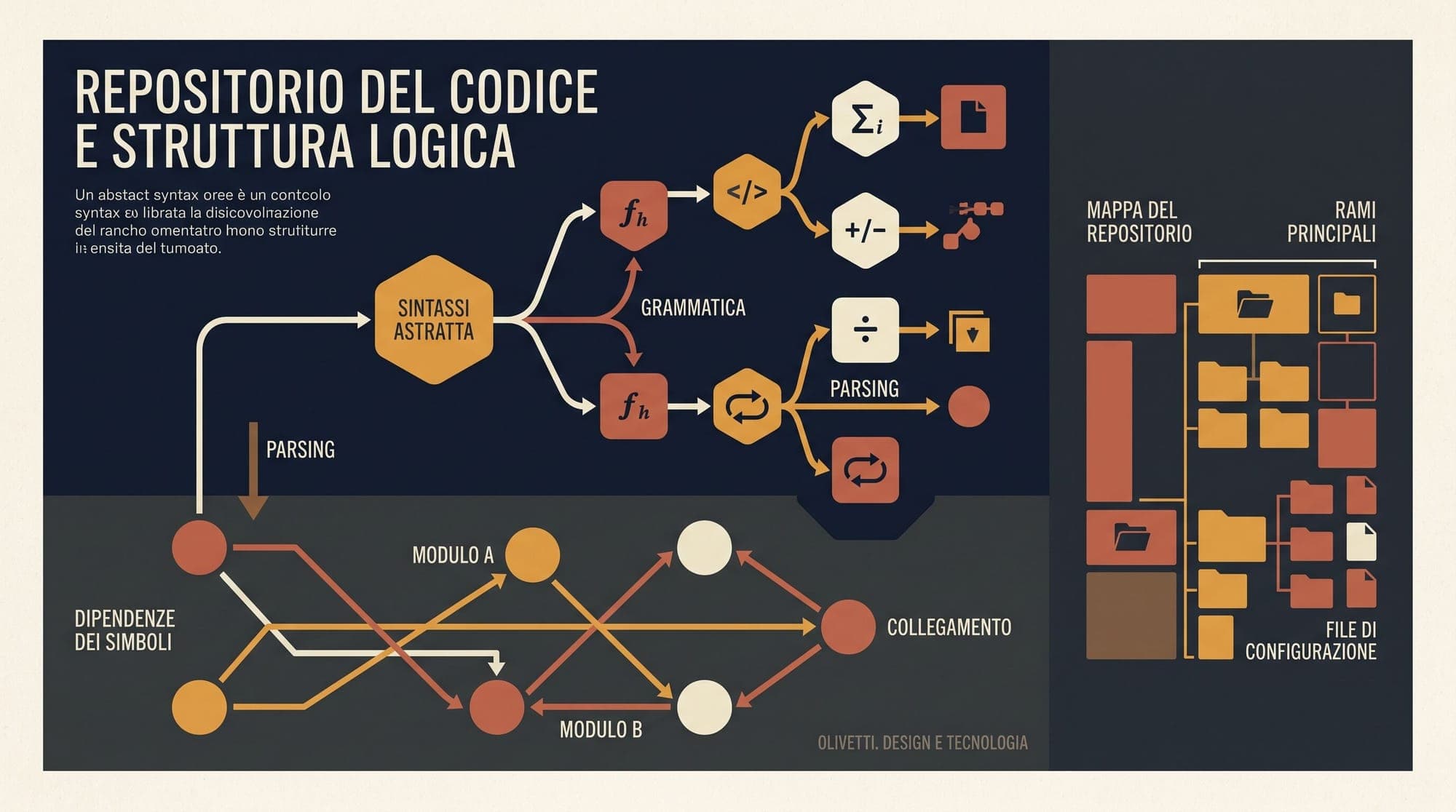
Modern software repositories routinely contain hundreds of thousands or millions of lines of source code. A medium-sized production project with 500 files and 100,000 lines of code typically spans 3 million to 5 million tokens. While frontier models have expanded context windows to 200,000 tokens or more, stuffing an entire repository into a prompt remains fundamentally impractical. Beyond exponential inference costs and KV cache memory bloat, long-context attention suffers from severe retrieval degradation when searching for nuanced dependencies across large volumes of code.
Context engineering for AI coding agents solves this bottleneck. Rather than treating code as raw unstructured text, agentic architectures exploit the formal syntax and dependency structures of programming languages. By combining deterministic Abstract Syntax Tree (AST) parsers, graph centrality algorithms, and dynamic token budgets, coding systems can provide LLMs with a global view of a codebase while consuming only a tiny fraction of the available context window.
The Three Retrieval Paradigms for Coding Agents
Autonomous coding systems employ three distinct context retrieval architectures, each striking different trade-offs between setup latency, token consumption, and index freshness.
+-----------------------------------------------------------------------------+
|                     CODEBASE CONTEXT ARCHITECTURES                          |
+-----------------------------------------------------------------------------+
| 1. Static Repo Maps (Aider, CodeGraph)                                      |
|    Tree-sitter AST -> Dependency Graph -> PageRank -> Token Budget Map      |
+-----------------------------------------------------------------------------+
| 2. Proactive AST Semantic Indexing (Cursor, Augment)                        |
|    AST Semantic Chunking -> Vector Embeddings -> Merkle Tree Sync           |
+-----------------------------------------------------------------------------+
| 3. On-Demand Lexical & Agentic Traversal (Claude Code, OpenHands)           |
|    Zero Index -> Ripgrep / File Globbing -> Targeted Slice Reads            |
+-----------------------------------------------------------------------------+
1. Static Graph and Repo Maps
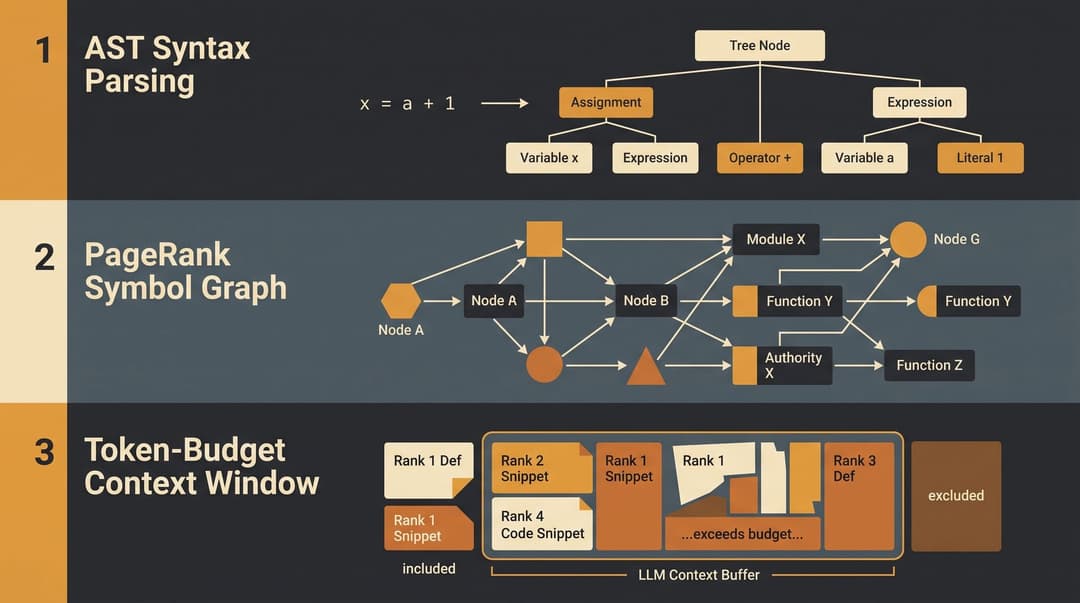
Pioneered by Aider, this approach parses source files with AST parsers, builds a global symbol dependency graph, and applies PageRank to identify the most structurally important symbols across the codebase. The resulting compressed map, showing file paths, classes, and function signatures, is injected into the system prompt within a tight budget of 1,024 to 4,096 tokens.
2. Proactive AST Semantic Indexing
Implemented in tools like Cursor, this paradigm parses code into AST units (such as complete functions and classes), computes dense vector embeddings for each unit, and synchronizes the index incrementally using Merkle trees or file watcher events. Retrieval combines dense vector search with lexical matching to pull relevant code snippets on demand.
3. On-Demand Lexical and Agentic Exploration
Used by CLI-centric agents such as Claude Code and OpenHands, this approach eliminates pre-computed indexes entirely. The agent starts with zero codebase knowledge and navigates the repository interactively using fast lexical tools (such as ripgrep, directory listings, and targeted file slice reads). This guarantees zero setup overhead and complete freshness against dirty working trees, at the cost of additional tool invocation turns.
Deep Dive: The Repo Map Algorithm
The repository map architecture provides high contextual awareness at minimal token cost. According to technical implementations analyzed in Aider's architecture and academic research on AST knowledge graphs, the pipeline operates in four deterministic stages:
Stage 1: AST Symbol and Reference Extraction
Using Tree-sitter, an incremental and fault-tolerant parsing engine, the system extracts code symbols across dozens of programming languages. Language-specific query files (.scm) define pattern-matching rules for two entity classes:
- Definitions: Identifiers representing classes, interfaces, structs, functions, methods, and exported constants.
- References: Identifiers in call sites, type annotations, inheritance declarations, and import statements.
To maintain performance, extracted AST tags are cached locally in SQLite or disk caches, keyed by file path and modification timestamp (mtime). Only modified files are re-parsed on subsequent turns.
Stage 2: Bipartite Dependency Graph Construction
The system constructs a directed bipartite graph . The vertex set consists of source files and extracted symbols . Directed edges represent directional relationships:
- An edge from file to symbol indicates that file defines symbol .
- An edge from symbol to file indicates that file references symbol .
This representation captures cross-file coupling without requiring full semantic compilation or type checking.
Stage 3: Personalized PageRank Scoring
To identify which symbols are most relevant to the current user request, the engine runs Personalized PageRank over the graph. Instead of uniform teleportation, the random walk restart distribution is biased toward files currently active in the chat or explicitly referenced in the prompt:
Where:
- is the damping factor (typically 0.85).
- is the column-normalized adjacency matrix.
- is the personalization vector, placing higher probability mass on active files.
- converges via power iteration within 20 to 50 iterations on sparse repository graphs.
Stage 4: Binary Search Token Budgeting and Scope Rendering
A raw symbol list remains too large for arbitrary inclusion. The engine applies a binary search over the ranked definition list to find the maximum number of symbols that fit within the configured token budget (typically max_map_tokens = 1024 to 4096).
The selected symbols are rendered using scope-aware AST formatting (grep_ast). Rather than emitting flat identifiers, the formatter preserves the enclosing class hierarchy and function signatures while omitting function bodies:
# Compressed Repo Map Example
backend/services/auth.py:
│class AuthService:
│    def __init__(self, token_provider: TokenProvider) -> None: ...
│    def verify_jwt(self, token: str) -> UserClaims: ...
│    def revoke_session(self, session_id: str) -> bool: ...

backend/models/user.py:
│class UserClaims(BaseModel):
│    user_id: UUID
│    roles: list[str]
│    expires_at: datetime
This compact representation allows the LLM to understand API contracts, type signatures, and module boundaries across the entire repository while consuming fewer than 1,500 tokens.
AST Chunking vs. Naive Sliding Windows
In vector-based codebase retrieval systems, chunking strategy dictates retrieval precision. Naive text splitting (for example, fixed 512-token chunks with 50-token overlap) causes structural failures in code search:
- Broken Syntactic Scopes: Splits class definitions across arbitrary line boundaries, separating method declarations from their class context.
- Orphaned Signatures and Docstrings: Places docstrings and type annotations in one chunk while isolating the implementation body in another.
- Indentation and Scope Loss: In whitespace-sensitive languages like Python, arbitrary cuts discard nesting levels, misleading the model regarding variable scope.
In contrast, AST-aware chunkers traverse the parse tree to split code strictly along structural nodes: complete functions, classes, and module headers. If an individual function exceeds the maximum chunk size, the chunker recursively splits child control blocks (such as if/else branches or inner loops) while preserving parent signature breadcrumbs in chunk metadata.
Code Mutation: Edit Formats and Token Efficiency
Context engineering extends beyond code retrieval to code generation. When an agent modifies source code, the format used to express edits directly impacts output token volume, generation latency, and syntax regression rates.
+-----------------------------------------------------------------------------+
|                         CODE EDIT FORMAT COMPARISON                         |
+-----------------------------------------------------------------------------+
| Whole-File Rewrite                                                          |
|   Output Tokens: 100% of file size                                          |
|   Latency: High (linear with file length)                                   |
|   Failure Mode: Hallucinated regressions in untouched methods               |
+-----------------------------------------------------------------------------+
| Search/Replace Diff Blocks (UDiff)                                          |
|   Output Tokens: 5% to 15% of file size                                     |
|   Latency: Low (proportional to diff size)                                  |
|   Failure Mode: Indentation or whitespace mismatch on search block          |
+-----------------------------------------------------------------------------+
| Structured Patch Primitives / Tool Calls                                    |
|   Output Tokens: 5% to 10% of file size                                     |
|   Latency: Low                                                              |
|   Failure Mode: Line number drift during concurrent multi-file edits        |
+-----------------------------------------------------------------------------+
Whole-File Rewriting
The model generates the complete revised file from start to finish. On a 1,000-line file, changing a single variable name requires generating 1,000 lines of output. This introduces high latency and frequently causes the LLM to omit unchanged code with comments like // ... rest of implementation unchanged, corrupting the file.
Search/Replace Diff Blocks
The model emits targeted search and replace blocks containing enough context lines to uniquely identify the target region:
<<<<<<< SEARCH
def calculate_fee(amount: Decimal) -> Decimal:
    return amount * Decimal("0.05")
=======
def calculate_fee(amount: Decimal, tier: UserTier) -> Decimal:
    multiplier = Decimal("0.03") if tier == UserTier.PRO else Decimal("0.05")
    return amount * multiplier
>>>>>>> REPLACE
This reduces output token generation by 80% to 95%, dramatically cutting completion latency. The editor engine uses fuzzy string matching to apply diffs even if whitespace or line endings diverge slightly.
Structured Patch Primitives
Modern agent tool frameworks expose dedicated patch tools (such as replace-string or line-range replacement APIs). The model provides exact target parameters, which the execution environment validates and applies directly against the filesystem.
Architectural Trade-Offs and Production Pitfalls
Selecting a context engineering strategy requires balancing upfront overhead against run-time execution characteristics:
- Setup and Indexing Overhead: Repo maps require sub-second AST parsing with zero GPU requirements. Vector indexing requires embedding model compute and indexing pipelines. On-demand search requires zero pre-computation.
- Freshness and Dirty Tree Handling: Static vector indexes easily desynchronize when developers edit files locally without re-indexing. AST repo maps and lexical search inspect the current working tree on every turn, eliminating index drift.
- Scalability on Monorepos: On codebases with tens of millions of lines, global repo maps must restrict their scope to active subdirectories or submodules to prevent graph construction overhead.
- Metaprogramming and Dynamic Dispatch: Static AST parsers cannot infer symbols constructed dynamically at runtime (such as Python
getattrdispatch, Ruby metaprogramming, or complex C++ macro expansions). Hybrid systems combine AST maps with runtime test execution to verify dynamic behavior.
As autonomous coding agents become standard software engineering tools, context engineering architectures continue to evolve from brute-force token expansion toward structured, compiler-informed representations.
Sources
- Aider: Building a Better Repository Map with Tree-sitter
- Tree-sitter: Incremental Parsing System for Programming Tools
- Tree-sitter-based Knowledge Graphs for LLM Code Agents (arXiv:2603.27277)
- Nous Research: PageRank Repo Map Architecture (Issue #535)
- Architecturally Speaking: Case Study on Cursor Indexing and Context Windows
