

Circuit Breakers and Graceful Degradation in Production AI Systems: Architecture, Failure State Machines, Fallback Cascades, and Dead-Letter Queues

Running LLM inference and multi-agent workflows in production introduces failure dynamics distinct from traditional microservice architectures. While standard REST APIs typically fail with deterministic status codes and predictable latency profiles, generative AI applications face multi-dimensional failure vectors: provider outages, regional rate limits (HTTP 429), token-per-minute (TPM) quota exhaustion, context window overflows (HTTP 400), severe time-to-first-token (TTFT) latency spikes, and stochastic semantic breakdowns such as infinite tool recursion or schema violation loops.
Blindly applying standard retry policies (such as naive exponential backoff) against failing LLM endpoints amplifies downstream congestion. Retrying long-context prompts against an overloaded provider burns API budgets, blocks worker threads, and exacerbates provider-side thundering herd conditions.
To maintain high availability and predictable tail latencies, enterprise AI architectures must adopt a layered resilience strategy: in-flight error categorization, adaptive circuit breakers, automated multi-tier fallback cascades, and dead-letter queues (DLQs) for poison pill isolation.
1. Taxonomy of LLM and Agent Failure Modes
Designing an effective resilience layer requires categorizing failures by their root cause, recoverability, and blast radius. As outlined in the Microsoft AI Red Team taxonomy of agent failure modes, failures in AI stacks fall across infrastructure, transport, payload, and behavioral dimensions:
- Transient Transport Failures (HTTP 500, 502, 503, 504, TLS resets):
These occur due to network blips or temporary upstream gateway restarts. They are recoverable with short, jittered backoff retries. If errors persist across multiple attempts, they must trip the circuit to avoid thread exhaustion.
- Rate & Capacity Quotas (HTTP 429, TPM/RPM exhaustion, GPU pool saturation):
These occur when tenant request volumes exceed provisioned concurrency or provider rate limits. Immediate retries worsen congestion. The system must trip the circuit immediately and route traffic to a secondary cloud provider or queue the request.
- Payload & Client Errors (HTTP 400, context length exceeded, schema violations):
These are non-recoverable deterministic client errors. Retrying identical payloads will never succeed. Gateways must fast-fail these requests to the client and avoid counting them against provider health metrics.
- Upstream Latency Spikes (TTFT > 10,000ms, model queue stalls):
Memory-bound autoregressive decoding and congested inference queues can cause severe response stalls. Systems must enforce tight time-to-first-token thresholds to trip slow-call breakers before socket timeouts occur.
- Semantic & Tool Execution Failures (malformed JSON, hallucinated parameters, infinite loops):
These occur when model outputs deviate from required structured schemas or enter circular reasoning paths. They require in-context reflection retries (bounded at 1 to 2 attempts) followed by graceful functional fallback.
- Poison Pill Inputs (adversarial injections, tokenizer crash bugs, extreme prompt explosion):
These inputs consistently cause worker crashes or excessive token generation. They must be quarantined immediately to a Dead-Letter Queue (DLQ) without re-entering the main processing pool.
2. The AI Circuit Breaker State Machine
The circuit breaker pattern formalized by Martin Fowler isolates failing downstream dependencies by wrapping network calls in a state machine with three operating states: Closed, Open, and Half-Open.
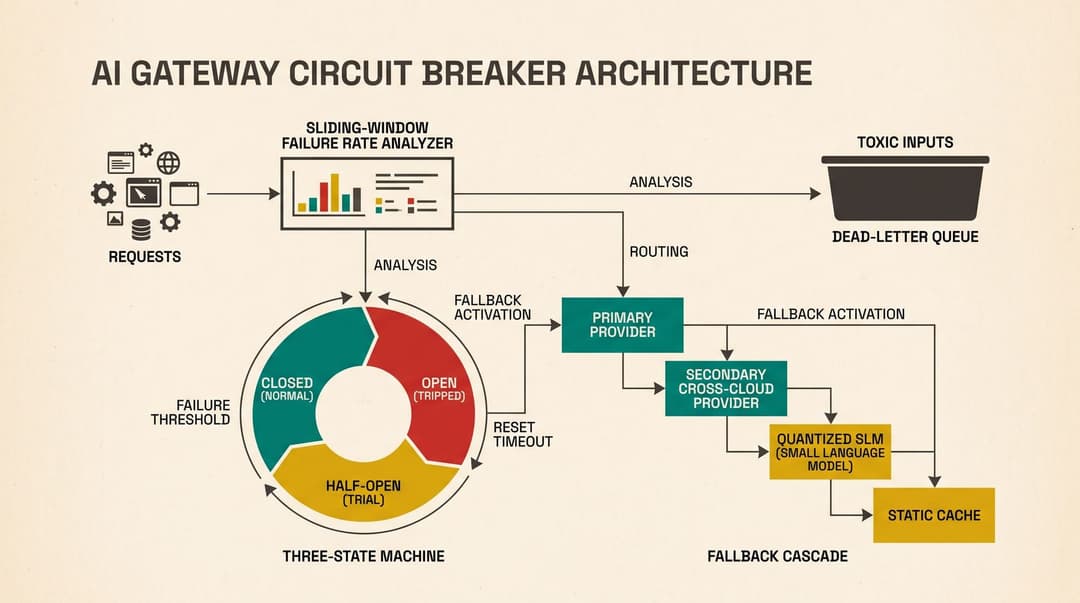
State Transitions in LLM Gateways
         +--------------------------------------------------+
         |                                                  |
         v                                                  | Success Rate >= Threshold
  +--------------+   Failure Rate > Threshold        +-------------+
  |              |   OR P99 TTFT > Max Latency       |             |
  |    CLOSED    | --------------------------------> |    OPEN     |
  | (Normal Ops) |                                   | (Fast-Fail) |
  +--------------+                                   +-------------+
         ^                                                  |
         |                                                  | Reset Timeout Elapsed
         |             Probe Request Success                v
         +------------------------------------------- +-------------+
                                                      |  HALF-OPEN  |
                                                      | (Canary 5%) |
                                                      +-------------+
                                                             |
                                                             | Probe Request Failure
+-> (Back to OPEN)- Closed (Normal Operation):
Requests flow directly to the primary LLM provider. The circuit breaker monitors a sliding execution window (e.g., the last 100 requests or a rolling 60-second window). Tracked metrics include the error percentage (HTTP 5xx, 429) and the slow-call percentage (requests where TTFT exceeds a threshold such as 4,000ms).
- Open (Fast-Fail):
If the failure rate exceeds the trip threshold (e.g., 40% errors over 50 requests) or the slow-call rate exceeds 50%, the circuit trips to OPEN. All subsequent requests bypass the primary provider with 0ms local rejection, immediately executing the configured fallback cascade instead of waiting for downstream socket timeouts.
- Half-Open (Canary Probing):
After a configured cooldown period (e.g., 30 to 60 seconds), the circuit transitions to HALF-OPEN. A small fraction of live traffic (e.g., 5% of requests or a fixed trial batch of 10 requests) is allowed through to probe provider health. If probe requests succeed above the recovery threshold (e.g., 90% success rate), the circuit resets to CLOSED. If any probe fails or times out, the circuit immediately returns to OPEN and resets the cooldown timer.
3. Fallback Cascades and Graceful Degradation
When a circuit breaker trips to OPEN, the system must not simply return a 500 Internal Server Error to the end user. Production AI gateways like LiteLLM Proxy and Portkey AI Gateway implement multi-tiered fallback cascades that trade fidelity for availability.
Tier 1: Horizontal Cross-Cloud Provider Failover
Enterprise model providers host identical open-weight or proprietary models across multiple cloud infrastructures. When the direct API endpoint degrades, traffic routes horizontally to a mirrored endpoint without changing prompt templates or token contracts:
- Primary: Anthropic Claude Sonnet via Anthropic Direct API
- Secondary: Anthropic Claude Sonnet via AWS Bedrock (us-east-1 / us-west-2)
- Tertiary: Anthropic Claude Sonnet via Google Cloud Vertex AI
Tier 2: Vertical Model Downgrade
If all instances of the primary model tier are unreachable or throttled, the gateway routes to a lower-latency, high-throughput model family:
- Primary: Frontier Reasoning Model (e.g., Claude Opus / GPT-5 class)
- Secondary: Cost-effective balanced model (e.g., Claude Sonnet / GPT-4o class)
- Tertiary: High-throughput small language model (e.g., Claude Haiku / GPT-4o-mini / Qwen 2.5 7B)
When executing vertical downgrades, prompt orchestrators apply dynamic context pruning or append strict few-shot examples to compensate for the smaller model's reduced zero-shot reasoning capacity.
Tier 3: Functional and Heuristic Degradation
For user-facing products where LLM latency SLAs are strict (such as search autocompletion or real-time customer support routing), systems fall back to non-generative heuristics:
- Semantic Cache Hit: Serving the closest cosine-similarity cached response if similarity exceeds 0.88.
- Deterministic Heuristics: Regex extraction, keyword routing, or template responses.
- Asynchronous Job Deferral: Acknowledging user receipt and queuing the processing task for background batch execution.
4. Dead-Letter Queues (DLQ) and Poison Pill Isolation
In multi-agent systems and asynchronous batch inference pipelines, certain inputs act as "poison pills" (e.g., inputs triggering unhandled edge cases in prompt formatting, malformed multi-byte Unicode strings that crash custom C++ tokenizers, or recursive agent loops that exhaust iteration limits).
Without isolation, retry loops cause workers to crash repeatedly, blocking queue consumers and causing widespread processing backlogs.
Incoming Tasks ---> [ Task Queue (Kafka/SQS) ] ---> [ Agent Worker Pool ]
                             ^                             |
                             | (Retry <= 3)                | Failure (Semantic / Crash)
                             +-----------------------------+
                                                           |
                                                           | (Retry > 3 OR Toxic Signature)
                                                           v
                                              [ Dead-Letter Queue (DLQ) ]
                                                           |
                                              +------------+------------+
                                              |                         |
                                              v                         v
                                     [ Quarantine Store ]      [ Human Triage UI ]
Dead-Letter Queue Architecture
- Execution Metadata Envelope: Every task dispatched to a DLQ includes full diagnostic context:
- Original prompt payload and system instructions.
- Historical trajectory of tool calls, partial responses, and error traces.
- Provider HTTP status codes, latency timings, and token consumption counts.
- Worker environment metadata and container instance ID.
- Quarantine and Poison Pill Detection:
Tasks failing repeatedly with identical error signatures (such as tokenizer panics or regex timeout crashes) are hashed by prompt signature. Future incoming requests matching the poisoned hash are intercepted at ingress and rejected or routed directly to triage, protecting the worker fleet.
- Automated Replay and Schema Drift Auditing:
Once underlying bugs (such as an outdated MCP tool schema or provider bug) are resolved, operators trigger selective batch replays from the DLQ directly into the processing pipeline.
5. Architectural Implementation: Gateway vs. In-Process
Engineers must choose where to locate circuit-breaking and fallback logic: at a centralized gateway layer or inside application-level client SDKs.
- Centralized AI Gateway (LiteLLM, Kong, Envoy):
Maintains global state synchronization across all instances via Redis or shared memory. Provides a single unified policy across microservices, universal cross-language support, and centralized observability at the cost of a 1ms to 3ms proxy network hop.
- In-Process SDK (LangGraph, Tenacity, Polly):
Executes directly inside the application process with 0ms network overhead. Enables fine-grained, context-aware degradation (such as rolling back in-memory agent state machines), but risks state drift across container replicas and requires library maintenance across every language stack.
Reference Implementation: Gateway Configuration
Below is a production configuration snippet for an AI Gateway circuit breaker and fallback cascade using LiteLLM syntax:
model_list:
  - model_name: production-inference-lane
    litellm_params:
      model: anthropic/claude-3-7-sonnet-20250219
      api_key: os.environ/ANTHROPIC_API_KEY
      rpm: 2000
      tpm: 100000

  - model_name: production-inference-lane
    litellm_params:
      model: bedrock/anthropic.claude-3-7-sonnet-20250219-v1:0
      aws_region_name: us-east-1
      rpm: 1500
      tpm: 80000

  - model_name: production-inference-lane
    litellm_params:
      model: openai/gpt-4o
      api_key: os.environ/OPENAI_API_KEY
      rpm: 3000
      tpm: 150000

router_settings:
  routing_strategy: latency-based-routing
  allowed_fails: 5
  cooldown_time: 45
  num_retries: 2
  timeout: 8.0
  fallbacks:
    - production-inference-lane:
        - bedrock/anthropic.claude-3-7-sonnet-20250219-v1:0
        - openai/gpt-4o
6. Production Best Practices and Tuning Guidelines
- Separate Latency Timeouts from Token Generation Timeouts:
Do not use a single monolithic timeout for LLM calls. Configure a tight TTFT timeout (e.g., 3,000ms to 5,000ms) to catch connection queue stalls, paired with a generous streaming inter-token timeout (e.g., 500ms between chunks) to accommodate long generation sequences.
- Differentiate 4xx Client Errors from System Failures:
Never count HTTP 400 (Bad Request) or HTTP 401 (Unauthorized) errors against a provider's circuit breaker health score. If a malformed prompt triggers an HTTP 400, tripping the circuit to OPEN will needlessly direct valid customer traffic to fallback providers.
- Jitter Recovery Probes in Half-Open State:
When multiple gateway replicas transition from OPEN to HALF-OPEN simultaneously, coordinate probe dispatches using distributed locks or randomized trial intervals to avoid flooding the recovering provider with a synchronized burst of test traffic.
- Preserve Context Prefix Affinity During Failover:
When failing over between providers or models, prefix caching benefits (such as prompt caching in Anthropic or OpenAI) are lost, resulting in higher initial TTFT. Account for cache cold starts when dimensioning secondary fallback capacity.
Sources
- Martin Fowler: Circuit Breaker Pattern
- Microsoft Security: Updating the Taxonomy of Failure Modes in Agentic AI Systems
- LiteLLM: Making the AI Gateway Resilient with Circuit Breakers
- Portkey: Retries, Fallbacks, and Circuit Breakers in LLM Apps
- TrueFoundry: LLM Failover and Load Balancing for Provider Outages
- Zuplo: API Gateway Resilience and Fault Tolerance
