
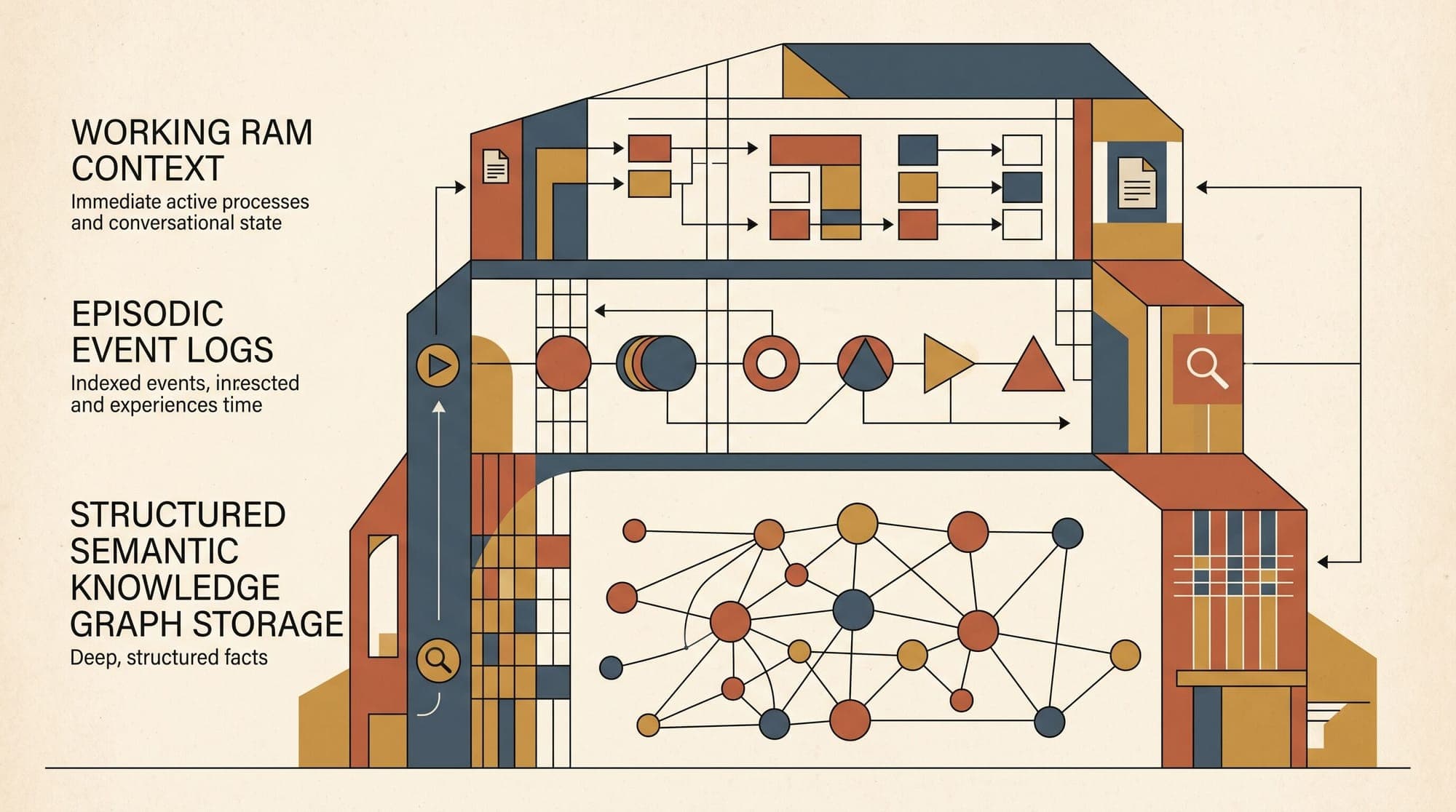
Large Language Models operate as stateless prediction engines: every API call processes an input prompt independently, without retaining memory of previous turns, decisions, or external interactions. While extending context windows to 1 million or 2 million tokens provides temporary capacity for long transcripts, treating raw context windows as long-term memory introduces severe engineering bottlenecks. Unbounded context growth dramatically inflates time-to-first-token (TTFT) latency, increases serving costs linearly, and degrades model reasoning due to attention saturation and context distraction.
To operate autonomously over multi-session workflows, AI agents require structured, persistent memory architectures. Modern production systems draw heavily from cognitive science and operating system virtual memory paradigms, organizing agent memory into four distinct tiers: working context, episodic logs, semantic knowledge graphs, and procedural skills.
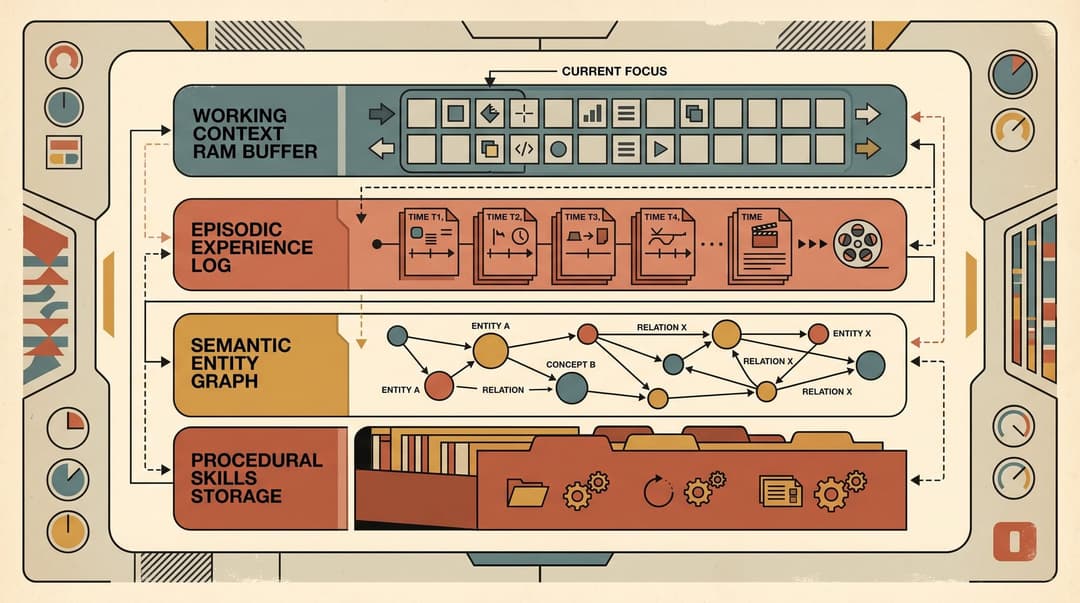
The Four Tiers of Agent Memory
Formalized in academic frameworks such as CoALA (Cognitive Architectures for Language Agents) and practical systems like MemGPT and Mem0, agent memory is decomposed into distinct operational layers based on access latency, mutability, and persistence scope.
1. Working Memory (In-Context Execution Scratchpad)
Working memory corresponds to the active context window provided to the LLM during a single inference turn. It represents the immediate "RAM" of the agent.
Working memory contains:
- System instructions and behavioral guardrails.
- Active agent goals, task decomposition plans, and current execution state.
- Short-term conversational buffer (the most recent user turns and tool responses).
- Scratchpad reasoning traces and intermediate variable values.
Because working memory consumes active prompt tokens, it requires active eviction policies. Production architectures implement sliding window buffers, token pruning, and automated mid-dialogue compaction to prevent prompt exhaustion.
2. Episodic Memory (Time-Indexed Experience and Execution Traces)
Episodic memory stores chronological records of past agent actions, user conversations, tool execution outputs, and observed failures. As detailed in recent research on Episodic Memory for Long-Term LLM Agents, episodic stores allow agents to ground current actions in specific historical experiences without retraining model weights.
In production, episodic records are stored in time-stamped vector indexes or relational document stores. When a user issues a new prompt, the agent queries episodic memory to retrieve relevant past trajectories.
Retrieval scoring across episodic memory typically builds upon the multi-signal ranking formulation introduced in the Stanford Generative Agents architecture:
Retrieval Score = (w1 * Recency) + (w2 * Importance) + (w3 * Relevance)- Recency: Modeled as an exponential decay function based on the elapsed time or turn count since the memory was created or last accessed.
- Importance: A saliency score (typically 1 to 10) assigned by an evaluator LLM during memory ingestion to separate trivial events from critical user instructions.
- Relevance: Cosine similarity between the embedding vector of the current query and the stored episodic memory chunk.
3. Semantic Memory (Abstracted Facts, Preferences, and Entity Graphs)
Semantic memory contains timeless, generalized knowledge extracted from conversations and external documents. Unlike episodic memory, which preserves temporal narrative ("On Tuesday the user asked for Python 3.11 migration"), semantic memory stores distilled entity relationships and user preferences ("User prefers Python with strict uv virtual environments").
Production systems represent semantic memory using:
- Key-Value User Profiles: Structured JSON schemas capturing explicit parameters, configuration settings, and identity attributes.
- Entity Knowledge Graphs: Dynamic property graphs (such as Neo4j, FalkorDB, or embedded SQLite triples) that map relationships between entities (User -> OWNS -> Repository -> USES -> Framework).
Semantic memory requires explicit conflict resolution. When new interactions contradict historical facts (e.g., "I moved from Seattle to Berlin"), the memory pipeline must execute an upsert or mutation operation rather than blindly appending duplicate vectors that create retrieval ambiguities.
4. Procedural Memory (Skills, Workflows, and Tool Schemas)
Procedural memory encodes the agent's internalized knowledge of how to perform tasks. This includes:
- Executable code routines and custom automation scripts.
- Multi-step playbooks (SKILL.md definitions and domain workflows).
- Few-shot execution examples demonstrating successful tool call chains.
- OpenAPI specifications and Model Context Protocol (MCP) tool schemas.
Procedural memory is generally static or version-controlled, loaded dynamically into working context only when relevant intent triggers are detected.
Architectural Implementation Patterns
Building production agent memory requires choosing between different orchestration patterns depending on latency budgets and data complexity.
The OS-Style Virtual Paging Architecture (MemGPT / Letta)
Pioneered by UC Berkeley researchers in the MemGPT project (now developed under Letta), this architecture treats the LLM context window as physical CPU/RAM and external databases as paging disks.
In this model:
- The agent is equipped with native memory management tools (
core_memory_append,core_memory_replace,archival_memory_insert,archival_memory_search). - When the active context approaches capacity, an automated interrupt mechanism triggers a memory consolidation pass, writing relevant facts to archival storage and evicting raw message history.
- The agent explicitly pages in historical records via tool invocations when answering queries that reference prior context.
The Asynchronous Sleep-Time Consolidation Pipeline
A major drawback of inline memory extraction is query latency: prompting an LLM to extract entities, score importance, and update databases on every turn adds 1 to 3 seconds of overhead.
Production systems decouple memory processing from conversational execution:
- Online Phase (Foreground): The agent reads from existing working memory, vector indexes, and entity profiles to generate immediate user responses with minimal latency.
- Offline Phase (Background / Sleep-Time): An asynchronous worker process consumes event streams from message queues (e.g., Kafka, Celery, or Redis Streams). The background worker:
- Evaluates conversation transcripts for new entities and preferences.
- Computes importance ratings and generates reflection summaries.
- Deduplicates and reconciles conflicting records in the semantic graph.
- Prunes redundant episodic vector chunks.
Foreground Path:
User Input ──► [Fast Memory Read] ──► [LLM Agent Reasoning] ──► Tool Call / Response
                                                 │
                                                 ▼ (Event Stream)
Background Path:
[Event Queue] ──► [Worker: Entity Extraction] ──► [Conflict Resolver] ──► [Graph & Vector Stores]
Multi-Level Memory Scoping
In enterprise environments, agent memory must respect tenant isolation, team permissions, and session boundaries. Frameworks such as Mem0 implement four-dimensional memory scoping:
app_id: Global domain knowledge and baseline tool definitions.org_id/tenant_id: Enterprise-wide facts, security boundaries, and shared team repositories.user_id: Cross-session personal preferences, interaction style, and individual history.session_id/run_id: Ephemeral working state isolated to a single workflow execution.
State Serialization and Durable Execution
Beyond conversational history, autonomous agents executing multi-step deterministic workflows require durable execution state. If an agent process crashes mid-execution during a 20-step deployment script, restarting from step 1 wastes tokens and can cause destructive side effects.
Modern orchestration frameworks like LangGraph and Redis Agent Memory implement state checkpointing:
- Thread Checkpointing: After each tool execution or node transition, the entire agent state (execution graph pointer, memory variables, pending approvals, and message history) is serialized to a persistent database (PostgreSQL, SQLite, or Redis).
- Time-Travel and Human-in-the-Loop Intercepts: Checkpointing allows operators to inspect state at arbitrary execution nodes, rewind state to previous checkpoints, edit memory variables, and resume execution without re-running earlier steps.
Architecture Comparison and Selection Guide
Selecting an agent memory pattern depends on workflow duration, user concurrency, and domain requirements.
Comparison of Memory Approaches
- Sliding Window + Summary Buffer:
- Primary Datastore: In-memory cache or relational SQL store.
- Latency: Sub-5ms reads; 1-2s asynchronous summary generation.
- Strengths: Minimal infrastructure complexity; low setup overhead.
- Failure Modes: Progressive loss of nuance over extended multi-session interactions; cannot perform cross-session entity lookups.
- Naive Episodic Vector RAG:
- Primary Datastore: Vector database (pgvector, Qdrant, Pinecone).
- Latency: 20-100ms similarity search.
- Strengths: Scales horizontally across millions of conversational turns; strong fuzzy semantic recall.
- Failure Modes: Complete lack of temporal awareness; cannot reconcile mutable facts or state updates.
- OS-Style Virtual Context Management (MemGPT / Letta):
- Primary Datastore: Relational database (PostgreSQL) paired with vector search.
- Latency: 100-300ms read overhead; write overhead managed via tool calls.
- Strengths: Deep autonomous control over memory lifecycles; native support for evolving agent personas.
- Failure Modes: High token overhead for memory management prompts; vulnerable to agent reasoning loops.
- Asynchronous Scoped Entity Graphs (Mem0 / Zep):
- Primary Datastore: Graph database paired with vector index and key-value profile store.
- Latency: 30-80ms hybrid query lookup; write overhead completely decoupled to background queues.
- Strengths: High precision for complex entity relationships; clean deterministic state updates and conflict resolution.
- Failure Modes: Higher operational overhead; pipeline complexity for asynchronous graph extraction and entity reconciliation.
Engineering Guidelines for Agent Memory
- Avoid Unbounded In-Context History: Long context windows are not a substitute for memory. Keep the active context window lean to maximize prompt cache hits and minimize token costs.
- Decouple Ingestion from User Latency: Use background message queues for entity extraction, reflection scoring, and graph reconciliation.
- Enforce Strict Memory Scoping: Isolate memories across user, organization, and session dimensions to prevent cross-tenant data leaks.
- Implement Mutation Primitives: Ensure your semantic memory layer supports explicit update, delete, and supersede operations to eliminate contradictory historical facts.
- Persist Execution State via Checkpoints: For multi-step task execution, serialize execution graph checkpoints to enable deterministic resumption after transient failures.
Sources
- CoALA: Cognitive Architectures for Language Agents (Princeton, CMU)
- MemGPT: Towards LLMs as Operating Systems (UC Berkeley)
- Generative Agents: Interactive Simulacra of Human Behavior (Stanford, Google)
- Episodic Memory for Long-Term LLM Agents (Position Paper)
- Multi-Agent Memory Systems in Production (Mem0)
- Long-Term Memory Architectures for AI Agents (Redis)
- LangGraph Persistence and Checkpointing Architecture
