Archive / page 24 of 49

Latest articles, page 24

  1. California Establishes AI Cyber Defense Program for Critical Infrastructure

    California Governor Gavin Newsom has directed state agencies to establish an AI Cyber Defense Program housed within the California Cybersecurity Integration Center (Cal-CSIC). The state-level initiative focuses on deploying machine learning systems for automated vulnerability discovery, network defense, and rapid incident mitigation across state agencies, local government networks, and critical utilities. Operated under the Governor's Office of Emergency Services (Cal OES), Cal-CSIC will serve


    AI
    2 min read
  2. Israel Outlines Five-Year AI Strategy: 100,000 Accelerators, 5nm Fab, and Quantum Base

    Israel's National Artificial Intelligence Directorate has released its five-year National AI Strategic Plan, outlining formal commitments to construct a sovereign infrastructure footprint spanning at least 100,000 advanced AI accelerators, a domestic quantum computer, and advanced semiconductor fabrication capabilities at 5 nanometers or below. Operating under the Prime Minister's Office, the Directorate published the roadmap to implement Government Resolution 4255, originally approved by the I

    AI
    2 min read
  3. Gradient Low-Rank Projection (GaLore): How Dynamic Subspaces Enable Full-Parameter LLM Pre-Training with Low-Rank Memory

    Pre-training foundation large language models has historically required massive compute clusters, largely due to the memory footprint of optimizer states rather than the model weights themselves. While parameter-efficient fine-tuning methods such as Low-Rank Adaptation (LoRA) freeze weights and introduce small adapter matrices, they fail when applied to pre-training from scratch because they restrict parameter updates to a fixed, static low-rank manifold. Gradient Low-Rank Projection (GaLore),

    AI
    8 min read
  4. Microscaling Formats in Production LLM Inference: NVFP4 vs. MXFP4 Architecture, Block Quantization, Kernel Scaling, and Perplexity Degradation

    As frontier language models scale into hundreds of billions of parameters, memory bandwidth and VRAM capacity remain the primary bottlenecks in production inference serving. While 8-bit floating-point formats (FP8 E4M3 and E5M2) achieved mainstream adoption across Hopper and Ada generation hardware, the industry is transitioning to 4-bit floating-point (FP4) arithmetic to double inference throughput and halve memory footprints. Directly quantizing deep transformer weights and activations into 4

    AI
    7 min read
  5. Alibaba Plans Record $10.2B Hong Kong Share Offering to Fund Full-Stack AI Infrastructure and Models

    Alibaba Group Holding announced a proposed equity placement in Hong Kong to raise HK$80 billion ($10.2 billion), allocating 100% of net proceeds to expand its full-stack artificial intelligence capabilities across custom silicon, cloud compute infrastructure, and foundation model development. Transaction Structure and Market Scale According to terms reviewed by Reuters, Alibaba is offering 710 million ordinary shares at HK$112.70 per share, representing a 3.6% discount to its latest closing p

    AI
    2 min read
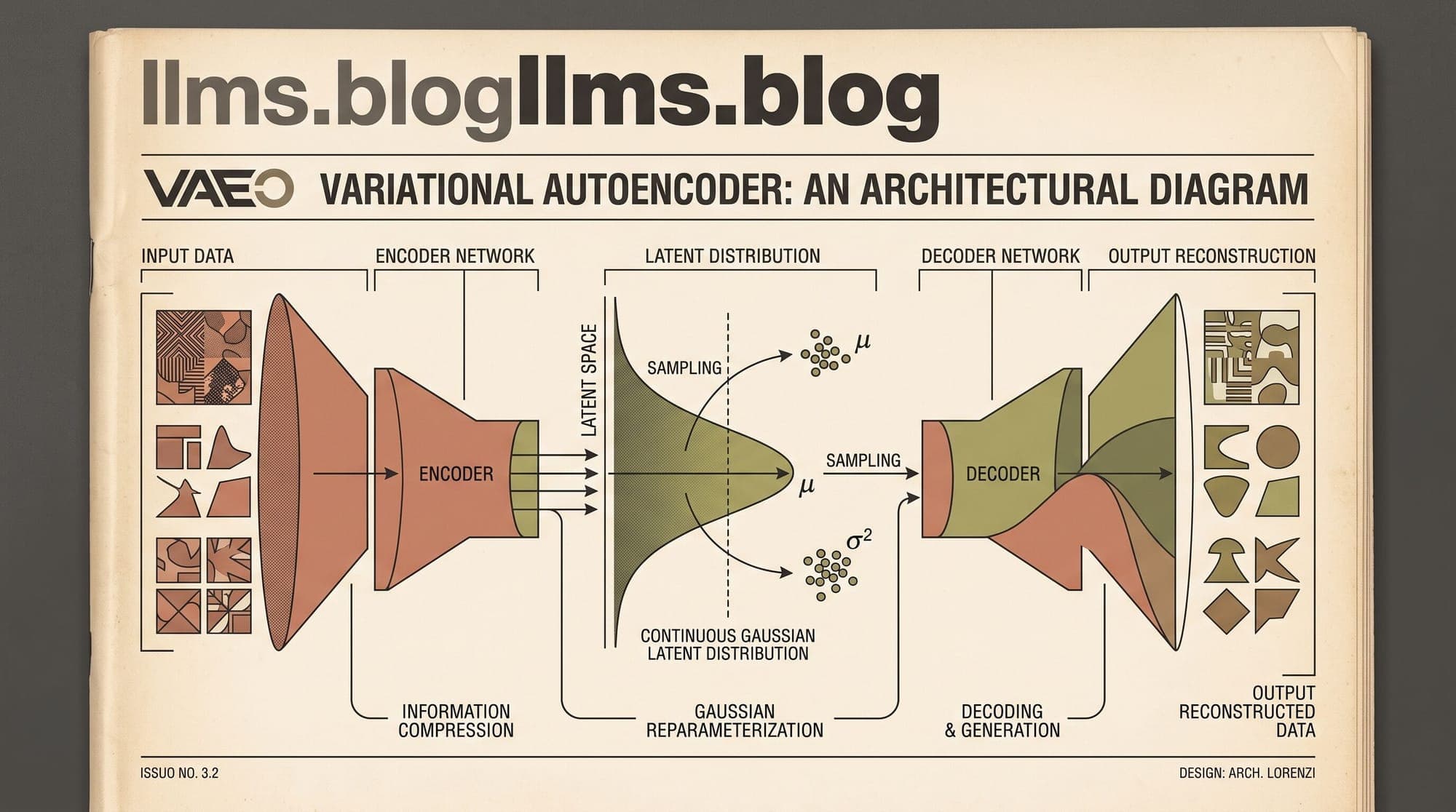
  6. Variational Autoencoders: Mathematical Derivation of the ELBO, the Reparameterization Trick, and Mitigating Posterior Collapse

    Variational Autoencoders: Mathematical Derivation of the ELBO, the Reparameterization Trick, and Mitigating Posterior Collapse Traditional autoencoders map high-dimensional data into deterministic latent vectors. While effective for dimensionality reduction and non-linear feature compression, deterministic autoencoders fail as generative models because their latent representations lack continuous probabilistic structure. Unregularized latent spaces contain wide regions of empty space and severe

    AI
    11 min read
  7. Fill-in-the-Middle (FIM) and Inline Code Completion in Production: Architecture, Prefix-Suffix Context Windows, Speculative Decoding, and Sub-50ms Serving Latencies

    Fill-in-the-Middle (FIM) and Inline Code Completion in Production: Architecture, Prefix-Suffix Context Windows, Speculative Decoding, and Sub-50ms Serving Latencies Inline code completion is the most latency-sensitive deployment of large language models in production software engineering. Unlike conversational assistants or background agentic batch jobs, inline code completion operates directly inside an active editor typing loop. Developers type at speeds ranging from 40 to 120 words per minut

    AI
    7 min read
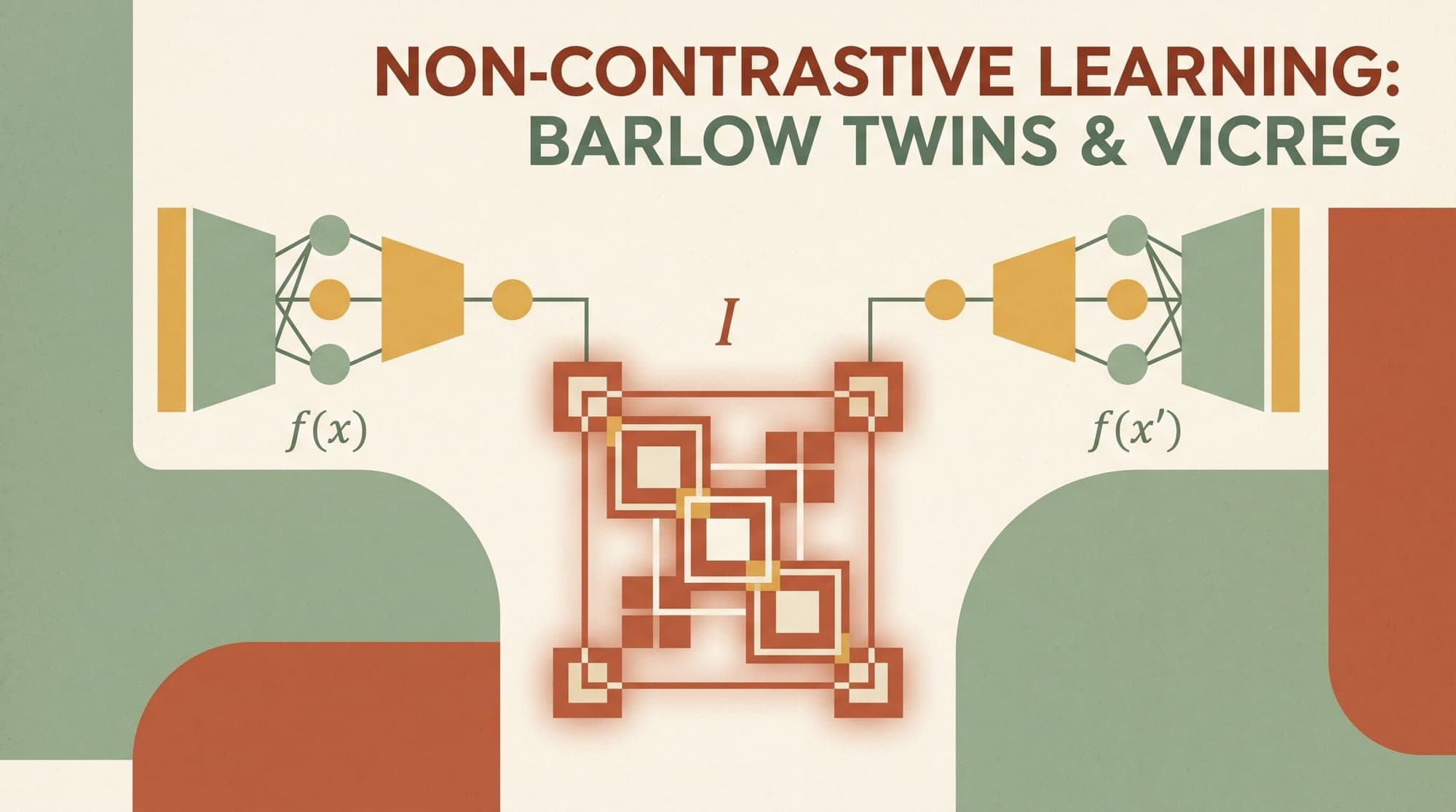
  8. Non-Contrastive Representation Learning: How Barlow Twins and VICReg Prevent Feature Collapse via Redundancy Reduction

    Self-supervised representation learning provides the foundation for modern foundation models across computer vision, audio, and multimodal systems. By training deep neural networks to produce compact vector embeddings without human annotations, self-supervised pre-training enables models to capture rich semantic structures directly from raw data. Historically, the dominant approach to self-supervised learning was contrastive learning, popularized by architectures such as SimCLR (Chen et al., 20

    edu
    9 min read
  9. Sparse-Dense Hybrid Retrieval in Production: Learned Lexical Weights, SPLADE vs. BGE-M3, Inverted Index Pruning, and Serving Economics

    Modern Retrieval-Augmented Generation (RAG) and enterprise search architectures increasingly encounter the operational limits of pure dense vector search. Dense bi-encoders project text passages into continuous latent spaces (typically 768 to 3,072 dimensions). While dense representations excel at conceptual matching and paraphrasing, they systematically struggle with exact keyword precision, rare alphanumeric tokens, product SKUs, and domain-specific jargon. Furthermore, serving dense vectors a

    Retrieval
    6 min read
  10. The Platonic Representation Hypothesis: How Foundation Models Across Modalities Converge on a Shared Geometry of Reality

    In 375 BC, Plato introduced the Allegory of the Cave, describing prisoners who could only perceive reality through shadows projected onto a stone wall. In modern machine learning, deep neural networks ingest distinct sensory shadows of the physical world: vision models process pixel arrays, large language models ingest tokenized text, and speech models parse raw acoustic waveforms. Historically, the machine learning literature assumed that models trained on different modalities, objectives, and

    AI
    6 min read