
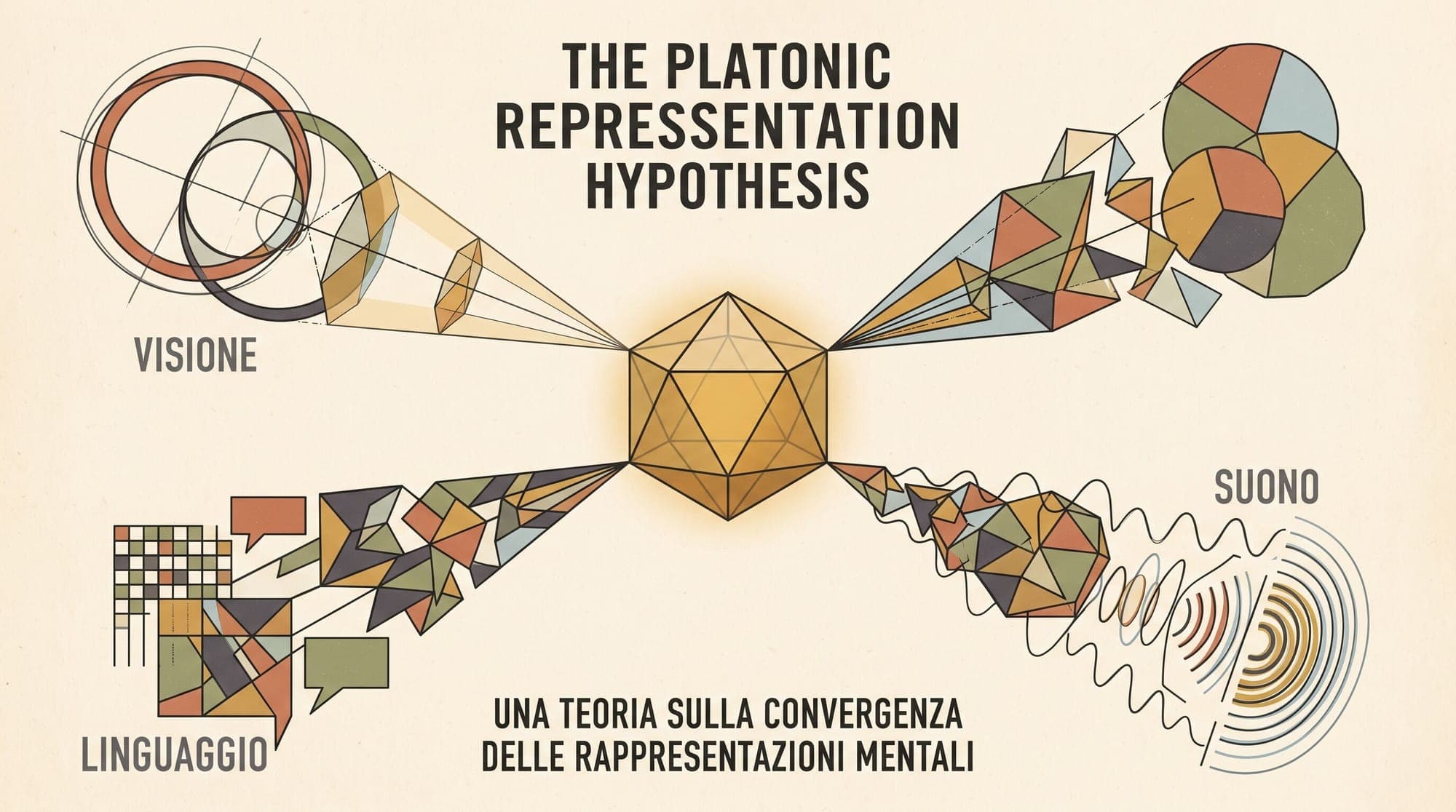
In 375 BC, Plato introduced the Allegory of the Cave, describing prisoners who could only perceive reality through shadows projected onto a stone wall. In modern machine learning, deep neural networks ingest distinct sensory shadows of the physical world: vision models process pixel arrays, large language models ingest tokenized text, and speech models parse raw acoustic waveforms.
Historically, the machine learning literature assumed that models trained on different modalities, objectives, and architectures would develop fundamentally disparate, incompatible internal geometries. However, empirical and theoretical work formalized by Minyoung Huh, Brian Cheung, Tongzhou Wang, and Phillip Isola in The Platonic Representation Hypothesis demonstrates the opposite: as neural networks scale in parameter count, data diversity, and task complexity, their internal representational spaces converge toward a shared, universal statistical model of reality.

Quantifying Representational Alignment Across Modalities
To test whether two disparate neural networks share internal representations, researchers cannot simply compare raw activation vectors directly. A vision transformer and a language model have completely different hidden dimensions (), distinct layer counts, and arbitrary rotational coordinate bases.
Instead, representational convergence is measured by analyzing the relational distance between datapoints within each model's latent manifold.
Centered Kernel Alignment (CKA)
The primary metric for measuring subspace similarity invariant to orthogonal rotations and isotropic scaling is Centered Kernel Alignment (Kornblith et al., 2019). Given test samples passed through Model A and Model B, yielding activation matrices and , we compute the Gram matrices and .
After centering the Gram matrices using the centering matrix , linear CKA is computed via the Hilbert-Schmidt Independence Criterion (HSIC):
When CKA approaches 1.0, both models preserve the exact same relative geometry and inter-sample similarity structure, regardless of internal basis rotations.
Mutual Nearest Neighbors and Procrustes Distance
Complementary metrics evaluate local topological consistency rather than global variance:
- Mutual Nearest Neighbors (MNN): For a shared set of semantic concepts, MNN measures the percentage of sample pairs that share identical -nearest neighbor neighborhoods in both latent spaces.
- Orthogonal Procrustes Distance: Finds the optimal orthogonal transformation matrix that aligns normalized representations by minimizing , quantifying residual geometric distortion (Schönemann, 1966).
- Linear Probe and Stitching Layers: If a single frozen linear layer can map the intermediate activations of Model A directly into Model B with near-zero loss penalty, the two models are functionally isomorphic (Lenc & Vedaldi, 2015).
The Four Drivers of Convergence
The Platonic Representation Hypothesis identifies four underlying mechanisms that force disparate models to converge on a single representational manifold.
1. The Multitask Scaling Hypothesis
Every machine learning task imposes constraints on the space of competent representations. A representation that only needs to classify whether an image contains a dog occupies a broad solution space. A representation that must simultaneously classify dog breeds, segment bounding contours, predict 3D depth, estimate joint kinematics, and predict next-frame physics faces a vastly more constrained optimization landscape.
As the number of tasks approaches infinity, the intersection of representations capable of solving all tasks simultaneously shrinks toward a singular optimal manifold:
Large models trained on Internet-scale multimodal data or diverse generative objectives are implicitly optimized across thousands of sub-tasks, leaving fewer degrees of freedom for idiosyncratic geometries.
2. The Capacity Hypothesis
Small neural networks lack the capacity to model true data distributions accurately. To minimize loss under tight parameter budgets, small models rely on idiosyncratic heuristic shortcuts, texture biases, and compressed local minimum solutions.
As model capacity expands (scaling parameters from millions to hundreds of billions), networks overcome bottleneck artifacts. In the overparameterized regime, neural networks reliably find the true underlying low-dimensional manifold that generated the data, eliminating architecture-dependent biases (Belkin et al., 2019).
3. The Simplicity Bias Hypothesis
Stochastic gradient descent (SGD) and its variants exhibit a strong implicit regularization bias toward simple, low-rank, smooth functions (Neyshabur et al., 2014; Rahaman et al., 2019).
Given multiple valid configurations that can achieve zero training loss, gradient optimization naturally selects the simplest geometric solution. Because this spectral simplicity bias is universal across standard architectures (Transformers, ResNets, State Space Models), independent models trained on similar data distributions are biased toward the exact same low-complexity solutions.
4. The Shared Causal Reality Hypothesis
Images, natural language, audio recordings, and sensory measurements are not independent random processes. They are distinct sensor projections of a single underlying physical and causal universe.
- A photograph captures light reflecting off a physical feline.
- The word "cat" describes the same biological entity and its behavioral properties.
- An audio waveform captures the feline vocalization.
Because the underlying causal state graph is identical, any model that successfully minimizes prediction error (whether predicting the next token, filling masked visual patches, or denoising continuous latents) must learn an invertible mapping from sensory space to the ground-truth causal state . As mutual information is maximized, different models inevitably reconstruct the same underlying state geometry.
Empirical Evidence Across AI and Neuroscience
Theoretical predictions of the Platonic Representation Hypothesis are supported by substantial empirical benchmarks across modalities and biological systems.
Vision-Language Alignment Without Paired Supervision
In classic contrastive learning architectures like CLIP (Radford et al., 2021), representations are explicitly forced together via joint contrastive loss. However, recent studies demonstrate that pure self-supervised vision models (e.g. DINOv2, Oquab et al., 2023) and pure autoregressive language models (e.g. LLaMA, Touvron et al., 2023) develop aligned relational structures without ever seeing paired image-text data during pre-training.
When evaluating pairwise cosine distances across matching visual concepts and text definitions, CKA similarity between unaligned vision encoders and LLMs increases monotonically as both models scale in parameter count.
The Collapse of Complex Multimodal Adapters
Early vision-language models required complex multi-layer cross-attention mechanisms, learned queries, and Q-Formers (such as BLIP-2, Li et al., 2023) to translate visual features into language tokens.
In modern frontier vision-language models (such as LLaVA-1.6 or Qwen2-VL), vision tokens are mapped into the LLM residual stream using a simple 2-layer MLP projection:
The fact that a basic two-layer projection is sufficient to achieve state-of-the-art multimodal reasoning proves that the geometric manifolds of vision encoders and language decoders are already near-isomorphic before any multimodal fine-tuning occurs.
Convergence with Biological Ventral Stream Representations
In computational neuroscience, the Brain-Score benchmark (Schrimpf et al., 2018) tracks how accurately artificial neural network activations predict electrophysiological neural firing in the primate visual cortex (areas V1, V2, V4, and IT).
As vision models and multimodal LLMs scale in performance on ImageNet and MMLU, their internal feature representations achieve higher neural predictivity with biological cortical recordings. Despite vastly different physical substrates (carbon-based dendritic spikes vs. silicon-based float16 tensor cores) and learning algorithms (biological STDP vs. backpropagation), biological and artificial networks converge on similar representational structures when task performance scales.
Structural Limits and Modality Asymmetries
While representational convergence holds across broad semantic categories, the hypothesis has defined limits:
- Modality-Specific Asymmetries: Text excels at representing precise logical negations, temporal conditionals, and abstract counterfactuals that lack direct visual equivalents. Conversely, raw images capture high-frequency spatial topologies, lighting gradients, and continuous physics that are rarely described in natural text.
- Cultural and Corpus Biases: AI models trained exclusively on English-language web crawls converge on the statistical biases of specific Internet sub-populations rather than absolute physical reality.
- Representation Collapse and Anisotropy: Extreme cross-entropy loss optimization can cause representation degeneration, where embeddings collapse into a narrow cone (Ethayarajh, 2019). Regularization techniques (such as RMSNorm, logit soft-capping, and weight decay) are required to ensure the shared manifold remains isotropic.
Architectural Implications for LLM and Multimodal Systems
The Platonic Representation Hypothesis provides a theoretical roadmap for next-generation foundation model architectures:
- Direct Multimodal Token Injection: As base encoders grow larger, specialized bridge networks become obsolete. Foundation models can ingest arbitrary data streams (lidar, radar, audio, robotics proprioception) via lightweight affine projections into the unified transformer backbone.
- Cross-Architecture Weight Merging: Understanding the shared geometric manifold enables zero-shot representation stitching, allowing models trained by different organizations on different modalities to be dynamically composed without full retraining.
- Data Scaling via Synthetic Translation: High-quality synthetic data generated in one modality (such as 3D spatial simulations) can directly train and ground abstract reasoning in pure language models through shared geometric grounding.
Sources
- The Platonic Representation Hypothesis (Huh et al., ICML 2024)
- Similarity of Neural Network Representations Revisited (Kornblith et al., ICML 2019)
- DINOv2: Learning Robust Visual Features without Supervision (Oquab et al., 2023)
- LLaMA: Open and Efficient Foundation Language Models (Touvron et al., 2023)
- Reconciling Modern Machine-Learning Practice and the Classical Bias-Variance Trade-off (Belkin et al., PNAS 2019)
- On the Spectral Bias of Neural Networks (Rahaman et al., ICML 2019)
- Brain-Score: Which Artificial Neural Network for Which Brain and Behavior? (Schrimpf et al., 2018)
- BLIP-2: Bootstrapping Language-Image Pre-training with Frozen Image Encoders and Large Language Models (Li et al., ICML 2023)
- How Contextual Are Contextualized Word Representations? (Ethayarajh, EMNLP 2019)



