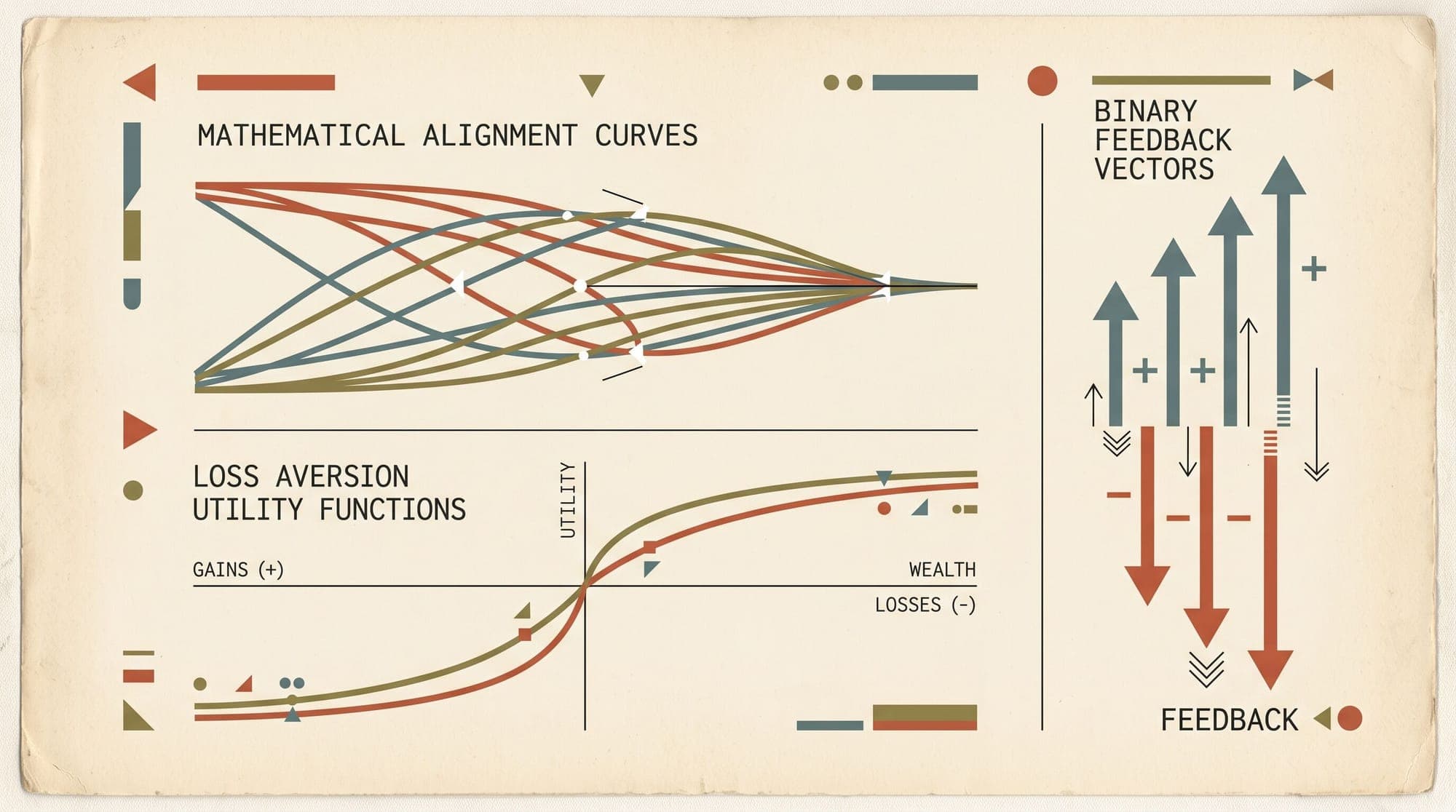
Kahneman-Tversky Optimization (KTO): Mathematical Foundations, Prospect Theory, and Binary Signal Alignment in Large Language Models
Post-training alignment of large language models has long relied on pairwise comparison datasets. Methods such as Reinforcement Learning from Human Feedback (RLHF) and Direct Preference Optimization (DPO) assume access to curated pairs $(x, y_w, y_l)$, where a human or automated judge explicitly marks completion $y_w$ as superior to $y_l$ for a given prompt $x$. In production environments, however, collecting paired preferences is logistically complex, expensive, and artificial. Real-world telem