
Google is adding a new opt-in setting to Google Messages called Enhanced protection mode. Turn it on, and Google's cloud Gemini models read conversations you have with unknown senders to spot scams, while Gemini Nano on your phone checks unfamiliar links before you tap them. Google announced it on October 14 with a handful of other Android scam defenses, and says Enhanced protection will roll out "in the coming weeks."
Here is what each piece does, which phones get it, and the privacy choice you make when you switch it on.
Why Google is doing this
Google's pitch is that scams have moved past obvious robocalls and phishing texts to spoofed numbers, fake bank alerts and AI voice cloning. In a survey Google ran with YouGov in the US, Canada and Australia, 40% of smartphone users said they are "very" or "extremely" concerned about mobile fraud. Google also says its existing Scam Detection in the Phone and Messages apps already flags more than 5 million suspected scam calls and texts every month.
Those figures come from Google and a survey it commissioned, so read them as Google's case for the feature rather than independent measurement.
What Enhanced protection mode turns on
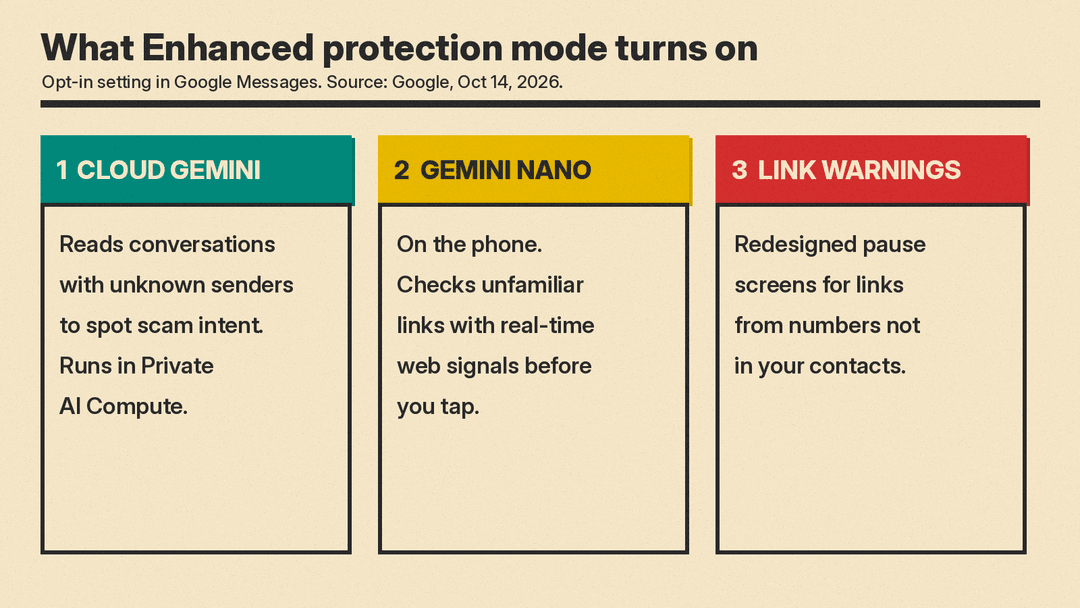
Enhanced protection is one switch that unlocks three things, according to Google's post:
- Cloud Gemini reads suspicious conversations. Some scams are slow. The first few messages look harmless, and the ask for money or a code comes later. With Enhanced protection on, Scam Detection in Google Messages can use "Google's most capable cloud Gemini models" to read the context of a conversation with an unknown sender and work out the scammer's intent sooner. Google says this adds to the on-device detection it already runs, it does not replace it.
- Gemini Nano checks new links. Messages already flags links to known malicious and phishing sites. The gap is brand-new scam sites that are not on any list yet. With Enhanced protection on, Gemini Nano, the small model that runs on the phone, uses real-time web signals to judge whether an unfamiliar link is trustworthy before you tap it.
- Pause screens for links from strangers. Redesigned warnings give you "extra time and clearer context" before you open a link from a number that is not in your contacts. Google says this was previously only available in select countries or on phones with Android Advanced Protection turned on.
Which phones get it
This is where it gets uneven. Per 9to5Google and Google's own footnotes, the Gemini Nano link check is available on the Pixel 10 and newer, the Samsung Galaxy S26 series, the Galaxy Z Flip 8 and Z Fold 8, and "other select devices." Google did not publish a full device list for the cloud scam detection part. Google's post does not give a menu path either, so if you do not see the setting in Google Messages yet, the rollout may not have reached your phone.
Enhanced protection itself only covers Google Messages on Android. It does nothing for iPhone users or for other texting apps, though one of the other changes below does reach chat app notifications.
The privacy trade
The new part is that message content leaves your phone. Google describes its existing Scam Detection in Messages as on-device detection. With Enhanced protection on, conversations with unknown senders are also analyzed by Google's cloud Gemini models.
Google says that analysis happens in Private AI Compute, where "your data is encrypted and processed in a secure dedicated space," and is "inaccessible to anyone else, including Google." 9to5Google notes that Private AI Compute already handles other Pixel features, such as Pixel Screenshots. For background on how cloud services try to keep data private while a model processes it, see our explainer on confidential LLM inference.
So the choice is plain. If you, or a parent you help with their phone, get a steady stream of "wrong number" texts and fake delivery alerts, the extra cloud check may be worth it. If you would rather no message content leaves the device under any promise, leave it off. Since it is opt-in, nothing changes unless you turn it on.
The other Android changes in the same update
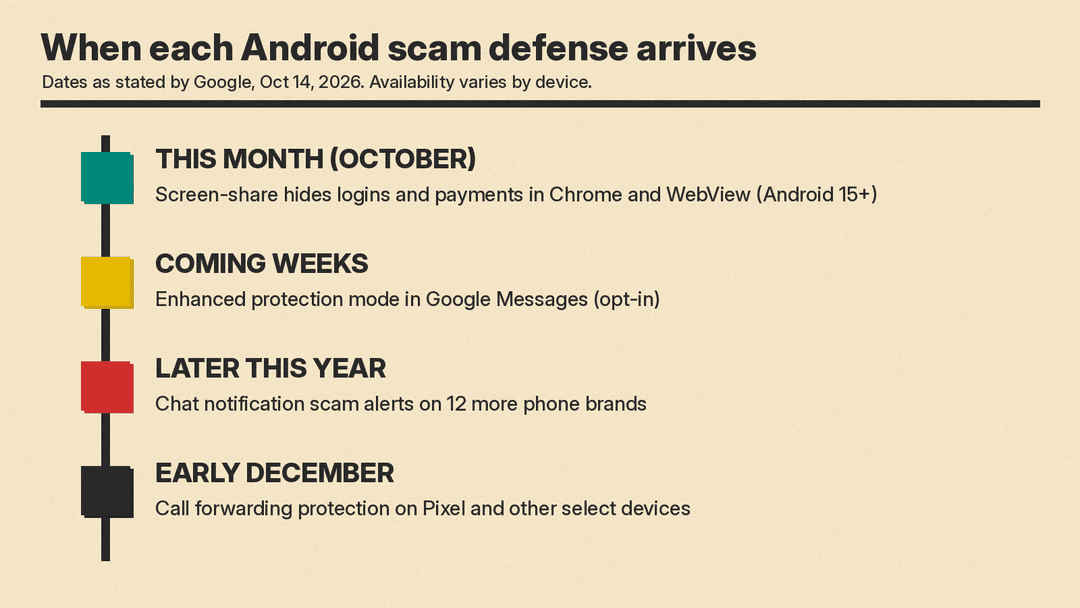
Google bundled several more defenses with Enhanced protection:
- Scam alerts for chat app notifications on more phones. Pixel already warns you about suspicious messages from popular chat apps right in the notification shade, before you open the app. Google is bringing that on-device check to phones from HONOR, Infinix, iQOO, itel, JOVI, Motorola, OPPO, OnePlus, realme, TECNO, vivo and Xiaomi "later this year," which it says covers hundreds of millions more users. Availability varies by phone maker.
- Screen sharing hides passwords and card details. Android already blanks out sensitive fields in its own apps during a screen share. That now extends to Chrome and Android WebView, hiding login fields and payment screens. Google says this is rolling out this month to Android 15 and newer.
- Call forwarding protection. A common account takeover trick is to quietly forward your calls to the scammer so they can catch one-time passcodes. Android will block apps from turning on call forwarding in the background, and will warn you if someone talks you into typing a forwarding code (an MMI code) into the dial pad. This arrives in early December on Pixel and other select devices.
- Verified bank calls. Working with banking apps, Android checks in real time whether a call that claims to be from your bank really came from it. If the check fails, Android hangs up and alerts you. Google says it has blocked more than 3 million spoofed calls from Banco do Brasil and Itaú Unibanco since June, and that Revolut customers are also covered. For a different defense against fake bankers on video calls, see how World ID's Human Badge works on Zoom.
About the iPhone comparison
Google's post leans on two sources to argue Android beats iPhone on scams: a Leviathan Security Group report that Google commissioned and funded, and the Google and YouGov survey of 4,500 smartphone users, in which iPhone users were more likely than Pixel users to say they had fallen for a scam. Both are Google-backed, so treat them as marketing claims until someone tests the two platforms independently.
What to do now
- If you have a recent Pixel or Galaxy phone and use Google Messages, watch for Enhanced protection in the app over the next few weeks and decide whether the cloud check is worth it to you.
- If you set up an Android phone for an older relative who uses Google Messages, the setting is worth a look once it arrives.
- Call forwarding protection and the wider chat alerts come later, in early December and later this year, so they will not show up right away.
