
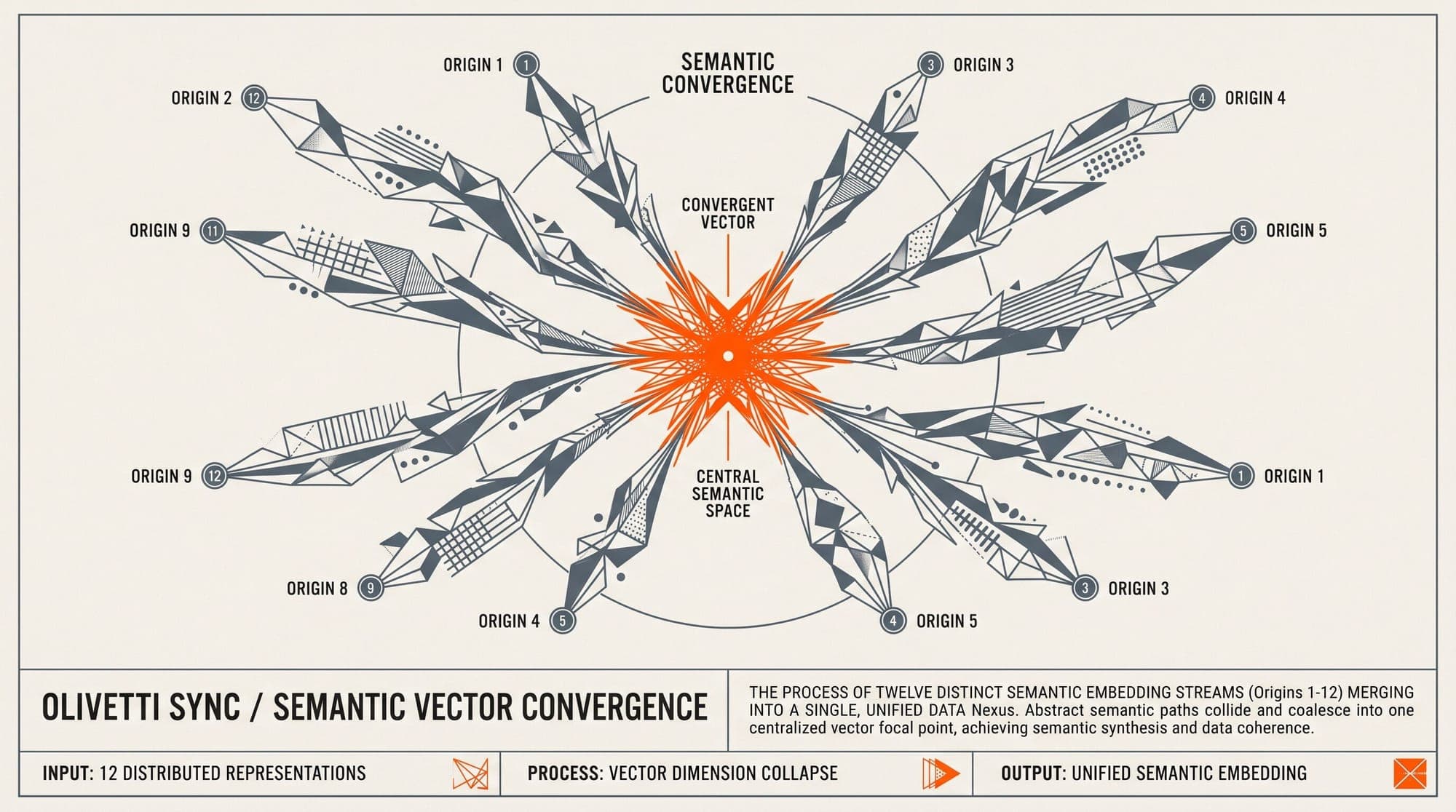
A longitudinal study by researchers at Duke University has documented a measurable decline in output diversity across major large language model families. Tracking 69 foundation model checkpoints released between March 2023 and July 2026, the researchers found that generative responses to open-ended creative and ideation prompts are increasingly converging toward semantic uniformity across competing providers.
The paper, titled Are LLMs becoming similarly creative? Evidence from three years of models, evaluated systems across 12 distinct provider lineages: Anthropic, Cohere, DeepSeek, Google, Meta, MiniMax, Mistral AI, Moonshot AI, OpenAI, Qwen, xAI, and Z.ai.
Measuring Semantic Distance Over Three Years
To evaluate creative diversity over time, the authors tested models across two distinct prompt suites under unified sampling parameters (temperature 1.0, top-p 1.0):
- The Alternate Uses Task (AUT): A standard psychology protocol testing divergent thinking by asking models to propose unconventional uses for everyday objects such as books, shoes, and hammers.
- Infinity-Chat100: A curated benchmark of 100 open-ended prompts derived from natural conversations, covering brainstorming, creative problem solving, and unstructured writing.

Generated responses were mapped into dense vector embeddings using the all-MiniLM-L6-v2 sentence-transformer. The researchers grouped the 27 release months into nine consecutive intervals and calculated pairwise semantic distances exclusively between models from different provider families.
Regression analysis across successive release cohorts confirmed a statistically significant downward trend in cross-provider semantic distance. While earlier model generations (2023–2024) produced divergent stylistic and conceptual responses to identical prompts, recent generations (2025–2026) show tightly clustered embedding distributions regardless of the underlying developer.
Drivers of Algorithmic Monoculture
The authors attribute this growing semantic homogenization to several structural factors in the current LLM development pipeline:
- Shared Pre-Training Corpora: Widespread reliance on overlapping web crawls (Common Crawl, FineWeb) and shared synthetic data generation pipelines creates similar foundational world representations.
- Preference Alignment Convergence: Standardized reinforcement learning from human feedback (RLHF) and direct preference optimization (DPO) datasets penalize atypical token sequences in favor of predictable, helpful responses.
- Cross-Distillation Loops: The widespread practice of fine-tuning open-weight models on outputs harvested from frontier proprietary systems compresses model behavioral variance toward industry-standard modes.
The findings highlight growing concerns over algorithmic monoculture, indicating that as enterprise workflows rely more heavily on multi-provider LLM ensembles, the true diversity of ideas and solutions generated across different models is narrowing.



