
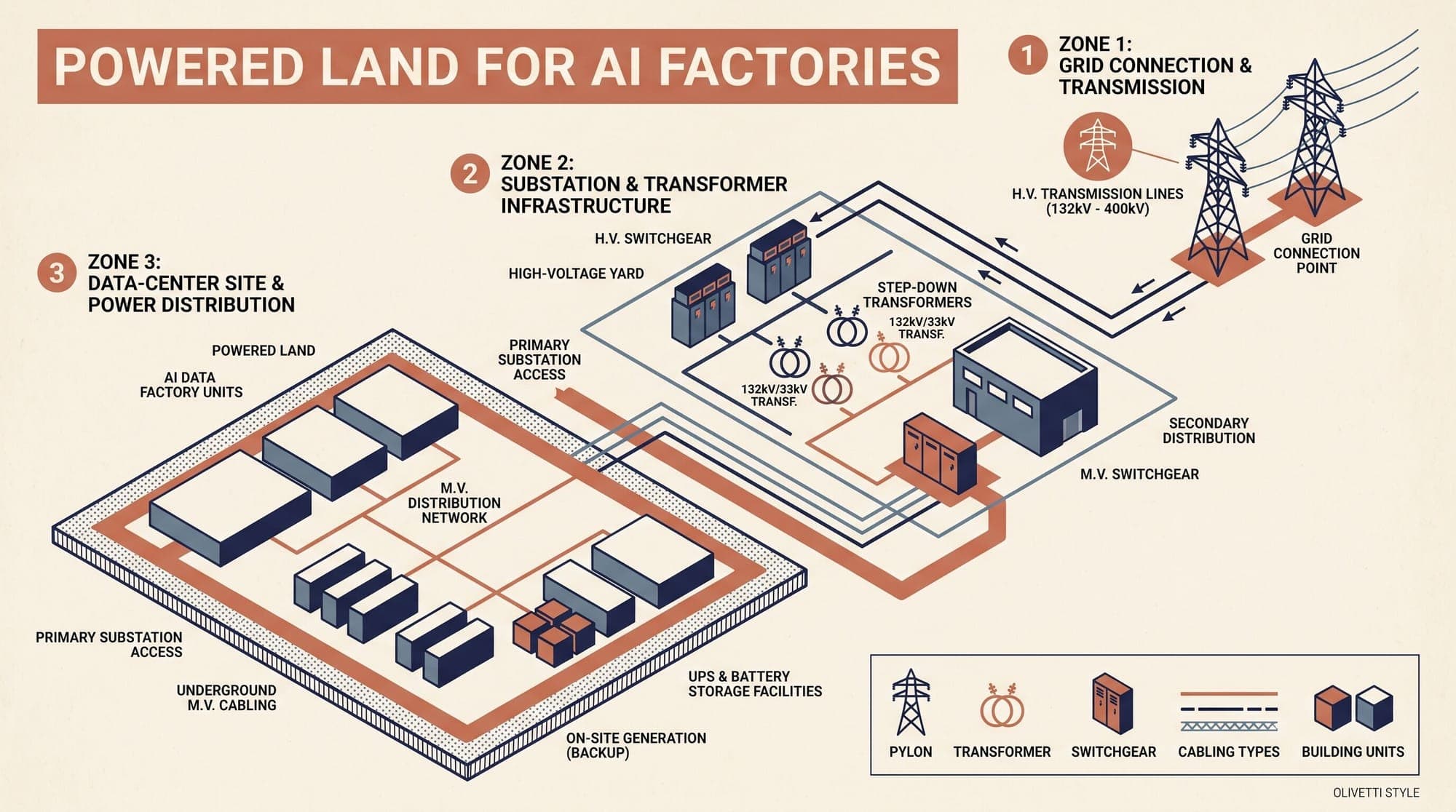
NVIDIA has taken a minority stake in Cloverleaf Infrastructure, a Houston-based developer of powered data-center sites, as part of a strategic partnership to accelerate the build-out of so-called AI factories. The companies did not disclose the size of the investment or its financial terms.
Cloverleaf occupies the powered-land layer of the data-center supply chain. It identifies and prepares sites with grid-connected power, then delivers shovel-ready locations to infrastructure builders and operators. Since its founding in 2024 with initial backing from Sandbrook Capital and NGP Energy Capital, Cloverleaf says it has delivered multiple gigawatt-scale projects across North America.
J.P. Morgan Securities served as financial advisor to Cloverleaf on the transaction, with Kirkland & Ellis as legal counsel.
Adopting NVIDIA DSX for Site Design
As part of the partnership, Cloverleaf will adopt NVIDIA DSX, a platform NVIDIA introduced at GTC Taipei on May 31, 2026. DSX bundles reference architectures, simulation tooling, and open-source operational software into a framework for AI-factory construction and management.

Cloverleaf plans to use DSX during the design phase to evaluate trade-offs between power, water, and grid constraints before construction begins, and to optimize energy use and compute density once facilities become operational. Key DSX components include:
- DSX MaxLPS: targets token-output-per-megawatt optimization within fixed power budgets. NVIDIA claims cooling and power-management techniques allow operators to run up to 40% more GPUs at peak efficiency.
- DSX Flex: connects facilities to grid services, enabling workload response to utility signals such as demand-response events.
Cloud infrastructure providers CoreWeave, IREN, and Nebius are already deploying core DSX components.
Extending NVIDIA's Infrastructure Balance Sheet
The Cloverleaf investment continues NVIDIA's recent strategy of taking equity positions in the physical-layer partners that support GPU deployment. The sequence of recent moves:
| Date | Partner | Investment / Commitment | Infrastructure Scope | | :--- | :--- | :--- | :--- | | May 7, 2026 | IREN | Equity stake + warrants ($2.1B potential at $70/share) | Up to 5 GW of DSX-aligned infrastructure | | August 2026 | OpenAI (Ohio campus) | Guarantee | Up to $105B for 8 GW Ohio campus | | August 21, 2026 | Cloverleaf | Minority stake (terms undisclosed) | Powered-land sites across North America |
The logic across deals remains consistent: NVIDIA's next platform generations sell into deployed capacity that does not yet exist. By seeding the developers, operators, and financing vehicles positioned to build that capacity, NVIDIA accelerates market penetration for future GPU generations.
Neither NVIDIA nor Cloverleaf disclosed a timeline for the first jointly developed powered-land site.



