

In standard transformer architectures, the self-attention mechanism computes pairwise token interactions through the scaled dot-product operator followed by a softmax normalization. While this formulation has underpinned modern large language models, it suffers from an architectural limitation: attention noise. Because the softmax function maps input logits to a strictly positive probability distribution summing to one, it forces probability mass onto irrelevant context tokens. In sequences spanning tens of thousands of tokens, this distributed background noise dilutes critical retrieval signals, accelerates contextual hallucinations, and introduces massive activation outliers that complicate low-bit quantization.
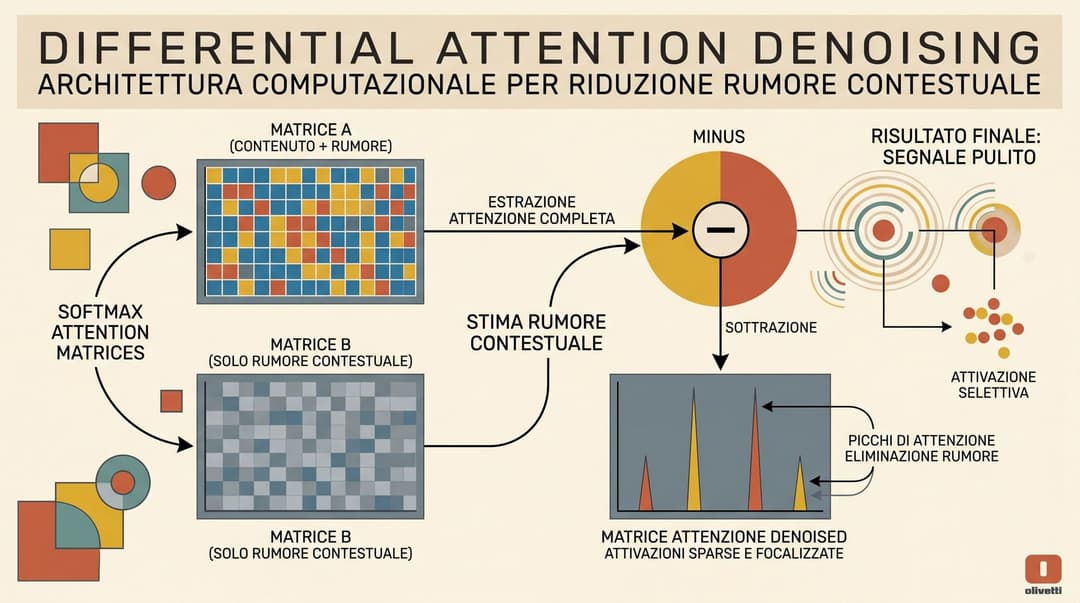
In a research paper accepted for oral presentation at ICLR 2025, researchers at Microsoft Research and Tsinghua University introduced the Differential Transformer (Diff Transformer). By replacing conventional softmax attention with differential attention, the architecture computes two separate softmax attention maps and subtracts them. This subtraction functions as a differential amplifier, canceling common-mode background noise and enforcing sparse, focused attention patterns without altering parameter budgets or computational complexity.
The Mechanics of Attention Noise
In standard multi-head attention introduced by Vaswani et al., attention weights are computed as:
Attention(Q, K, V) = softmax(Q * K^T / sqrt(d)) * VBecause the exponential function in softmax never reaches zero, every token in the sequence receives a non-zero attention weight. When processing long documents, a query seeking a specific factual needle must attend across thousands of distracting background tokens. Even when individual distracting tokens receive minute attention weights (for example, 0.001), their aggregate sum across a long context window can dominate the attention distribution.
Empirical evaluations demonstrate that in standard transformers, the attention allocated to irrelevant context tokens often exceeds 50% of the total attention mass. As a consequence:
- Retrieval signals drown: In multi-needle retrieval benchmarks, attention weights assigned to target answer spans drop below 5% to 10%, causing retrieval accuracy to degrade sharply when facts are located in the early or middle portions of the context window.
- Contextual hallucinations increase: When summarizing or answering queries over complex reference documents, attention noise misdirects the model toward irrelevant sentences, generating unfaithful assertions despite correct information existing in the context.
- Prompt permutation sensitivity worsens: Standard in-context learning exhibits high variance depending on the ordering of few-shot demonstrations, as noise from preceding examples corrupts downstream token representations.
- Activation outliers proliferate: As documented by Bondarenko et al., transformers develop extreme activation spikes in attention logits and residual stream hidden states, creating steep precision walls for post-training quantization.
Differential Attention Architecture
Differential attention addresses this failure mode by adapting differential signaling from electrical engineering. In hardware design, differential amplifiers measure the voltage difference between two conductors to reject electromagnetic interference that affects both lines equally (common-mode noise).
Differential attention applies the same principle to attention maps. Given an input sequence representation X, linear projection matrices map the inputs into two sets of query vectors, two sets of key vectors, and a shared value vector:
[Q_1; Q_2] = X * W^Q
[K_1; K_2] = X * W^K
V = X * W^V
The projection matrices W^Q and W^K map from the model dimension d_model to 2 * d, while W^V maps to 2 * d. The differential attention operator then computes two separate softmax attention maps and subtracts the second from the first:
DiffAttn(X) = ( softmax(Q_1 * K_1^T / sqrt(d)) - lambda * softmax(Q_2 * K_2^T / sqrt(d)) ) * VHere, lambda is a learnable scalar that balances the noise-canceling term. When a token is irrelevant, both softmax terms produce similar probabilities (A_1 approx A_2), causing their difference (A_1 - lambda * A_2) to approach zero. Conversely, when a token is relevant, the primary attention map A_1 spikes while A_2 remains flat, preserving the sharp attention signal.
Learnable Lambda Re-parameterization
To ensure gradient stability during training, lambda is re-parameterized via four learnable vectors (lambda_q1, lambda_k1, lambda_q2, lambda_k2) along with an initialization constant:
lambda = exp(lambda_q1 . lambda_k1) - exp(lambda_q2 . lambda_k2) + lambda_initThe initialization constant lambda_init is varied across the L layers of the network according to an exponential schedule:
lambda_init = 0.8 - 0.6 * exp(-0.3 * (l - 1))This schedule sets lambda_init to 0.2 at the initial layer (where broader context aggregation is beneficial) and scales up toward 0.8 in deeper layers (where precise, denoised token routing is critical). Ablation studies confirm that the model remains robust across alternative initialization values, including fixed constants of 0.5 or 0.8.
Headwise Normalization
Because differential attention eliminates noise, individual attention heads exhibit higher sparsity and greater variance in their output statistics. To stabilize gradient flow, Diff Transformer applies independent normalization per head before concatenation:
head_i = DiffAttn(X; W_i^Q, W_i^K, W_i^V, lambda)
head_bar_i = (1 - lambda_init) * RMSNorm(head_i)
MultiHead(X) = Concat(head_bar_1, ..., head_bar_h) * W^O
The scaling factor (1 - lambda_init) aligns the output gradient magnitude with that of standard transformers, enabling the architecture to reuse standard AdamW optimizer hyperparameters without learning rate recalibration.
To maintain strict parity in parameters and FLOPs against baseline transformers, the number of attention heads in Diff Transformer is set to h = d_model / (2 * d), exactly half the head count of a standard transformer with identical head dimension d.
Empirical Performance and Scaling Properties
Evaluations conducted on models ranging from 830M to 13.1B parameters demonstrate consistent architectural advantages across standard benchmarks.
Scaling Efficiency
When evaluated across pre-training compute scaling curves:
- A 6.8B Diff Transformer achieves validation loss comparable to an 11B baseline transformer, requiring only 62.2% of the parameter count.
- A 7.8B Diff Transformer matches the validation loss of a 13.1B baseline transformer using 59.5% of the parameters.
- When scaling training tokens on a 3B model, Diff Transformer trained on 160B tokens reaches the validation loss of a standard transformer trained on 251B tokens, consuming only 63.7% of the compute.
On zero-shot downstream benchmarks (including ARC-Challenge, BoolQ, HellaSwag, PIQA, and WinoGrande), a 3B Diff Transformer trained on 1T tokens achieved an average score of 60.6, outperforming comparable 3B baselines such as OpenLLaMA-3B-v2 (57.5) and StableLM-base-alpha-3B-v2 (56.8).
Needle Retrieval and Context Utilization
In multi-needle retrieval tasks (N needles inserted, R needles queried):
- In 4K contexts with N=6 and R=2, standard transformers dropped to 55% retrieval accuracy, while Diff Transformer maintained 85% accuracy.
- In 64K extended-context evaluations, standard transformers suffered steep performance degradation when targets appeared in the first quartile (0% to 25% depth). At 25% depth within a 64K context, Diff Transformer delivered a 76% accuracy improvement over the transformer baseline.
- Quantitative attention score analysis revealed that Diff Transformer assigned 27% to 40% of its attention weight directly to the target answer span (compared to 3% to 9% for standard transformers), while reducing attention noise across irrelevant tokens from ~50% down to 1% to 2%.
Hallucination and In-Context Learning
In contextual hallucination evaluations across summarization (XSum, CNN/DailyMail, MultiNews) and question answering (Qasper, HotpotQA, 2WikiMultihopQA), Diff Transformer substantially reduced factual errors:
- MultiNews summarization factual accuracy rose from 0.42 to 0.61.
- Qasper question-answering accuracy increased from 0.28 to 0.39.
In many-shot in-context learning extended up to 64K context on classification tasks (TREC, Banking-77, Clinic-150), Diff Transformer improved average accuracy by 5.2% to 21.6%. In addition, it demonstrated near-zero variance under demonstration order permutations, resolving a chronic vulnerability in standard prompting pipelines.
Activation Outlier Suppression and Quantization
A major bottleneck in deploying quantized LLMs is the emergence of high-magnitude activation outliers. In standard transformers, pre-softmax attention logits frequently produce extreme spikes that break uniform quantization grids.
Measurements over 400,000 tokens reveal that Diff Transformer fundamentally alters activation distributions:
- Top-1 Attention Logits: Slashed from 318.0 in standard transformers to 38.8 in Diff Transformer.
- Top-10 Attention Logits: Reduced from 284.7 to 32.0.
- Top-1 Layer Hidden States: Reduced from 3608.6 to 1688.2.
When applying dynamic post-training quantization to attention logits:
- Standard transformers suffer severe accuracy degradation below 8-bit precision, collapsing at 6-bit and 4-bit configurations.
- Diff Transformer maintains unquantized accuracy through 6-bit quantization. At 4-bit quantization, Diff Transformer matches the accuracy of a 6-bit standard transformer and outperforms a 4-bit standard transformer by 25 percentage points on HellaSwag.
Hardware Implementations and Serving Considerations
Because differential attention requires evaluating two softmax operations per head, naive implementations introduce memory and latency overhead. However, the operations map efficiently to fused GPU kernels.
Using custom adaptations of FlashAttention-2 developed by the authors:
- On Nvidia H100 GPUs at 4K sequence lengths (3B model), Diff Transformer achieved 6,718 tokens/sec during forward+backward training passes compared to 7,491 tokens/sec for standard transformers (a 12% difference).
- Forward prefill throughput reached 44,521 tokens/sec for Diff Transformer compared to 48,762 tokens/sec for standard transformers (a 10% difference).
- At 13B scale (2K sequence length), the prefill throughput gap narrowed to 5%.
As custom kernels are ported to FlashAttention-3 and specialized Triton backends, the computational overhead of the dual-softmax subtraction is expected to diminish further. More importantly, the native sparsity of differential attention patterns provides a structural foundation for dynamic KV cache pruning and low-bit KV quantization in high-throughput serving systems.
Sources
- Ye, T., Dong, L., Xia, Y., Sun, Y., Zhu, Y., Huang, G., & Wei, F. (2024). Differential Transformer. arXiv:2410.05258
- Vaswani, A., Shazeer, N., Parmar, N., Uszkoreit, J., Jones, L., Gomez, A. N., Kaiser, L., & Polosukhin, I. (2017). Attention Is All You Need. arXiv:1706.03762
- Dao, T., Fu, D. Y., Ermon, S., Rudra, A., & Re, C. (2022). FlashAttention: Fast and Memory-Efficient Exact Attention with IO-Awareness. arXiv:2205.14135
- Bondarenko, Y., Nagel, M., & Blankevoort, T. (2024). Quantizable Transformers: Removing Outliers by Helping Attention Heads Retire. arXiv:2402.04376
- Kamradt, G. (2023). Needle In A Haystack - Pressure Testing LLMs. GitHub Repository
