
The Linear Representation Hypothesis in Large Language Models: How Neural Geometry Organizes Concepts, Latent Truth, and Steerable Features
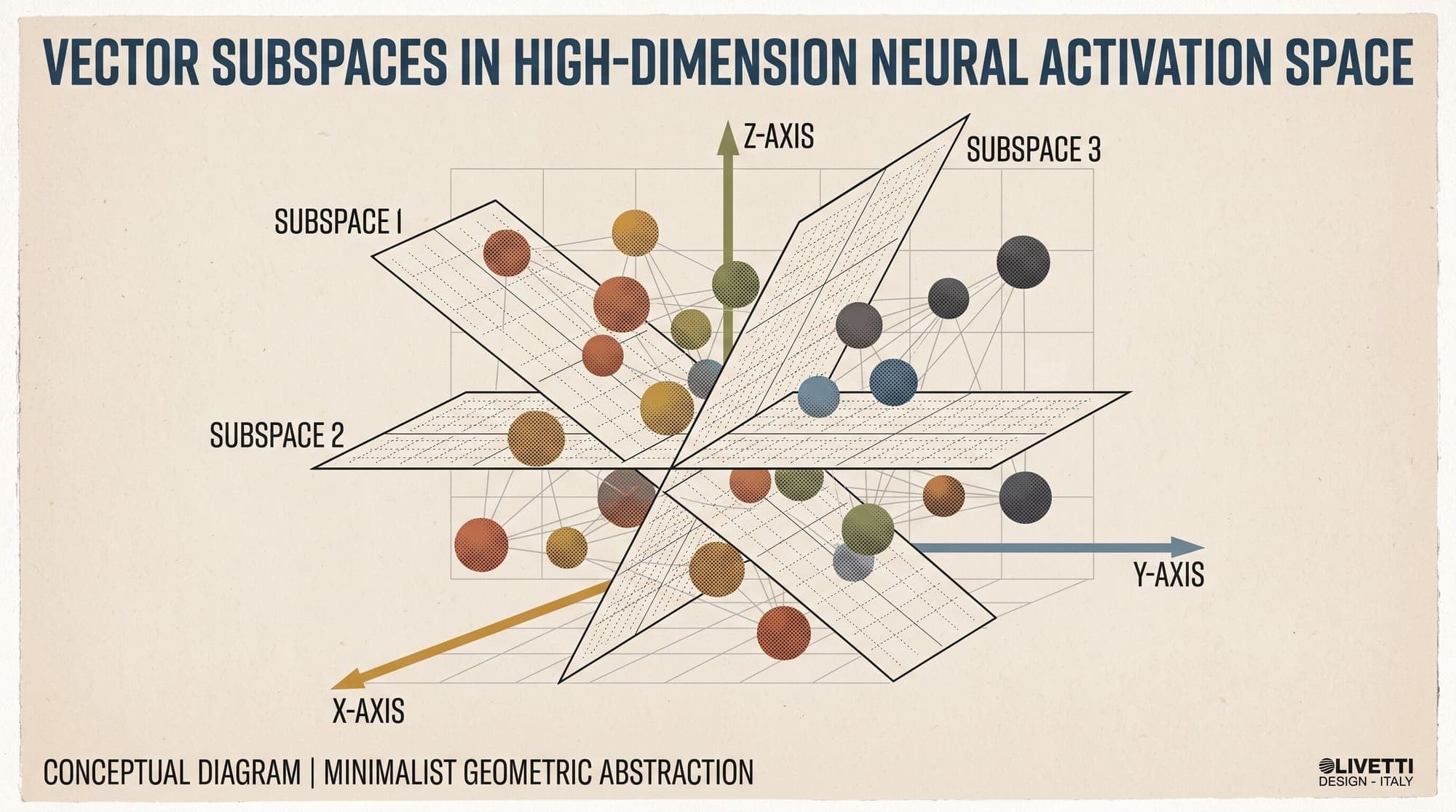
Deep neural networks are composed of alternating non-linear activation functions, multi-head attention operations, and high-dimensional matrix projections. Despite this architectural non-linearity, empirical research across mechanistic interpretability reveals a striking geometric regularity: within the intermediate representation spaces of large language models (LLMs), high-level semantic concepts, factual properties, truth values, and relational operators are organized predominantly as linear directions and flat affine subspaces.
This phenomenon is formalized as the Linear Representation Hypothesis (LRH). First observed informally in word embedding vector arithmetic, the LRH has been rigorously analyzed across transformer representations by Park, Choe, and Veitch (2023), Marks and Tegmark (2023), Hernandez et al. (2023), and Burns et al. (2022). Understanding why and how linear representations emerge provides the theoretical foundation for linear probing, concept editing, activation steering, and representation engineering.

1. Defining the Linear Representation Hypothesis
At its core, the Linear Representation Hypothesis asserts that high-level concepts are represented as one-dimensional directions or low-dimensional linear subspaces within the activation space of a neural network. Under this framework:
- Feature Presence as Linear Projection: The extent to which a concept or property applies to a given input is measured by the inner product of the model's activation state with a concept direction vector :
- Semantic Operations as Vector Translations: Modifying an input conceptually (such as converting present tense to past tense, changing sentiment from negative to positive, or altering a factual subject) corresponds to shifting the hidden state along :
- Subspace Disentanglement: Independent concepts occupy orthogonal or nearly orthogonal subspaces, allowing the model to compute, update, and read individual attributes without interfering with unrelated representations.
The Formal Counterfactual Framework
In "The Linear Representation Hypothesis and the Geometry of Large Language Models", Park, Choe, and Veitch formalized this intuition using causal counterfactual pairs.
Consider a distribution of text inputs where a specific binary attribute (such as grammatical gender, sentiment, or truth value) can be intervened upon while holding all other latent attributes constant. Let and denote a counterfactual input pair differing only in attribute . Under the strict linear representation hypothesis, the difference vector between their hidden states: points in a invariant direction across all contexts, up to bounded noise:
Park et al. demonstrated that this formulation connects three distinct notions of linearity in machine learning:
- Subspace representation: Concepts live in isolated linear coordinate directions.
- Linear probing: A linear classifier (e.g., logistic regression or support vector machine) trained on hidden activations achieves near-optimal classification accuracy on the target concept.
- Causal intervention: Adding the difference vector to an activation vector during a forward pass alters model outputs in precisely the manner predicted by counterfactual modification.
2. Empirical Evidence: From Word2Vec to the Geometry of Truth
The origins of linear representations trace back to distributed word vectors like Word2Vec and GloVe, which famously demonstrated linear analogies such as $\vec{v}_{\text{king}} - \vec{v}_{\text{man}} + \vec{v}_{\text{woman}} \approx \vec{v}_{\text{queen}}$. However, modern transformer LLMs operate in contextualized activation spaces where token vectors shift dynamically across layers and token positions. Recent research confirms that linear geometry not only persists in deep transformers, but scales in sophistication.
The Geometry of Truth
In "The Geometry of Truth: Emergent Linear Structure in Large Language Model Representations of True/False Datasets", Samuel Marks and Max Tegmark investigated whether LLMs internally represent the truthfulness of factual statements as a linear feature.
By analyzing models including LLaMA-1, LLaMA-2, and Vicuna across diverse true/false statement datasets (spanning geography, arithmetic, common sense assertions, and scientific facts), Marks and Tegmark found:
- Mass-Mean Truth Vectors: Computing the simple difference in means between true and false activation vectors:
identifies a consistent direction in intermediate and late transformer layers.
- Cross-Domain Generalization: A truth direction identified solely on simple geographic facts (e.g., "Paris is in France" vs. "Paris is in Italy") accurately separates true and false statements in arithmetic, biology, and historical dates without retraining.
- Bimodal Separation: Projecting hidden states onto yields two clean, well-separated Gaussian-like distributions corresponding to true and false statements.
Contrast Consistent Search (CCS)
In "Discovering Latent Knowledge in Language Models Without Supervision", Collin Burns et al. showed that truth directions can be discovered entirely without labels. Contrast Consistent Search (CCS) identifies a linear projection that satisfies logical consistency properties across contrastive question-answer pairs (representing affirmative and negative answers):
- Consistency: , where .
- Informativeness: , preventing the trivial solution of .
CCS recovers the latent belief state of the model even when the model's generated surface text is sycophantic or deceptive, demonstrating that linear projections expose internal representations independent of output generation policies.
Spatio-Temporal Linear Manifolds
In "Language Models Represent Space and Time", Wes Gurnee and Max Tegmark analyzed whether physical world dimensions are embedded linearly. By probing activation vectors for thousands of global entities (cities, landmarks) and historical figures/events, they revealed:
- Spatial Geometry: A 2D linear regression probe on intermediate hidden states reconstructs accurate 2D geographic maps of the Earth, preserving relative distances and cardinal directions.
- Temporal Linearity: Historical timestamps from 1000 BCE to 2000 CE map monotonically along a 1D linear direction, exhibiting a unified temporal axis across diverse historical entities.
3. Linearity of Relation Representations (LRE)
Beyond static properties and binary truth, relational knowledge inside transformers also exhibits linear structure. In "Linearity of Relation Representations in Large Language Models", Hernandez et al. introduced the Linear Relational Embedding (LRE) framework.
For a factual relation (such as "is the capital of", "plays instrument", or "is CEO of") mapping a subject to an object , the LRE hypothesis posits that the relation acts as a localized linear transformation matrix :
Hernandez et al. demonstrated that:
- can be estimated via closed-form linear regression or low-rank singular value decomposition across subject-object pairs.
- The transformation is low-rank, indicating that relations operate on low-dimensional sub-spaces of the full activation dimension .
- Applying to the subject representation and passing the result through the model's unembedding matrix decodes the correct target entity with high fidelity across hundreds of factual relation types.
4. Architectural Drivers: Why Do Transformers Favor Linearity?
Why do complex, non-linear neural networks converge on linear representations? Several architectural and computational properties of modern transformers actively incentivize linear geometric organization.
The Additive Residual Stream
Modern decoder-only LLMs are built around a central residual stream. At each layer , the hidden state is updated additively:
Because information accumulates through addition rather than replacement or non-linear composition:
- The residual stream acts as a shared linear communication bus.
- Any sub-network (an attention head or MLP neuron) can write information by adding a vector to the stream.
- Any subsequent sub-network can read that information via a linear projection (dot product), without needing to invert non-linear transformations applied by intermediate layers.
The Unembedding Bottleneck
At the final layer, token probabilities are generated by projecting the hidden state through a linear unembedding matrix , followed by softmax:
Because logit differences between competing tokens and are strictly linear in the final activation vector:
Any feature that directly influences output token probabilities must be accessible linearly at the output layer. To minimize computational routing overhead, intermediate layers maintain representations in linear formats that can be mapped directly to unembedding directions.
High-Dimensional Orthogonality and Superposition
In high-dimensional vector spaces (such as in LLaMA-7B or in larger models), the geometry of the sphere allows an exponentially large number of almost-orthogonal vectors to coexist.
By the Johnson-Lindenstrauss lemma and high-dimensional concentration of measure:
- Two random vectors in have an expected cosine similarity of , with standard deviation .
- A model can store distinct features in linear superposition (Elhage et al., 2022), provided the features are sparse (rarely active simultaneously).
- Linear representations allow individual features to be projected and manipulated independently with minimal cross-talk interference.
5. Probing vs. Causal Interventions: Steering Vectors
A foundational principle of mechanistic interpretability is that observational correlation does not establish causation. Finding a linear direction with a classifier (probing) does not prove the model uses that direction during inference.
To confirm that linear representations are functionally active, researchers employ causal interventions, commonly implemented as activation addition or representation steering (Turner et al., 2023; Zou et al., 2023).
Forward Pass with Activation Intervention:
h_l_steered = h_l + alpha * v_concept
When a concept direction (e.g., honesty, refusal, sentiment, formality) is added to the residual stream at layer :
- Positive Scaling (): Strongly amplifies the target behavior across generated tokens without requiring fine-tuning or prompt engineering.
- Negative Scaling (): Suppresses or reverses the target behavior.
- Specificity: Orthogonal features and linguistic fluency remain intact when the direction is cleanly isolated, validating that the model processes the concept as an independent linear degree of freedom.
Furthermore, comparative evaluations indicate that simple mass-mean difference vectors () frequently yield cleaner causal interventions than regularized logistic regression or SVM probes, because difference-in-means vectors align directly with the primary axis of variance rather than fitting boundary artifacts.
6. Theoretical Boundaries and Limitations
While the Linear Representation Hypothesis holds across a broad spectrum of semantic and factual domains, it is not universally applicable. Key boundaries and non-linear failure modes include:
- Hierarchical and Tree-Structured Knowledge:
Taxonomical relationships and nested hierarchies cannot always be embedded in flat Euclidean subspaces without distortion. Research in hyperbolic representation learning shows that tree structures often reside on curved manifolds rather than linear hyperplanes.
- Multi-Token Compositional Logic:
Complex multi-step reasoning and algorithmic tasks require iterative state updates across multiple layers and token positions. The intermediate state cannot be represented as a static linear projection at a single token position.
- Contextual Feature Drift and Polysemantic Interference:
Under dense superposition, feature directions are not perfectly orthogonal. In contexts where many related features fire simultaneously, cross-talk noise increases, causing apparent non-linearities and projection errors.
- Circular and Periodic Variables:
Periodic attributes (such as days of the week, months, or clock time) embed as circular or toroidal manifolds (2D closed curves) rather than 1D linear lines, requiring multi-dimensional subspace projections.
Summary
The Linear Representation Hypothesis provides a unifying framework for understanding how transformer models organize knowledge internally. Driven by the additive architecture of the residual stream and the linear nature of the unembedding layer, large language models structure high-level concepts, factual relations, spatio-temporal coordinates, and truth values as linear directions in activation space. This linear geometry forms the operational foundation for mechanistic interpretability, linear probing, and steering vector interventions.
Sources
- The Linear Representation Hypothesis and the Geometry of Large Language Models (Park, Choe, & Veitch, 2023)
- The Geometry of Truth: Emergent Linear Structure in Large Language Model Representations of True/False Datasets (Marks & Tegmark, 2023)
- Discovering Latent Knowledge in Language Models Without Supervision (Burns et al., 2022)
- Language Models Represent Space and Time (Gurnee & Tegmark, 2023)
- Linearity of Relation Representations in Large Language Models (Hernandez et al., 2023)
- Toy Models of Superposition (Elhage et al., 2022)
- Representation Engineering: A Top-Down Approach to AI Transparency (Zou et al., 2023)



