
Orbital compute startup Starcloud has closed a $250 million Series A extension at a $2.3 billion post-money valuation, more than doubling its valuation from March 2026. The round brings the company's total funding to $450 million since its founding in 2024.
The extension was led by Manhattan West, with partner Lauren Selig joining as a board observer. Participating investors include existing backers Benchmark, EQT, Soma, NFX, and 776, alongside new strategic investments from NVIDIA, Cisco Investments, Cedar Capital, Goanna Capital, and Standard Capital. According to sources familiar with the transaction, NVIDIA contributed $25 million to the round.
Capital Allocation and Hardware Milestones
Starcloud plans to deploy the capital across three primary areas: scaling its 100,000-square-foot manufacturing plant in Woodinville, Washington; advancing co-engineering with NVIDIA on space-rated accelerator modules; and securing forward launch capacity on commercial heavy-lift rockets.
| Metric / Parameter | Specification / Milestone | | :--- | :--- | | Round Size & Valuation | $250M Extension at $2.3B Post-Money ($450M total raised) | | Lead & Strategic Backers | Manhattan West (Lead), NVIDIA ($25M), Cisco Investments, Benchmark, EQT | | Orbital Hardware Deployed | Starcloud-1 (NVIDIA H100 in orbit, launched Nov 2025) | | Next Generation Spacecraft | Starcloud-2 (8 kW compute payload, deployable thermal radiators) | | Target Constellation Scope | 88,000 satellites requested in FCC filing, targeting 20 GW capacity | | Intersatellite Comms | 50+ SpaceX Starlink Mini Laser terminals (up to 25 Gbps optical links) |
In November 2025, Starcloud launched Starcloud-1, deploying the first NVIDIA H100 GPU into low Earth orbit. The platform was used to perform orbital fine-tuning and inference experiments, including running quantized Gemini models in orbit.

The company is currently preparing Starcloud-2, an 8 kW compute satellite equipped with a deployable radiator designed to handle vacuum thermal dissipation. It is also collaborating with NVIDIA on the Space-1 Vera Rubin Module, adapting NVIDIA's upcoming architecture for high-radiation, vacuum-cooled operating environments.
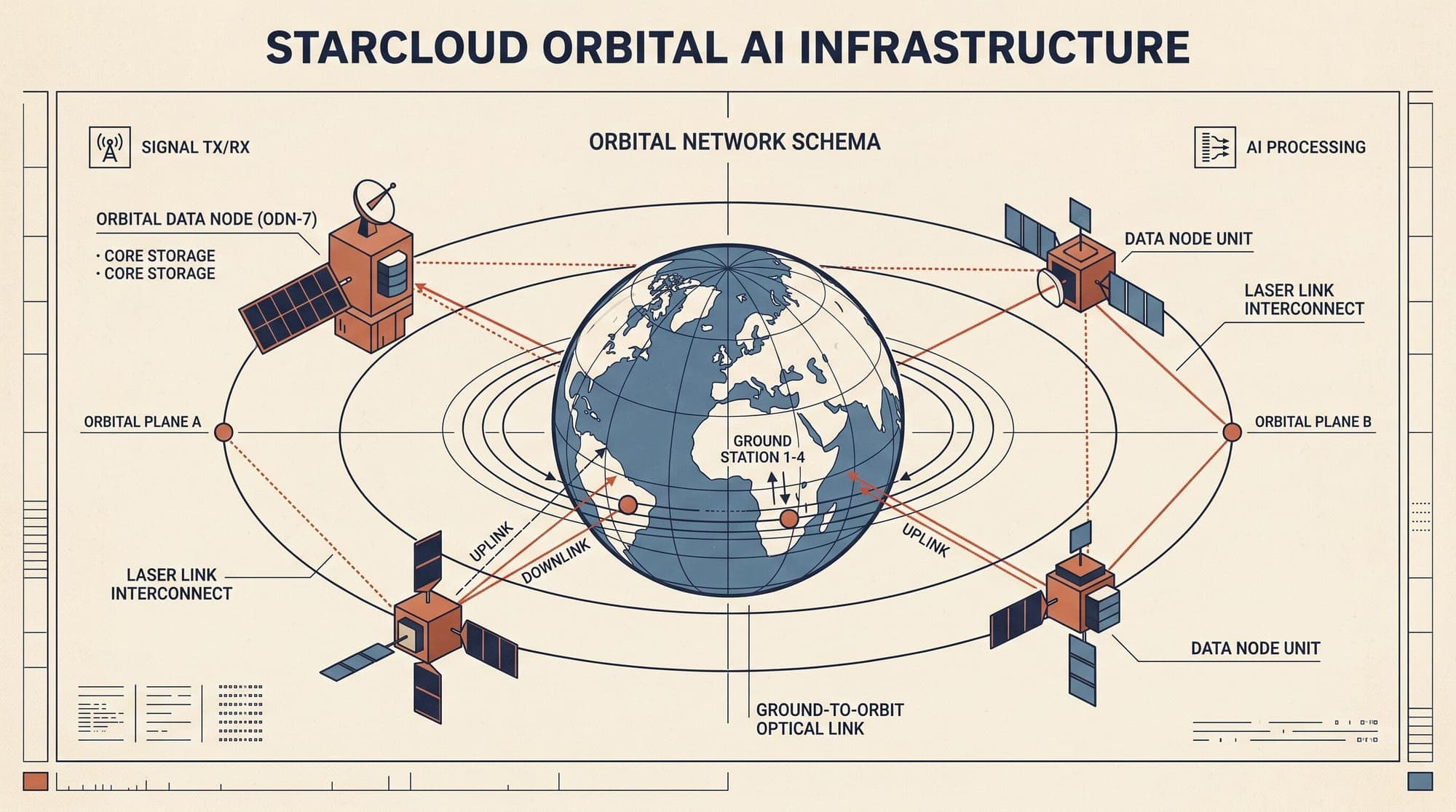
To support inter-satellite networking, Starcloud contracted with SpaceX in May 2026 to integrate more than 50 Starlink Mini Laser communication terminals, providing up to 25 Gbps optical interconnects across its orbital nodes.
Launch Bottlenecks and Market Economics
The expansion comes as orbital AI ventures face tightening commercial launch availability. With SpaceX preparing to transition launch volume from Falcon 9 to Starship by 2028, and alternative heavy-lift vehicles (Blue Origin New Glenn, ULA Vulcan, Rocket Lab Neutron) still scaling flight cadences, securing payload slots has become a major capital expenditure.
Starcloud has submitted applications to the FCC to operate an orbital constellation of up to 88,000 satellites, targeting a long-term compute capacity of 20 GW. Competitors in the orbital compute domain are pursuing distinct architectures: Cowboy Space raised $275 million in May 2026 to convert rocket upper stages into 1 MW orbital data centers, while Google continues research under Project Suncatcher.



