
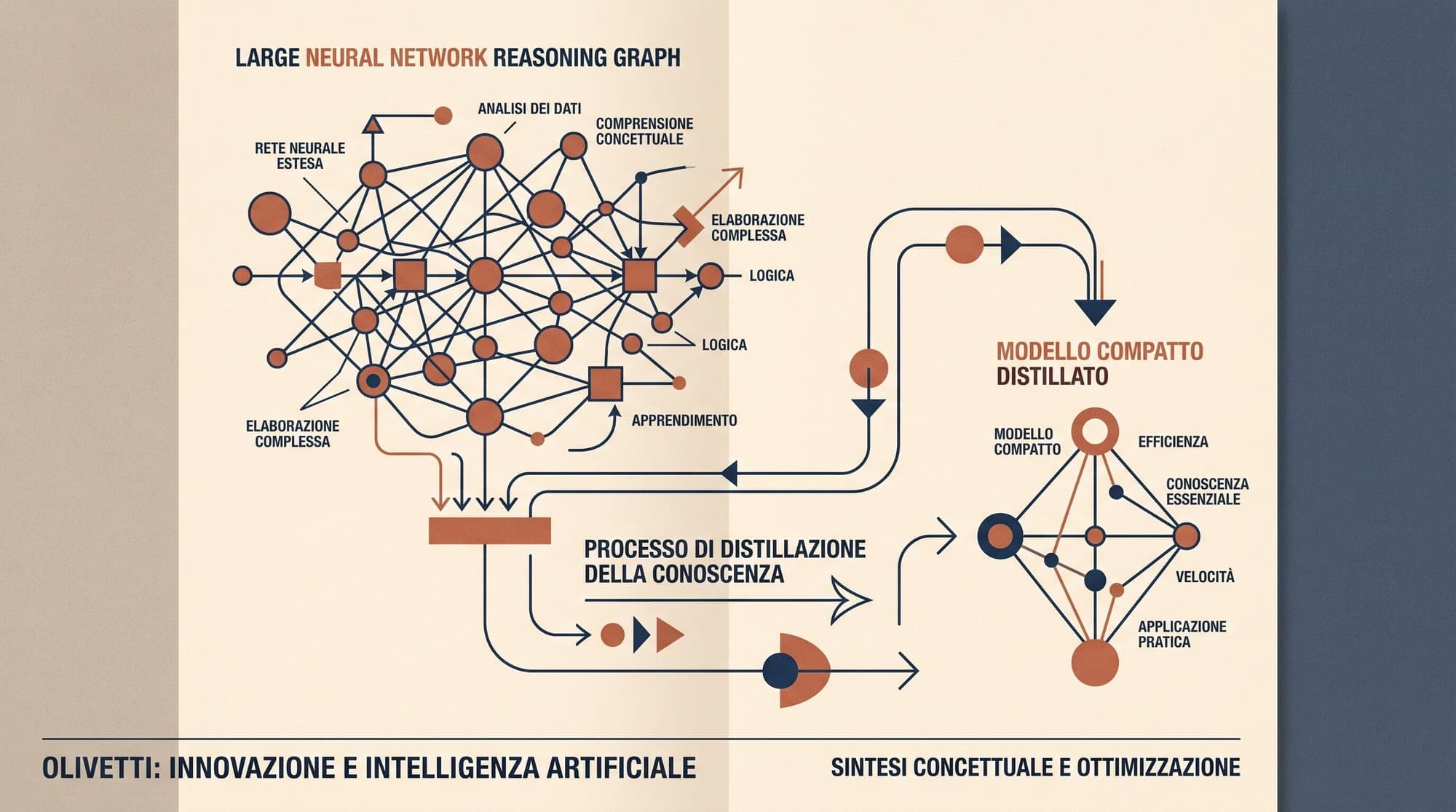
Reasoning Model Distillation in Production: Trajectory Curation, Thinking-Token Formatting, Over-Thinking Mitigation, and Student RL Alignment
Distilling frontier reasoning models into compact language models has emerged as one of the most effective strategies for deploying low-latency, cost-efficient inference pipelines. Rather than training small models purely on input-output answer pairs, reasoning distillation transfers the intermediate exploration, backtracking, and verification trajectories generated by large reinforcement-learning-driven models into dense student checkpoints.
While the empirical gains across mathematics, code synthesis, and structured planning are substantial, deploying reasoning distillation in production introduces distinct architectural challenges. Engineers must filter degenerative search loops, standardize thinking tokens across varied context lengths, mitigate latency-inducing over-thinking on trivial queries, and reinforce student checkpoints with post-distillation policy optimization.

1. The Shift from Output Distillation to Reasoning Trace Transfer
Traditional knowledge distillation in language models focuses on matching student output logits or supervising students with high-quality reference solutions. As demonstrated by Hsieh et al. in Distilling Step-by-Step, extracting explicit intermediate rationales from large models allows smaller student models to match or exceed teacher task accuracy with a fraction of the training data.
The release of frontier reasoning systems trained with large-scale reinforcement learning, notably detailed in the DeepSeek-R1 technical report, fundamentally changed the scale and structure of reasoning distillation. Frontier teachers generate extensive internal chains of thought containing dynamic hypothesis generation, sub-problem decomposition, sanity checks, and self-correction steps before outputting a terminal solution.
Distilling these explicit reasoning traces into dense architectures such as Qwen 2.5 and Llama 3 yields significant reasoning gains over standard supervised fine-tuning (SFT). However, directly imitating raw teacher traces often transfers structural quirks, excessive verbosity, and ungrounded self-corrections unless strict filtering pipelines are applied.
2. Rejection Sampling and Deterministic Verification Pipelines
Raw rollouts from reasoning models contain a non-trivial proportion of incorrect answers, invalid logic leaps, and dead ends that fail to resolve. Training student models on uncurated traces induces severe error propagation and reduces calibration.
A production reasoning distillation pipeline relies on multi-pass rejection sampling backed by programmatic verification:
- Deterministic Test Oracles: For algorithmic coding tasks, candidate reasoning traces and solution patches are executed in isolated sandboxes against unit test suites. For formal mathematics and symbolic logic, solutions are checked against symbolic solvers like SymPy or verified ground-truth values. Traces that produce incorrect final answers are immediately discarded.
- Process and Step-Level Verification: As outlined in research such as Math-Shepherd (Yu et al.), verifying intermediate reasoning steps with automated process rewards prevents the student from learning flawed intermediate derivations that coincidentally arrive at correct terminal answers.
- Trace Deduplication and Diversity Sampling: Generating multiple rollouts per prompt via temperature sampling and selecting diverse valid trajectories prevents the student from overfitting to specific stylistic phrasing or repetitive deduction patterns.
3. Token Formatting, Thought Delimiters, and Sequence Packing
Reasoning traces require explicit structural delimitation during training so that downstream inference runtimes can parse, stream, or suppress thinking tokens dynamically.
Standard implementations encapsulate the reasoning trajectory within explicit control tokens, typically <think> and </think> tags, followed immediately by the final answer. During training, loss masking must be configured carefully:
- Prompt Masking: The prompt tokens are masked out from the cross-entropy loss computation (labels set to
-100). - Thinking and Answer Supervision: Both the intermediate thinking tokens within
<think>...</think>and the final response tokens are supervised. Supervised training across the entire generated sequence ensures the student learns the autoregressive probability distribution over both exploratory steps and conclusive answers. - Sequence Packing with Attention Isolation: Because reasoning traces frequently extend from 4,000 to 16,000 tokens, training efficiency requires sequence packing. Production trainers must apply block-diagonal attention masks (FlashAttention varlen or document boundary masking) to prevent cross-contamination across concatenated prompt-trajectory pairs within a single context window.
4. Mitigating Over-Thinking and Degenerative Loops
A primary operational failure mode in reasoning-distilled models is over-thinking: the tendency of student models to spend thousands of tokens verifying simple factual lookups or basic classification tasks where direct generation is optimal.
Furthermore, student models can enter repetitive verification loops where the model repeatedly restates "Let me double-check this step" without altering its internal state.
Mitigating these failure modes requires explicit data curation:
- Mixed-Task Corpus Composition: Production distillation datasets must combine long-chain reasoning problems (math, code, multi-step logic) with direct-answer non-reasoning data (factual QA, creative writing, translation, summarization). In the DeepSeek-R1 pipeline, hundreds of thousands of non-reasoning examples without thinking tags were co-trained with reasoning traces to preserve general task capabilities and prevent unnecessary thinking loops on trivial inputs.
- Length-Aware Rejection and Pruning: Traces exhibiting token-level n-gram repetition, circular backtracking loops, or lengths exceeding predefined percentiles without added information density are pruned during dataset curation.
- Format Normalization: Standardizing reasoning structure into coherent subsections (problem understanding, step-by-step evaluation, synthesis) eliminates erratic conversational tangents generated by raw teacher samples.
5. Beyond SFT: Reinforcement Learning Alignment on Distilled Students
Supervised fine-tuning on reasoning traces teaches the student model the stylistic form and syntax of thinking, but SFT alone does not provide the student with genuine trial-and-error policy exploration. When confronted with out-of-distribution problems, purely SFT-distilled models often generate hollow reasoning traces that mimic verification language without checking valid constraints.
To close the capability gap, production pipelines apply a second stage of reinforcement learning directly onto the distilled student checkpoint:
                  +----------------------------------+
                  |     Frontier Teacher Model       |
                  | (e.g. DeepSeek-R1 / QwQ-32B)     |
                  +-----------------+----------------+
                                    |
                            Rollout Generation
                                    |
                                    v
                  +----------------------------------+
                  |  Rejection Sampling & Filtering  |
                  |  (Test Oracles, Math Solvers)    |
                  +-----------------+----------------+
                                    |
                            Curated Traces
                                    |
                                    v
                  +----------------------------------+
                  | Stage 1: Supervised Fine-Tuning  |
                  | (Sequence-Packed Dense Student)  |
                  +-----------------+----------------+
                                    |
                           Distilled Policy
                                    |
                                    v
                  +----------------------------------+
                  | Stage 2: Rule-Based RL (GRPO)    |
                  | (Verifiable Rewards, Format/Acc) |
                  +----------------------------------+
Using algorithms like Group Relative Policy Optimization (GRPO) with rule-based verifiable rewards (accuracy verification and format compliance), the distilled student explores solution spaces autonomously. This stage teaches the student when to backtrack, how to allocate thinking tokens proportionally to problem complexity, and how to recover from self-identified errors during decoding.
6. Production Serving Economics and Dynamic Thinking Budgets
Deploying reasoning-distilled models in enterprise serving frameworks (such as vLLM or SGLang) fundamentally changes inference economics:
- Output Token Dynamics: Standard compact models generate 200 to 800 tokens per request. Distilled reasoning models generate 2,000 to 8,000 tokens per request, significantly increasing decoding time while staying well below the 4,000 to 16,000 tokens typical of full frontier reasoners.
- Hardware Footprint: While frontier reasoning models (such as 671B MoE architectures) require multi-node clusters of 8 to 16 H100 GPUs, distilled 8B to 14B student models run comfortably on a single 16GB to 24GB GPU, reducing infrastructure barriers by orders of magnitude.
- Latency and Throughput Profiles: Distilled models retain sub-150ms Time to First Token (TTFT) and deliver full responses in 3 to 12 seconds, compared to 10 to 45 seconds on frontier reasoning endpoints.
- Cost Arbitrage: Serving distilled reasoning models on dedicated GPUs brings per-million query costs down to $30 to $120, compared to $1,500 to $6,000 on proprietary frontier reasoning APIs.
To manage serving latency and compute expenditure in production:
- Thinking Token Clamping: Runtimes can enforce hard caps on maximum thinking tokens for latency-sensitive applications or dynamically inject stopping markers when confidence thresholds are satisfied.
- Client-Side Stream Parsing: Frontends and API gateways stream reasoning tokens into collapsible UI accordions while parsing the closing
</think>token to present the verified answer immediately upon completion. - Speculative Decoding Alignment: Reasoning-distilled models make effective draft models for large reasoning teachers due to their shared reasoning vocabulary, token distributions, and structural patterns.
Sources
- DeepSeek-AI. (2025). DeepSeek-R1: Incentivizing Reasoning Capability in LLMs via Reinforcement Learning. arXiv:2501.12948.
- Hsieh, C. Y., et al. (2023). Distilling Step-by-Step! Outperforming Larger Language Models with Less Training Data and Smaller Model Sizes. ACL 2023. arXiv:2305.02301.
- Yu, L., et al. (2024). Math-Shepherd: Verify and Reinforce LLMs Step-by-step without Human Annotations. ACL 2024. arXiv:2312.08935.
- Wang, X., et al. (2022). Self-Consistency Improves Chain of Thought Reasoning in Language Models. ICLR 2023. arXiv:2203.11171.
- Yuan, Z., et al. (2025). NaturalThoughts: Selecting and Distilling Reasoning Traces for General Reasoning Tasks. arXiv:2507.01921.



