
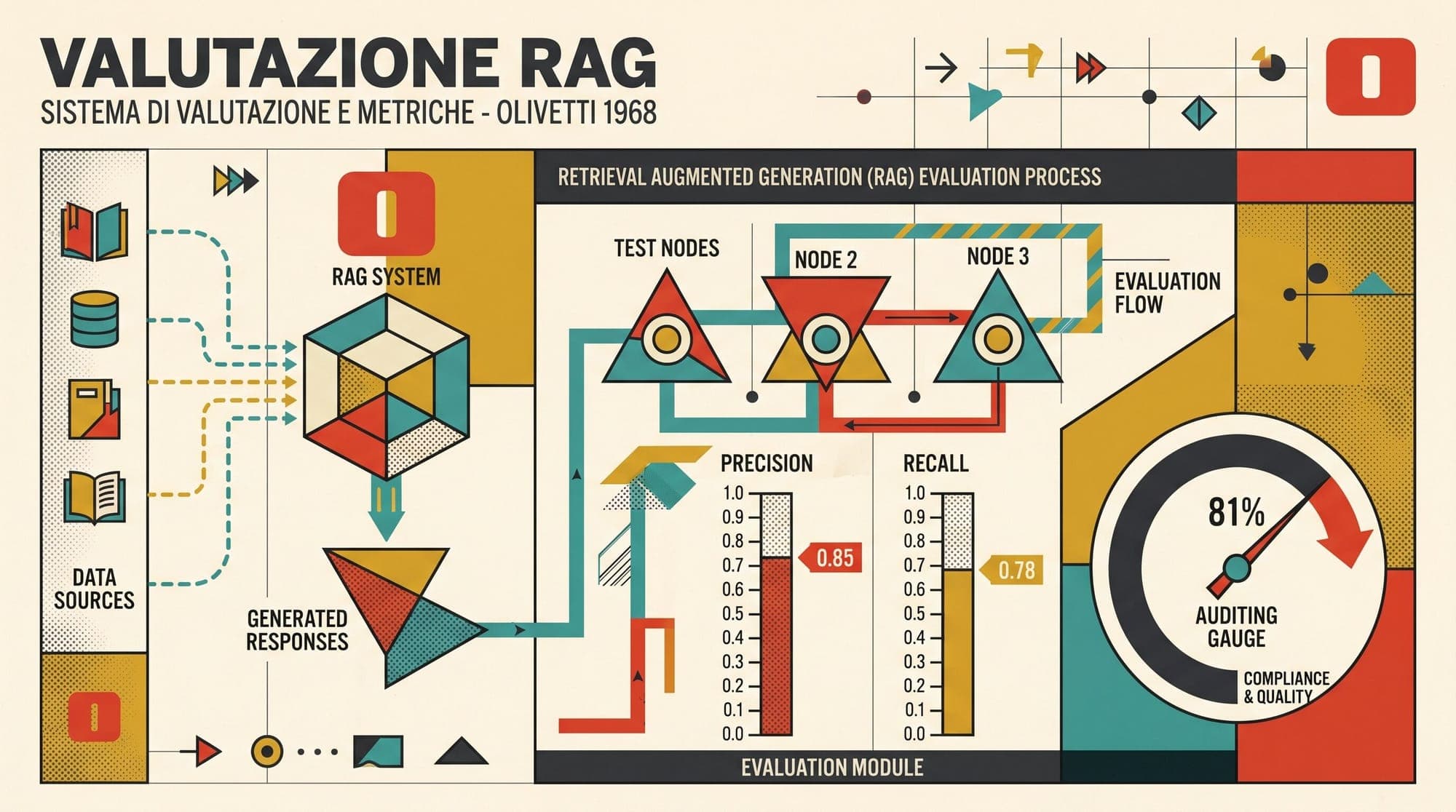
Production Retrieval-Augmented Generation (RAG) systems fail silently. Unlike traditional software pipelines that throw explicit exceptions on invalid states, a broken RAG pipeline produces syntactically fluent, confident prose that conceals severe underlying defects. When a user receives an incorrect response, the failure can stem from multiple distinct failure points across the stack: the query embedding failed to retrieve relevant chunks, the reranker discarded the critical passage, the chunking strategy severed necessary context, the prompt template injected distracting noise, or the generator hallucinated extraneous details despite having accurate context.
Evaluating RAG systems using traditional natural language processing metrics such as BLEU, ROUGE, or exact match fails because lexical overlap correlates poorly with factual correctness and semantic alignment. Conversely, treating the entire pipeline as a black box and evaluating only the final output obscures component-level regressions.
To diagnose and prevent quality degradation, the AI engineering ecosystem has converged on automated RAG evaluation frameworks. Four primary frameworks define the current landscape: Ragas (Exploding Gradients), DeepEval (Confident AI), TruLens (Snowflake), and ARES (Stanford Future Data Lab). While all four frameworks target RAG validation, they reflect fundamentally different architectural philosophies, execution models, and integration targets.

The Metric Taxonomy: Deconstructing the RAG Triad
RAG evaluation decomposes the pipeline into two decoupled subsystems: retrieval and generation. This separation produces four core metrics, often grouped into the "RAG Triad" alongside retrieval recall.
1. Context Precision and Relevance
Context precision measures the signal-to-noise ratio within the retrieved context chunks, assessing whether relevant information is concentrated at the top of the context window.
In Ragas, Context Precision is calculated using Mean Average Precision (MAP) at rank . Given a question and top- retrieved contexts , an LLM judge assigns a binary relevance verdict to each chunk:
This penalty structure directly penalizes retrievers that place irrelevant distractors before relevant passages, reflecting the positional bias ("lost-in-the-middle" effect) inherent in autoregressive transformer decoders.
2. Context Recall
Context recall evaluates whether the retriever successfully captured all necessary information required to answer the query. Unlike precision, true recall requires comparison against a ground-truth reference answer or ground-truth context set.
To compute context recall, the evaluation judge decomposes the ground-truth answer into a set of atomic sentences or claims . Each ground-truth statement is classified as supported or unsupported by the retrieved context chunks :
A low context recall with high faithfulness indicates that the generation model is faithfully answering from incomplete context, producing omission errors rather than hallucinations.
3. Faithfulness (Groundedness)
Faithfulness measures whether the final answer relies strictly on the retrieved context without introducing ungrounded assertions or hallucinations.
The mathematical formulation relies on statement decomposition. Given a generated response , the evaluation system extracts all verifiable factual claims . An evaluation prompt evaluates each claim against the context :
If an answer contains six claims and five are verifiable from the text while one introduces outside knowledge, the faithfulness score is .
4. Answer Relevance
Answer relevance evaluates whether the response directly addresses the user's input query, regardless of factual grounding. A response can be 100% faithful to the retrieved context but completely irrelevant to the prompt.
To bypass the circular dependency of using an LLM to directly score quality on an arbitrary scale, Ragas pioneered reverse question generation. Given the generated answer , an LLM generates synthetic questions . The embedding representation of each synthetic question is compared against the embedding of the original query using cosine similarity:
If the generated answer is concise and focused, the reverse-generated questions align closely with the original prompt in embedding space. If the answer is evasive or off-topic, the generated questions diverge, depressing the cosine similarity score.
Architectural Comparison of Major Frameworks
1. Ragas: Reference-Free Decomposition and Synthetic Test Generation
Ragas (Retrieval Augmented Generation Assessment) focuses on dataset-level evaluation and automated test generation. Its defining strength is reference-free scoring coupled with evolutionary dataset synthesis.
Ragas implements an automated pipeline for generating synthetic test suites directly from unannotated document corpora using an adaptation of the Evol-Instruct methodology. Starting from raw document chunks, Ragas generates base questions and applies evolutionary operators to increase complexity:
- Reasoning evolution: Rewriting queries to require multi-step deductive inference over the text.
- Multi-context evolution: Combining facts across multiple distinct chunks to test cross-document retrieval.
- Conditional evolution: Adding conditional constraints to simulate specific user personas or operational contexts.
This eliminates the manual labeling bottleneck when building benchmark datasets for RAG optimization. However, because Ragas relies on multi-step prompt chains (sentence extraction followed by statement-level verification), running full test suites against frontier commercial APIs introduces non-trivial latency and cost during rapid iteration.
2. DeepEval: Pytest-Native CI Testing and G-Eval Scoring
Developed by Confident AI, DeepEval approaches LLM evaluation through standard software testing practices. It is structured as an extension of the Python pytest ecosystem, allowing teams to execute evaluations using standard CLI commands such as deepeval test run.
Key architectural characteristics include:
- Unit-Test Abstraction: Tests are declared as
LLMTestCaseobjects with explicit assertions on metric thresholds (assert_test(test_case, [faithfulness_metric, relevancy_metric])). - G-Eval Framework Implementation: DeepEval implements G-Eval, an evaluation method from Microsoft Research that dynamically generates evaluation steps using Chain-of-Thought (CoT) reasoning and computes continuous scores by weighting the output token probabilities of the judge model.
- Deterministic and Heuristic Fallbacks: DeepEval bundles deterministic algorithms (Levenshtein distance, exact match, regex patterns, BLEU/ROUGE) alongside LLM-as-a-judge metrics, allowing engineering teams to gate low-level syntactic checks without incurring API inference costs.
DeepEval is designed for CI/CD regression gates where pull requests must satisfy hard quality thresholds before merging into deployment branches.
3. TruLens: OpenTelemetry Tracing and Production Observability
Maintained by Snowflake following its acquisition of TruEra, TruLens is built around application instrumentation and live telemetry. Rather than treating evaluation strictly as an offline batch job, TruLens instruments the runtime execution graph.
Architectural highlights include:
- Execution Graph Selectors: Using decorators like
@instrumentor framework-specific wrappers for LlamaIndex and LangChain, TruLens intercepts intermediate inputs and outputs across every node in the execution graph. - Feedback Functions: TruLens attaches decoupled "feedback functions" to specific telemetry spans. For example, a feedback function can extract the query from the root span and context from an internal retrieval span to compute Context Relevance in real time.
- Production Telemetry Store: Results are recorded into a structured relational database (SQLite/PostgreSQL) with a built-in dashboard for record-level debugging, latency profiling, and token cost tracking.
TruLens is optimized for continuous production monitoring, enabling teams to sample live user interactions and trace quality regressions to specific retrieval spans.
4. ARES: Fine-Tuned Classifiers and Prediction-Powered Inference
Introduced by researchers from Stanford University, ARES addresses the two primary weaknesses of commercial LLM judges: high inference costs and uncalibrated evaluation drift.
ARES operates through a three-stage pipeline:
- Synthetic Generation: ARES generates synthetic query-passage-answer triples from the target corpus, generating both positive and negative (corrupted) examples.
- Lightweight Classifier Fine-Tuning: Instead of using frontier models (GPT-4 or Claude 3.5) for every evaluation, ARES fine-tunes dedicated, lightweight language models (such as DeBERTa-v3 or small LLaMA variants) for Context Relevance, Faithfulness, and Answer Relevance.
- Prediction-Powered Inference (PPI): To provide statistical rigor, ARES applies Prediction-Powered Inference. By annotating a small human validation set (100 to 300 samples) and running the fine-tuned classifier over a large unlabeled dataset (), ARES calculates provably valid confidence intervals for system accuracy.
This statistical foundation ensures that evaluation scores remain mathematically bounded, preventing false conclusions caused by subtle judge model miscalibrations.
Architectural Trade-Off Analysis
Selecting an evaluation framework requires balancing computational overhead, integration surface, and testing velocity.
Execution Model and Pipeline Fit
- DeepEval provides the lowest barrier to entry for standard continuous integration pipelines. Its native Pytest integration allows developers to run regression suites on code commits, failing builds when retrieval precision drops below an established threshold.
- TruLens provides the deepest runtime visibility. Teams debugging complex multi-hop retrieval or agentic RAG benefit from its call-tree tracing, which isolates whether a failure occurred in query transformation, reranking, or final generation.
- Ragas provides the most comprehensive toolkit for cold-start evaluation where labeled test sets do not exist, leveraging Evol-Instruct to generate synthetic benchmarks across varied difficulty tiers.
- ARES provides the highest statistical validity and lowest per-run inference cost once trained, making it suitable for high-volume offline benchmarking across large candidate retriever configurations.
Computational Cost and Latency Overheads
LLM-as-a-judge evaluation carries a non-trivial latency and financial footprint. Evaluating a single RAG query across four Ragas or DeepEval metrics typically requires 4 to 8 individual LLM calls due to statement extraction, verification, and reverse question synthesis.
For a benchmark suite of 500 test cases, evaluating with frontier API models can consume 2,000 to 4,000 API requests, taking 15 to 30 minutes and incurring meaningful token expenses. To mitigate this overhead in production CI:
- Gate CI with small golden datasets (50 to 100 curated cases) using lightweight judge models (such as GPT-4o-mini or Claude 3.5 Haiku).
- Run full synthetic suites (500+ cases) on nightly or weekly schedules rather than on every git push.
- Use local fine-tuned judges or ARES classifiers for continuous high-throughput evaluations.
Designing a Multi-Stage Production Evaluation Architecture
Enterprise AI teams typically implement a tiered evaluation strategy that combines offline gating with live telemetry:
- Offline CI/CD Stage: DeepEval runs on pull requests against a version-controlled "golden dataset" of critical queries and edge cases. Hard assertions enforce minimum thresholds (for example: Faithfulness , Context Precision , Context Recall ).
- Synthetic Regression Stage: Weekly scheduled jobs use Ragas to synthesize updated test suites from recently ingested corpus documents, benchmarking retriever parameter changes (such as chunk size, embedding model, top-, and hybrid search weights).
- Online Telemetry Stage: TruLens or OpenTelemetry middleware instruments 5% to 10% of live production traffic, capturing question-context-answer triples and computing background feedback scores to detect silent drift in production embeddings or data sources.
- Statistical Auditing Stage: ARES PPI validates system-wide accuracy shifts during major architectural migrations, providing statistical confidence intervals before routing user traffic to new retrieval backends.
By decoupling retrieval verification from generative faithfulness, engineering teams transform subjective RAG debugging into quantifiable, automated software engineering.
Sources
- RAGAS: Automated Evaluation of Retrieval Augmented Generation (Shahul Es et al., 2023)
- ARES: An Automated Evaluation Framework for Retrieval-Augmented Generation Systems (Saad-Falcon et al., Stanford / NAACL 2024)
- G-Eval: NLG Evaluation using GPT-4 with Better Human Alignment (Liu et al., Microsoft Research, 2023)
- Prediction-Powered Inference (Angelopoulos et al., 2023)
- DeepEval: The Open-Source LLM Evaluation Framework
- TruLens Documentation and RAG Triad Architecture (Snowflake / TruEra)



