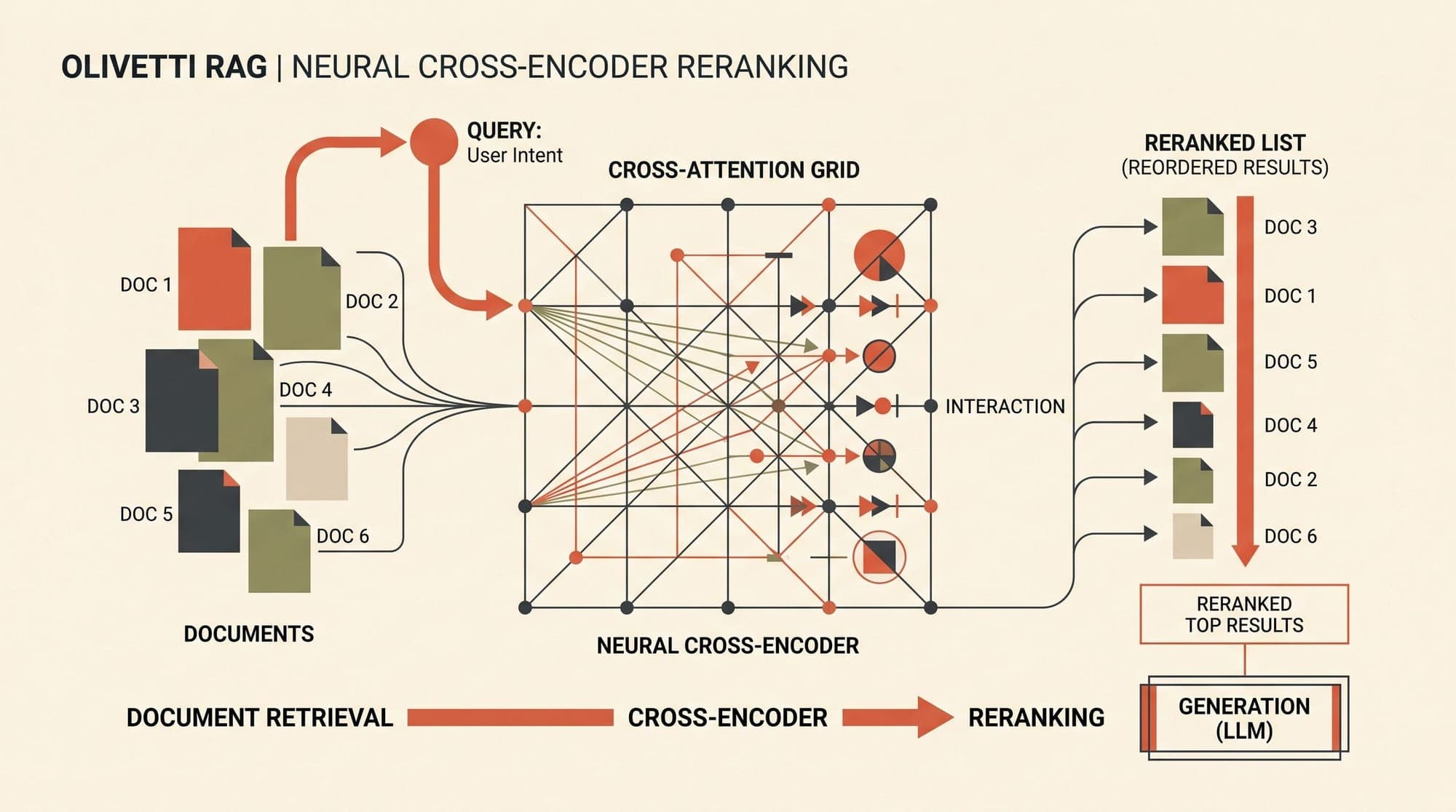
Retrieval-Augmented Generation (RAG) systems in production frequently suffer from a fundamental precision failure: vector search surfaces the correct chunk somewhere in the top 50 candidates, but fails to place it in the top 3 positions required for high-fidelity LLM synthesis. When irrelevant or tangential chunks lead the context window, generation quality degrades through hallucinations, lost-in-the-middle context neglect, and inflated inference costs.
Cross-encoder rerankers serve as the standard architectural remedy. By positioning a specialized neural reranker between initial candidate retrieval and LLM context injection, production systems achieve 10 to 25 point improvements in Normalized Discounted Cumulative Gain (NDCG@10) with minimal latency overhead. However, operating cross-encoders at scale introduces critical engineering trade-offs around quadratic self-attention complexity, score calibration drift, dynamic batching, and hardware selection.

1. The Representation Bottleneck: Bi-Encoders vs. Cross-Encoders
The disparity in retrieval accuracy between first-stage vector search and second-stage reranking stems from the architectural difference between bi-encoders (dual-encoders) and cross-encoders.
Bi-Encoder Information Loss
Bi-encoder systems encode the query and candidate documents independently into isolated dense vector representations:
Relevance scoring is computed via vector dot product or cosine similarity:
This decoupled design enables pre-computing document vectors offline and performing sub-millisecond approximate nearest neighbor (ANN) search across millions of records using Hierarchical Navigable Small World (HNSW) or Inverted File with Product Quantization (IVF-PQ) graphs. However, forcing an entire 500-word passage into a single 768-dimensional or 1024-dimensional embedding vector creates a severe information bottleneck. Bi-encoders cannot model cross-token interactions, syntactic dependencies, numerical comparisons, or negation between query terms and document passages.
Cross-Encoder Cross-Attention
A cross-encoder eliminates the vector bottleneck by feeding the query and candidate passage simultaneously into a single transformer encoder:
Every query token attends directly to every document token across all self-attention layers:
This all-to-all cross-attention captures subtle semantic conditions, keyword exact matches, and domain-specific terminology that single-vector embeddings collapse. Because full cross-attention scales quadratically with sequence length (), cross-encoders cannot be run across an entire database of millions of documents. Instead, they operate as a second-stage filter over a candidate pool of 50 to 100 items retrieved by first-stage lexical (BM25) and dense vector search.
+-----------------------------------------------------------------------+
|                       Two-Stage Retrieval Funnel                      |
+-----------------------------------------------------------------------+
|  User Query (q)                                                       |
|       |                                                               |
|       v                                                               |
|  [Stage 1: Broad Recall] (BM25 Lexical + HNSW Dense Vector)           |
|       |                                                               |
|       |--> 1,000,000+ Documents in Store                              |
|       +--> Retrieves Top K = 100 Candidates (Latency: 10-25 ms)       |
|       |                                                               |
|       v                                                               |
|  [Stage 2: Precision Ranking] (Cross-Encoder Joint Self-Attention)   |
|       |                                                               |
|       |--> Evaluates 100 (q, d) pairs with full cross-attention       |
|       +--> Selects Top M = 5 High-Precision Chunks (Latency: 30-90 ms)|
|       |                                                               |
|       v                                                               |
|  [LLM Context Injection] (Generation Prompt Assembly)                 |
+-----------------------------------------------------------------------+
2. Mathematical Formulation and Score Calibration Pitfalls
Cross-encoders output a single scalar score per query-document pair by projecting the final hidden state of the classification token () through a linear layer:
Depending on the training objective, the model produces either a raw unbounded logit or a bounded probability via a logistic sigmoid transformation:
The Score Drift Pitfall
A common engineering error in production RAG systems is applying a static global threshold to cross-encoder scores (for example, discarding any candidate with ). This approach fails in practice due to three calibration phenomena:
- Query Length Sensitivity: Long, specific queries with multiple constraints yield systematically lower raw logit scores than short, generic queries, even when the document is an exact factual match.
- Domain Outlier Shifts: Out-of-domain vocabulary shifts the activation distribution of the token, causing uncalibrated logit compression.
- Model Architecture Divergence: Different cross-encoders utilize distinct loss formulations during pre-training. Some models (such as BGE-Reranker-v2) use cross-entropy with hard negative mining, producing raw logits centered around negative values, while others optimize binary cross-entropy.
Production Thresholding Strategies
To prevent erratic filtering, production systems implement dynamic calibration strategies:
- Relative Score Margin ( Filtering): Filter candidates whose score drops significantly below the top-ranked document score:
- Min-Max Pool Normalization: Normalize candidate scores within each individual query batch before applying cutoffs:
- Dynamic Top-K with Confidence Knee: Sort candidates in descending order and compute the first-derivative difference between adjacent ranks (). Truncate the list when the drop-off exceeds the average intra-rank variance.
3. Latency Budgets, Computational Complexity, and Batching Economics
Integrating a cross-encoder adds synchronous latency to the user-facing request path. Designing a production reranking system requires balancing model parameter size, candidate pool depth (), sequence length budget, and batch scheduling.
End-to-End Latency Budget
In enterprise RAG applications with a strict 1,000 ms time-to-first-token (TTFT) SLA, retrieval and reranking must complete in under 150 ms combined:
| Pipeline Stage | Implementation | P50 Latency | P95 Latency | | :--- | :--- | :--- | :--- | | First-Stage Retrieval | Hybrid BM25 (OpenSearch) + Dense HNSW | 15 ms | 35 ms | | Network Transport / Payload Deserialization | gRPC / Internal VPC | 3 ms | 8 ms | | Cross-Encoder Scoring () | BGE-Reranker-v2-m3 (FP8 / TensorRT) | 35 ms | 65 ms | | Context Assembly & Tokenization | Python / Rust Worker | 2 ms | 5 ms | | LLM TTFT (Prefill + First Token) | vLLM / SGLang (32B / 70B Model) | 350 ms | 650 ms | | Total Pipeline Retrieval Overhead | | 55 ms | 113 ms |
Computational Complexity and FLOPs
Scoring candidate passages of length against a query of length across an -layer transformer requires:
Because computation scales quadratically with , allowing unconstrained document chunk sizes (e.g., 2,048 tokens) causes massive latency spikes. Production architectures enforce strict sequence truncation, passing only the first 256 to 384 tokens of each candidate chunk to the reranker, or splitting longer chunks into sub-passages and aggregating with max-pooling.
Batch Optimization Techniques
- Dynamic Length Sorting and Padding: Grouping candidate pairs by character length before tokenization minimizes padding tokens, cutting redundant FLOPs by up to 40% per batch.
- FlashAttention-2 / FlashAttention-3 Encoders: Running transformer encoder layers with memory-efficient tiled attention kernels eliminates intermediate attention matrix materialization in GPU HBM.
- Weight and Activation Quantization: Serving cross-encoders in INT8 or FP8 format using engines like Hugging Face Text Embeddings Inference (TEI) or ONNX Runtime doubles pair-scoring throughput without measurable loss in ranking precision.
4. Leading Model Comparison
Choosing the appropriate reranking model depends on hardware constraints, latency tolerances, and multilingual requirements.
+----------------------------------------------------------------------------------------------------+
|                                    Production Reranker Landscape                                   |
+-----------------------------------+------------+---------------+------------+-----------+----------+
| Model                             | Parameters | Context Window| Throughput | P95 (K=100| License  |
|                                   |            | (Tokens)      | (Pairs/s)  | on L40S)  |          |
+-----------------------------------+------------+---------------+------------+-----------+----------+
| BAAI/bge-reranker-v2-m3          | 568M       | 8,192         | ~1,100     | 65 ms     | MIT      |
| jinaai/jina-reranker-v2-base-multi| 278M       | 8,192         | ~3,500     | 28 ms     | Apache 2 |
| cross-encoder/ms-marco-MiniLM-L-6 | 22M        | 512           | ~8,500     | 12 ms     | Apache 2 |
| Alibaba-NLP/gte-reranker-modernbert| 149M      | 8,192         | ~4,200     | 24 ms     | Apache 2 |
| BAAI/bge-reranker-v2-gemma       | 9.2B       | 8,192         | ~95        | 920 ms    | Apache 2 |
| Cohere Rerank-v3.5 (API)          | Managed    | 4,096         | API Managed| 120 ms    | Cloud    |
+-----------------------------------+------------+---------------+------------+-----------+----------+
Architectural Highlights
- BAAI BGE-Reranker-v2-m3: Built on the XLM-RoBERTa architecture, supporting over 100 languages with an 8,192 token context window. It represents the industry standard for high-accuracy enterprise deployments.
- Jina Reranker v2 (Multilingual): Uses a 278M parameter encoder backbone with custom flash-attention kernels, optimized for high throughput and sub-30ms P95 latency on modern GPUs.
- FlashRank / MiniLM-L-6: Ultra-lightweight 22M to 33M parameter models running via ONNX Runtime on standard CPU instances. Ideal for edge deployments, serverless functions, or workloads without dedicated GPU accelerators.
- ModernBERT-Based Rerankers (GTE-Reranker-ModernBERT): Leverages native unpadding, rotary embeddings (RoPE), and GeGLU activations to achieve high accuracy at 149M parameters, outperforming older 500M+ parameter BERT models.
5. Architectural Trade-Offs: Bi-Encoders, Late Interaction, Cross-Encoders, and LLMs
The retrieval landscape features four distinct ranking paradigms, each positioned at a different point on the quality-versus-latency frontier:
+-------------------+----------------------+--------------------+--------------------+--------------------+
| Dimension         | Dense Bi-Encoder     | Late Interaction   | Pure Cross-Encoder | Generative LLM     |
|                   | (e.g. BGE-Large)     | (e.g. ColBERTv2)   | (e.g. BGE-M3)      | (e.g. RankGPT)     |
+-------------------+----------------------+--------------------+--------------------+--------------------+
| Scoring Mechanism | Single vector dot    | Multi-vector       | Joint all-to-all   | Autoregressive     |
|                   | product              | MaxSim token match | self-attention     | prompt generation  |
+-------------------+----------------------+--------------------+--------------------+--------------------+
| Query Latency     | 5-15 ms (ANN index)  | 15-40 ms           | 25-90 ms           | 800-4,000 ms       |
+-------------------+----------------------+--------------------+--------------------+--------------------+
| Index Storage     | 1.5 - 6 KB / doc     | 50 - 250 KB / doc  | 0 (No vector index)| 0 (No vector index)|
+-------------------+----------------------+--------------------+--------------------+--------------------+
| Compute Location  | Pre-computed offline | Pre-computed tokens| Synchronous GPU/CPU| Large GPU Cluster  |
+-------------------+----------------------+--------------------+--------------------+--------------------+
| Precision (BEIR)  | Baseline (50-60%)    | High (68-74%)      | Very High (72-80%) | Maximum (75-84%)   |
+-------------------+----------------------+--------------------+--------------------+--------------------+
| Cost per 1M Qs    | Low ($0.05-$0.20)    | Moderate ($0.50)   | Moderate ($0.80)   | High ($15-$80)     |
+-------------------+----------------------+--------------------+--------------------+--------------------+- Dense Bi-Encoders: Essential for first-stage recall across millions of records, but insufficient as a standalone ranker.
- Late Interaction (ColBERT): Retains token-level embeddings and uses the MaxSim operator to compute relevance scores without full cross-attention. Offers lower latency than cross-encoders for large candidate sets (), but increases vector index storage requirements by 10x to 50x.
- Pure Cross-Encoders: The optimal balance for scoring 50 to 100 first-stage candidates, providing maximum cross-token attention without index storage penalties.
- Generative LLM Rerankers (RankGPT): Uses large instruction-tuned models (e.g., LLaMA-3-70B) to score or sort candidate lists. While achieving top benchmark accuracy, the multi-second latency and high inference cost restrict them to offline analysis or asynchronous evaluation pipelines.
6. Production Implementation Blueprint
The following Python implementation demonstrates a high-throughput, batched cross-encoder reranker with dynamic sequence padding, length sorting, and relative score delta thresholding:
import torch
from transformers import AutoModelForSequenceClassification, AutoTokenizer
from typing import List, Dict, Any, Tuple

class ProductionReranker:
    def __init__(
        self,
        model_name: str = "BAAI/bge-reranker-v2-m3",
        max_length: int = 512,
        batch_size: int = 32,
        device: str = "cuda" if torch.cuda.is_available() else "cpu"
    ):
        self.device = device
        self.max_length = max_length
        self.batch_size = batch_size

        self.tokenizer = AutoTokenizer.from_pretrained(model_name)
        self.model = AutoModelForSequenceClassification.from_pretrained(
            model_name,
            torch_dtype=torch.float16 if self.device == "cuda" else torch.float32
        ).to(self.device)
        self.model.eval()

    def rerank(
        self,
        query: str,
        candidates: List[Dict[str, Any]],
        top_k: int = 5,
        score_margin: float = 3.5
    ) -> List[Dict[str, Any]]:
        """
        Rerank candidate passages against query using dynamic length sorting
        and relative delta thresholding.
        """
        if not candidates:
            return []

        # 1. Pair query with candidate text and track original indices
        pairs = [(query, c["text"]) for c in candidates]
        indexed_pairs = list(enumerate(pairs))

        # 2. Sort pairs by passage length to minimize padding FLOPs
        sorted_pairs = sorted(indexed_pairs, key=lambda x: len(x[1][1]))
        sorted_indices = [x[0] for x in sorted_pairs]
        raw_pairs = [x[1] for x in sorted_pairs]

        scores = [0.0] * len(candidates)

        # 3. Batch inference with no gradient tracking
        with torch.inference_mode():
            for i in range(0, len(raw_pairs), self.batch_size):
                batch = raw_pairs[i : i + self.batch_size]
                inputs = self.tokenizer(
                    batch,
                    padding=True,
                    truncation=True,
                    max_length=self.max_length,
                    return_tensors="pt"
                ).to(self.device)

                logits = self.model(**inputs).logits.squeeze(dim=-1)

                # Handle single-item batch scalar edge case
                if logits.dim() == 0:
                    logits = logits.unsqueeze(0)

                batch_scores = logits.cpu().tolist()
                for original_idx, score in zip(sorted_indices[i : i + len(batch)], batch_scores):
                    scores[original_idx] = score

        # 4. Attach scores and rank candidates
        scored_candidates: List[Tuple[Dict[str, Any], float]] = [
            (candidates[idx], scores[idx]) for idx in range(len(candidates))
        ]
        scored_candidates.sort(key=lambda x: x[1], reverse=True)

        # 5. Apply relative delta thresholding against top rank
        top_score = scored_candidates[0][1]
        filtered_results = []
        for cand, score in scored_candidates[:top_k]:
            if (top_score - score) <= score_margin:
                cand_copy = cand.copy()
                cand_copy["rerank_score"] = float(score)
                filtered_results.append(cand_copy)

        return filtered_results
Production Checklist
- Keep Candidate Pools Sized at 50 to 100: Setting increases tail latency without meaningful recall gains.
- Truncate Candidate Passages to 384 Tokens: In over 95% of standard RAG corpora, the relevance signal is concentrated in the first 300 tokens; scoring 2,000 token documents wastes compute.
- Use FP8 / INT8 Quantized Serving in High-Traffic Paths: Deploying via Hugging Face TEI or vLLM embedding endpoints provides dynamic request batching, auto-padding, and P99 latency stability under heavy concurrency.
- Avoid Fixed Sigmoid Thresholds: Implement relative margin () or min-max normalization to protect against query-length score drift.
Sources
- C-Pack: Packaged Resources To Advance General Chinese Embedding and Reranking (BAAI)
- ColBERT: Efficient and Effective Passage Search via Contextualized Late Interaction over BERT (Khattab & Zaharia)
- BEIR: A Heterogeneous Benchmark for Zero-shot Evaluation of Information Retrieval Models (Thakur et al.)
- Jina Reranker v2: Multilingual Retrieval Technical Report (Jina AI)
- Is ChatGPT Good at Search? Investigating Large Language Models as Re-Ranking Agents (RankGPT)
- Text Embeddings Inference Documentation (Hugging Face)