
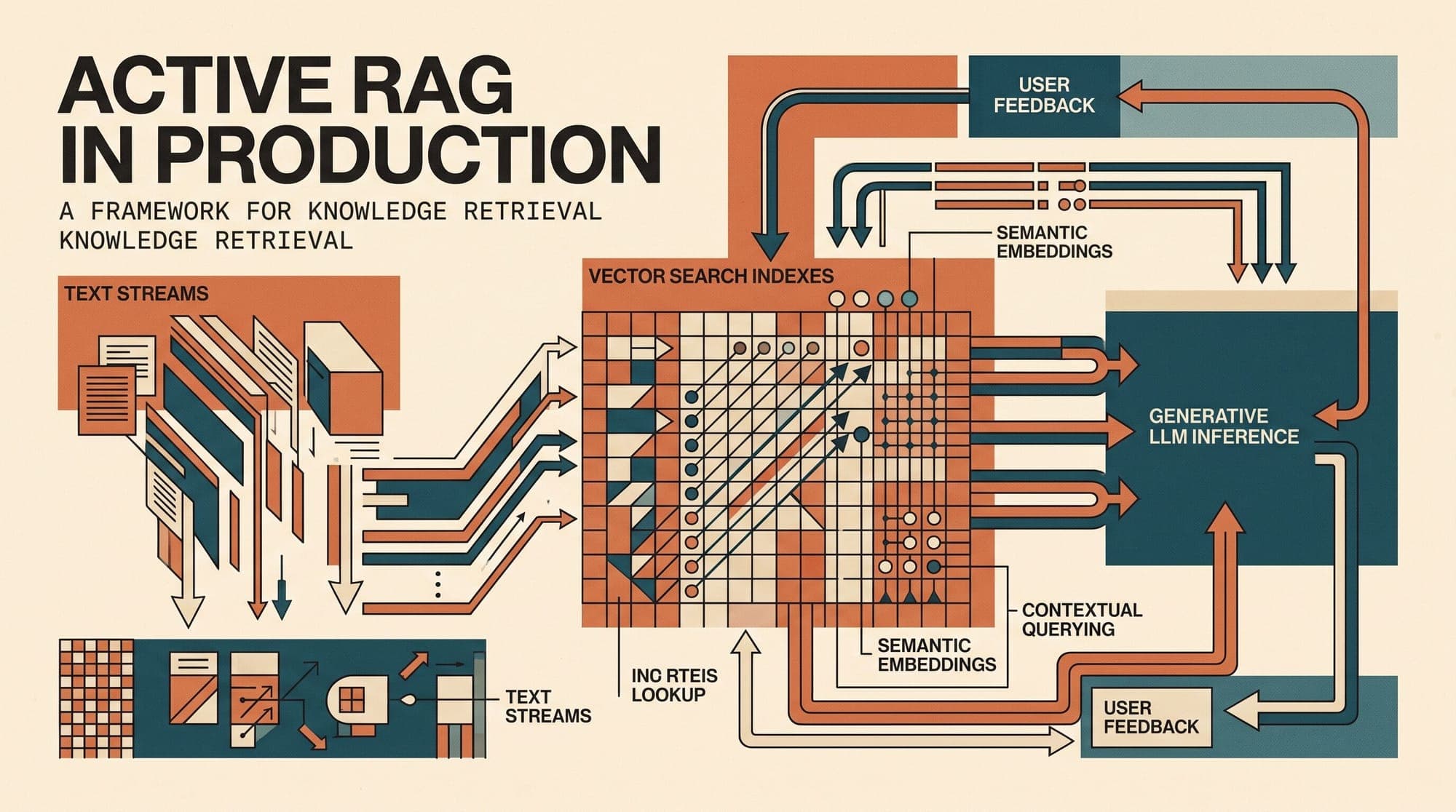
Standard Retrieval-Augmented Generation (RAG) relies on a static, single-shot execution model: the system takes a user prompt, executes a vector or hybrid search upfront, prepends the retrieved chunks into the prompt context, and executes autoregressive generation. While this pattern suffices for short question-answering workloads, it breaks down systematically in complex, long-horizon generation tasks such as comprehensive technical reports, multi-step agent trajectories, and iterative problem solving.
In long-form outputs, a language model's information needs cannot be fully predicted from the initial user prompt alone. Pre-fetching all potentially relevant context upfront bloats the prompt, wastes context budget, increases inference costs, and exposes the model to attention dilution and "lost in the middle" degradation. Conversely, retrieving too little leaves downstream sections vulnerable to parametric hallucinations.
Active Retrieval-Augmented Generation (Active RAG) addresses this structural bottleneck by transforming retrieval from an isolated pre-processing step into an interleaved, dynamic runtime loop. By monitoring internal model uncertainty, predicting upcoming sentence intent, and triggering targeted external searches mid-stream, Active RAG systems fetch evidence strictly when and where it is needed.

The Core Mechanics of Active Retrieval
Rather than treating the knowledge base as an upfront context injection, Active RAG architectures treat retrieval as an on-demand verification and repair mechanism embedded directly inside the autoregressive loop.
The general lifecycle follows a cyclic state machine:
- Speculative Generation: The model generates a candidate chunk (typically a sentence or logical block) based on existing verified context.
- Uncertainty Evaluation: The serving runtime inspects token-level confidence metrics (such as log-probabilities, entropy, or explicit reflection states) across the generated span.
- Trigger Decision: If all generated tokens meet a calibrated confidence threshold, the candidate span is committed to the final output. If any token falls below the threshold, the span is flagged for dynamic retrieval.
- Forward-Looking Query Distillation: The system extracts the core semantic intent of the uncertain span to construct an explicit search query.
- Context Splicing and Regeneration: External documents are retrieved, formatted into the context window, and the uncertain span is regenerated under grounded conditioning.
Comparative Analysis of Triggering Mechanisms
Different Active RAG architectures implement distinct strategies for deciding when to trigger retrieval. The optimal choice depends on whether the underlying base model can be fine-tuned or must be accessed strictly via black-box inference APIs.
1. Token Confidence and Log-Probability Thresholding (FLARE)
Introduced in the Forward-Looking Active REtrieval (FLARE) framework by Jiang et al., this approach monitors the autoregressive generation probabilities directly:
If the generation probability of any token in a candidate sentence falls below a preset threshold , retrieval is triggered. Tokens with are treated as knowledge gaps. This method requires no model fine-tuning and operates directly on log-probability streams exposed by standard inference engines (such as vLLM or OpenAI APIs).
2. Real-Time Information Need and Attention Tracking (DRAGIN)
The DRAGIN framework by Su et al. refines confidence thresholding by combining token entropy with transformer attention weight distributions. While low probability can occasionally reflect syntactic variation rather than a lack of factual knowledge, DRAGIN distinguishes knowledge-intensive tokens (such as named entities, numbers, and dates) from structural tokens by measuring how much attention recent tokens allocate across the prompt history. This selective filtering reduces unnecessary retrieval invocations by up to 35% compared to raw log-probability checks.
3. Special Reflection Tokens (Self-RAG)
Developed by Asai et al., Self-RAG trains the language model to output dedicated structural tokens mid-stream:
[Retrieve]: Predicted when external knowledge is required to complete the next thought.[NoRetrieve]: Predicted when internal parametric knowledge is sufficient.[IsRel],[IsSup],[IsUse]: Output during post-retrieval generation to critique whether retrieved passages are relevant, fully supportive, and useful.
During decoding, Self-RAG uses segment-wise beam search across candidate paths to maximize overall factual utility. While highly effective, it requires custom supervised fine-tuning and token dictionary extensions.
4. Fixed Step-Wise Interleaving (ITER-RETGEN)
Proposed by Shao et al., ITER-RETGEN alternates between generation and retrieval at fixed token or paragraph boundaries. While simpler to deploy with off-the-shelf pipelines, fixed schedules trigger unnecessary retrieval calls during purely logical or stylistic passages, increasing overall inference latency without improving factuality.
Forward-Looking Query Formulation
A critical innovation in Active RAG is the shift from backward-looking queries to forward-looking queries.
In conventional setups, multi-step search agents construct search queries using previously generated tokens (). However, past context frequently describes background details rather than the specific fact required next.
Active RAG leverages the speculative draft as a representation of future intent. Query formulation generally follows two main patterns:
- Span Masking and Question Generation (FLARE-Instruct): The system takes the speculative sentence, identifies tokens below confidence threshold , and prompts the model (or a lightweight auxiliary extractor) to formulate a direct question targeting the missing span:
- Speculative draft: "The facility was constructed in [1984, low confidence] under the direction of [Architect Name, low confidence]."
- Generated query: "When was the facility constructed and who was the architect?"
- Direct Masked Retrieval (FLARE-Direct): Low-confidence tokens are stripped or replaced with wildcard vectors, and the remaining high-confidence lexical tokens are used directly in a BM25 or dense retrieval query against the index.
Production Engineering Trade-offs and Architecture
Deploying Active RAG in production environments introduces distinct systems challenges across cache management, latency budgets, and streaming interfaces.
KV Cache Management and Prefix Retention
Because Active RAG frequently discards speculative draft sentences upon detecting low confidence, naive implementations re-process the entire prompt prefix from scratch.
To maintain throughput in production engines like vLLM or SGLang:
- Prefix Caching: The verified prefix must remain pinned in the KV cache using block-level radix or prefix-tree allocators.
- Speculative Rolling Back: The speculative draft tokens must be allocated in ephemeral KV blocks that can be pruned or overwritten upon retrieval without invalidating the immutable prefix history.
- Context Insertion: Retrieved document chunks are injected at the current sequence boundary, requiring dynamic re-computation of positional embeddings (such as RoPE offsets) for subsequent tokens.
Latency Profiles: TTFT vs. Inter-Token Latency
Static RAG concentrates latency overhead in the Time-To-First-Token (TTFT) phase, where document retrieval and prompt encoding happen before generation starts. Once prefill finishes, generation streams smoothly.
Active RAG exhibits the opposite profile:
- TTFT remains low because generation begins immediately with initial context.
- Inter-Token Latency (ITL) experiences periodic spikes whenever dynamic retrieval is triggered mid-stream.
Static RAG:   [--- Heavy Retrieval & Prefill (TTFT) ---] [Token] [Token] [Token] [Token]
Active RAG:   [Fast Prefill] [Token] [Token] [--- Mid-Stream Retrieval Pause ---] [Token] [Token]
To prevent disruptive stalls in interactive applications:
- Speculative Async Retrieval: Production systems initiate background vector searches ahead of anticipated sentence boundaries based on topic drift classifiers.
- Threshold Tuning: The confidence threshold must be calibrated against validation sets. Overly strict thresholds trigger excessive retrievals, causing high latency and API rate-limiting; overly loose thresholds fail to catch factual drift.
Streaming UX and Gateway Buffering
When serving end users via Server-Sent Events (SSE) or WebSockets, raw speculative tokens cannot be streamed immediately to the client interface. If a speculative sentence is subsequently rejected and rewritten after retrieval, emitting it directly results in visible text flickering and retracted output.
Production AI gateways solve this by introducing a sentence-level sliding buffer:
- Generated tokens are held in the gateway buffer until the sentence boundary is reached and verified above confidence threshold .
- Once verified, the entire sentence is flushed to the downstream client stream at high burst speed.
- If retrieval is triggered, the buffer is quietly purged, the retrieval is completed server-side, and the grounded sentence is emitted.
Summary Comparison of RAG Paradigms
- Static Single-Shot RAG: Low runtime complexity, high TTFT, low ITL variance. Suffers from upfront retrieval blind spots and context bloat on long documents.
- Fixed Step-Wise RAG (ITER-RETGEN): Moderate complexity, predictable retrieval frequency, high token and compute waste on predictable content.
- Active Dynamic RAG (FLARE / DRAGIN): Dynamic runtime triggering, optimal token efficiency, low TTFT, variable ITL during retrieval pauses. Requires access to token log-probabilities or attention weights.
- Self-Reflective RAG (Self-RAG): Fine-grained quality control via internal reflection tokens, low hallucination rate. Requires custom fine-tuned model checkpoints and modified decoding harnesses.
Sources
- Active Retrieval Augmented Generation (FLARE) - Jiang et al., 2023.
- DRAGIN: Dynamic Retrieval Augmented Generation based on the Real-time Information Needs of Large Language Models - Su et al., 2024.
- Self-RAG: Learning to Retrieve, Generate, and Critique through Self-Reflection - Asai et al., 2023.
- Iterative Retrieval-Augmented Language Model Pre-Training (ITER-RETGEN) - Shao et al., 2023.
- In-Context Retrieval-Augmented Language Models - Ram et al., 2023.



