
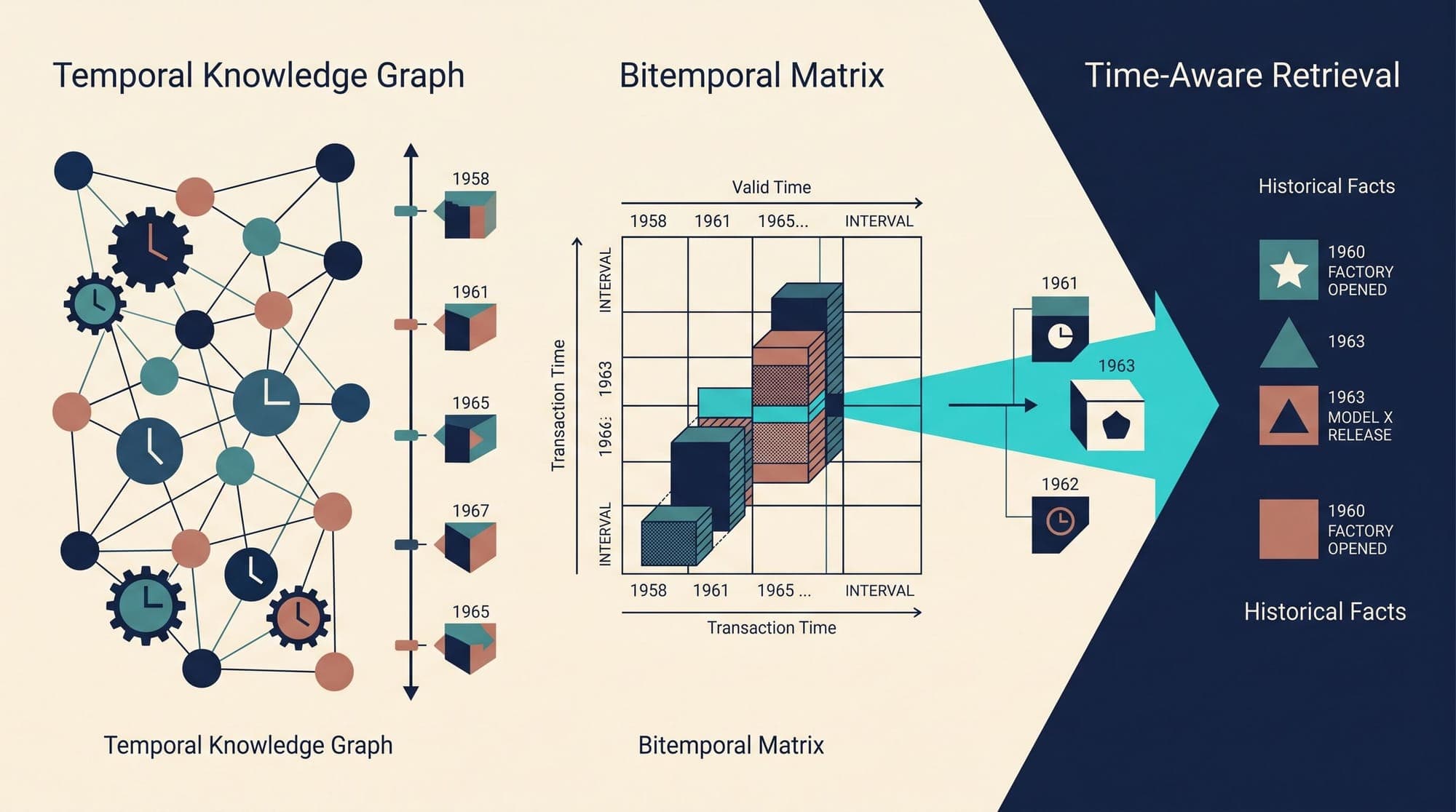
Temporal Knowledge Graphs in Production RAG: Bitemporal Schemas, Dynamic Entity Resolution, and Point-in-Time Context Retrieval
Standard Retrieval-Augmented Generation (RAG) pipelines operate on a flat assumption: facts retrieved from a vector database or static knowledge graph are treated as timeless truths. When an enterprise corpus contains documents spanning multiple quarters or years, this timeless representation breaks down. Information changes: executives step down, compliance policies are superseded, software configurations evolve, and customer accounts migrate.
When an LLM queries a conventional vector database for time-sensitive questions like "What was our data retention policy for EU customers in Q3 2024?" or "Who was leading infrastructure engineering during the November outage?", vector similarity scoring retrieves chunks based purely on semantic overlap. This frequently surfaces current documentation instead of historical state, or mixes contradictory clauses across different revisions.
To resolve these failure modes, engineering teams are adopting Temporal Knowledge Graphs (TKGs). By structuring unstructured data into bitemporal graphs with explicit validity intervals and provenance metadata, production systems can execute deterministic point-in-time traversals, track evolving relationships, and supply LLMs with chronologically coherent context.

1. The Temporal Failure Modes of Static Retrieval
Static vector retrieval and standard GraphRAG architectures suffer from three core temporal failure modes:
- Temporal Anachronism and Recency Bias: Vector embeddings map semantic proximity without encoding time as an orthogonal coordinate. If a 2023 document and a 2026 document discuss "remote work travel reimbursement," both reside in adjacent vector spaces. If the newer document has slightly lower lexical density, cosine similarity may score the outdated policy higher.
- State Contradiction and Context Thrashing: When an LLM receives chunks containing conflicting facts (for example, "Vendor A is our primary payment gateway" from 2024 and "Vendor B is our primary payment gateway" from 2025), the generator often merges both into a single hallucinated state or selects one at random without explaining the transition.
- Multi-Hop Chronological Reasoning Collapse: Questions requiring sequential reasoning ("Did the database migration occur before or after the SOC2 audit was finalized?") require graph pathfinding constrained by temporal intervals. Vector search cannot evaluate whether event A preceded event B.
Recent empirical studies, such as research on Temporal GraphRAG (arXiv:2510.13590), show that incorporating explicit time-aware graph structures reduces factual error rates by more than 40% on evolving corporate corpora compared to flat RAG baselines.
2. The Bitemporal Data Model
In traditional property graphs, knowledge is expressed as relational triples: Subject, Predicate, Object.
A Temporal Knowledge Graph expands triples into timestamped quadruples or attributed hyperedges. Production implementations adopt bitemporal modeling, tracking two independent time dimensions for every assertion:
- Valid Time: The interval [valid_from, valid_to] during which the fact was true in the real world. If the state is currently active, valid_to is left open (NULL).
- Transaction Time: The interval [recorded_at, invalidated_at] tracking when the system ingested, modified, or superseded the assertion in the database.
Key attributes of the bitemporal schema:
- valid_from: Timestamp when the fact became true in reality (for example,
2024-03-01T00:00:00Z). - valid_to: Timestamp when the fact ceased being true (for example,
2025-06-30T23:59:59Z). - recorded_at: Ingestion timestamp when the fact entered the graph (for example,
2024-03-05T14:22:10Z). - invalidated_at: Ingestion timestamp when the system learned it was superseded (for example,
2025-07-02T09:15:00Z).
Tracking both dimensions enables point-in-time rollbacks. An enterprise audit system can query what the real-world state was on March 15, 2024, or query what the system believed the state was as of its ingestion state on April 1, 2024.
3. Ingestion Architecture: Episodic Extraction and Entity Resolution
Building a temporal graph from raw text requires an extraction pipeline that anchors relative time expressions to concrete ISO 8601 timestamps.
[Unstructured Document / Transcript]
                │
                ▼
┌─────────────────────────────────────────────────┐
│ 1. Document Metadata Normalization               │
│    Extract creation date (T_doc: 2025-04-12)    │
└─────────────────────────────────────────────────┘
                │
                ▼
┌─────────────────────────────────────────────────┐
│ 2. LLM Episodic Temporal Extraction              │
│    Resolve "yesterday" -> 2025-04-11            │
│    Extract (Subject, Relation, Object, [t1, t2])│
└─────────────────────────────────────────────────┘
                │
                ▼
┌─────────────────────────────────────────────────┐
│ 3. Dynamic Entity Resolution & Alias Matching   │
│    Link aliases to persistent Graph Node IDs    │
└─────────────────────────────────────────────────┘
                │
                ▼
┌─────────────────────────────────────────────────┐
│ 4. Edge Invalidation & Graph Ingestion          │
│    Detect state changes -> update valid_to      │
└─────────────────────────────────────────────────┘
Relative Time Grounding
Unstructured enterprise documents rarely contain absolute timestamps in every sentence. Expressions like "last quarter," "two weeks ago," or "effective next month" must be resolved against document creation timestamps.
Prompting strategies for temporal extractors instruct the model to ground relative references into absolute ISO intervals:
{
  "source_text": "Effective next Monday, Sarah Chen will take over as interim CTO.",
  "document_date": "2024-10-04T12:00:00Z",
  "extracted_facts": [
    {
      "subject": "Sarah Chen",
      "predicate": "holds_role",
      "object": "Interim CTO",
      "valid_from": "2024-10-07T00:00:00Z",
      "valid_to": null,
      "confidence": 0.95
    }
  ]
}
Dynamic Invalidation and Conflict Detection
When a new assertion enters the graph that contradicts an open-ended relationship (for example, a new document stating "Marcus Vance was named CTO on 2025-03-01"), the ingestion engine performs an invalidation sweep:
- Locate existing active edges where
subject = "Organization",predicate = "has_cto", andvalid_to IS NULL. - Update the existing edge's
valid_toattribute to2025-03-01T00:00:00Z. - Insert the new edge with
valid_from = 2025-03-01T00:00:00Zandvalid_to = NULL.
The historical edge is never deleted; its validity window is bounded, preserving the lineage of leadership transitions.
4. Point-in-Time Retrieval and Hybrid Query Execution
Querying a Temporal Knowledge Graph involves translating a natural language question into semantic filters combined with temporal range constraints.
Temporal Query Decomposition
When an incoming query arrives, a pre-retrieval routing layer extracts two components:
- Semantic Search Vector: The semantic intent of the query for dense embedding matching.
- Temporal Constraint Tuple: An explicit point in time or target interval.
If the user asks "Who managed security compliance during the 2024 AWS migration?", the decomposition produces:
- Intent:
security compliance manager AWS migration - Temporal Target:
[2024-01-01T00:00:00Z, 2024-12-31T23:59:59Z]
Cypher and GQL Point-in-Time Traversal
The retrieval engine constructs an index-backed graph query to retrieve active edges during the target interval. In openCypher syntax:
MATCH (p:Person)-[r:ASSIGNED_ROLE]->(role:Role {name: "Security Compliance Officer"})
WHERE r.valid_from <= datetime('2024-12-31T23:59:59Z')
  AND (r.valid_to IS NULL OR r.valid_to >= datetime('2024-01-01T00:00:00Z'))
RETURN p.name AS person, r.valid_from AS start_date, r.valid_to AS end_date, role.name AS role
ORDER BY r.valid_from ASC
Hybrid Score Fusion
To balance exact relational precision with unstructured document context, production systems merge graph paths with dense vector chunks using Reciprocal Rank Fusion (RRF):
RRF_Score(d) = Sum_{m in Methods} [ 1 / (60 + Rank_m(d)) ]Methods include Dense Vector Search, Temporal Graph Traversal, and BM25 lexical search. Temporal graph edges that match the exact point-in-time constraint receive an additive boost, suppressing semantically similar chunks that fall outside the target temporal window.
5. Production Frameworks and Engine Implementations
Several open-source and commercial engines support temporal knowledge graph operations for LLM workflows:
- Zep / Graphiti: Employs native bi-temporal schemas (
valid_at,invalid_at) with automatic conflict resolution across Neo4j, FalkorDB, and Kùzu backends. Optimized for long-term agent memory and episodic session context. - Neo4j Temporal: Leverages native property graph capabilities with Cypher temporal data types and composite spatial/temporal indexes. Suited for complex enterprise multi-hop relationship querying.
- Kùzu: Embedded C++ graph database offering columnar property storage with interval join acceleration. Ideal for local, low-latency agent execution and embedded RAG.
- TerminusDB: Git-like immutable triplestore providing native time-travel and branch-based bitemporal queries. Designed for regulatory audit, legal compliance, and immutable histories.
According to technical benchmarks published by the Zep Team (arXiv:2501.13956), running hybrid temporal graph retrieval with pre-computed edge invalidations achieves sub-160ms p95 retrieval latencies while reducing context window payload sizes by more than 50% compared to raw document chunk dumps.
6. Architectural Trade-offs and Best Practices
Deploying a temporal knowledge graph introduces specific engineering trade-offs:
- Extraction Latency vs. Query Latency: Extracting timestamped quadruples via an LLM during ingestion adds token overhead and processing time (1.5s to 4.0s per document chunk). However, this shifts computation to write-time; query-time retrieval requires no iterative LLM graph resolution, returning ranked subgraphs in milliseconds.
- Granularity of Time Intervals: Setting temporal bounds at sub-second precision causes index bloat in business domains where dates or quarters suffice. Standardize on ISO 8601 UTC dates (
YYYY-MM-DD) unless real-time infrastructure event logging explicitly mandates microsecond telemetry. - Chronological Context Formatting: When feeding retrieved temporal subgraphs into an LLM generation prompt, format entities in strictly ascending chronological order. LLMs exhibit position bias and recency bias; presenting events sequentially from oldest to newest prevents the model from conflating past conditions with present outcomes.
Sources
- Zep: A Temporal Knowledge Graph Architecture for Agent Memory (arXiv:2501.13956)
- RAG Meets Temporal Graphs: Time-Sensitive Modeling and Retrieval for Evolving Knowledge (arXiv:2510.13590)
- Graphiti: Knowledge Graph Memory for an Agentic World (Neo4j Engineering)
- KG-IRAG: Knowledge Graph-Based Iterative Retrieval for Temporal Reasoning (arXiv:2503.14234)
- Temporal Graph RAG Architecture & Benchmarks (Zep Platform Documentation)



