
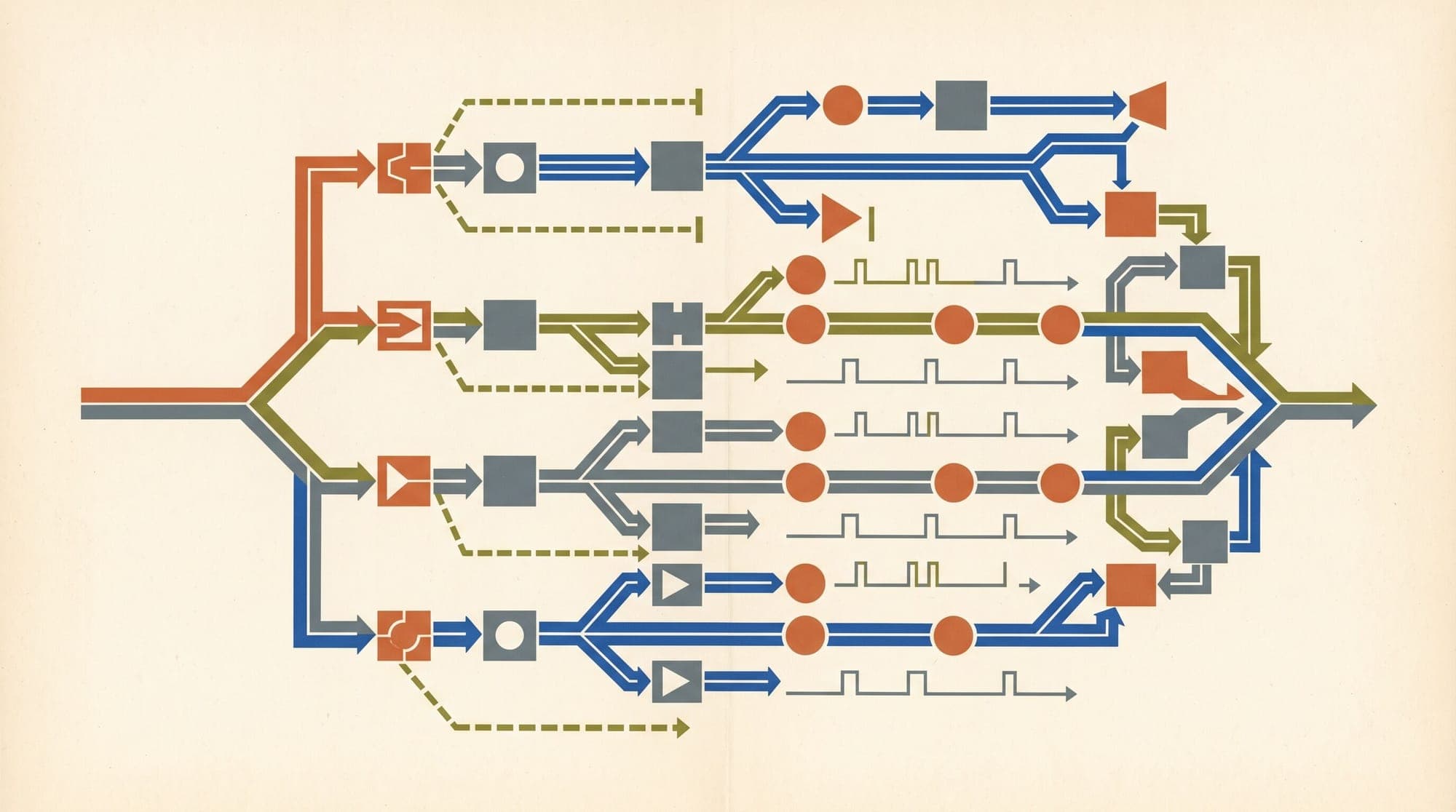
Autonomous AI agents operating in complex environments (such as software engineering, scientific discovery, and automated workflow orchestration) face an operational bottleneck: execution latency. While foundation models have become faster at token generation, the standard agent interaction loop remains strictly serial. A model reasons, outputs a single tool call, halts generation, waits for the external environment to return a result, appends the output to context, and resumes reasoning.
In multi-step tasks requiring dozens of tool invocations, this serial round-trip structure causes cumulative latency walls. Recent systems research (Kim et al., 2024; Ye et al., 2025; Sui et al., 2026) demonstrates that decoupling agent reasoning from synchronous tool execution through parallel action graphs and speculative execution can reduce end-to-end task completion latency by 40% to 50%.
Architecting speculative and parallel tool execution in production requires formal dependency analysis, optimistic sandboxing, and deterministic rollback mechanics.
The Serial Bottleneck in Agentic Workflows
The classical ReAct paradigm alternates deterministically between thought generation and environment action:
- Inference Phase: The model generates tokens until emitting a tool call descriptor.
- Execution Halt: The inference engine suspends generation and dispatches the tool call over the network (e.g., HTTP request, database query, local shell execution, or Model Context Protocol RPC).
- Observation Wait: The system blocks until the external tool finishes and returns its payload.
- Context Update: The observation is formatted, appended to the conversation history, and sent back to the model for the next inference phase.
When an agent executes an 8-step investigation involving repository search, file reading, compiler execution, and test evaluation, latency accumulates additively:
If each LLM generation takes 2.5 seconds and each tool execution averages 1.5 seconds, an 8-turn interaction consumes at least 32 seconds of wall-clock time, excluding context ingestion overhead. External API calls or sandboxed compilation runs often stretch tool execution times to 5 to 15 seconds per step.

Parallel Tool Calling vs. Speculative Execution
Production architectures differentiate between two distinct concurrency patterns: intra-step parallel dispatch and inter-step speculative execution.
Intra-Step Parallel Tool Dispatch
In intra-step parallelism, the model plans and emits multiple independent tool invocations within a single generation turn. Formalized in frameworks like LLMCompiler, the agent functions as a query planner:
- The planner generates a batch of function calls with explicit variable bindings (e.g., `, $\).
- A task-fetching unit inspects dependencies across the batch.
- An asynchronous executor dispatches independent tasks concurrently to worker pools.
- Results are joined at a synchronization barrier before invoking subsequent dependent tasks or returning to the model.
Intra-step dispatch requires no guesswork regarding arguments; the LLM explicitly authors all invocations in one prompt completion. However, it cannot parallelize steps where the output of tool dictates the existence or parameters of tool .
Inter-Step Speculative Execution
Inter-step speculation (Ye et al., 2025; Sui et al., 2026) optimizes across reasoning turns by predicting future tool invocations before the primary model has decided on them or while prior tools are still executing:
- Act While Thinking: While a large reasoning model generates its chain-of-thought rationale, a lightweight predictor predicts the target tool and anticipated arguments based on workflow control-flow patterns.
- Speculative Prefetching: Read-only tools (e.g., retrieving documentation, fetching search indices, reading candidate files) execute in the background before the primary model completes its token stream.
- Speculative Branching: If the primary model confirms the predicted tool invocation and parameter set, the pre-computed observation is immediately returned without introducing an idle wait state.
Directed Acyclic Graphs (DAGs) and Dependency Scheduling
To execute actions concurrently without corrupting agent state, the runtime must model agent plans as Directed Acyclic Graphs (DAGs), where nodes represent compute units (LLM reasoning or tool executions) and edges represent data dependencies.
                  ┌──────────────────────┐
                  │ User Task Definition │
                  └──────────┬───────────┘
                             │
                  ┌──────────▼───────────┐
                  │    LLM Planner /     │
                  │ Dynamic DAG Compiler │
                  └──────────┬───────────┘
                             │
             ┌───────────────┴───────────────┐
             │                               │
    ┌────────▼────────┐             ┌────────▼────────┐
    │ Task A: ReadAST │             │ Task B: FetchAPI│
    └────────┬────────┘             └────────┬────────┘
             │                               │
             └───────────────┬───────────────┘
                             │ (Join Barrier)
                  ┌──────────▼───────────┐
                  │  Task C: Synthesize  │
                  └──────────┬───────────┘
                             │
                  ┌──────────▼───────────┐
                  │ Task D: Mutate State │ (Isolated Sandbox)
                  └──────────────────────┘
Static vs. Dynamic DAG Resolution
- Static Pre-Planning: The planner maps out the full dependency graph upfront. While computationally clean, static graphs fail in non-deterministic environments where intermediate outputs (e.g., unexpected compiler errors or empty search results) invalidate downstream nodes.
- Dynamic Streaming DAGs: The system constructs a dynamic graph that updates incrementally. As streaming tokens arrive from the inference engine, regex-based or grammar-constrained stream parsers extract tool signatures on the fly, dispatching background network calls before the model finishes producing subsequent arguments or formatting.
Optimistic Concurrency and Side-Effect Isolation
The primary architectural risk of speculative execution is unauthorized state mutation. If a speculative branch executes an action that alters the environment (such as writing to a filesystem, deleting a database record, or firing an external webhook) and the primary model subsequently diverges or rejects the action, the environment is left in an inconsistent state.
Tool Classification Taxonomy
Production frameworks categorize tools into strict isolation tiers:
| Tier | Characteristics | Examples | Speculation Safety | | :--- | :--- | :--- | :--- | | Tier 1: Pure Read-Only | Idempotent, zero external side effects, deterministic read | read_file, grep_search, query_docs, get_status | Fully safe for speculative execution and prefetching | | Tier 2: Ephemeral Mutating | Mutates state within a sandboxed, discardable container | Local sandbox compilation, temporary workspace edits | Safe with Copy-on-Write (CoW) overlay isolation | | Tier 3: External Mutating | Mutates shared external infrastructure, irreversible side effects | send_email, charge_card, git_push_remote, drop_table | Strictly barred from speculative dispatch |
Sandboxing via Copy-on-Write Overlays
For Tier 2 tools, speculative execution uses isolated ephemeral environments:
- Filesystem Overlays: Speculative file writes are redirected to an OverlayFS or temporary workspace layer. If the model accepts the branch, the overlay layer commits to the base root. If the branch misses, the overlay layer is dropped.
- Transactional Database Shadows: Speculative database queries run within nested transactions (
SAVEPOINT) or against isolated branch replicas, issuing aROLLBACKon speculative deviation.
Verification Oracles and Rollback Mechanics
When the ground-truth inference engine finishes generating its step, the system executes a verification routine comparing the predicted tool signature against the actual emitted parameters.
       [Speculative Action Dispatched] ───► [Isolated Container / Memory Buffer]
                       │
             [Ground-Truth Generation]
                       │
                       ▼
            [Parameter Verification]
                  /         \
            (Exact Match)   (Mismatch)
                /             \
               ▼               ▼
      [Commit State &     [Discard Buffer &
       Return Result]      Trigger Rollback]
Match Evaluation Strategies
- Exact Parameter Hash Match: The speculative execution result is valid only if all serialized tool parameters match the model's generated parameters byte-for-byte.
- Semantic Subsumption: For retrieval tools, if a speculative call fetches 50 document chunks and the final generated call specifies a subset of those chunks or a slightly looser filter, the runtime serves the cached result without a network refetch.
- Optimistic Pre-Warming: Even if parameter verification fails, the underlying connection pool, DNS lookup, or container spin-up remains warm, shaving initial connection latency from the corrected tool execution.
Cost and Rate-Limit Economics
Speculative execution introduces a fundamental trade-off between wall-clock latency and resource consumption:
- Speculation Hits: Hide 80% to 100% of tool execution latency, delivering 1.5x to 2.0x end-to-end task acceleration.
- Speculation Misses: Consume extraneous tool compute and upstream API rate limits. Issuing speculative queries to third-party APIs risks hitting rate-limit ceilings, inadvertently degrading overall cluster throughput.
Production schedulers employ adaptive speculation budgets based on predictive confidence scores, throttling speculation when model entropy is high or when API rate quotas approach saturation.
Sources
- Kim, S., et al. (2024). LLMCompiler: An LLM Compiler for Parallel Function Calling. ICML 2024. arXiv:2312.04511
- Ye, N., et al. (2025). Speculative Actions: A Lossless Framework for Faster Agentic Systems. arXiv:2510.04371
- Sui, Y., et al. (2026). Act While Thinking: Accelerating LLM Agents via Pattern-Aware Speculative Tool Execution. Microsoft Research. arXiv:2603.18897
- Shi, Z., et al. (2026). SimpleTool: Parallel Decoding for Real-Time LLM Function Calling. arXiv:2603.12345
- Model Context Protocol Working Group. (2024). Model Context Protocol Specification. modelcontextprotocol.io



