
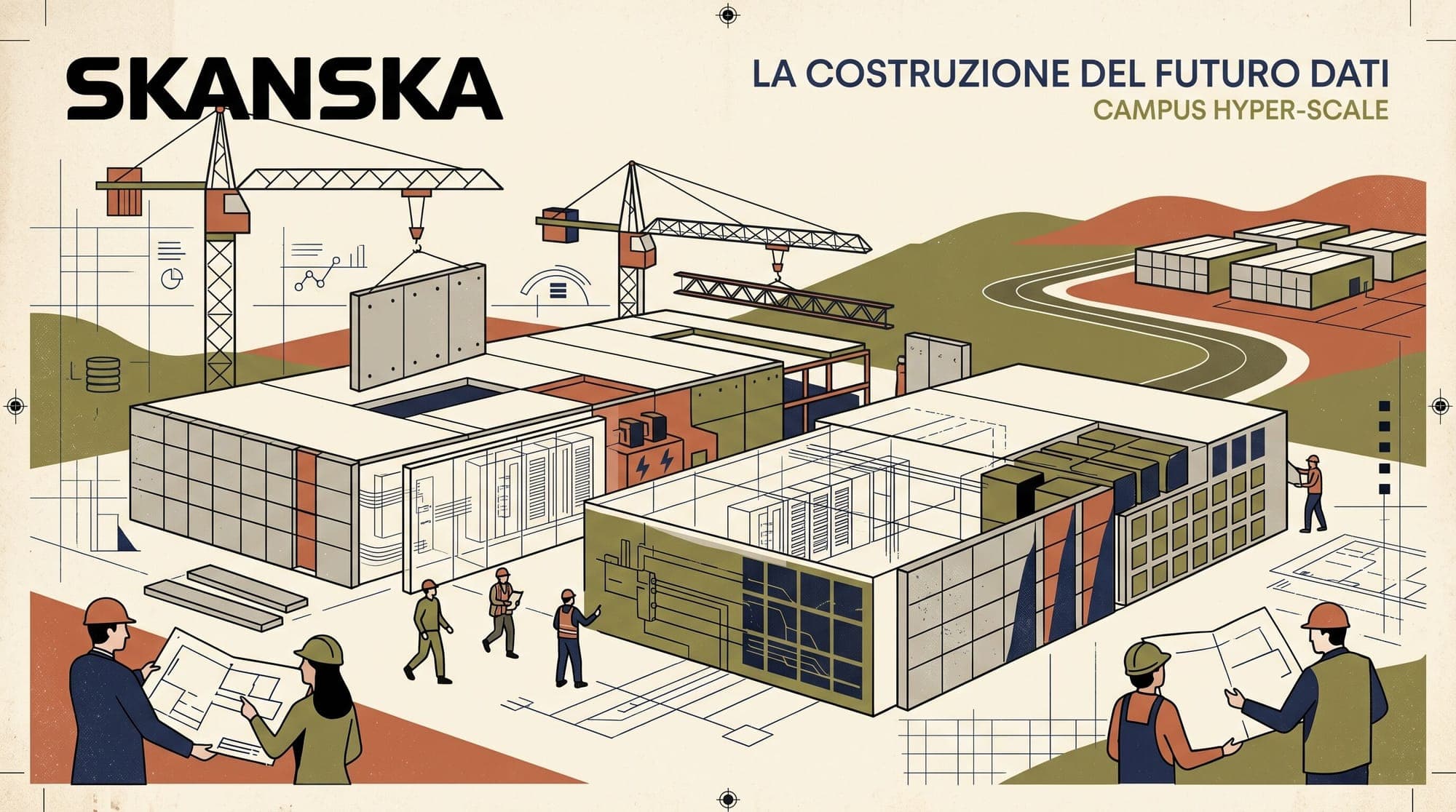
Swedish construction and development group Skanska has signed a $1.2 billion (SEK 11.2 billion) contract with an existing client to construct four new data center facilities in the southeastern United States.
The full contract value will be included in Skanska's US order bookings for the third quarter of 2026, representing the largest single data center award in the contractor's history.
Scope of Work and Campus Specifications
The multi-facility project spans four standalone structures totaling approximately 75,000 square meters (808,000 square feet) of technical, mechanical, and operational floor area. Skanska’s contract covers core civil engineering, structural shell erection, and complete interior technical fit-out for data halls, power distribution rooms, cooling infrastructure corridors, and administrative offices.

Key parameters of the contract include:
- Footprint and Density: 75,000 square meters distributed across four multi-hall structures, equating to approximately $16,000 per square meter in structural shell and technical fit-out costs.
- Execution Window: Construction begins in the third quarter of 2026, with full project turnover scheduled for the third quarter of 2028.
- Separation of Scopes: The contract encompasses the structural envelope, thermal barrier, and facilities infrastructure. Server hardware, networking fabric, and computational accelerators are procured and deployed separately by the facility operator.
Compounding Regional Data Center Commitments
The $1.2 billion award follows a sustained series of campus expansions executed by Skanska across the southeastern data center corridor for undisclosed hyperscale operators.
Earlier in August 2026, Skanska secured a $238 million contract for a 22,000-square-meter facility in Virginia, following a $94 million award in July for a 19,500-square-meter data center on a neighboring site. In Georgia, the firm booked a $255 million expansion in June 2026 alongside an initial $75 million facility contract in April.
The repeat contract awards reflect how cloud hyperscalers and AI infrastructure providers are committing long-term capital to multi-year civil works and powered-shell development, securing regional physical capacity in advance of successive hardware refresh cycles.



