As context windows expand beyond one million tokens, production LLM systems face an unexpected bottleneck: memory bandwidth and prefill latency. In high-throughput serving environments, feeding tens of thousands of tokens of few-shot demonstrations, system prompts, multi-turn conversational history, and retrieved document chunks directly into frontier models incurs heavy token costs and degrades time-to-first-token (TTFT).
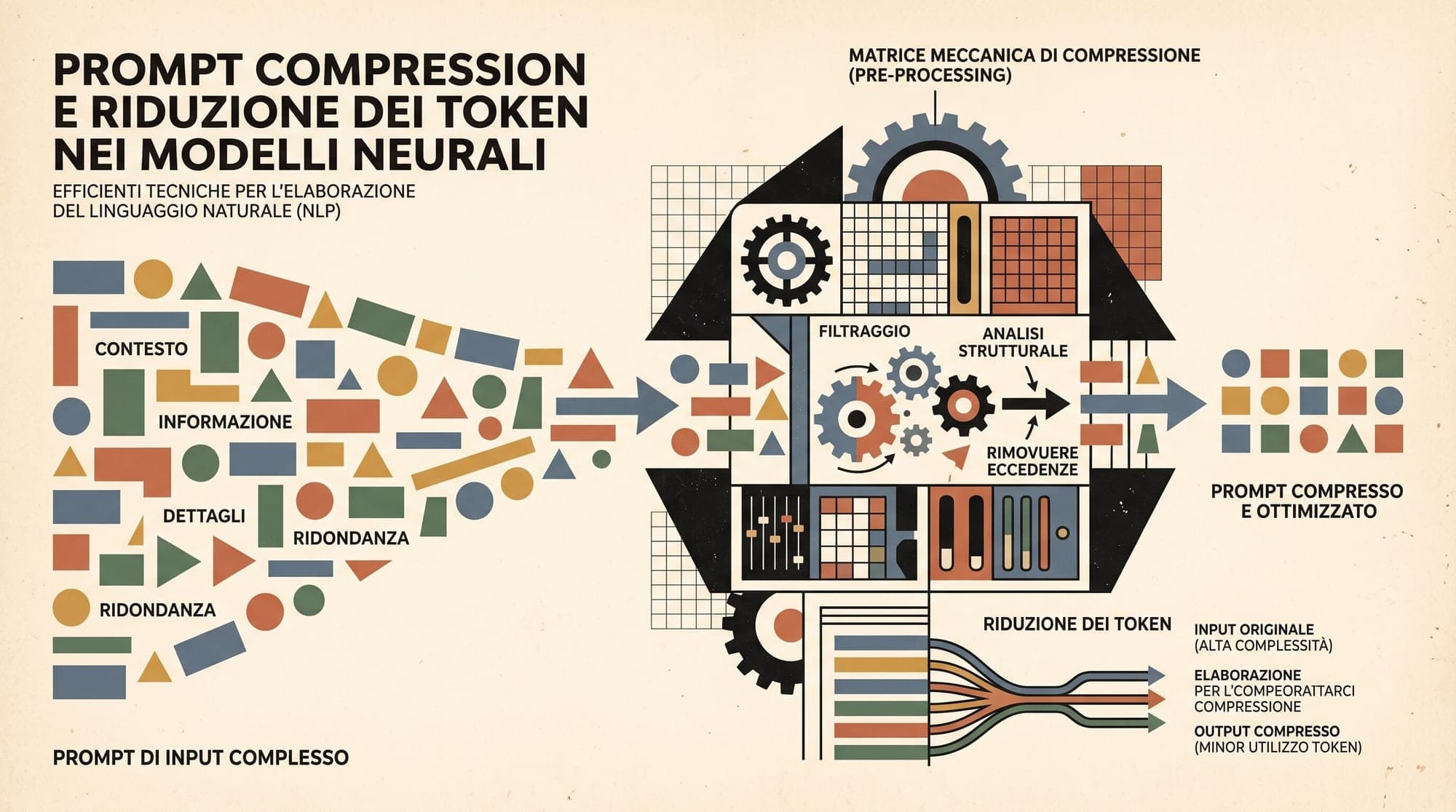
While early mitigation focused purely on retrieval rerankers, production engineering teams increasingly deploy prompt compression pipelines. By filtering redundant, uninformative, or task-irrelevant tokens before requests hit target foundation models, teams achieve 2x to 5x token reductions. However, prompt compression introduces a distinct set of architectural trade-offs, latency overheads, and failure modes that complicate enterprise deployment.

The Prefill Latency and Cost Bottleneck
In autoregressive transformer serving, the compute profile divides strictly into the prefill phase and the decoding phase. Prefill computes self-attention across all input tokens simultaneously, scaling quadratically with sequence length in raw FLOPs and linearly in memory allocations for key-value (KV) activations.
When an agentic workflow or retrieval-augmented generation (RAG) system injects 32,000 tokens of context into a model such as Claude 3.5 Sonnet or GPT-4o, the prefill phase dominates overall response time. Furthermore, API pricing scales linearly with raw input token counts.
Retrieval systems frequently introduce high semantic noise. A standard top-10 chunk retrieval might supply 8,000 tokens of text, of which only 15% contains factual tokens necessary to answer the prompt. The remaining 85% consumes memory bandwidth, inflates serving costs, and distracts attention heads, contributing to documented "lost in the middle" degradation patterns.
Taxonomy of Context Compression Paradigms
Production compression techniques divide into four distinct architectural approaches:
1. Extractive Token Pruning
Extractive pruning evaluates individual tokens or lexical units in the original text and removes low-information elements while preserving the remaining text verbatim.
The earliest formal framework, Selective-Context (Li et al., 2023), calculates the self-information (negative log-likelihood) of lexical units using a small base language model like GPT-2 or LLaMA-7B. Units with low self-information are discarded based on a percentile cutoff.
Microsoft Research expanded this with LLMLingua (Jiang et al., 2023), introducing iterative token pruning and budget allocation across instruction, demonstration, and document components. LLMLingua calculates conditional perplexity under a causal language model (e.g., LLaMA-2-7B or Alpaca-7B) to prune tokens with minimal loss to semantic coherence.
2. Query-Aware Context Extraction
Task-agnostic token pruning risks dropping information that is semantically dense in isolation but irrelevant to the user's immediate question. LongLLMLingua (Jiang et al., 2023) and RECOMP Extractive (Xu et al., 2023) introduce query conditioning.
LongLLMLingua uses contrastive perplexity: it evaluates token perplexity conditioned on the query against token perplexity without the query. Tokens exhibiting a substantial perplexity drop when conditioned on the query receive high retention priority. RECOMP Extractive trains a dual-encoder sentence selector to extract only sentences directly predictive of target answers.
3. Abstractive Generation and Soft Prompt Embeddings
Rather than dropping tokens from existing strings, abstractive systems synthesize compact summaries. RECOMP Abstractive trains a sequence-to-sequence model to condense multi-document retrieval sets into dense textual summaries prior to prompt insertion.
Soft prompt approaches, such as AutoCompressor and In-Context Autoencoder (ICAE), compress hundreds of text tokens into a handful of continuous "gist" virtual embeddings. While achieving extreme compression ratios (up to 20x), soft embeddings require access to internal model weight projections and cannot be transmitted over standard third-party text APIs.
4. Dynamic KV Cache Eviction
Unlike upstream prompt compression, which operates on text before tokenization, systems like StreamingLLM, H2O (Heavy Hitter Oracle), and SnapKV operate inside the inference engine. They dynamically evict less-attended key-value pairs from GPU VRAM during execution, maintaining fixed memory footprints for infinite-sequence workloads.
The Architecture of LLMLingua-2
The primary operational challenge with first-generation token pruning was inference overhead. Running an autoregressive 7B-parameter causal model like LLaMA-2 to compute perplexities for every token in a 16,000-token prompt took hundreds of milliseconds, frequently exceeding the prefill time saved on the target model.
Microsoft addressed this with LLMLingua-2 (Pan et al., ACL 2024). Instead of calculating causal perplexity, LLMLingua-2 reformulates prompt compression as a token classification problem:
- Bidirectional Context: The compression engine uses an encoder-only architecture (e.g.,
xlm-roberta-largewith 560M parameters orbert-base-multilingualwith 110M parameters). This allows the compressor to capture bidirectional semantic relationships rather than being constrained to unidirectional causal masking. - Data Distillation: Training labels are generated via data distillation from GPT-4. GPT-4 iteratively compresses passages by removing non-essential words while ensuring the reconstructed text remains fully interpretable.
- Binary Sequence Labeling: The encoder is trained with a binary classification head that assigns a probability to each token .
- Dynamic Thresholding: Rather than enforcing rigid static pruning rates, the system sorts token scores and retains tokens exceeding dynamic probability thresholds, adapting automatically to the information density of each sample.
Because LLMLingua-2 runs on a compact encoder, it achieves 3x to 6x faster compression latency than LLMLingua while matching or exceeding downstream task accuracy across LongBench and GSM8K benchmarks.
The Latency Economics and the "Compressor Tax"
Deploying prompt compression introduces an upfront latency penalty known as the compressor tax. A production pipeline must evaluate whether the compressor execution time is smaller than the prefill latency savings on the downstream target model.
Where is input sequence length and is the compression ratio (e.g., 0.50 for 2x compression).
Consider the operational performance characteristics across prompt lengths:
| Input Tokens | Compressor Model | Compression Latency (GPU) | Target Model (70B) Base Prefill | Target Model (70B) Compressed Prefill (2.5x) | Net TTFT Delta | | :--- | :--- | :--- | :--- | :--- | :--- | | 1,000 | LLMLingua-2 (XLM-R) | 8 ms | 22 ms | 9 ms | +5 ms (Slower) | | 4,000 | LLMLingua-2 (XLM-R) | 28 ms | 88 ms | 35 ms | -25 ms (Faster) | | 16,000 | LLMLingua-2 (XLM-R) | 110 ms | 350 ms | 140 ms | -100 ms (Faster) | | 32,000 | LLMLingua-2 (XLM-R) | 225 ms | 710 ms | 285 ms | -200 ms (Faster) |
For short prompts (<2,000 tokens), the compressor overhead exceeds target prefill savings. For long contexts (>4,000 tokens), prompt compression delivers significant net TTFT improvements in addition to direct 50% to 70% API spend reductions.
The Prompt Caching Conflict
A major architectural consideration in modern LLM infrastructure is the tension between prompt compression and prefix KV caching (such as Anthropic Prompt Caching, OpenAI Automatic Caching, or vLLM PagedAttention prefix reuse).
KV prompt caching requires exact token prefix matches. If an extractive compressor modifies dynamic segments located early in a prompt, or mutates a shared system prompt based on query perplexity, it breaks the deterministic hash of the token sequence.
When this occurs, the target serving engine cannot reuse pre-computed KV cache blocks. The full uncompressed prefill cost must be paid, wiping out any economic advantage provided by the compressor.
To avoid cache invalidation, production pipelines must enforce strict contextual boundaries:
- Static Invariant Prefixes: System instructions, tool schemas, and core role descriptions must bypass the compressor entirely and remain fixed to ensure 100% KV cache hit rates.
- Dynamic Payload Compression: Compression must be applied exclusively to retrieved document context chunks, web scrape bodies, or historical conversational turns appended after the cached prefix.
Failure Modes and Semantic Degradation
While prompt compression preserves aggregate benchmark scores in question-answering and summarization, it introduces subtle failure modes in production edge cases:
1. Dropping Syntactic Negation and Logic Operators
Extractive classifiers frequently assign low information entropy to short function words like "not", "never", "except", or "neither". If a prompt contains negative constraints (such as "Do not include customer PII"), an over-aggressive compression pass may discard the negation token, inverting the instruction.
A recent study titled Lost in Compaction (Penn State, 2026) revealed that automated context compression techniques can drop up to 83% of subtle negative constraints and edge-case instructions in multi-agent environments.
2. Structural Syntax Breakage
Extractive pruning treats text as flat sequences of natural language tokens. When applied to structured data formats (JSON, YAML, XML, or source code), pruning individual brackets, indentation tabs, or quotation marks breaks parsing syntax. The downstream LLM either errors out or produces malformed outputs.
3. Entity Fragmentation and Numeric Drift
Tokenizers partition complex named entities and floating-point numbers into multiple subword tokens. A statistical classifier may retain the primary subword and discard numerical suffixes or punctuation, corrupting financial figures, dates, and unique identifier hashes.
Production Implementation Blueprint
To deploy prompt compression reliably, engineering teams implement a layered gateway architecture combining structural protection rules with dynamic token pruning:
from typing import List, Dict, Any
from llmlingua import PromptCompressor

class ResilientPromptCompressor:
    def __init__(self, model_name: str = "microsoft/llmlingua-2-xlm-roberta-large-meetingbank"):
        self.compressor = PromptCompressor(
            model_name=model_name,
            use_llmlingua2=True,
            device_map="cuda"
        )
        self.min_token_threshold = 2048
        self.protected_tokens = ["not", "never", "none", "must", "except", "true", "false"]

    def compress_context(
        self,
        system_prompt: str,
        retrieved_documents: List[str],
        user_query: str,
        target_rate: float = 0.40
    ) -> Dict[str, Any]:
        # 1. Preserve static system prompt verbatim for KV cache hits
        total_raw_tokens = len(system_prompt.split()) + sum(len(d.split()) for d in retrieved_documents) + len(user_query.split())

        # 2. Bypass compression if payload is below latency break-even point
        if total_raw_tokens < self.min_token_threshold:
            return {
                "system": system_prompt,
                "context": "\n\n".join(retrieved_documents),
                "query": user_query,
                "compressed": False
            }

        # 3. Compress dynamic document payload with structural protection
        concatenated_docs = "\n\n".join(retrieved_documents)
        compression_result = self.compressor.compress_prompt(
            concatenated_docs,
            rate=target_rate,
            force_tokens=self.protected_tokens,
            drop_consecutive=True
        )

        return {
            "system": system_prompt,
            "context": compression_result["compressed_prompt"],
            "query": user_query,
            "compressed": True,
            "tokens_saved": compression_result["origin_tokens"] - compression_result["compressed_tokens"],
            "compression_ratio": compression_result["ratio"]
        }
Architectural Guidelines
For enterprise teams evaluating prompt compression in production stacks:
- Target Payloads Over 2,000 Tokens: Do not introduce compression steps into short transactional API calls. Apply compressors strictly to RAG document context, large tool outputs, and historical chat backlogs.
- Standardize on Bidirectional Encoders: Avoid 7B causal autoregressive compressors. Deploy encoder models like LLMLingua-2 on dedicated GPU or CPU inference endpoints to keep compression latencies under 30 milliseconds.
- Protect the Prefix Cache: Always compress retrieved content before appending it to prompts, while leaving system prompts and invariant instruction blocks untouched.
- Isolate Structured Schemas: Never run extractive token pruning over JSON schemas, code snippets, or mathematical formulas without AST-aware token masking.
Sources
- LLMLingua-2: Data Distillation for Efficient and Faithful Task-Agnostic Prompt Compression (Pan et al., ACL 2024)
- LLMLingua: Compressing Prompts for Accelerated Inference of Large Language Models (Jiang et al., EMNLP 2023)
- Compressing Context to Enhance Inference Efficiency of Large Language Models (Li et al., EMNLP 2023)
- LongLLMLingua: Accelerating and Enhancing LLMs in Long Context Scenarios via Prompt Compression (Jiang et al., 2023)
- RECOMP: Improving Retrieval-Augmented LMs with Compression and Selective Augmentation (Xu et al., ICLR 2024)
- Lost in Compaction: LLM Context Compression Drops 83% of User Constraints (Penn State, 2026)
- Microsoft LLMLingua Project Repository