
Tool Retrieval and Dynamic Function Selection in Production AI Agents: Architecture, Semantic Indexing, and Serving Trade-Offs
The default approach to LLM tool calling—stuffing every function schema into the prompt—works for demos with a dozen tools. It fails in production where agents face hundreds or thousands of available functions. Context windows saturate, selection accuracy degrades, and latency grows linearly with registry size.
This post surveys the architectural progression from static injection to semantic retrieval, hierarchical routing, and dynamic discovery protocols, grounding each layer in published benchmarks and serving economics.
The Static Injection Problem
Early function-calling implementations (OpenAI's functions parameter, LangChain's bind_tools) assume the full tool registry fits in the prompt. With 50 tools averaging 500 tokens each, that's 25,000 tokens before the user query—half a 128k context window consumed by schema alone.
BFCL (Berkeley Function Calling Leaderboard) evaluates models on up to 4 concurrent tools. Real enterprise deployments routinely expose 200–2,000 tools across CRM, ERP, observability, and internal APIs. The Gorilla team notes that "GPTs' function documents are difficult to format and their typings are restrictive in real-world scenarios" and that models underperform when "parameters are not immediately available in the user question but instead require some implicit conversions."
Static injection also conflates two distinct tasks: relevance detection (is any tool needed?) and selection (which tool?). BFCL's "Function Relevance Detection" category explicitly tests whether models abstain when no provided function applies—a capability that degrades as the candidate set grows.
Semantic Retrieval as a First-Class Layer
The ToolRet benchmark (ACL 2025) formalizes tool retrieval as an IR task: given a user query and a corpus of 43,000 tools, retrieve the top-k relevant candidates before the LLM sees them. Their key finding: conventional IR models (E5, BGE, GTE, Contriever) perform poorly on tool retrieval despite strong MTEB scores. The best zero-shot model (NV-Embed-v1) achieves only ~45% Recall@10 on ToolRet without instruction tuning.
Two factors explain the gap:
- Schema structure mismatch: Tool descriptions mix natural language, JSON Schema, type signatures, and parameter constraints. Standard embeddings trained on prose don't capture the structured semantics.
- Multi-field relevance: A tool matches on name, description, parameter names, parameter types, and return types. ToolRet introduces multi-field tool retrieval (MFTR) that indexes these fields separately and fuses scores.
The ToolRet team released a 200k-instance training dataset (ToolRet-train) that substantially closes the gap when used to fine-tune retrievers. In production, this means: invest in a domain-adapted retriever, not a generic embedding model. The retriever becomes a tunable component with measurable impact on downstream pass rate—ToolRet shows a near-linear correlation between retrieval Recall@k and task-solving success.
Hierarchical and Two-Stage Selection
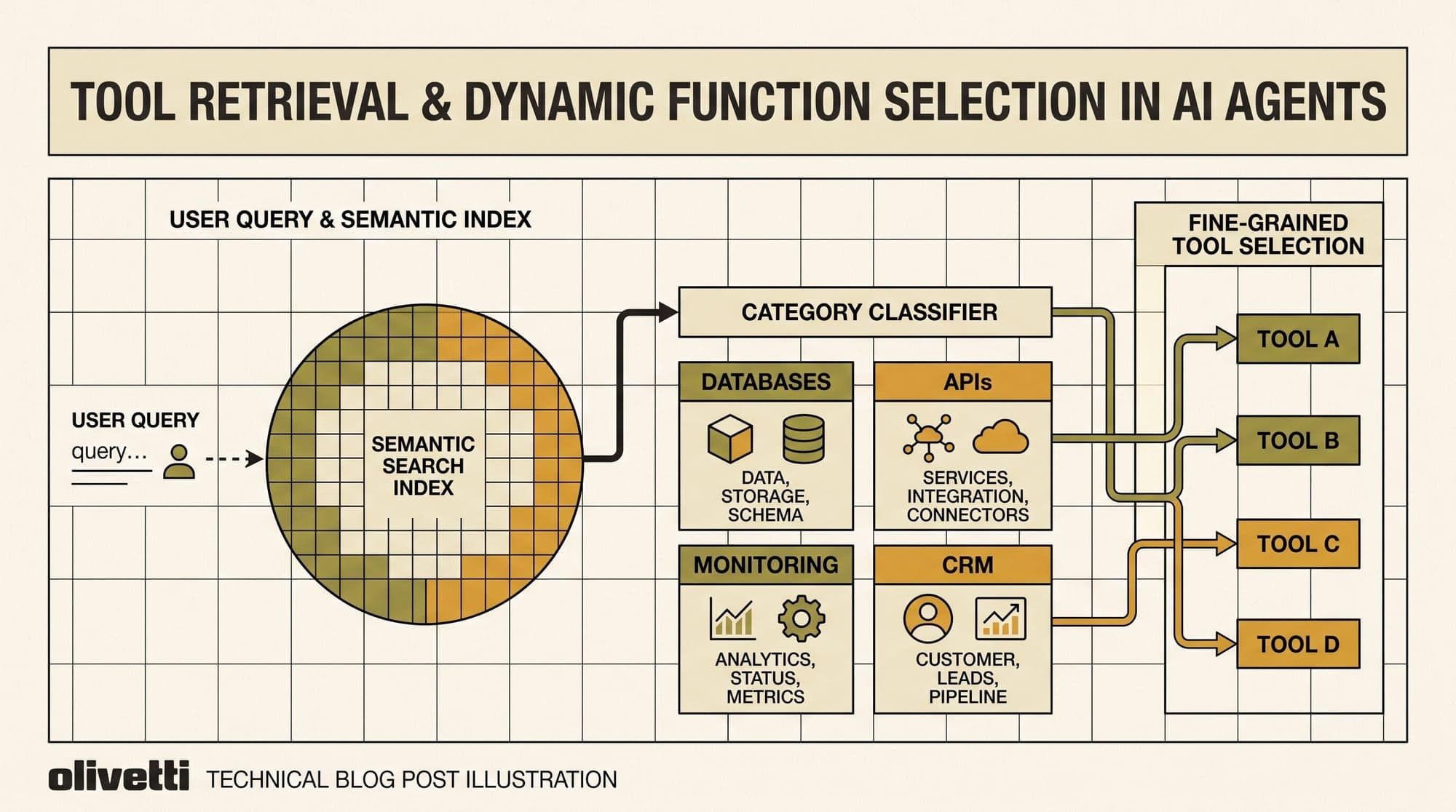
When the tool corpus exceeds a few hundred entries, flat semantic retrieval still returns too many candidates for reliable LLM selection. The industry has converged on two-stage routing:
Stage 1 — Category/namespace routing: A lightweight classifier (or the LLM with a minimal prompt) routes the query to a tool namespace: salesforce, kubernetes, billing, monitoring. This reduces the candidate pool by 10–100x.
Stage 2 — Fine-grained selection: Within the chosen namespace, semantic retrieval + LLM selection picks the exact tool and fills parameters.
This pattern appears in:
- ToolBench's progressive retrieval: hierarchical API organization with category-level then API-level retrieval.
- LangGraph's
ToolNodewithtool_choice="auto": pre-filtering via vector store before LLM invocation. - Enterprise MCP deployments: Kong's MCP Registry documentation explicitly recommends "controlling which agents can access which tools, across which environments" via namespaced registries.
The trade-off: misrouting at Stage 1 is fatal. If the classifier sends a billing query to the monitoring namespace, no amount of Stage 2 retrieval recovers. Production systems mitigate this with:
- Overlap retrieval: fetch top-k from top-n namespaces (increases recall, adds latency).
- Confidence thresholds: if Stage 1 confidence < threshold, fall back to flat retrieval.
- Human-in-the-loop for ambiguous routes: escalate to operator for low-confidence classifications.
Dynamic Discovery via MCP and Function Registries
Model Context Protocol (MCP) standardizes the discovery contract: servers expose tools/list (paginated, with listChanged notifications for real-time updates) and clients discover tools at runtime rather than at compile time. This enables:
- Zero-downtime tool addition/removal: new MCP servers register; agents discover on next
tools/listcall. - Environment-scoped toolsets: dev/staging/prod registries with different tool inventories.
- Governance: the MCP Registry Specification adds access control, audit logging, and versioning—critical for enterprise compliance.
However, MCP's discovery is pull-based and client-initiated. The client must know which servers to query. For large-scale deployments, a registry-of-registries (or a gateway aggregating multiple MCP servers) becomes necessary. Kong's MCP Registry and the community-run registry.modelcontextprotocol.io serve this role, but neither provides built-in semantic search—they're catalogs, not retrievers.
A practical architecture layers semantic retrieval on top of MCP discovery:
- Gateway aggregates
tools/listfrom all registered MCP servers. - Background indexer embeds tool schemas (multi-field: name, description, parameters, returns) into a vector store.
- At inference time: query → retriever → top-k tool IDs → gateway fetches full schemas from MCP servers → LLM selects and invokes.
This decouples discovery freshness (MCP's listChanged notifications trigger incremental re-indexing) from selection quality (retriever operates on a search-optimized index).
Retrieval Quality Directly Determines Downstream Success
ToolRet's downstream evaluation is the most actionable finding for practitioners: they paired ToolBench's tool-use LLM with toolsets retrieved by different IR models and measured task pass rate. The correlation is stark—a 10-point drop in Recall@10 translates to a 15–20% drop in task success.
This reframes retriever investment: it's not a "nice-to-have" search feature; it's a direct lever on agent reliability. Budget accordingly:
- Fine-tune a retriever on ToolRet-train (or your own labeled data) rather than using off-the-shelf embeddings.
- Add a cross-encoder reranker (BGE-reranker-v2-m3, Jina-reranker-v2) for the final top-20 → top-5 compression. Rerankers add 20–50ms but recover 5–10 points of Recall@5.
- Monitor retrieval metrics in production: log recall@k (via ground-truth sampling) and correlate with task completion rates.
Serving Trade-offs: Latency, Freshness, and Hybrid Search
| Component | Latency Budget | Scaling Concern | Mitigation | |-----------|----------------|-----------------|------------| | Category classifier | 5–15ms | Model size vs accuracy | Distilled BERT/ModernBERT; cache frequent routes | | Dense retrieval (ANN) | 10–30ms | Index size (43k tools = trivial; 1M = needs sharding) | HNSW/IVF-PQ; GPU-accelerated (Faiss, Milvus, Qdrant) | | Cross-encoder rerank | 20–50ms | Quadratic in candidates | Limit to top-20; batch rerank; consider COLBERT late interaction | | MCP schema fetch | 5–20ms/server | Number of servers | Parallel fetch; schema caching with TTL; gateway aggregation | | LLM selection | 200–2000ms | Context length of selected tools | Cap at 5–8 tools; use structured output (BAML/Instructor/Outlines) |
Hybrid search (BM25 + dense + rerank) consistently outperforms pure dense on ToolRet. Tool names and parameter names are exact-match friendly; descriptions benefit from semantic matching. Implement as:
- BM25 over tokenized tool names + parameter names (fast, exact).
- Dense retrieval over descriptions + typed signatures (semantic).
- Reciprocal rank fusion (RRF) or weighted merge.
- Cross-encoder rerank top-20.
Freshness: Tool schemas change (API versions, parameter additions). MCP's listChanged notification enables incremental re-indexing. For non-MCP tools, schedule nightly re-embedding with a diff check—re-embedding 43k tools takes ~2 minutes on a single A10G with batched E5-large-v2.
Practical Implementation Checklist
- Instrument the retriever: log query, retrieved tool IDs, ground-truth (from successful executions), compute Recall@k daily.
- Separate retrieval from selection: the retriever is a search system; the LLM is a reasoner. Optimize them independently.
- Cap LLM context: never send more than 8–10 tool schemas to the LLM. If retrieval returns more, rerank harder or add a second filtering pass.
- Use structured output for selection: BAML, Instructor, or Outlines to guarantee valid tool calls and parameter shapes. Avoid JSON parsing repair loops.
- Version your tool schemas: treat tool definitions as code—CI-lint JSON Schema, test parameter validation, gate deployments on BFCL-style evaluation.
- Plan for registry growth: design the index for 10x current size. Sharding strategy, embedding model upgrade path, and retrieval latency SLAs should be defined before you hit them.
Sources
- ToolRet: "Retrieval Models Aren't Tool-Savvy: Benchmarking Tool Retrieval for Large Language Models" (ACL 2025) — https://arxiv.org/abs/2503.01763
- ToolRet benchmark site — https://mangopy.github.io/tool-retrieval-benchmark
- ToolBench: "ToolLLM: Facilitating Large Language Models to Master 16000+ Real-world APIs" — https://arxiv.org/abs/2307.16789
- Berkeley Function Calling Leaderboard (BFCL) — https://gorilla.cs.berkeley.edu/leaderboard.html
- BFCL blog: evaluation categories, common mistakes — https://gorilla.cs.berkeley.edu/blogs/8_berkeley_function_calling_leaderboard.html
- Model Context Protocol (MCP) specification: tools, discovery — https://modelcontextprotocol.io/specification/2026-07-28/server/tools
- MCP Registry Specification and Kong's MCP Registry overview — https://konghq.com/blog/learning-center/what-is-an-mcp-registry
- BAML vs Instructor structured output comparison — https://www.glukhov.org/llm-performance/benchmarks/baml-vs-instruct-for-structured-output-llm-in-python
- Multi-field tool retrieval (MFTR) paper — https://alphaxiv.org/abs/2602.05366v1



