
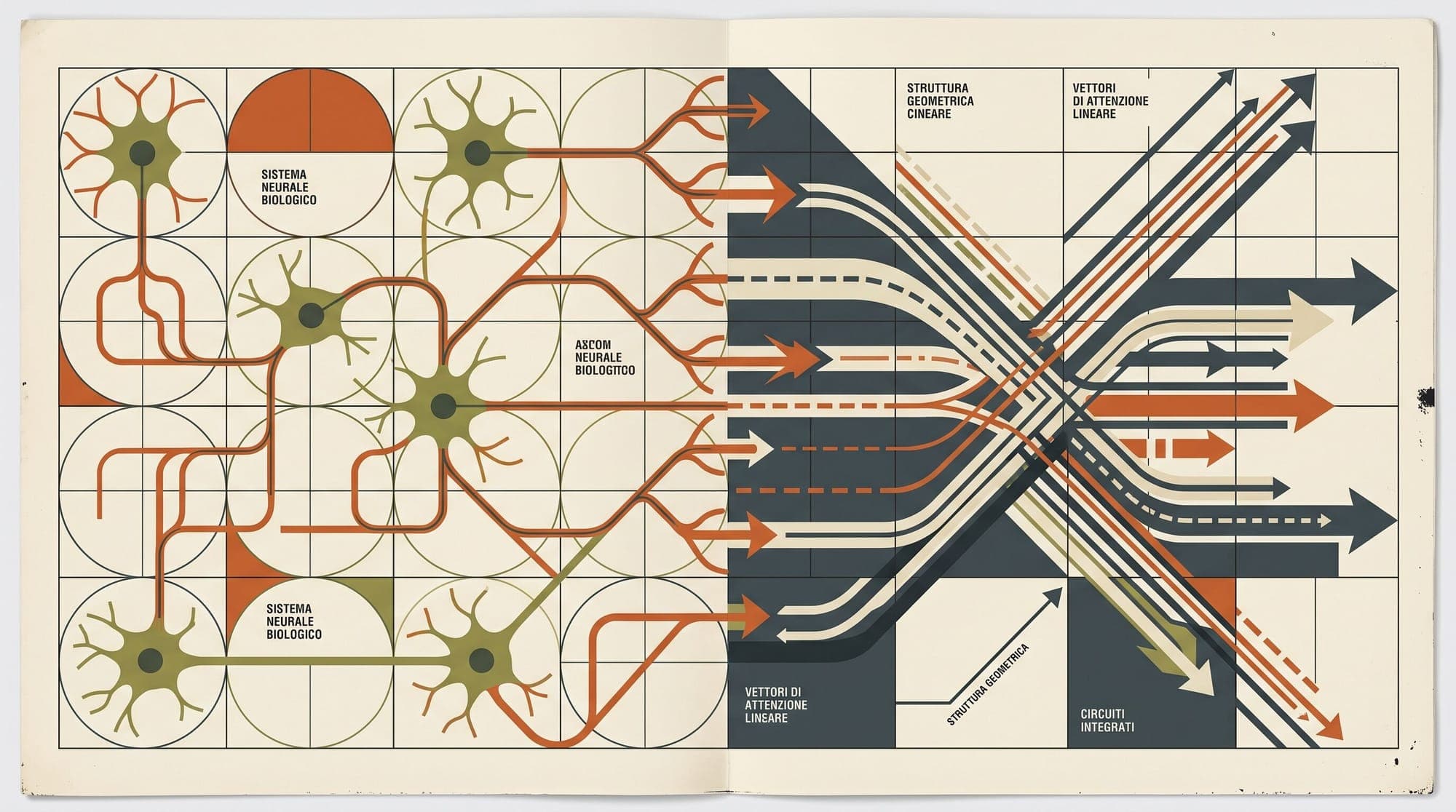
AI research company Pathway has secured additional capital at a $500 million valuation, bringing its total seed funding to $30 million. The company is developing a post-Transformer architecture dubbed Baby Dragon Hatchling (BDH) designed to combine continuous in-weights adaptation, long-horizon reasoning, and memory within neural representations without relying on expanding KV caches or external retrieval pipelines.

The BDH Post-Transformer Architecture
Standard Transformer architectures suffer from quadratic attention complexity relative to sequence length and separate context retention from model parameter weights. In contrast, Pathway's BDH architecture connects linear attention mechanisms with sparse key-query vectors and biologically inspired dynamic neural circuits.
According to Pathway, BDH scales contextual reasoning as a function of the model's active neuron capacity rather than a static sequence window limit. By maintaining internal state continuity, the architecture aims to support:
- Continuous In-Context Adaptation: The model modifies internal activation dynamics and state trajectories during runtime without requiring standard gradient fine-tuning.
- Linear Attention Scaling: Replacing standard softmax attention matrices with linear time-complexity mechanisms reduces memory bandwidth bottlenecks during inference.
- Internal Temporal Reasoning: Integrating memory directly into the network dynamics enables long-horizon multi-month enterprise business processes—such as continuous quarterly financial reconciliations—without ballooning KV cache memory footprints.
Compute Partnership and Enterprise Deployment
Pathway developed and trained BDH in partnership with Amazon Web Services (AWS), utilizing Amazon SageMaker HyperPod for distributed compute and cluster orchestration.
Alongside the foundation model architecture, the startup maintains the Pathway Framework—an open-source Python engine optimized for stream processing, real-time ETL, and streaming RAG pipelines. The new funding will support increasing BDH parameter scale and training broader models targeting mathematical reasoning and benchmarks such as ARC-AGI-2 and ARC-AGI-3.



