
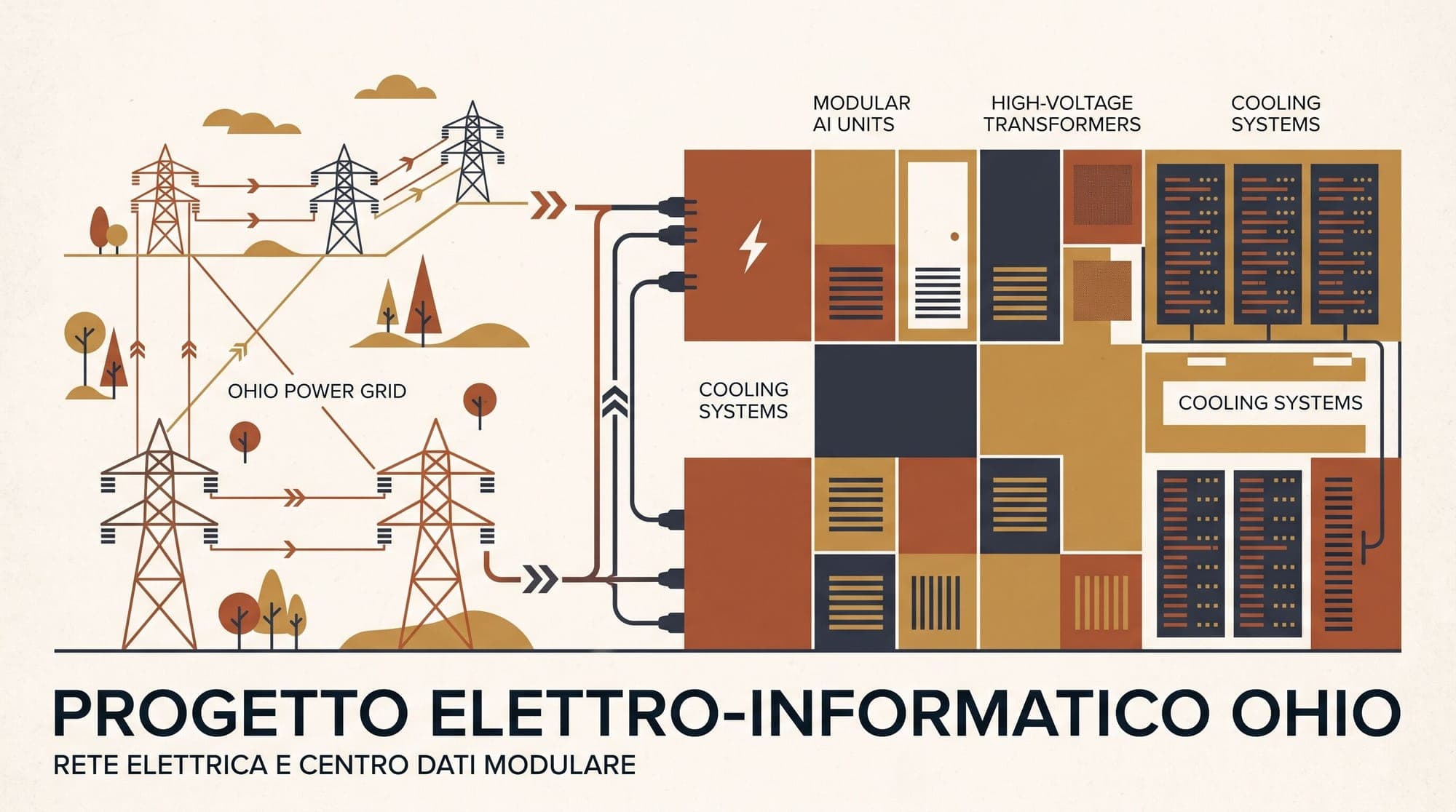
OpenAI has signed a 20-year lease agreement to anchor a multi-gigawatt AI data center campus in Pike County, Ohio, developed by SoftBank subsidiary SB Energy. Under the tripartite agreement, Nvidia will serve as the exclusive compute infrastructure provider and supply financial guarantees covering the site's land, power, and shell development.
The facility, designated the PORTS-Pike Technology Campus, is designed to support an initial 4.25 gigawatts of information technology load (IT-GW) dedicated to OpenAI workloads. Nvidia retains an option to secure an additional 3.75 IT-GW at the campus, bringing total planned compute capacity up to 8 IT-GW across the buildout.

Financing Structure and Nvidia Backstop
SB Energy will construct, own, and operate the physical data center infrastructure. To enable long-term debt financing for the multi-gigawatt campus, Nvidia is providing credit support and lease backstop commitments that could reach up to $105 billion over the lifespan of the facility.
Alongside the credit facilities, Nvidia announced a direct $1.5 billion equity investment in SB Energy to accelerate infrastructure deployment and grid interconnection. The project also establishes an initial $80 million community benefit fund in southern Ohio to support regional energy transition initiatives and workforce development.
The data center deployment will be built around Nvidia's DSX AI factory architecture, integrating high-density GPU clusters, custom CPUs, and NVLink optical switching fabrics.
Power Demands and Grid Realities
The 20-year commitment reflects the escalating difficulty frontier AI developers face in securing dedicated electrical grid capacity. Securing gigawatt-scale power allocations has become a primary gating factor for frontier model training, prompting labs to contract directly with independent power producers and infrastructure developers years in advance.
The Ohio project represents one of the largest single-site computing commitments signed to date, surpassing typical hyperscale campus footprints by an order of magnitude.
Sources
- Nvidia Newsroom: NVIDIA Guarantees SB Energy's PORTS-Pike Technology Campus in Ohio to Exclusively Host NVIDIA AI Compute
- OpenAI: OpenAI Joins PORTS-Pike Project
- Wall Street Journal: OpenAI Locks In Lease for Huge Data Center in Ohio with Backing from Nvidia
- crypto.news: OpenAI Secures 20-Year Ohio Data Center Lease Backed by Nvidia



