
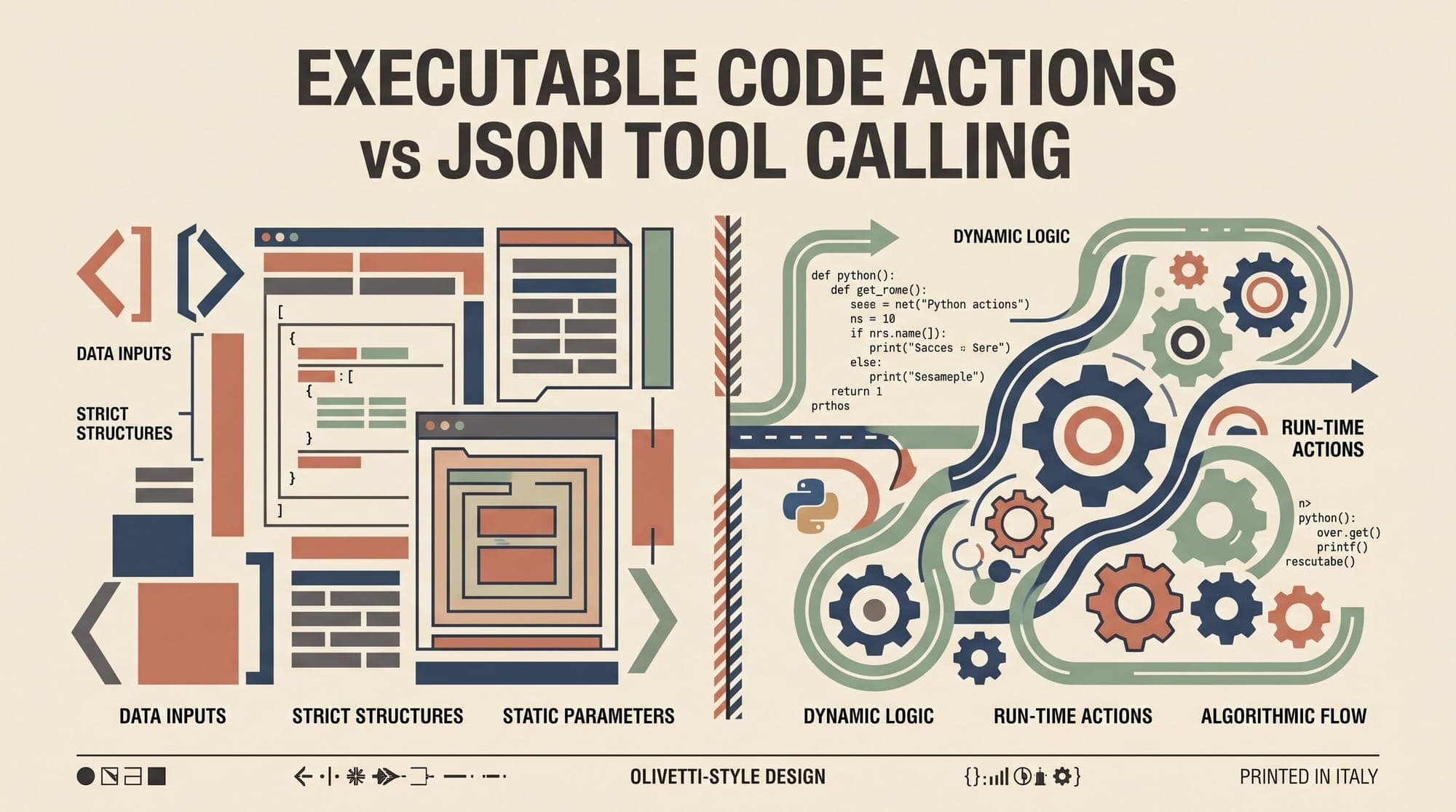
Executable Code Actions vs. JSON Tool Calling: Architecture, Token Economics, Sandboxing, and Expressivity in Production AI Agents
The dominant paradigm for connecting large language models to external tools has relied on structured JSON function calling. First standardized across commercial APIs via JSON Schema manifests and constrained decoding, this approach frames agent interaction as remote procedure calls (RPC): the model outputs a JSON object specifying a tool name and parameters, the host orchestrator parses the object, calls the corresponding function, and returns the serialized output back into the conversation context.
While structured JSON tool calling provides schema validation and deterministic boundary control, it introduces systemic bottlenecks when applied to complex, multi-step workflows. High token consumption, context window pollution from intermediate payloads, and latency compounding across sequential tool invocations have spurred an architectural shift toward Executable Code Actions (CodeAct). In this paradigm, agents generate executable code (primarily Python or shell scripts) to interact directly with APIs, libraries, and environments.

The Mechanical Bottlenecks of JSON Function Calling
Standard JSON tool calling operates through a synchronous request-response loop between the model and the application harness. While effective for single-shot operations like database lookups, multi-step tasks expose three architectural limitations:
1. The Multi-Turn Latency Tax
Every tool invocation under JSON calling requires a complete round-trip through the inference engine. If an agent must query an API for 20 distinct records, inspect each record, and filter the subset matching specific criteria, JSON function calling requires:
- 20 sequential LLM generations.
- 20 prefill passes over an ever-expanding conversation history.
- 20 network round-trips between the client and the model provider.
This serial execution pattern causes end-to-end latency to scale linearly with the number of atomic operations. For workflows involving search-filter-aggregate patterns, total completion time is dominated by model generation latency and context re-ingestion rather than tool execution speed.
2. Context Window Pollution and Token Inflation
Under the JSON RPC model, every tool output must be converted into string format (typically JSON or markdown) and appended to the context buffer. When an API returns a 100 KB payload containing 500 records, the entire payload enters the model's active context even if the downstream logic requires only a single scalar value or three fields.
This context inflation has direct operational costs:
- Financial overhead: Input token billing increases quadratically over multi-turn conversations as large payloads are repeatedly processed in subsequent prefill phases.
- Attention degradation: Diluting critical instructions with hundreds of lines of raw serialized data exacerbates "lost in the middle" phenomena and increases instruction-following drift.
- Context exhaustion: For workflows processing tabular datasets, PDF documents, or large API responses, the context window can be consumed before the reasoning chain completes.
3. Expressivity and Control Flow Limits
JSON objects cannot natively represent algorithmic control structures. An agent cannot execute a while loop, apply list comprehensions, handle transient exceptions with try/except, or conditionally branch based on intermediate calculations without returning control to the LLM. The model must serve as its own runtime interpreter, substituting token generation for basic control flow.
The Architecture of Executable Code Actions (CodeAct)
Executable Code Actions consolidate an agent's reasoning, tool dispatch, and data manipulation into a unified code execution space. Instead of emitting JSON payloads, the agent generates executable code snippets that execute inside a dedicated interpreter or sandboxed runtime.
+-------------------------------------------------------------------+
|                        CodeAct Architecture                       |
+-------------------------------------------------------------------+
|                                                                   |
|   1. LLM Generation: Multi-step Python script                     |
|      - Import tools / SDKs                                        |
|      - Loop constructs and branch logic                           |
|      - In-memory data filtering and transformation                |
|                                                                   |
|   2. Sandboxed Runtime Execution                                  |
|      - Executes code in isolated environment (MicroVM / AST)      |
|      - Captures stdout, stderr, and return values                 |
|      - Discards intermediate raw payloads from context            |
|                                                                   |
|   3. Minimal Context Ingestion                                    |
|      - Only printed results, distilled tables, or tracebacks      |
|        are appended to the conversational buffer                  |
|                                                                   |
+-------------------------------------------------------------------+
In-Memory Composition and Output Distillation
By operating in a standard Python or shell runtime, agents can leverage existing packages (requests, pandas, math, re) and user-defined tool wrappers. Intermediate data structures remain in memory during script execution.
For example, an agent tasked with identifying outlier transactions across multiple accounts can fetch thousands of records, process them in memory with Pandas, and print only the top three anomalies. The 500 KB raw transaction feed never touches the model's context window; only the final 200-byte summary is returned to the agent loop.
Native Error Handling and Pre-Trained Tracebacks
When a JSON tool call fails due to invalid parameters or unexpected schemas, the host must synthesize a descriptive error string to prompt correction. Conversely, modern frontier LLMs are heavily pre-trained on code repositories, stack traces, and compiler errors. When an executable action throws an exception, the standard Python traceback provides precise line-number localization and exception typing (KeyError, IndexError, TypeError), allowing the model to self-debug and patch code across iterative turns with high reliability.
Empirical Performance and Benchmarks
Empirical evaluations across academic and production benchmarks demonstrate clear efficiency and accuracy gains when shifting from JSON tool calling to executable code actions.
Task Success Rates on M³ToolEval and API-Bank
In the foundational CodeAct study by Wang et al. (ICML 2024 / arXiv:2402.01030), researchers evaluated 17 LLMs across API-Bank and M³ToolEval, a benchmark consisting of 82 complex tasks requiring multi-tool interaction across web browsing, scientific computing, and financial analysis.
Key findings include:
- Success Rate Improvements: On M³ToolEval, CodeAct improved task completion rates by up to 20.7% over JSON and text-based tool formats on models such as GPT-4.
- Turn Efficiency: CodeAct required an average of 2.1 fewer interaction turns per task compared to JSON tool calling, directly reducing total API requests.
- Self-Debugging: When models encountered runtime errors, code tracebacks enabled successful recovery in multi-turn interactions where JSON-based agents repeatedly stalled or repeated identical malformed requests.
Context Reduction in Coding and Software Engineering Agents
Recent evaluations of software engineering scaffolds on SWE-bench Verified demonstrate the quantitative impact of tool surfaces. Research published by Ablation Studies on Agent Tool Surfaces (arXiv:2607.10569) examined agents restricted to bash and execute_code primitives versus atomic JSON tool APIs.
The study noted that routing multi-step file manipulation, search, and data aggregation through programmatic code execution reduced token consumption by up to 98% to 99% compared to issuing individual tool calls for each atomic file read, grep, and patch operation.
Similarly, Hugging Face's smolagents library documented that its CodeAgent implementation substantially outperformed JSON-based ToolCallingAgent baselines on the GAIA benchmark, specifically on questions requiring dynamic composition, arithmetic verification, and web search filtering.
Security and Sandboxing in Production
While JSON function calling is safe by design because execution occurs strictly through predefined application code paths, Executable Code Actions introduce arbitrary code execution (ACE) risks. Running untrusted model-generated code in production requires rigorous isolation layers.
| Isolation Tier | Mechanism | Latency Overhead | Security Profile | Primary Use Case | | :--- | :--- | :--- | :--- | :--- | | Tier 1: AST-Restricted Interpreter | Abstract Syntax Tree traversal (e.g., smolagents LocalPythonExecutor) | < 1 ms | Low to Moderate (Prone to memory exhaustion and C-level bypasses) | Local developer prototyping and constrained mathematical operations | | Tier 2: WebAssembly / Pyodide | In-process WASM sandboxes (e.g., Pyodide running under V8 or Deno) | 5 - 20 ms | High (Safe memory sandbox, restricted syscalls) | Edge environments, browser agents, and stateless compute | | Tier 3: MicroVMs & Kernel Sandboxes | Hardware-virtualized microVMs (e.g., Firecracker via E2B, Modal, gVisor) | 20 - 100 ms | High to Enterprise-Grade (Full kernel isolation, network policy controls) | Production multi-tenant agent systems, arbitrary pip installs, full OS tooling |
Production Sandbox Architectures
For production deployments, three isolation patterns dominate:
- Ephemeral MicroVMs: Systems such as E2B and Modal provision isolated Linux environments backed by Firecracker microVMs or lightweight containers. Each agent session runs in its own guest kernel with strict CPU, memory, and disk quotas. Network egress can be disabled or restricted to whitelisted API gateways.
- Stateful REPL Sessions: For long-running interactive agents, persistent Jupyter kernels or Docker containers maintain in-memory state across multiple user turns, avoiding the overhead of re-importing libraries or re-fetching baseline datasets on each step.
- Execution Guardrails: Host systems enforce static analysis on generated scripts before execution, blocking access to sensitive environment variables, internal network sockets, or unauthorized system paths.
Architectural Decision Matrix
When architecting production LLM agent systems, teams should evaluate tool interfaces against workload characteristics:
When to Use JSON Function Calling:
- Deterministic CRUD Operations: Simple transactional APIs where operations are atomic, schema-validated, and do not require iterative filtering (e.g., updating a CRM record or booking a calendar event).
- Zero-Infrastructure Deployments: Serverless architectures where spinning up execution sandboxes adds unacceptable infrastructure complexity.
- Strict Host-Controlled Execution: Environments where security policies strictly forbid executing dynamic code.
When to Use Executable Code Actions:
- Data-Heavy Retrieval and Analysis: Workflows involving large payloads, CSV/SQL queries, and statistical computations where in-memory filtering avoids context window bloat.
- Multi-Step Tool Orchestration: Workflows that require looping, batching, pagination, or dynamic parameter passing across multiple services.
- Software Engineering and DevOps: Repository maintenance, test execution, script automation, and debugging tasks where terminal and Python execution are native primitives.
- Cost-Sensitive Multi-Turn Agents: Long-horizon tasks where reducing token round-trips is necessary to stay within budget constraints.
Sources
- Executable Code Actions Elicit Better LLM Agents (arXiv:2402.01030) - Wang et al., ICML 2024.
- When Does Restricting a Coding Agent to execute_code Help? (arXiv:2607.10569) - Agent-Design Ablation and Tool Surface Analysis.
- Hugging Face smolagents: Beating the GAIA Benchmark - Hugging Face.
- Secure Code Execution in smolagents - Hugging Face Documentation.
- SWE-bench Verified: Benchmark for Software Engineering Agents - Epoch AI.



