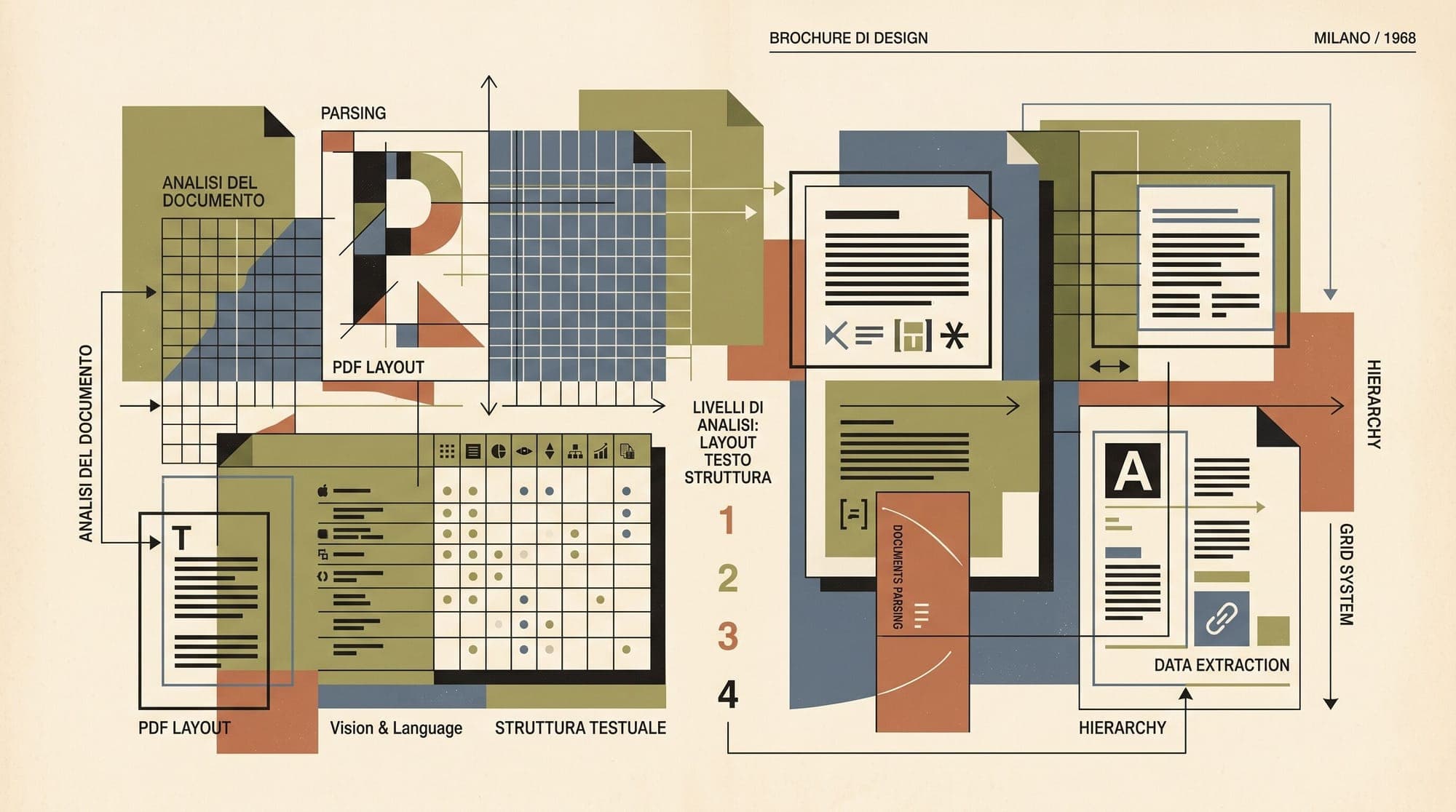
Production retrieval-augmented generation (RAG) and document agent systems often fail before a single vector embedding is calculated or an LLM prompt is constructed. The breakdown occurs at the document ingestion boundary. Standard text extraction utilities, such as pypdf or raw pdfminer, extract text streams sequentially without spatial awareness. When processing multi-column academic papers, financial reports with multi-header tables, or technical manuals with complex formulas, these naive extractors merge adjacent columns, destroy tabular cell relationships, and turn mathematical equations into unparseable character salad.
To solve this ingestion bottleneck, open-source document intelligence engines have transitioned from rigid OCR pipelines to hybrid vision-language architectures and modular multi-model cascades. These engines classify bounding boxes, reconstruct reading orders, parse table structures into semantic trees, and convert complex documents into structured intermediate representations such as markdown or hierarchical JSON.
Four open-source frameworks dominate production document parsing: IBM Docling, Marker, MinerU, and Unstructured. While all four convert complex PDFs and documents into LLM-ready formats, they diverge significantly in model architecture, computational overhead, licensing constraints, and downstream chunking ergonomics.

Architectural Deconstruction
1. IBM Docling: Modular Pipelines and Semantic Hierarchies
Developed by IBM Research and published under a permissive MIT license, Docling is engineered as an extensible, modular document conversion engine. Rather than relying entirely on a monolithic vision-language model, Docling orchestrates specialized models across distinct parsing stages:
- Layout Analysis: Utilizes object detection architectures trained on the DocLayNet dataset to identify functional document regions (paragraphs, titles, headers, footers, figures, and tables).
- Table Structure Recognition: Employs TableFormer, a vision-transformer architecture specifically trained to predict row, column, and spanning cell relationships, handling borderless and complex nested tables. Docling offers both fast and accurate TableFormer modes.
- OCR Fallback: Integrates multiple pluggable OCR backends, including EasyOCR, Tesseract, RapidOCR, and SuryaOCR, executing OCR only on scanned pages or image regions while parsing native PDF text directly.
- Granite-Docling & DocTags: Supports IBM Granite-Docling, an ultra-compact vision-language model using DocTags markup to preserve spatial and relational attributes across complex multi-modal pages.
- Data Model: Generates a unified
DoclingDocumentobject that preserves hierarchical reading order, parent-child section relationships, and bounding box coordinates, allowing lossless serialization into markdown, HTML, or structured JSON.
2. Marker: High-Throughput Transformer Vision and Math Extraction
Created by Vik Paruchuri and maintained under the GPL-3.0 license, Marker focuses on converting academic papers, books, and technical PDFs into clean markdown with high fidelity on mathematical expressions:
- Surya OCR & Layout Foundation: Built on top of Surya, a multilingual Vision Transformer (ViT) encoder-decoder system supporting over 90 languages. Surya handles line-level text detection, layout segmentation, reading order detection, and table recognition.
- Math and LaTeX Processing: Incorporates specialized models (originally Texify, now integrated into Surya) that translate complex block and inline mathematical formulas directly into KaTeX-compatible LaTeX.
- Heuristic and Neural Assembly: Combines transformer predictions with deterministic heuristics to filter repeated headers, suppress running footers, and stitch split paragraphs across page breaks.
- Inference Serving: Supports accelerated local execution via vLLM for GPU deployments and llama.cpp for CPU and Apple Silicon environments.
3. MinerU: Multi-Module Deep Extraction for Dense Scientific Documents
Developed by the OpenDataLab team at the Shanghai Artificial Intelligence Laboratory and released under the AGPL-3.0 license, MinerU is built on top of PDF-Extract-Kit for high-precision extraction from complex technical literature:
- DocLayout-YOLO: Implements custom-trained YOLOv8/YOLOv10 and LayoutLMv3 object detection backends optimized across 11 distinct document domains, achieving high mean Average Precision (mAP) on diverse textbook and paper layouts.
- UniMERNet Formula Recognition: Integrates UniMERNet to detect and parse intricate mathematical expressions into LaTeX, matching commercial math recognition engines on formula recognition benchmarks.
- TableMaster & PaddleOCR: Deploys specialized table recognition networks alongside PaddleOCR to extract dense multi-column tabular data and nested cross-page tables.
- Format Breadth: Beyond PDFs, MinerU provides native parsing pipelines for DOCX, PPTX, XLSX, and raw scanned image files.
4. Unstructured: Enterprise Document ETL and Element Partitioning
Maintained by Unstructured.io under the Apache-2.0 license, Unstructured operates as an enterprise ingestion layer designed for ingestion across dozens of enterprise file formats:
- Unified Document Partitioning: Exposes standardized partition functions (
partition_pdf,partition_docx,partition_pptx,partition_html) that map raw documents into a consistent taxonomy of typed elements (Title,NarrativeText,Table,Header,ListItem). - Strategy Selection: Provides granular execution modes:
fast(pure text extraction via pdfminer),ocr_only(tesseract/paddleocr text sweeps), andhi_res(layout detection via Detectron2, Chipper, or YOLOv8 models). - Chunking Integration: Ships native structure-aware chunking routines like
chunk_by_title, which bundle coherent sections together while respecting heading hierarchies and preserving table isolation. - Ecosystem Connectors: Features pre-built ingestion connectors for enterprise data stores including S3, Azure Blob, Google Cloud Storage, SharePoint, and Confluence.
Performance, Latency, and Hardware Profiles
Document parsing performance diverges sharply based on whether an engine operates on digital text layers or routes pages through vision models:
- Native Digital PDF Throughput: When processing PDFs with selectable text layers, Docling and Unstructured (
fastmode) operate at thousands of pages per minute on commodity CPU instances. They parse layout bounding boxes and extract existing character streams without invoking neural OCR. - Neural Vision Throughput: For scanned pages or image-heavy layouts requiring deep layout analysis, Marker and MinerU require dedicated GPU acceleration. Marker running on modern GPUs processes tens to hundreds of pages per minute per card, whereas MinerU's multi-stage pipeline (YOLO + UniMERNet + PaddleOCR) incurs higher per-page latency in exchange for maximum formula and table fidelity.
- Memory Footprints: Docling operates comfortably within 4 GB to 8 GB of system RAM on standard CPU servers. In contrast, running high-resolution layout detection with Detectron2 in Unstructured or full multi-model ensembles in MinerU typically requires 16 GB+ of VRAM on NVIDIA GPUs (such as A10G, L4, or A100 instances) to sustain high-throughput batch processing.
Table Structure and Mathematical Formula Fidelity
The primary failure mode of simple parsers is the corruption of tabular and scientific data:
- Table Structure Recognition: Docling's TableFormer and MinerU's TableMaster reconstruct the underlying HTML or Markdown table grid with column and row spans intact. In contrast, standard extractors flatten table cells into arbitrary whitespace-separated strings, breaking tabular RAG retrieval.
- Formula Recognition: MinerU (via UniMERNet) and Marker (via Surya LaTeX OCR) lead the open-source domain in mathematical accuracy. They convert inline symbols () and multi-line equations into syntactically valid LaTeX, allowing downstream LLMs to parse and execute scientific formulas accurately.
- Reading Order Recovery: Multi-column layouts often cause extractors to read horizontally across column gutters. Docling, Marker, and MinerU perform explicit reading order sorting based on detected layout trees, preserving logical narrative flow before chunking.
Production Ingestion and RAG Chunking Strategy
Selecting a parser is only half the engineering challenge; how downstream pipelines consume the output dictates retrieval quality.
Naive RAG pipelines extract markdown and immediately apply fixed-token sliding window chunkers. This practice discards the structural metadata generated by modern parsers:
- Structure-Aware Chunking: Instead of arbitrary 512-token cuts, production architectures chunk against the document hierarchy. Docling's
DoclingDocumentand MinerU's structural JSON expose section nodes and paragraph boundaries. Chunks should break on section headers (#,##) while keeping entire tables and code blocks atomic within a single chunk. - Table Representation in Embeddings: Tables should be embedded as clean Markdown or HTML strings, augmented with section header breadcrumbs (for example,
Document > Financial Results > Q3 Cash Flow). Flattening tables into text destroys key-value associations. - Contextual Chunk Enrichment: Attaching page numbers, document titles, and section hierarchy paths to chunk metadata enables vector databases to execute hybrid search with metadata pre-filtering.
Open-Source Licensing and Deployment Constraints
License compatibility is a critical architectural consideration for commercial applications:
- IBM Docling (MIT): Highly permissive. Suitable for proprietary SaaS, enterprise internal tooling, and commercial redistribution without reciprocal open-source obligations.
- Unstructured (Apache 2.0): Permissive open-source license. Easily integrated into commercial RAG pipelines and proprietary microservices.
- Marker (GPL-3.0): Strong copyleft. Deploying Marker as an embedded library inside proprietary applications can trigger open-source compliance requirements. Teams using Marker in proprietary architectures typically isolate it as an independent microservice behind an internal HTTP/gRPC API.
- MinerU (AGPL-3.0): Network-triggered copyleft. Using MinerU over a network in commercial SaaS backends requires careful legal review regarding code disclosure obligations, favoring isolated worker architectures or non-SaaS batch ETL pipelines.
Architectural Selection Framework
Engineering teams should select parsing engines based on document topology and infrastructure constraints:
- Enterprise RAG Across Mixed Formats (DOCX, PDF, PPTX) on Commodity Compute: Choose IBM Docling. Its MIT license, low CPU memory overhead, TableFormer accuracy, and structured
DoclingDocumentrepresentation make it the standard for enterprise document pipelines. - Academic Papers, Textbooks, and STEM Repositories: Choose Marker (for high-speed batch conversion to clean Markdown on GPUs) or MinerU (for maximum precision on complex LaTeX equations, dense multi-layer tables, and CJK multilingual documents).
- Broad Multi-Source Cloud Data Ingestion (S3, SharePoint, GCS ETL): Choose Unstructured. Its broad format support and integration with cloud storage providers provide an effective preprocessing foundation for diverse document corpora.
Sources
- Docling Technical Report (arXiv:2408.09869)
- Docling: An Efficient Open-Source Toolkit for AI-driven Document Conversion (IBM Research)
- IBM Granite-Docling: End-to-end document understanding
- MinerU: An Open-Source Solution for Precise Document Content Extraction (arXiv:2409.18839)
- PDF-Extract-Kit GitHub Repository (OpenDataLab)
- Surya Multilingual Document OCR & Layout Analysis (Datalab)
- Marker Document Conversion Project (Mozilla Builders / Vik Paruchuri)
- Unstructured Partitioning and Document Strategies Documentation
- Unstructured Chunking Strategies and Best Practices