Nvidia and Amazon channel billions into AI power infrastructure

Nvidia and Amazon are putting serious money into the power generation needed to keep AI data centers running, with two separate deals announced this week that underscore how energy has become a bottleneck for the industry. Nvidia is investing up to $3 billion in Lancium, the power infrastructure developer behind the OpenAI and Oracle data center in Texas, according to The Information. A roughly $2 billion stake would give Nvidia about 20 percent of the company, which is valued at around $10 bil

2 min
Nvidia and Amazon channel billions into AI power infrastructure

Nvidia and Amazon are putting serious money into the power generation needed to keep AI data centers running, with two separate deals announced this week that underscore how energy has become a bottleneck for the industry.

Nvidia is investing up to $3 billion in Lancium, the power infrastructure developer behind the OpenAI and Oracle data center in Texas, according to The Information. A roughly $2 billion stake would give Nvidia about 20 percent of the company, which is valued at around $10 billion. Lancium already has four gigawatts of power under contract in Texas and is developing sites for up to 15 more gigawatts.

Amazon, meanwhile, is backing a massive gas-fired power plant in Pecos County, Texas, to supply one of its own data centers. The facility could emit up to 33 million tons of CO2 per year, according to the New York Times, which would make it the dirtiest power plant in the country. Its 35 gas turbines are designed to generate up to 7.65 gigawatts of electricity.

Why power is the constraint

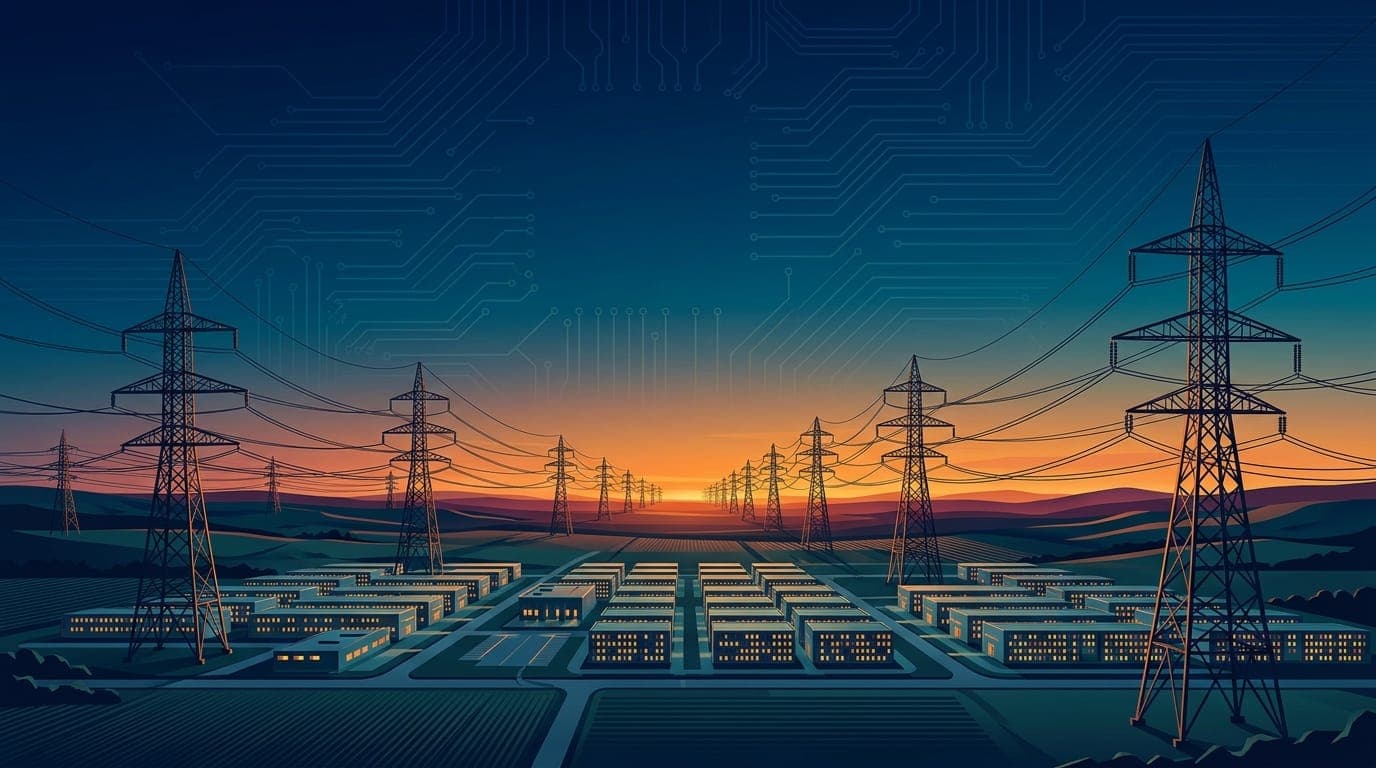
Editorial infographic comparing Nvidia's investment in Lancium power infrastructure with Amazon's Texas gas-fired power plant

The deals reflect a broader shift in the AI industry, where compute capacity is no longer the only limit on scale. Agentic AI workloads are dramatically more energy-hungry than simple chat prompts. Climate scientist Zeke Hausfather estimates that a heavy user of agentic AI burns about as much energy per year as a clothes dryer, and that figure is climbing.

Amazon spokesperson Margaret Callahan said the company's climate goals still stand but acknowledged that AI data centers could make hitting them harder. Environmental groups are raising alarms about health and pollution risks from the Texas facility.

The numbers are a reminder that AI expansion now depends on the power grid as much as on chips and model architecture. Both Nvidia and Amazon are effectively betting billions on the assumption that demand for AI compute will keep growing fast enough to justify the infrastructure.

Sources

AI's energy appetite drives Nvidia and Amazon to pour billions into massive power infrastructure (The Decoder, Aug 9, 2026): https://the-decoder.com/ais-energy-appetite-drives-nvidia-and-amazon-to-pour-billions-into-massive-power-infrastructure/

Nvidia to invest up to $3 billion in Blackstone-backed power firm behind Stargate (The Information): https://www.theinformation.com/articles/nvidia-to-invest-up-to-3-billion-in-blackstone-backed-power-firm-behind-stargate

Amazon data center and a record-setting polluting power plant in Texas (New York Times, Aug 8, 2026): https://www.nytimes.com/2026/08/08/climate/amazon-data-center-texas-pollution.html


Written by

More to read

  • Automated Prompt Optimization in Production: Signatures, Teleprompters, and Metric-Driven Compilation with DSPy

    Manual prompt engineering remains one of the largest sources of technical debt in modern LLM applications. Teams routinely spend weeks hand-crafting multi-paragraph system prompts, hardcoding few-shot examples, and tweaking phrasing to extract reliable outputs from specific model checkpoints. When the underlying model is upgraded, migrated to an open-weight alternative, or integrated into a multi-step pipeline, these hand-crafted strings break, requiring another cycle of trial-and-error adjustme

    1 min
  • Model Merging in Large Language Models: How Task Arithmetic, TIES, and DARE Combine Checkpoints Without Training

    Fine-tuning foundation models for specialized tasks typically produces isolated checkpoints. A model adapted for mathematical reasoning retains high numerical precision but often degrades in general dialogue or code generation. Traditionally, unifying these capabilities required multi-task training: gathering mixed datasets, re-running optimization across multiple GPUs, and managing gradient conflicts during backpropagation. Model merging provides an alternative paradigm. By operating directly

    1 min
  • Harvey Introduces Tenet, Its First In-House Legal LLM Trained on Moonshot's Kimi K3

    Legal AI startup Harvey has announced Harvey Tenet, its first proprietary, in-house foundation model tailored for legal workflows. The release marks a strategic shift for the $11 billion legal tech company, which has historically relied on API access to third-party frontier models from OpenAI and Anthropic. Tenet is post-trained on top of Kimi K3, an open-weights model released in July 2026 by Chinese AI lab Moonshot AI. The initiative is part of a broader platform update titled Harvey II, whic

    1 min