
Multi-Vector Late Interaction in Production: PLAID Indexing, Residual Compression, and Serving Architectures
Dense single-vector embeddings and cross-encoder rerankers represent the two traditional extremes of neural information retrieval. Single-vector models collapse entire documents into a single dense representation (typically 768 to 3,072 dimensions), losing token-level nuance, lexical precision, and localized facts. Cross-encoders preserve token interactions across the entire input sequence via full cross-attention, but their computational complexity ( per candidate document) makes large-scale first-stage retrieval cost-prohibitive.
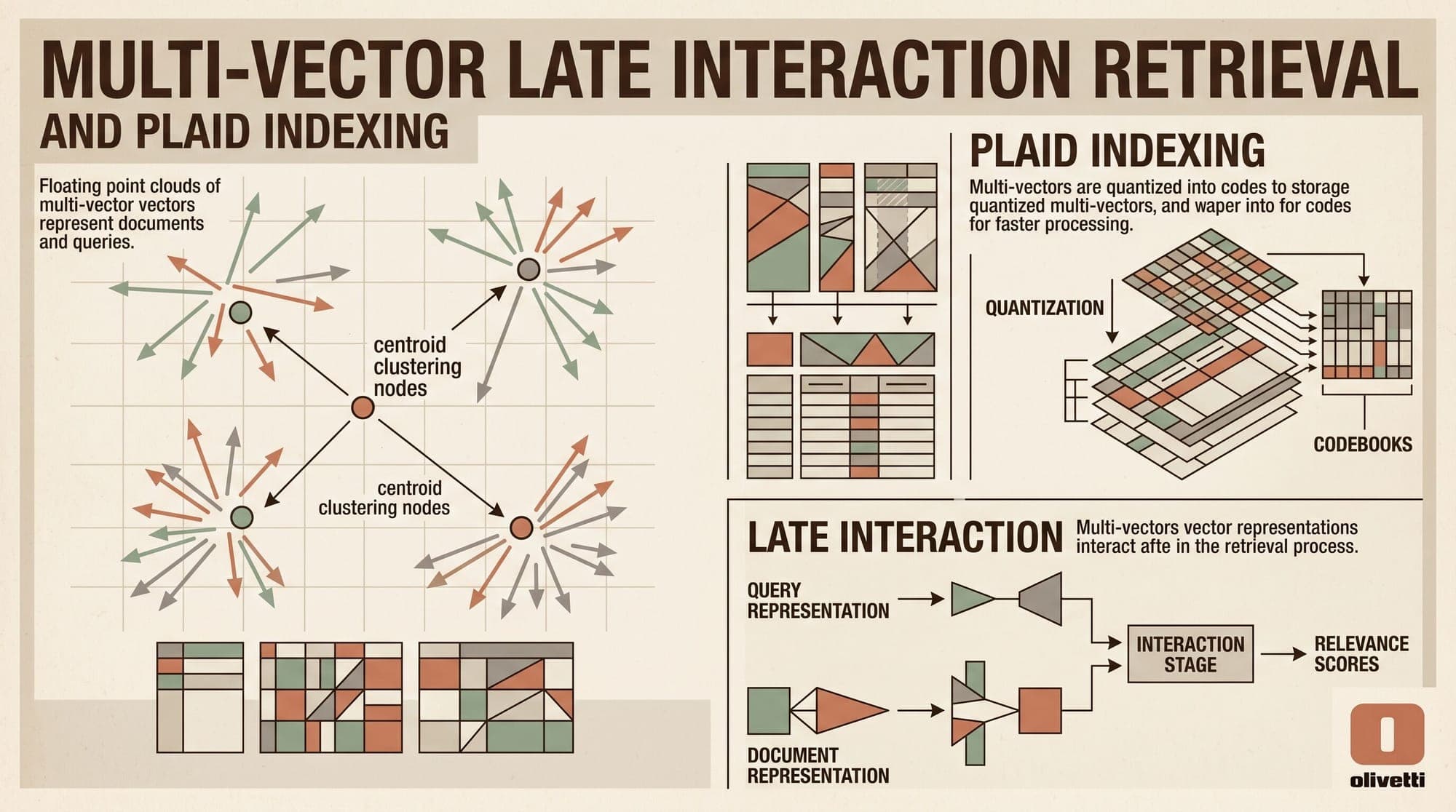
Multi-vector late interaction models, pioneered by ColBERT and extended to multimodal visual retrieval by ColPali, bridge this divide. Instead of compressing a document into one vector, late interaction produces an embedding for every token or visual patch. Query and document representations interact only at the final retrieval stage using the MaxSim operator, preserving fine-grained token alignments while precomputing document embeddings offline.
However, naive multi-vector serving creates a severe memory and bandwidth bottleneck. Storing hundreds of 128-dimensional FP16 vectors per document increases index footprint by two orders of magnitude compared to dense vectors, overwhelming RAM and memory bandwidth during scoring. Production deployments rely on specialized indexing engines like PLAID, residual compression in ColBERTv2, and hardware-accelerated binary quantization.

The Late Interaction Memory Dilemma
The late interaction score between query Q with token vectors {q_1, q_2, ..., q_|Q|} and document D with token vectors {d_1, d_2, ..., d_|D|} is defined by the Sum of Maximum Similarities (SumMaxSim):
Score(Q, D) = Sum_{i=1..|Q|} Max_{j=1..|D|} (q_i . d_j)
For typical embedding dimensions (d = 128) stored in 16-bit floating point (FP16), each token vector consumes 256 bytes. The storage implications scale rapidly with corpus size:
- Text Passages (ColBERT): An average passage length of 180 tokens yields 46.08 KB per document. A standard corpus of 10 million passages requires 460.8 GB of raw vector storage, compared to only 15.36 GB for a single 768-dimensional dense vector in FP16.
- Visual Documents (ColPali): A single PDF page encoded by a Vision-Language Model like PaliGemma generates approximately 1,030 patch tokens. At 256 bytes per token, each page requires approximately 263.7 KB. A collection of 10 million pages consumes over 2.63 TB of vector memory.
In addition to capacity constraints, computing exact MaxSim across millions of candidates is memory bandwidth bound. Gathering hundreds of vectors per candidate from DRAM to GPU registers creates severe latency bottlenecks if every token vector must be read in full precision.
ColBERTv2 Residual Compression
ColBERTv2 addresses the storage footprint by decoupling token vectors into cluster centroids and low-bit residual vectors.
Centroid Clustering and Residual Decomposition
During indexing, all token embeddings in the training corpus are clustered into K centroids using K-means, where K = 2^b (typically b = 16 to 18, yielding 65,536 to 262,144 centroids). Each document token vector d_j is mapped to its nearest centroid c(d_j):
c(d_j) = argmin_{c in C} ||d_j - c||_2
The residual vector r_j represents the displacement from the centroid:
r_j = d_j - c(d_j)
Quantization and Bit-Packing
Because token vectors cluster tightly around centroids in the projected 128-dimensional space, the residual vector elements follow a zero-centered distribution with small variance. ColBERTv2 quantizes each dimension of the residual vector to 1 bit (sign only) or 2 bits (sign and coarse magnitude).
The storage breakdown per token vector under 2-bit residual quantization consists of:
- Centroid Index: 16 to 18 bits (2 to 2.25 bytes).
- Residual Vector: 128 dimensions x 2 bits = 256 bits (32 bytes).
- Total Footprint: Approximately 34.25 bytes per token.
This represents an 86.6% reduction compared to raw FP16 storage (256 bytes), bringing a 10-million-passage index down from 460 GB to approximately 62 GB.
PLAID: Performance-Optimized Late Interaction
While ColBERTv2 compresses storage, searching the index remained bottlenecked by residual decompression. Evaluating candidate passages required reading and reconstructing uncompressed vector representations for thousands of documents.
The PLAID engine resolves this by using centroids not just for compression, but as search proxies to eliminate low-scoring passages before decompression occurs.
+-------------------------------------------------------------------+
|                        Query Tokens (Q)                           |
+-------------------------------------------------------------------+
                                  |
                                  v
+-------------------------------------------------------------------+
| 1. Query Centroid Mapping: Map each q_i to top-v centroids        |
+-------------------------------------------------------------------+
                                  |
                                  v
+-------------------------------------------------------------------+
| 2. Centroid Inverted Index: Retrieve posting lists of passage IDs |
+-------------------------------------------------------------------+
                                  |
                                  v
+-------------------------------------------------------------------+
| 3. Centroid-Only MaxSim: Approximate document scores via centroids|
+-------------------------------------------------------------------+
                                  | (Filter to top K_cand, e.g. 1024)
                                  v
+-------------------------------------------------------------------+
| 4. Centroid Pruning: Sparsify bag-of-centroids per candidate      |
+-------------------------------------------------------------------+
                                  | (Decompress only surviving subset)
                                  v
+-------------------------------------------------------------------+
| 5. Exact MaxSim Re-Ranking: SIMD dot product with residuals       |
+-------------------------------------------------------------------+
                                  |
                                  v
+-------------------------------------------------------------------+
|                        Top-k Ranked Results                       |
+-------------------------------------------------------------------+
1. Query-Centroid Mapping and Inverted Lists
For each query token q_i, PLAID identifies the top-v nearest centroids in the codebook (typically v between 8 and 16). The engine uses an inverted index mapping each centroid ID to the list of passage IDs containing tokens assigned to that centroid.
2. Centroid Interaction Score Approximation
Instead of decompressing token vectors immediately, PLAID computes an approximate MaxSim score for candidate documents using only the centroid embeddings:
Score_approx(Q, D) = Sum_{i=1..|Q|} Max_{c in C(D)} (q_i . c)
Where C(D) is the set of unique centroid IDs present in document D. Because the total number of unique centroids in a document is substantially smaller than the number of tokens, and centroid dot products are precomputed per query, this step filters the candidate pool down to a small candidate set (typically K_cand = 1,024) in single-digit milliseconds.
3. Centroid Pruning and Decompression
For candidates passing the threshold, PLAID applies centroid pruning: discarding token positions whose assigned centroids contribute negligibly to the upper bound of the MaxSim score. Only the remaining token residuals are decompressed into vector registers.
4. SIMD-Accelerated Exact MaxSim
The final exact score is computed on the surviving candidates using SIMD-optimized dot product kernels (AVX-512 on x86, NEON on ARM, or warp-level tensor instructions on GPU).
Across empirical benchmarks on MS MARCO and LoTTE, PLAID achieves a 7x latency reduction on GPU and up to 45x speedup on CPU compared to unoptimized ColBERTv2, maintaining identical retrieval effectiveness (less than 0.1% difference in MRR@10 and NDCG@10).
Visual Token Indexing with ColPali
ColPali extends late interaction to visual page search by feeding rendered PDF page images directly into a vision backbone (such as SigLIP or PaliGemma). Instead of running optical character recognition (OCR) and layout parsers, ColPali maps 32x32 image patches into 1,030 contextualized visual tokens projected to d = 128.
Visual Redundancy and Token Pruning
Visual documents contain extensive empty space, headers, margins, and uniform backgrounds. These produce visual patch embeddings that carry near-zero semantic information but consume substantial indexing capacity.
Production visual late-interaction pipelines apply token pruning strategies:
- Attention-Entropy Pruning: Patches with low self-attention variance across neighboring tokens are discarded during indexing.
- Centroid-Based Saliency Filtering: Patches that map to high-frequency background centroids (representing white or blank regions) are pruned from the document's posting lists.
Pruning 30% to 50% of visual patch tokens reduces per-page index size from ~35 KB (compressed) to ~18 KB with negligible impact on retrieval accuracy across document benchmarks such as ViDoRe.
Production Serving Frameworks
Serving late interaction models in production requires architectures optimized for high vector counts and low-latency sparse-dense operations.
+------------------------------------------------------------------------------------+
|                                Production Approaches                               |
+--------------------+--------------------------------+------------------------------+
| Architecture       | Mechanism                      | Primary Trade-Off            |
+--------------------+--------------------------------+------------------------------+
| Vespa Content Node | Native in-engine tensor MaxSim | Colocated compute, no network|
|                    | with binary Hamming distance   | hop; requires C++ engine     |
+--------------------+--------------------------------+------------------------------+
| Next-PLAID / ONNX  | Memory-mapped index (mmap),    | Minimal RAM overhead; NVMe   |
|                    | INT8/INT4 residual tables      | read latency on cache misses |
+--------------------+--------------------------------+------------------------------+
| Binary ColBERT /   | 1-bit sign quantization of     | Ultra-fast popcount kernels; |
| FastColPali        | embeddings; Hamming distance   | Small accuracy trade-off     |
+--------------------+--------------------------------+------------------------------+
| Dedicated Multi-   | Milvus / Qdrant multi-vector   | Standard DB API; network hop |
| Vector Databases   | field indexing with IVF-PQ     | for multi-vector payload     |
+--------------------+--------------------------------+------------------------------+
1. Colocated In-Node Evaluation (Vespa)
Vespa's late interaction implementation avoids transferring multi-vector payloads over the network by executing the MaxSim operator directly inside the content nodes. Vespa represents token embeddings as tensor attributes, evaluating candidate matching in C++ using AVX-512 popcount instructions.
2. Binary Late Interaction (FastColPali)
To maximize throughput without centroid clustering overhead, binary quantization converts 128-dimensional float vectors into 128-bit integer masks:
b_k = 1 if v_k > 0 else 0
MaxSim dot products are replaced by bitwise XOR and hardware popcount operations:
Sim_binary(q, d) = 128 - 2 * popcount(q XOR d)
This reduces storage to exactly 16 bytes per token and computes token similarities in sub-nanosecond instruction cycles.
3. Memory-Mapped Indices (Next-PLAID)
LightOn's Next-PLAID packages ColBERT models with ONNX Runtime, storing inverted indices and residual codebooks in memory-mapped (mmap) disk files. Operating systems page active centroid lists into the page cache on demand, enabling serving of millions of passages on budget instances with limited physical RAM.
Architectural Comparison and Serving Economics
+------------------------------------------------------------------------------------+
|                         Retrieval Architecture Comparison                          |
+----------------------+--------------------+--------------------+-------------------+
| Metric / Dimension   | Dense + Rerank     | ColBERTv2 + PLAID  | Binary Vespa      |
+----------------------+--------------------+--------------------+-------------------+
| Index Size (10M Docs)| ~15 GB (dense)     | ~62 GB (2-bit res) | ~29 GB (1-bit bin)|
| P95 Retrieval Latency| 35ms + 80ms rerank | 18ms - 45ms        | 8ms - 25ms        |
| First-Stage NDCG@10  | Moderate (~0.68)   | Very High (~0.74)  | High (~0.72)      |
| Primary Bottleneck   | Transformer FLOPS  | Memory bandwidth   | Vector gathering  |
| Throughput (QPS/GPU) | ~40 QPS            | ~180 QPS           | ~450 QPS          |
+----------------------+--------------------+--------------------+-------------------+
Production Selection Criteria
- Use ColBERTv2 + PLAID when retrieval accuracy on fine-grained textual details, code symbols, or legal clauses is critical, and index sizes fit within standard NVMe/RAM memory-mapping configurations.
- Use Binary Late Interaction (Vespa / FastColPali) when scaling to tens of millions of visual document pages where sub-30ms P95 latency and horizontal content-node scaling are required.
- Use Dense Bi-Encoder + Cross-Encoder Reranking when working with strict memory budgets under 16 GB and where a 2-stage pipeline latency (over 100ms) is acceptable.
Sources
- ColBERT: Efficient and Effective Passage Search via Contextualized Late Interaction over BERT (Khattab & Zaharia, SIGIR 2020)
- ColBERTv2: Effective and Efficient Retrieval via Lightweight Late Interaction (Santhanam et al., NAACL 2022)
- PLAID: An Efficient Engine for Late Interaction Retrieval (Santhanam et al., CIKM 2022)
- ColPali: Efficient Document Retrieval with Vision Language Models (Faysse et al., arXiv 2024)
- Scaling ColPali to Billions of PDFs with Vespa (Vespa Engineering Blog)
- Next-PLAID: Memory-Mapped ONNX Late Interaction Engine (LightOn)



