
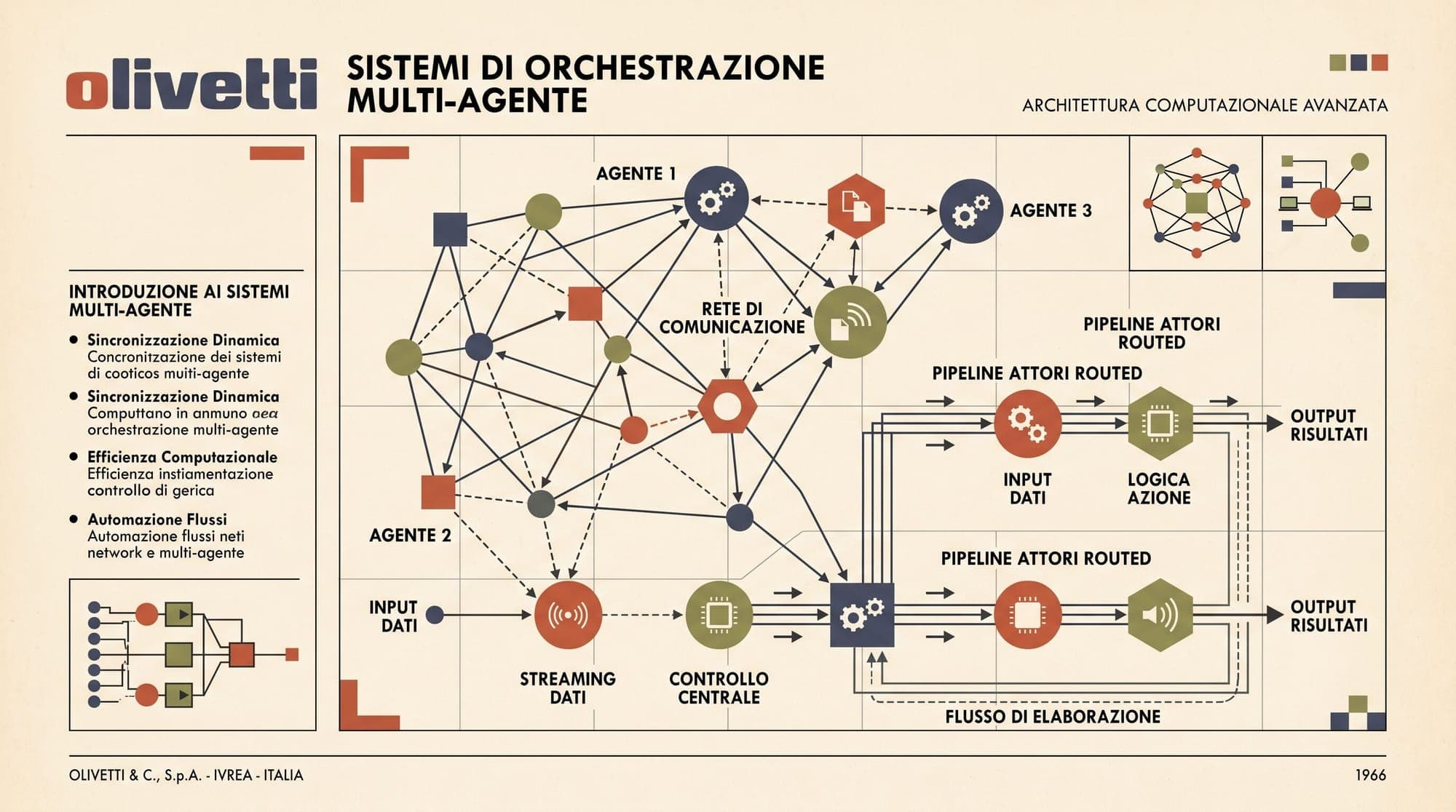
Multi-Agent Orchestration Frameworks in Production: Comparing LangGraph, AutoGen, CrewAI, and LlamaIndex Workflows Architecture, State Durability, Human-in-the-Loop Interrupts, and Serving Economics
As enterprise generative AI applications evolve beyond single-turn retrieval-augmented generation (RAG) and simple prompt pipelines, engineering teams face significant architectural hurdles in state management, cyclic execution, task delegation, and multi-agent coordination. Unconstrained LLM agent loops frequently suffer from non-deterministic execution paths, compounding token costs, fragile error recovery, and difficult debugging.
To address these failure modes, modern orchestration frameworks provide distinct abstractions for structuring agent interactions. Rather than treating multi-agent systems as informal prompt-swapping chat rooms, production frameworks implement formal distributed systems patterns: Pregel-inspired compute graphs, actor-model message passing, hierarchical task delegation, and event-driven reactive state machines.
This comparative analysis evaluates four prominent orchestration engines running in production environments: LangGraph (LangChain), AutoGen v0.4 / AG2 (Microsoft Research), CrewAI (CrewAI), and LlamaIndex Workflows (LlamaIndex). We examine their underlying execution models, state persistence layers, human-in-the-loop (HITL) primitives, token consumption overheads, and operational economics.
Architectural Paradigms: Graphs, Actors, Roles, and Event Queues
The primary differentiator among multi-agent frameworks lies in how they structure control flow and data exchange between isolated execution units.
+----------------------------------------------------------------------------------------------------+
|                               Multi-Agent Orchestration Paradigms                                  |
+----------------------------------------------------------------------------------------------------+
| LangGraph (Pregel Model)       | AutoGen 0.4 (Actor Model)    | CrewAI (Role Delegation)           |
| - Centralized StateGraph       | - Decentralized RoutedAgents | - Hierarchical Manager Agent       |
| - Super-step synchronization   | - Asynchronous message queue | - Sequential & delegated tasks     |
| - Deterministic reducers       | - Event-driven dispatch      | - Multi-tier memory stores         |
+----------------------------------------------------------------------------------------------------+
| LlamaIndex Workflows (Event-Driven Reactive State Machine)                                         |
| - Discrete @step methods subscribed to typed Event payloads via internal async queues              |
+----------------------------------------------------------------------------------------------------+
1. LangGraph: Cyclic Computation via the Pregel Algorithm
LangGraph models agent workflows as cyclic computation graphs inspired by Google's Pregel graph processing framework. In LangGraph, execution proceeds in synchronized discrete steps called super-steps:
- Nodes: Python functions representing agent steps, tool executions, or LLM transformations.
- Edges: Direct transitions or conditional routing functions (
add_conditional_edges) that inspect the central state to select the next destination node. - State Schema and Reducers: State is represented by a centralized schema (typically a
TypedDictor Pydantic model). When multiple nodes execute concurrently within a super-step, updates to state keys are merged deterministically using user-defined reducer functions (such asoperator.addfor appending messages).
This design ensures strict determinism: state updates occur only at super-step boundaries, preventing race conditions and simplifying runtime tracing.
2. AutoGen v0.4 (AG2): Asynchronous Actor Model
Microsoft's complete architectural rewrite in AutoGen v0.4 discarded brittle synchronous chat loops in favor of a layered, event-driven actor framework:
- AutoGen Core: Implements the classic Actor Model. Each agent is an independent actor inheriting from
RoutedAgentorBaseAgent, running behind a dedicated asynchronous message queue. Actors maintain private state and communicate exclusively by dispatching typed messages. - Agent Runtimes: AutoGen provides both a
SingleThreadedAgentRuntime(processing events on a localasyncioloop) and a distributedDistributedAgentRuntimeusing gRPC, enabling agents to operate across separate physical servers and network perimeters. - AutoGen AgentChat & Extensions: High-level abstractions for multi-agent teams (such as
RoundRobinGroupChatandSelectorGroupChat) layered over Core.
By decoupling message dispatch from agent processing logic, AutoGen eliminates blocking loops and allows agents to handle concurrent background tasks asynchronously.
3. CrewAI: Opinionated Role-Based Task Delegation
CrewAI implements a top-down, role-based abstraction centered on three core primitives: Agent, Task, and Crew (CrewAI Documentation). Control flow is configured via execution processes:
- Sequential Process (
Process.sequential): Tasks execute in linear order, passing accumulated context down the chain. - Hierarchical Process (
Process.hierarchical): A designatedmanager_llmor custommanager_agentautonomously delegates tasks to specialized worker agents, evaluates task outputs, and coordinates iterative refinements before returning final results.
CrewAI emphasizes high-level configuration over low-level control flow definition, packaging built-in memory stores, guardrail validations, and tool execution caching into its base classes.
4. LlamaIndex Workflows: Pure Event-Driven Reactive State Machines
LlamaIndex Workflows replaces static Directed Acyclic Graphs (DAGs) with a reactive, event-driven architecture:
- Execution units are standalone Python functions decorated with
@step. - Each step declares the exact event classes it consumes (for instance,
ev: StartEvent | ValidationErrorEvent) and emits new typedEventobjects back into an internal event queue. - Steps execute concurrently whenever a matching event appears in the queue. A workflow completes when any step yields a
StopEvent.
Because steps do not know which step executed before them or which will execute after them, LlamaIndex Workflows provides modular composability, particularly for complex RAG evaluation loops and self-correcting query pipelines.

State Durability, Checkpointing, and Time-Travel Debugging
Production multi-agent applications often run for minutes or hours and must survive network partitions, API rate limits, and server restarts.
+----------------------+-------------------+-------------------+-------------------+-------------------+
| Feature              | LangGraph         | AutoGen v0.4      | CrewAI            | LlamaIndex WFs    |
+----------------------+-------------------+-------------------+-------------------+-------------------+
| State Storage Model  | Centralized State | Actor-private     | Task context + DB | Event payload/Ctx |
| Checkpointer Engines | Postgres / Sqlite | Event stream logs | SQLite / ChromaDB | Step hooks        |
| Checkpoint Boundary  | Super-step        | Per-message       | Task boundary     | Step completion   |
| Time-Travel Debug    | Native fork       | Replay event log  | Task replay       | Event replay      |
| Fault Tolerance      | Auto-resume step  | Queue persistence | Task-level retry  | Event redelivery  |
+----------------------+-------------------+-------------------+-------------------+-------------------+
Checkpointing Mechanics in LangGraph
LangGraph serializes the entire state payload after every super-step into a persistent checkpointer backend (such as PostgreSQL via PostgresSaver). Because each state version receives an immutable checkpoint identifier (thread_ts or checkpoint_id), engineers can implement time-travel debugging:
- Inspect intermediate agent decisions at step N.
- Modify state variables (such as injecting corrected tool parameters).
- Fork execution into a new thread from that historical checkpoint without re-running preceding LLM calls.
Decentralized Actor State in AutoGen
In AutoGen 0.4, state is decentralized across actors. Each actor manages its own internal memory and registers message handlers. State persistence requires logging the event stream or serializing individual actor state dictionaries. While this avoids centralized bottlenecks in large distributed deployments, reconstructing global system state for debugging requires aggregating distributed event traces.
Human-in-the-Loop (HITL) and Dynamic Interrupts
Real-world agent systems executing destructive operations (financial transactions, code deployment, database schema modifications) require reliable pause-and-resume mechanisms.
# LangGraph: Native interrupt() primitive within a node
from langgraph.types import interrupt, Command
from typing import TypedDict

class OrderState(TypedDict):
    order_id: str
    amount: float
    status: str

def payment_gate_node(state: OrderState) -> Command:
    # Execution halts here; full state saved to checkpointer
    user_approval = interrupt({
        "question": f"Approve transaction of ${state['amount']} for order {state['order_id']}?",
        "context": state
    })

    if user_approval.get("approved"):
        return Command(goto="process_payment", update={"status": "approved"})
    return Command(goto="cancel_order", update={"status": "rejected"})
1. LangGraph: First-Class interrupt() Primitives
LangGraph provides native human-in-the-loop support via the interrupt() function (LangGraph Documentation). When an interrupt() call executes inside a node:
- The framework halts execution immediately and persists the current node incoming state to the configured checkpointer.
- The graph execution yields an
interruptpayload to the caller, freeing CPU and network resources. - The application can remain suspended indefinitely (hours or days).
- Upon receiving external user input via
graph.stream(Command(resume=user_input), config=config), LangGraph restores state and resumes the node from the exact point of interruption.
2. AutoGen: Interactive Message Handlers
AutoGen supports human interaction by registering human-proxy actors or setting human input modes (ALWAYS, NEVER, TERMINATE). In AutoGen 0.4, an actor can yield control to an asynchronous user prompt handler, publishing an event to the runtime queue when human input arrives.
3. CrewAI: Task-Level Human Feedback
CrewAI allows setting human_input=True on specific Task definitions. When a worker agent completes the task, CrewAI pauses and prompts the operator via standard console or callback hooks to provide review feedback. If the user requests corrections, the agent re-runs the task with the appended critique.
4. LlamaIndex Workflows: Event-Gated Validation
In LlamaIndex Workflows, human-in-the-loop is modeled as an asynchronous event exchange. A step emits a HumanReviewRequiredEvent, and the host application yields execution. Once human input is received, the host injects a HumanApprovalEvent into the workflow event queue to trigger downstream execution steps.
Multi-Turn Latency, Token Explosion, and Orchestration Economics
The economic viability of multi-agent architectures in production depends heavily on orchestration topology. Different paradigms exhibit drastically different token overheads and latency profiles.
Token Consumption Growth:
- LangGraph (Fixed Graph):           Linear O(N) with step count
- CrewAI (Hierarchical Delegation): Exponential O(N * M) if sub-delegation loops engage
- AutoGen (Group Chat Consensus):    Polynomial O(N^2) as message history broadcasts to all agents
1. The Token Multiplication Problem in Conversational Multi-Agent Systems
In conversational multi-agent setups (such as AutoGen group chats or unconstrained CrewAI hierarchical teams), every agent interaction appends messages to a shared conversation history. When K agents participate across T turns:
- Tokens processed scale quadratically: O(T^2 * K)
- System prompts and full message histories are re-encoded on every turn.
In production, this quadratic expansion leads to severe token accumulation, rapid context window saturation, and soaring inference costs.
2. Deterministic Graph Routing vs Dynamic Delegation
LangGraph and LlamaIndex Workflows minimize token overhead by maintaining structured, explicit state dictionaries. Instead of re-broadcasting entire conversational histories to every agent, each node receives only the specific state keys required for its subtask.
Furthermore, deterministic conditional edges eliminate runaway agent loops: routing decisions are governed by deterministic Python logic, structured JSON schema validations, or lightweight classifier calls rather than open-ended LLM deliberations.
+----------------------------------------------------------------------------------------------------+
|                                    Production Trade-Off Matrix                                     |
+----------------------------------------------------------------------------------------------------+
| Metric                 | LangGraph         | AutoGen 0.4       | CrewAI            | LlamaIndex WFs |
+------------------------+-------------------+-------------------+-------------------+----------------+
| Primary Abstraction    | Cyclic Pregel DAG | Actor Model       | Role / Task Crew  | Event Machine  |
| State Coordination     | Centralized       | Decentralized     | Centralized Task  | Event Queues   |
| Durability / Resume    | Production-Grade  | Event-Log Based   | Basic SQLite/DB   | Custom Hooks   |
| Debuggability          | Exceptional       | Good (Traces)     | Moderate          | High           |
| Token Efficiency       | High (O(N))       | Low-Mod (O(N^2))  | Moderate          | High (O(N))    |
| Learning Curve         | Steep (Systems)   | Moderate          | Low (Intuitive)   | Moderate       |
| Best Production Fit    | Complex workflows | Async simulation  | Rapid role teams  | Advanced RAG   |
+----------------------------------------------------------------------------------------------------+
Production Recommendations
Engineering teams selecting an orchestration framework should align their choice with workload requirements:
- Enterprise Mission-Critical Workflows (LangGraph): When systems require deterministic routing, strict database-backed state checkpointing, time-travel auditing, and robust human-in-the-loop pause/resume gates, LangGraph provides the most resilient primitives.
- Asynchronous Distributed Agents and Simulations (AutoGen v0.4): When building scalable systems where heterogeneous agents operate independently across network perimeters and exchange typed messages over message brokers, AutoGen 0.4 actor model offers superior architectural decoupling.
- Rapid Prototyping and Role-Centric Automation (CrewAI): When business stakeholders need intuitive role-based agents (such as researcher, copywriter, compliance reviewer) with minimal boilerplate, CrewAI offers the fastest path from concept to execution.
- Data-Centric and Cyclic RAG Pipelines (LlamaIndex Workflows): When building retrieval-heavy systems requiring dynamic query rewriting, document validation loops, and seamless integration with vector indexes, LlamaIndex Workflows delivers a clean, decoupled event-driven architecture.
Sources
- LangGraph Graph API Documentation
- LangGraph Interrupts and Human-in-the-Loop Guide
- Microsoft Research: AutoGen v0.4 Redesign Announcement
- AutoGen Core Architecture and Actor Model
- CrewAI Hierarchical and Sequential Process Concepts
- LlamaIndex Workflows: Event-Driven LLM Architecture
- Arize AI: Navigating Cyclical Agents with LlamaIndex Workflows



