Production AI agent architectures have evolved past single-prompt loops and linear chains into complex multi-agent systems. When systems require multiple specialized models, tools, and validation gates to collaborate, selecting an orchestration framework determines the application's runtime latency, fault tolerance, state persistence, and debugging overhead.
Four major frameworks dominate modern production multi-agent design: LangGraph, Microsoft AutoGen, CrewAI, and LlamaIndex Workflows. Each enforces a distinct execution philosophy, ranging from cyclic computation graphs and asynchronous actor systems to role-based hierarchical teams and event-driven state transitions.
This analysis evaluates these four frameworks across their core execution mechanics, state synchronization models, human-in-the-loop resumption capabilities, failure domains, and serving economics.
Core Architectural Paradigms
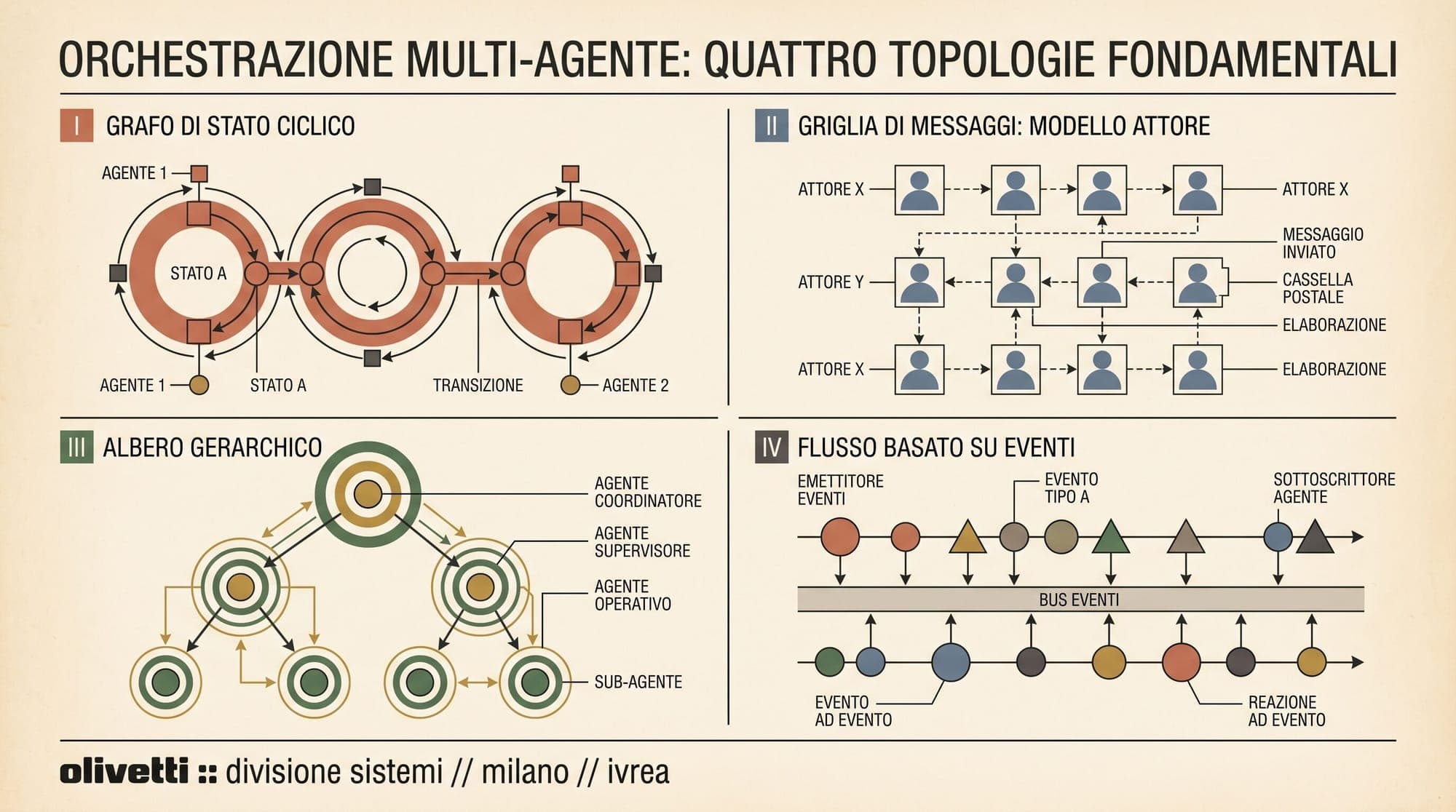
+-------------------------------------------------------------------------------+
|                      MULTI-AGENT EXECUTION TOPOLOGIES                         |
+-------------------------------------------------------------------------------+
| 1. LangGraph: Bulk Synchronous Parallel (BSP) Cyclic State Graph              |
|    [Node A] ---> [Super-step Barrier / Checkpoint] ---> [Node B]              |
|         ^                                                   |                 |
|         +----------------- (Conditional Edge) --------------+                 |
+-------------------------------------------------------------------------------+
| 2. AutoGen v0.4: Asynchronous Actor Model & Message Passing                   |
|    [Agent Actor 1] <==== (Async Messages / Mailbox) ====> [Agent Actor 2]     |
|          |                                                       |            |
|          +------------> [GroupChat / Team Runtime] <-------------+            |
+-------------------------------------------------------------------------------+
| 3. CrewAI: Role-Based Hierarchical Delegation                                 |
|    [Manager Agent] ---> Delegates Task A ---> [Specialist Agent 1]            |
|          |                                                                    |
|          +------------> Delegates Task B ---> [Specialist Agent 2]            |
+-------------------------------------------------------------------------------+
| 4. LlamaIndex Workflows: Typed Asynchronous Event Loops                       |
|    (StartEvent) ---> [@step Handler 1] ---> (CustomEvent) ---> [@step Handler 2]
+-------------------------------------------------------------------------------+
1. LangGraph: Cyclic Graphs on the Pregel Runtime
LangGraph models agent workflows as directed graphs that support cycles, loops, and conditional branching. Built on Google's Pregel Bulk Synchronous Parallel (BSP) model, execution proceeds through discrete "super-steps":
- Nodes as pure execution units: Nodes receive the current graph state, execute tool calls or model inference, and return updates.
- Channels as shared memory: Channels define how updates are merged (such as appending to lists or overwriting specific keys).
- Super-step barriers: In each super-step, active nodes execute concurrently. The runtime pauses at the barrier, writes updates to channels, executes configured checkpointers, and evaluates conditional edges to determine the next set of active nodes.
2. AutoGen (v0.4+): Asynchronous Actor Architecture
With the release of AutoGen v0.4, Microsoft re-architected the framework from a conversational prompt loop into an event-driven actor model divided into three modular layers:
autogen-core: The foundational layer providing asynchronous message passing, actor mailboxes, and distributed agent lifecycle management.autogen-agentchat: High-level abstractions includingAssistantAgent,GroupChat, andTeamorchestrators for multi-turn collaboration.autogen-ext: Pluggable extensions for tool execution, Docker sandboxes, and specific model clients.
Agents in AutoGen operate as independent state machines that communicate strictly via immutable messages, eliminating global shared memory bottlenecks.
3. CrewAI: Role-Based Hierarchical Task Delegation
CrewAI abstracts agents as human-like roles with explicit attributes: role, goal, and backstory. Execution is organized around Task objects and managed via two primary execution strategies:
- Sequential process: Tasks execute linearly in predefined order, passing structured outputs downstream.
- Hierarchical process: A manager agent dynamically delegates tasks to specialized subordinate agents based on their configured capabilities, validates intermediate outputs, and orchestrates task reallocation if sub-agents fail validation.
4. LlamaIndex Workflows: Type-Safe Event Loops
LlamaIndex Workflows avoids explicit graph definitions and role prompts, relying instead on Python's asynchronous event-driven model:
- Typed events: Inter-step communication is governed by Pydantic models inheriting from
BaseEvent. - Decoupled
@stephandlers: Step functions listen for specific event types, perform computation, and emit new events into the workflow context. - Dynamic routing: Steps can yield multiple events concurrently or collect multiple events before firing, enabling dynamic fan-out and fan-in workflows without central graph compiler overhead.

State Synchronization and Persistence
State management across distributed agent turns dictates whether an orchestration layer can survive container restarts, transient network failures, and multi-day execution pauses.
Checkpointing and Channel Reductions (LangGraph)
LangGraph Checkpoint captures full graph state at every super-step boundary. Each snapshot receives a monotonically increasing checkpoint identifier tied to a specific thread_id:
- State reduction: State channels use explicit reducers (such as
operator.addfor message histories or custom merging functions). - Storage adapters: First-party adapters serialize checkpoints to SQLite (
SqliteSaver), PostgreSQL (PostgresSaver), or in-memory key-value stores usingJsonPlusSerializerto handle non-standard objects. - Time-travel debugging: Because every checkpoint version is preserved, developers can rewind graph execution to any prior step and branch execution along new paths.
Actor Mailboxes and Message Logs (AutoGen)
AutoGen decouples agent state by isolating memory inside individual actor instances:
- No global state vector: State is preserved within each agent's internal history and conversation logs.
- Event stream replay: Distributed runtimes serialize message streams across actor boundaries, ensuring that resuming a conversation requires replaying messages through the actor's event handler.
Task Context Handoffs (CrewAI)
CrewAI manages state at the task and crew level:
TaskOutputpropagation: Outputs from completed tasks are injected into subsequent task context windows either as raw text or structured Pydantic schemas.- Memory subsystem: CrewAI includes integrated short-term memory, long-term memory (backed by vector stores like Chroma), and entity memory to preserve facts across distinct tasks.
Context Queues and Event Collection (LlamaIndex Workflows)
LlamaIndex Workflows maintains state via the execution Context:
- Shared context dictionary: Step functions access thread-safe context storage (
ctx.setandctx.get) alongside typed event payloads. - Event aggregation: The
ctx.collect_eventsmethod buffers arriving events until all prerequisite event types are available, providing native synchronization barriers without custom locks.
Human-in-the-Loop and Resumption Semantics
Production agent systems require human oversight for sensitive operations, such as executing financial transactions, modifying production infrastructure, or approving high-stakes external messages.
LangGraph: Breakpoints and update_state
LangGraph provides native human-in-the-loop controls through graph compilation arguments:
- Static breakpoints: Specifying
interrupt_before=["node_name"]orinterrupt_after=["node_name"]halts graph execution at super-step boundaries. - Dynamic state modification: External human reviewers can inspect the current checkpoint via
get_state(config)and inject corrected values or approvals viaupdate_state(config, values, as_node="human_reviewer"). - Seamless resumption: Calling
invoke(None, config)resumes graph execution directly from the modified checkpoint without re-running previous nodes.
AutoGen: Function Approval Content Handlers
In AutoGen v0.4, human-in-the-loop workflows operate through structured message types:
- Tool approval requests: When an agent determines a tool call is necessary, it emits a
FunctionCallApprovalRequestevent. - Execution pause: The agent stops processing until a client sends a matching
FunctionCallApprovalResponseback to the actor's mailbox. - Interactive CLI and Webhooks: Approvals can be routed to interactive terminal sessions or webhook endpoints for asynchronous review.
CrewAI: Task-Level Human Review
CrewAI embeds human interaction at the individual task definition:
human_input=True: Configuring a task with human input prompts the operator for feedback once the assigned agent generates an initial draft.- Iterative refinement: Human comments are routed back to the agent as refinement prompts until the output is approved or iteration limits are reached.
LlamaIndex: Input Events and Streaming Hooks
LlamaIndex Workflows handles pauses through event stream suspension:
- Custom input events: Workflows can emit an
ApprovalRequiredEventand wait for an incomingHumanApprovalEvent. - Async queue integration: Web services can pause the workflow handler, persist the run identifier, and resume execution once the webhook delivers the approval payload to the event bus.
Failure Domains and Error Recovery
Multi-agent systems introduce failure modes distinct from standard software pipelines, including context saturation, recursive delegation loops, and non-deterministic routing deadlocks.
+------------------------------------------------------------------------------------+
|                         PRODUCTION FAILURE MODES BY FRAMEWORK                      |
+------------------------------------------------------------------------------------+
| LangGraph:                                                                         |
|   - Risk: Unbounded cyclic graph execution.                                        |
|   - Mitigation: Strict 'recursion_limit' parameter and per-node retry policies.    |
+------------------------------------------------------------------------------------+
| AutoGen v0.4:                                                                      |
|   - Risk: Agent chatter loops and redundant peer messages.                         |
|   - Mitigation: Explicit termination conditions ('MaxMessageTermination').        |
+------------------------------------------------------------------------------------+
| CrewAI:                                                                            |
|   - Risk: Manager delegation ping-pong and hallucinated role handoffs.             |
|   - Mitigation: Disable 'allow_delegation' on leaf workers; hard iteration caps.   |
+------------------------------------------------------------------------------------+
| LlamaIndex Workflows:                                                              |
|   - Risk: Unhandled orphan events leaving async loops permanently pending.         |
|   - Mitigation: Strict Pydantic event contracts and global execution timeouts.     |
+------------------------------------------------------------------------------------+
Delegation Loops and Chatter Control
- CrewAI delegation overhead: In hierarchical configurations, manager agents frequently enter recursive loops by re-delegating tasks back and forth between analysts. Restricting
allow_delegation=Falseon leaf agents and enforcing explicit output validators prevents circular delegations. - AutoGen termination conditions: AutoGen requires combining multiple termination predicates (such as
MaxMessageTermination,TextMentionTermination("TERMINATE"), and timeout limits) to avoid runaway token consumption in multi-agent group chats. - LangGraph recursion limits: LangGraph enforces a mandatory
recursion_limit(defaulting to 25 super-steps), terminating runs with aGraphRecursionErrorif nodes cycle indefinitely.
Context Window Pollution and Token Inflation
When agents exchange unpruned message histories, prompt token volume grows quadratically with turn count:
- LangGraph: Encourages explicit message trimming nodes using utility filters like
trim_messagesto cap historical context before invoking model APIs. - LlamaIndex: Decouples event payloads from global history, ensuring individual steps only receive data explicitly encapsulated within their triggered event.
Serving Economics and Architectural Selection
Choosing the right framework requires balancing operational complexity against structural control.
Framework Evaluation Summary
- LangGraph:
- Best For: Complex enterprise workflows with strict conditional paths, multi-step validation loops, state time-travel, and deep human-in-the-loop requirements.
- Strengths: Deterministic execution model, robust checkpointers (Postgres/SQLite), granular sub-graph composability.
- Weaknesses: Steep learning curve, boilerplate required for simple agent pipelines.
- AutoGen (v0.4+):
- Best For: Collaborative multi-agent research, open-ended problem solving, automated red-teaming, and distributed actor-based systems.
- Strengths: True asynchronous actor architecture, multi-agent conversational patterns, clean layered architecture.
- Weaknesses: Higher non-determinism in group chats, complex debugging across distributed actors.
- CrewAI:
- Best For: Rapid prototyping of role-driven team workflows, content generation pipelines, and business process automation with structured roles.
- Strengths: High-level intuitive API, clear role/task abstractions, built-in memory connectors.
- Weaknesses: Manager delegation loops can incur unexpected token costs; rigid abstractions limit non-standard graph topologies.
- LlamaIndex Workflows:
- Best For: Complex RAG pipelines, data ingestion flows, and event-driven document processing systems.
- Strengths: Minimalist Pythonic syntax, native Pydantic typing, zero graph compilation overhead, seamless integration with LlamaIndex data loaders and vector indexes.
- Weaknesses: Less built-in multi-agent conversational machinery compared to AutoGen or CrewAI.
Sources
- LangGraph Pregel Runtime API Reference
- LangGraph Checkpointing Concepts and Storage Adapters
- Microsoft Research: AutoGen Multi-Agent Framework Publication
- CrewAI Hierarchical and Sequential Process Documentation
- LlamaIndex Workflows Architecture and Event-Driven Orchestration
- LlamaIndex Workflows Beta Technical Overview