
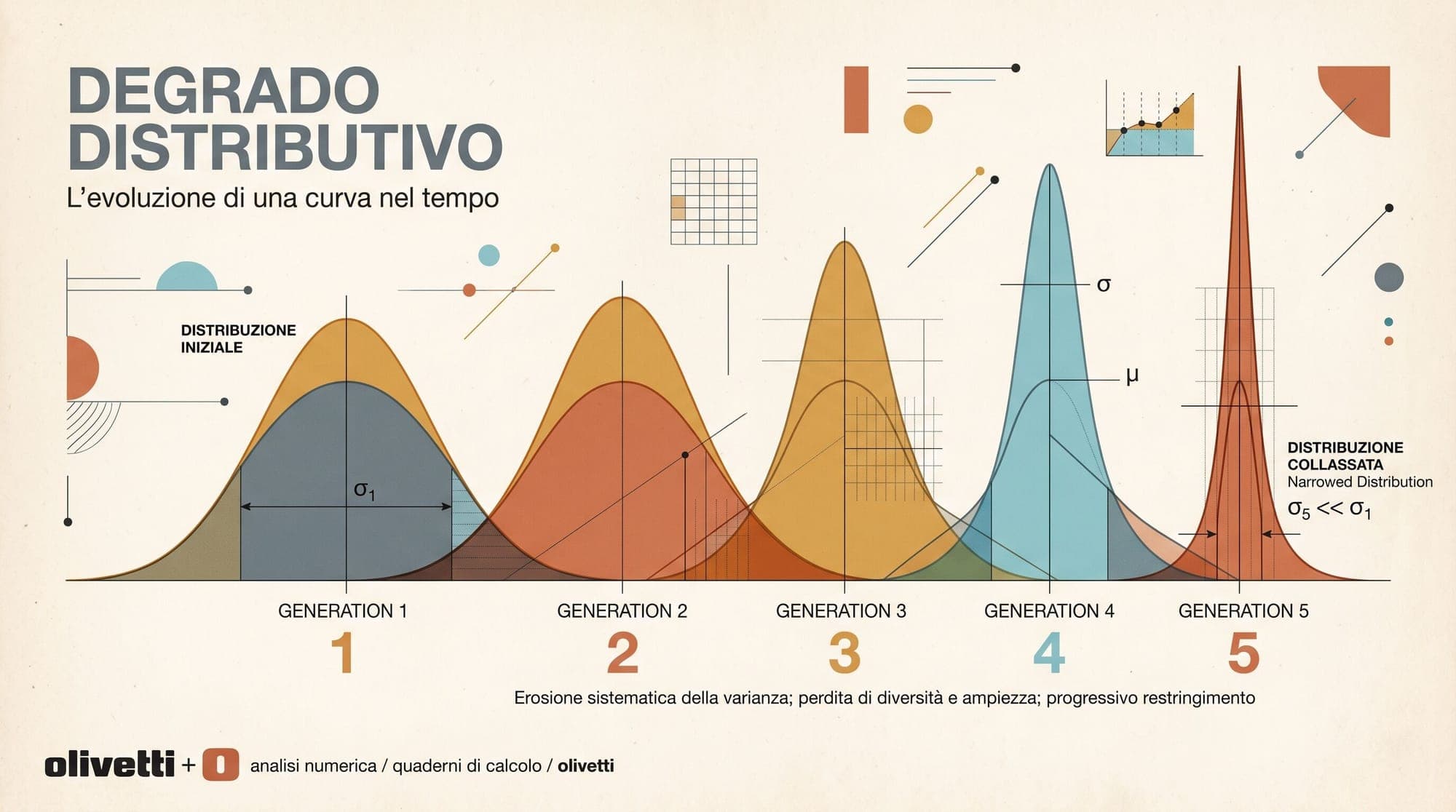
As large language models scale and generate a growing share of digital text, code, and media, the web datasets used to train next-generation models increasingly consist of machine-generated outputs. When generative models are trained recursively on data produced by earlier model generations without sufficient ground-truth anchoring, they undergo a systematic degradation process known as model collapse.
First formalized in foundational statistical literature and demonstrated across modern deep learning architectures by researchers at Oxford, Cambridge, Toronto, Stanford, and Rice, model collapse represents an irreversible deterioration in model expressiveness, statistical variance, and output diversity.
Understanding how model collapse emerges, why variance contracts over recursive generations, and how production pipelines distinguish between degenerative synthetic loops and verified synthetic reasoning is critical for modern foundation model development.
The Generational Feedback Loop
Model collapse is a degenerative learning process that occurs when successive generations of machine learning models consume synthetic data generated by their predecessors. The process operates as a discrete-time Markov chain over model parameters:
- A base model is trained on an initial dataset sampled from the true human distribution .
- The model parameters approximate a predictive distribution .
- Synthetic samples are drawn from via Monte Carlo sampling.
- A descendant model is trained on , fitting an updated approximation .
- The cycle repeats recursively for generations .

In a seminal 2024 paper published in Nature, researchers Ilia Shumailov, Zakhar Shumaylov, Yiren Zhao, Nicolas Papernot, Ross Anderson, and Yarin Gal categorized this degenerative progression into two distinct operational phases:
- Early Model Collapse: The model begins losing information about the tails of the original data distribution. Low-probability vocabulary, rare syntactic structures, minority viewpoints, and nuanced domain facts disappear from generated outputs. The model retains high-probability modes but experiences a significant narrowing of variance and semantic diversity.
- Late Model Collapse: The model undergoes severe representation collapse. The predictive distribution converges to a degenerate state (approaching a delta function or trivial periodic loops), where outputs lose all structural resemblance to the original human data distribution and perplexity on real-world validation sets diverges toward infinity.
A related framework introduced by Sina Alemohammad et al. in their ICLR 2024 paper on Model Autophagy Disorder (MAD) identified two parallel mathematical phenomena in self-consuming generative models: mean drift, in which the empirical centroid of the model distribution drifts away from the true data distribution via a random walk, and variance collapse, in which the effective support of the distribution contracts toward zero.
Mathematical and Statistical Error Mechanisms
Model collapse is driven by three compounding error sources that accumulate across successive training generations:
1. Statistical Approximation Error (Finite Sample Variance)
Because training sets are finite, drawing samples from a generative model introduces Monte Carlo sampling noise. For any low-probability event where , the probability that is omitted entirely from a finite synthetic sample of size is given by:
Once a rare event or low-frequency token is omitted from dataset , the next-generation model receives zero empirical gradient signal for that state. Consequently, assigns an even lower probability mass to than did. Over multiple iterations, this creates an absorbing boundary: tail events vanish completely, and probability density concentrates exclusively around the highest-density modes.
2. Functional Approximation Error (Expressiveness and Inductive Bias)
Neural networks are parameterized function approximators with finite capacity. Loss functions (such as cross-entropy or mean squared error), network architectures, normalization layers, and weight regularizers impose continuous, smooth inductive biases. When fitting a model to empirical data, the model smooths over sharp local modes and underestimates multimodality.
When the next model generation fits to samples generated from this smoothed distribution, it applies its own functional smoothing on top of the previous approximation. As shown by Shumailov et al., even in the theoretical limit of infinite sample size (), functional approximation errors compound monotonically, ensuring that the estimated density becomes progressively sparser and flatter over generational time.
3. Optimization and Algorithmic Error
Empirical risk minimization via stochastic gradient descent (SGD) or AdamW does not compute exact maximum likelihood parameters. Learning rate schedules, batch stochasticity, early stopping, and non-convex loss landscapes introduce optimization noise. In recursive training, these optimization residuals alter the parameter trajectories, accelerating both mean drift and variance reduction.
Data Replacement vs. Data Accumulation
The severity and inevitability of model collapse depend heavily on dataset curation policy across generations. In an extensive theoretical and empirical study titled Is Model Collapse Inevitable? Breaking the Curse of Recursion by Accumulating Real and Synthetic Data, Matthias Gerstgrasser et al. analyzed the mathematical boundary between data replacement and data accumulation:
- The Replacement Regime ( only): If each new model generation is trained exclusively on the synthetic outputs of the immediately preceding model, test error grows without bound. The distance between the learned distribution and the true data distribution increases with each iteration step , leading inexorably to late-stage collapse.
- The Accumulation Regime (): If historical data is retained and accumulated across generations alongside newly produced synthetic data, test error remains bounded. The inclusion of the original ground-truth dataset acts as a regularizing anchor, preventing the Markov chain from drifting arbitrarily far from the true data manifold.
Replacement Regime (Degenerative):
D_0 (Human) -> Model 0 -> D_1 (Synthetic) -> Model 1 -> D_2 (Synthetic) -> Model 2 [Unbounded Error / Collapse]

Accumulation Regime (Bounded):
D_0 (Human) -> Model 0 -> (D_0 + D_1) -> Model 1 -> (D_0 + D_1 + D_2) -> Model 2 [Bounded Error]
This theoretical distinction has major real-world ramifications for web crawlers. If public web scraping indiscriminately replaces legacy human-written text with unverified, auto-generated web content, web-scale pre-training datasets transition from the accumulation regime to the replacement regime, exposing downstream foundation models to accelerated collapse.
Empirical Manifestations in Autoregressive Language Models
When transformer-based autoregressive language models undergo recursive training on their own unverified outputs, the degradation manifests across several measurable dimensions:
1. Lexical and Syntactic Homogenization
Language models trained recursively exhibit a steep decline in lexical diversity metrics, such as Type-Token Ratio (TTR) and distinct -gram counts. The models converge toward repetitive, stereotypical linguistic patterns. Phrases that were moderately frequent in the original distribution become dominant ("the jackpot effect"), while idioms, technical jargon, dialectal variations, and complex syntactic clauses are systematically pruned.
2. Validation Perplexity Divergence
While a recursively trained model may report decreasing training loss on its own synthetic training set, its evaluation perplexity on held-out human benchmark corpora (such as WikiText-103, Lambada, or C4) degrades rapidly. After 5 to 10 generations of unanchored recursive fine-tuning, autoregressive models often enter late-stage collapse, generating looping sequences of repetitive tokens or incoherent sentence fragments.
3. Loss of Long-Tail Knowledge and Multi-Lingual Capabilities
Low-resource languages and specialized technical domains (such as niche legal codes, medical subdisciplines, or uncommon programming languages) represent statistical tails in web-scale corpora. In recursive loops, these domains suffer near-total erasure first. A model that initially possessed basic competence in dozens of languages contracts to a narrow subset of high-resource languages within a few recursive iterations.
Why Synthetic Data Works in Reasoning Pipelines
The existence of model collapse raises an apparent paradox: frontier AI labs increasingly rely on massive synthetic data generation to train state-of-the-art reasoning models, code generators, and mathematics solvers without suffering collapse.
The resolution lies in the distinction between unguided generative sampling and verified, grounded synthetic data pipelines:
| Dimension | Unguided Generative Sampling (Collapses) | Verified Synthetic Pipeline (Stable / Improves) | | :--- | :--- | :--- | | Generation Type | Free-form natural language continuation | Structured reasoning traces, code, proofs | | Filtering Mechanism | None or raw model likelihood | Deterministic execution, formal compilers, PRMs | | Ground Truth Anchor | Zero human or oracle verification | Grounded in formal logic, unit tests, or human seeds | | Error Propagation | Hallucinations and bias compound recursively | Incorrect trajectories are filtered and rejected | | Mathematical Role | Unanchored Monte Carlo sampling | Policy improvement via search and rejection sampling |
1. Deterministic Execution and Formal Oracles
In domains like code generation and mathematics, synthetic samples can be verified by external, deterministic execution engines:
- Code execution: Generated programs are run against automated test suites and linters. Code that fails unit tests or syntax validation is rejected.
- Formal mathematics: Mathematical reasoning steps are verified using formal proof assistants (such as Lean 4, Isabelle, or Coq) or symbolic computation engines.
- Process Reward Models (PRMs): Step-by-step verifiers evaluate intermediate reasoning steps, isolating errors before they propagate into the training corpus.
By applying strict rejection sampling or Reinforcement Learning from Verifiable Rewards (RLVR), the training process does not fit to raw model samples. Instead, it filters for trajectories that successfully satisfy deterministic constraints, converting recursive training from a degenerative loop into an optimization process.
2. Ground-Truth Data Ratios
Production pre-training and post-training mixtures enforce strict quotas on human-authored data. Modern synthetic data pipelines blend high-quality synthetic tokens with curated human corpora, ensuring that the empirical data distribution remains anchored to real-world linguistic diversity.
3. Synthetic Provenance and Filtering
To protect pre-training corpora from uncurated web-crawled synthetic text, frontier data engineering workflows deploy aggressive filtering stacks:
- Statistical and Neural Classifiers: Classifiers trained to detect machine-generated text filter out low-quality web slop before pre-training deduplication.
- Cryptographic and Algorithmic Watermarking: Standards such as SynthID and statistical logit watermarking embed detectable signals into model outputs, enabling crawlers to tag and isolate generated content.
- Quality and Perplexity Heuristics: Multi-stage filters prune repetitive, low-entropy, or structurally degenerate web pages before tokenizer ingestion.
Engineering Takeaways
Model collapse demonstrates that generative models cannot serve as passive, closed-loop replacements for real-world data generation. Indiscriminate ingestion of uncurated model outputs causes statistical tail erasure, variance contraction, and functional degradation.
Sustainable foundation model scaling requires:
- Preserving and accumulating verified human datasets as an immutable ground-truth anchor.
- Restricting synthetic training data to domains with verifiable correctness oracles (formal logic, compilers, execution sandboxes, and process reward verification).
- Implementing rigorous data provenance and filtering pipelines to prevent unverified machine-generated slop from contaminating web-scale pre-training distributions.
Sources
- Shumailov, I., Shumaylov, Z., Zhao, Y., Papernot, N., Anderson, R., & Gal, Y. (2024). AI models collapse when trained on recursively generated data. Nature, 631(8022), 755-759.
- Alemohammad, S., Casco-Rodriguez, J., Luzi, L., Humayun, A. I., Babaei, H., LeJeune, D., Siahkoohi, A., & Baraniuk, R. (2024). Self-Consuming Generative Models Go MAD. International Conference on Learning Representations (ICLR).
- Gerstgrasser, M., Schaeffer, R., Dey, A., Rafailov, R., Sleight, H., Hughes, J., Korbak, T., Agrawal, R., Pai, D., Gromov, A., Roberts, D. A., Yang, D., Donoho, D. L., & Koyejo, O. (2024). Is Model Collapse Inevitable? Breaking the Curse of Recursion by Accumulating Real and Synthetic Data. arXiv preprint arXiv:2404.01413.
- Bohacek, M., & Farid, H. (2023). Nepotistically Trained Generative-AI Models Collapse. arXiv preprint arXiv:2311.12202.
- Guo, Y., Shang, G., Vazirgiannis, M., & Clavel, C. (2023). The Curious Decline of Linguistic Diversity: Training Language Models on Synthetic Text. arXiv preprint arXiv:2311.09807.



