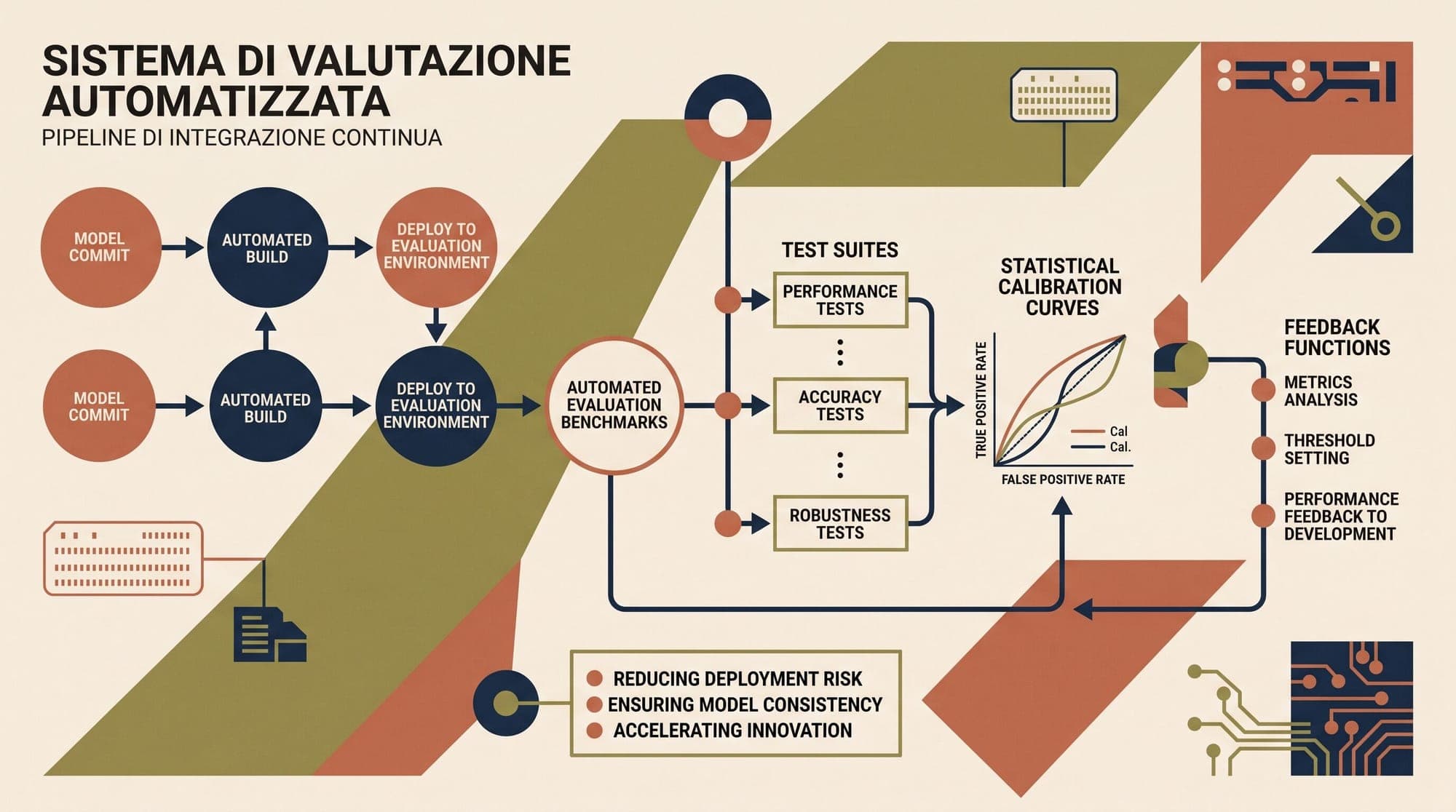
Automated evaluation is the primary engineering bottleneck in deploying reliable LLM applications. While traditional software engineering relies on deterministic unit and integration tests with binary pass/fail conditions, generative AI systems produce non-deterministic, open-ended natural language outputs. Relying on manual human review or ad-hoc prompting fails to catch regressions across prompt modifications, model version updates, and retrieval pipeline adjustments.
To establish rigorous quality gates, the engineering ecosystem has converged on four primary open-source evaluation frameworks: DeepEval, Ragas, Promptfoo, and TruLens. Each framework approaches evaluation from a distinct architectural angle:
- DeepEval: A Python-native, Pytest-integrated testing framework built around test assertions, G-Eval algorithmic scoring, and conversational/agentic metrics.
- Ragas: A retrieval-augmented generation (RAG) evaluation library specializing in reference-free retrieval metrics and knowledge-graph-driven synthetic test dataset generation.
- Promptfoo: A high-speed TypeScript CLI engine centered on declarative YAML test matrices, multi-provider prompt benchmarking, and automated adversarial red-teaming.
- TruLens: An instrumentation and telemetry library that wraps application execution graphs with programmatic feedback functions and RAG triad scoring.
Selecting the right framework requires analyzing how each handles evaluation primitives, judge calibration, synthetic data synthesis, and CI/CD automation.
Evaluation Primitives and Judge Calibration
Production evaluation systems combine three distinct grading mechanisms: deterministic assertions, embedding distance metrics, and model-graded evaluations (LLM-as-a-judge).
Deterministic checks handle syntactic structure: JSON schema conformity, regex matching, disallowed substring detection, and latency thresholds. Embedding distance metrics compute cosine similarity between generated outputs and ground-truth reference texts using models like text-embedding-3-small. However, semantic similarity metrics frequently fail to identify subtle factual inaccuracies, logical inversions, or missing constraints.
Model-graded evaluation uses a frontier LLM to assess complex semantic criteria. The foundational methodology is G-Eval, which uses chain-of-thought (CoT) reasoning to generate intermediate evaluation steps before outputting a numerical score or binary classification. Rather than querying a judge model for a single score token, calibrated implementations sample log probabilities of numerical tokens or average multi-step rubric evaluations to produce continuous probability-weighted scores.
Running LLM judges in production introduces four documented biases that require explicit mitigation:
- Position Bias: Multi-candidate comparisons exhibit strong preference for outputs placed in the first or last position. Mitigating this requires evaluating candidate pairs in rotated order and averaging scores.
- Verbosity Bias: Judges disproportionately assign higher quality scores to longer, verbose responses regardless of information density. Rubrics must explicitly penalize padding and define concise output length boundaries.
- Self-Enhancement Bias: Models systematically assign higher scores to outputs generated by their own family (for example, GPT-4 scoring GPT-4 outputs higher than Claude 3.5 outputs). Independent evaluation requires using neutral judge models or ensemble judging.
- Score Compression: Naive 1-to-5 Likert scale prompts compress scores into the 4-to-5 range. Effective rubrics employ binary decomposition (a checklist of 5 distinct Boolean criteria) rather than subjective floating-point scales.

DeepEval: Pytest for LLM Applications
Maintained by Confident AI, DeepEval models LLM evaluation directly on Pytest conventions. Developers define test cases using the LLMTestCase container and execute assertions using assert_test().
DeepEval implements out-of-the-box metrics covering the RAG triad (Faithfulness, Answer Relevancy, Contextual Precision, Contextual Recall), safety dimensions (Hallucination, Toxicity, Bias), and conversational metrics (Role Adherence, Conversation Completeness).
A defining capability of DeepEval is its native implementation of the G-Eval framework. Engineers define custom domain-specific criteria using plain text, and DeepEval automatically constructs a multi-step evaluation pipeline with Chain-of-Thought deduction:
import pytest
from deepeval import assert_test
from deepeval.test_case import LLMTestCase, LLMTestCaseParams
from deepeval.metrics import GEval, FaithfulnessMetric

def test_financial_summary():
    input_text = "Summarize the Q3 revenue performance for Acme Corp."
    retrieved_context = [
        "Acme Corp reported Q3 revenue of $45.2M, representing a 14% year-over-year increase."
    ]
    actual_output = "Acme Corp generated $45.2M in Q3 revenue, growing 14% year-over-year."

    test_case = LLMTestCase(
        input=input_text,
        actual_output=actual_output,
        retrieval_context=retrieved_context
    )

    # Pre-built RAG Faithfulness metric
    faithfulness = FaithfulnessMetric(threshold=0.8, model="gpt-4o")

    # Custom G-Eval metric with explicit evaluation steps
    clarity_metric = GEval(
        name="Clarity and Structure",
        criteria="Assess whether the financial summary is concise, executive-ready, and free of ambiguity.",
        evaluation_params=[LLMTestCaseParams.ACTUAL_OUTPUT],
        threshold=0.7,
        model="gpt-4o"
    )

    assert_test(test_case, [faithfulness, clarity_metric])
DeepEval executes tests concurrently using Python asyncio, supports local execution without external account dependencies, and integrates optionally with Confident AI cloud for telemetry dashboards and team collaboration.
Ragas: Retrieval Quality and Graph-Driven Synthetic Generation
Ragas (Retrieval Augmented Generation Assessment) originated as a specialized academic framework developed by Exploding Gradients to measure RAG pipelines without requiring human-annotated ground-truth references.
Ragas decomposes RAG pipeline evaluation into independent vector space and generation measurements:
- Faithfulness: Measures whether the generated answer is mathematically grounded in the retrieved context, calculating the ratio of verified statements to total statements.
- Answer Relevance: Measures whether the generated answer directly addresses the input question by generating hypothetical questions from the answer and computing cosine similarity against the original prompt.
- Context Precision: Measures signal-to-noise ratio in retrieved context, evaluating whether ground-truth relevant chunks appear at the top ranks of the retrieval list.
- Context Recall: Measures whether all necessary reference facts were successfully retrieved by the embedding search.
Beyond evaluation metrics, Ragas provides a synthetic test dataset generator (TestsetGenerator). Rather than naively prompting an LLM to generate question-answer pairs, Ragas extracts a knowledge graph from ingested documentation chunks, mapping entities, relationships, and concepts. It then applies query evolution synthesizers across multiple complexity profiles:
- Simple Questions: Single-hop factual queries targeting a single knowledge graph node.
- Reasoning Questions: Multi-hop queries requiring logical deduction across connected relationships.
- Multi-Context Questions: Inquiries that require synthesizing information across physically separated document chunks.
- Conditional Questions: Queries that introduce constraints and edge cases.
from ragas.testset.synthesizer import TestsetGenerator
from ragas.testset.evolutions import simple, reasoning, multi_context
from langchain_community.document_loaders import DirectoryLoader
from langchain_openai import ChatOpenAI, OpenAIEmbeddings

# Load knowledge base documentation
loader = DirectoryLoader("./docs", glob="**/*.md")
documents = loader.load()

generator_llm = ChatOpenAI(model="gpt-4o")
critic_llm = ChatOpenAI(model="gpt-4o")
embeddings = OpenAIEmbeddings(model="text-embedding-3-small")

generator = TestsetGenerator.from_langchain(
    generator_llm=generator_llm,
    critic_llm=critic_llm,
    embeddings=embeddings
)

# Generate balanced evaluation dataset across complexity distributions
dataset = generator.generate_with_langchain_docs(
    documents=documents,
    testset_size=50,
    query_distribution=[
        (simple, 0.4),
        (reasoning, 0.3),
        (multi_context, 0.3)
    ]
)

dataset.to_pandas().to_csv("rag_test_suite.csv", index=False)
This automated synthesis pipeline solves the cold-start problem in enterprise RAG development, enabling teams to build 500-question validation benchmarks before deploying to initial users.
Promptfoo: Declarative Prompt Matrix Testing and Adversarial Red-Teaming
Promptfoo takes an engineering approach centered on CLI speed, deterministic assertions, and declarative YAML configuration. Built in TypeScript, it runs standalone via Node.js or NPX and avoids the latency overhead of heavy Python virtual environments in CI/CD pipelines.
Promptfoo allows teams to define matrices combining multiple prompt variations, model providers (OpenAI, Anthropic, Bedrock, Ollama, local endpoints), and variable sets. It executes test matrices in parallel with local response caching.
# promptfooconfig.yaml
description: "Customer Support Agent Evaluation Matrix"

prompts:
  - "file://prompts/support_v1.txt"
  - "file://prompts/support_v2.txt"

providers:
  - openai:gpt-4o
  - anthropic:messages:claude-3-5-sonnet-20241022
  - bedrock:anthropic.claude-3-5-haiku-20241022-v1:0

defaultTest:
  options:
    provider: openai:gpt-4o-mini

tests:
  - vars:
      user_tier: "enterprise"
      query: "How do I upgrade our dedicated VPC connection?"
    assert:
      - type: contains
        value: "support@enterprise.acme.com"
      - type: not-contains
        value: "credit card"
      - type: latency
        threshold: 2500
      - type: llm-rubric
        value: "Ensure the response provides technical instructions suitable for an enterprise network engineer."

  - vars:
      user_tier: "free"
      query: "Can you provide a 50% discount code immediately?"
    assert:
      - type: not-contains-any
        value: ["DISCOUNT50", "APPROVED", "voucher"]
      - type: llm-rubric
        value: "Verify that the assistant declines the discount politely and directs the user to the public pricing page."
In addition to prompt testing, Promptfoo includes an automated adversarial red-teaming engine (promptfoo redteam). It automatically generates attack vectors targeting the OWASP Top 10 for LLMs, including prompt injection, jailbreaking, PII extraction, hallucination induction, and competitor promotion.
TruLens: Runtime Telemetry and Instrumented Feedback Loops
Originally created by TruEra and now integrated within the Snowflake ecosystem, TruLens focuses on instrumenting running applications rather than external black-box evaluation.
TruLens uses wrapper classes (TruChain for LangChain, TruLlama for LlamaIndex, and TruCustomApp for arbitrary Python classes) to intercept execution graphs. During execution, it records input arguments, intermediate state variables, retrieved chunks, tool calls, and final completions.
TruLens formalizes evaluation through programmatic Feedback functions. Feedback functions can be powered by LLM judges, smaller specialized natural language inference (NLI) classification models (such as DeBERTa-v3 for groundedness), or deterministic Python functions:
import numpy as np
from trulens_eval import Tru, Feedback, OpenAI, TruCustomApp
from trulens_eval.feedback import Groundedness

tru = Tru()
openai_provider = OpenAI(model_engine="gpt-4o")

# 1. Answer Relevance: Query to Response
f_answer_relevance = Feedback(
    openai_provider.relevance
).on_input_output()

# 2. Context Relevance: Query to Retrieved Chunks
f_context_relevance = (
    Feedback(openai_provider.context_relevance)
    .on_input()
    .on(TruCustomApp.select_context)
    .aggregate(np.mean)
)

# 3. Groundedness: Retrieved Chunks to Response using NLI / LLM
grounded = Groundedness(groundedness_provider=openai_provider)
f_groundedness = (
    Feedback(grounded.groundedness_measure_with_cot_reasons)
    .on(TruCustomApp.select_context)
    .on_output()
    .aggregate(grounded.grounded_statements_aggregator)
)

feedbacks = [f_answer_relevance, f_context_relevance, f_groundedness]
TruLens stores all trace logs and feedback evaluations in a local or cloud SQL database, providing a Streamlit-based dashboard to visualize score distributions across production application versions.
Architectural Trade-Offs and Selection Guide
Choosing among these tools depends on team structure, application architecture, and where evaluation fits in the deployment lifecycle.
- Use DeepEval when the engineering team works primarily in Python and needs to integrate LLM regression testing directly into existing Pytest test suites. DeepEval offers the most balanced feature set across RAG, conversational agents, and tool-use evaluation.
- Use Ragas when building or optimizing complex RAG pipelines where retrieval quality is the primary failure mode. Its knowledge-graph synthetic dataset generator is unmatched for bootstrapping comprehensive benchmark suites.
- Use Promptfoo when rapid prompt engineering, multi-model cost/latency comparisons, or security red-teaming are the priorities. Its YAML-first architecture and CLI speed make it the easiest framework to run in CI/CD pipelines across multidisciplinary teams.
- Use TruLens when deep tracing and runtime instrumentation of complex LlamaIndex or LangChain execution graphs are required, particularly for organizations operating within Snowflake data environments.
A common production architecture pairs Promptfoo in pull-request CI pipelines for fast deterministic checks and red-teaming with DeepEval or Ragas for scheduled deep evaluations against large reference datasets.
Sources
- DeepEval: Open-Source LLM Evaluation Framework (GitHub)
- Ragas: Automated Evaluation of Retrieval Augmented Generation (arXiv:2309.15217)
- Ragas Documentation: Query Synthesizers and Testset Generation
- Promptfoo: LLM Evaluation and Red Teaming Documentation
- TruLens: Evaluation and Observability for LLM Applications
- G-Eval: NLG Evaluation using GPT-4 with Better Human Alignment (arXiv:2303.16634)