
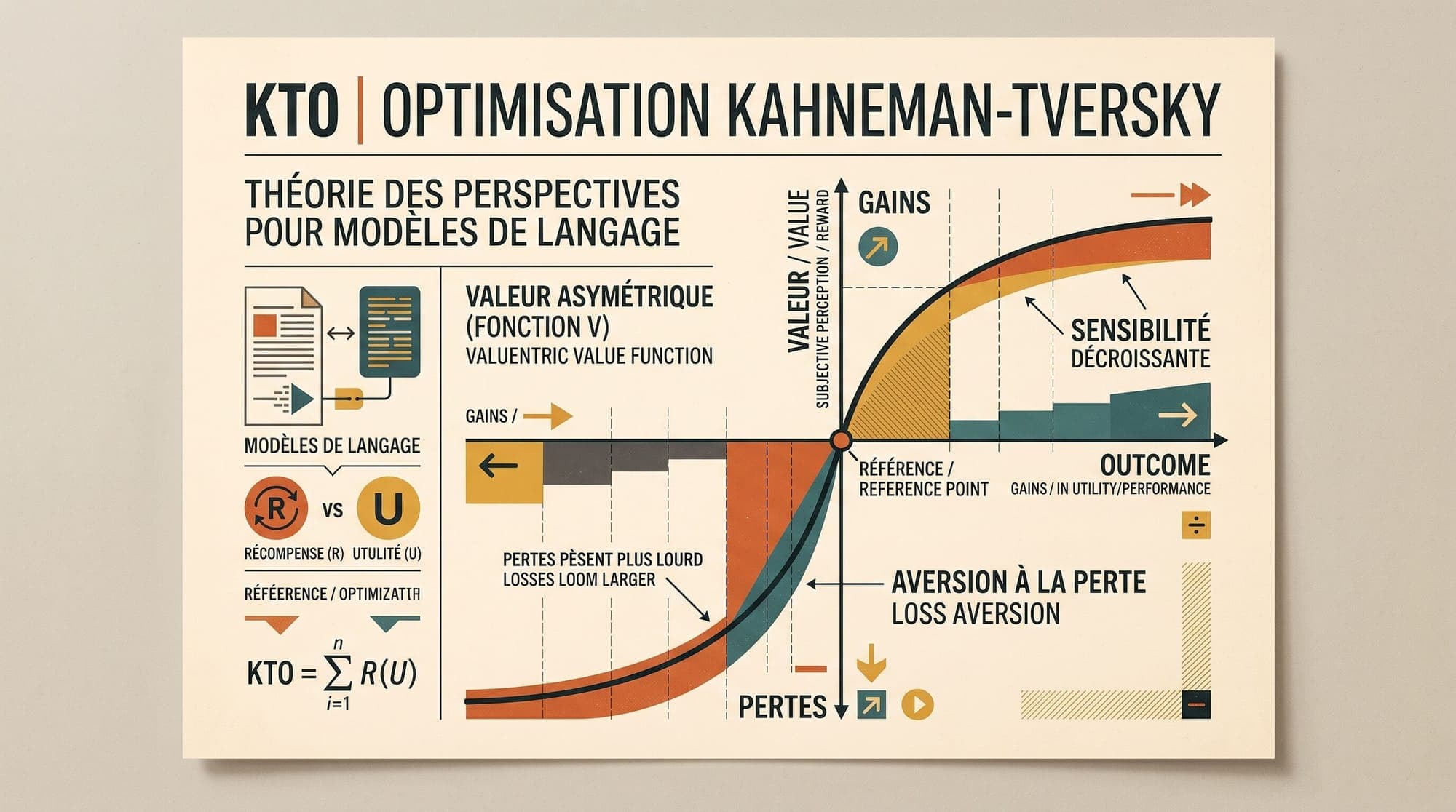
Kahneman-Tversky Optimization (KTO): Mathematical Foundations, Prospect Theory Utility, Binary Feedback Alignment, and Loss Aversion Dynamics
Aligning large language models with human expectations has historically relied on pairwise preference data. Under traditional Reinforcement Learning from Human Feedback (RLHF) and Direct Preference Optimization (DPO), models learn from paired tuples where one completion is preferred over another for a given prompt. While mathematically grounded in the Bradley-Terry choice model, paired preference collection presents significant operational bottlenecks: pairwise annotations are expensive to acquire, difficult to gather from live production telemetry, and structurally vulnerable to non-transitive or intransitive preference loops.
Kahneman-Tversky Optimization (KTO), introduced by researchers at Stanford University and Contextual AI, reformulates post-training alignment through behavioral economics. Instead of maximizing the log-likelihood of paired preference choices, KTO directly maximizes the utility of model generations according to cumulative prospect theory. By defining utility relative to an endogenous reference point and accounting for human loss aversion, KTO enables effective alignment using unpaired binary feedback (whether an individual response is desirable or undesirable).

1. Theoretical Foundations: Prospect Theory and Human-Aware Losses
Standard expected utility theory posits that human decision-makers evaluate outcomes based on total absolute utility. In contrast, behavioral experiments documented by Daniel Kahneman and Amos Tversky (1979, 1992) demonstrate that human judgments deviate systematically from expected utility maximization in three consistent ways:
- Reference Dependence: Outcomes are not evaluated in isolation; they are perceived as relative gains or losses measured against a neutral reference point.
- Diminishing Sensitivity: The marginal perceived value of both gains and losses decreases as the distance from the reference point increases (concavity in the gain domain, convexity in the loss domain).
- Loss Aversion: Humans exhibit greater sensitivity to losses than to gains of equal absolute magnitude. A loss produces roughly twice the psychological dissatisfaction as an equivalent gain produces satisfaction.
The canonical Kahneman-Tversky value function maps an objective outcome z relative to a reference point z_0:
v(z; lambda, alpha, z_0) = (z - z_0)^alpha                if z >= z_0
v(z; lambda, alpha, z_0) = -lambda * (z_0 - z)^alpha      if z < z_0
In empirical behavioral studies, median fitted parameters across human cohorts are alpha approximately equal to 0.88 and loss aversion parameter lambda approximately equal to 2.25.
The Human-Aware Loss (HALO) Framework
Ethayarajh et al. formalize alignment objectives through the concept of Human-Aware Loss functions (HALOs). Let pi_theta denote the parameterized policy model undergoing alignment, pi_ref the frozen reference policy (typically the Supervised Fine-Tuning base), and r_theta(x, y) the implicit reward function measured in nats:
r_theta(x, y) = log( pi_theta(y | x) / pi_ref(y | x) )Under the HALO framework, given a reference distribution Q(Y' | x) over possible completions and a monotonic value function v: R -> R that is concave on (0, infinity), the subjective human value of an input-output pair (x, y) is defined as:
Value(x, y) = v( r_theta(x, y) - E_{y' ~ Q}[ r_theta(x, y') ] )A loss function qualifies as a HALO if it can be written as the expectation over feedback data D of weighted subjective values:
L_HALO(pi_theta, pi_ref) = E_{(x, y) ~ D}[ a_{x, y} * v( r_theta(x, y) - E_{y' ~ Q}[ r_theta(x, y') ] ) ] + C_DWhere a_{x, y} in {-1, +1} indicates directionality and C_D is a data-dependent constant. Ethayarajh et al. prove that Direct Preference Optimization (DPO) and PPO-Clip are human-aware loss functions, whereas sequence calibration methods like SLiC and conditional SFT (CSFT) do not satisfy HALO properties.
2. Mathematical Derivation of the KTO Objective
While DPO operates as a preference-based HALO comparing paired tokens (y_w, y_l), KTO directly optimizes the Kahneman-Tversky value function over unpaired examples labeled either desirable (y in Y_desirable) or undesirable (y in Y_undesirable).
Value Function Parameterization
The polynomial formulation of classical prospect theory introduces numerical instability during backpropagation due to unbounded gradients near zero and exponentiation of negative values. KTO replaces the power function with the continuous logistic sigmoid function sigma(z) = 1 / (1 + exp(-z)), which preserves the key qualitative properties of prospect theory: concavity in positive gains, convexity in negative losses, and natural bounds in [0, 1].
The KTO subjective value function is formulated as:
For desirable outputs (y ~ y_desirable | x):
v(x, y) = lambda_D * sigma( beta * ( r_theta(x, y) - z_0 ) )

For undesirable outputs (y ~ y_undesirable | x):
v(x, y) = lambda_U * sigma( beta * ( z_0 - r_theta(x, y) ) )
Where:
beta > 0is an inverse temperature hyperparameter governing risk aversion. Higher beta values cause the value function to saturate more steeply around the reference threshold.lambda_Dandlambda_Uare non-negative weighting coefficients governing the positive scale and loss aversion penalty respectively.z_0is the subjective human reference point.
Defining and Estimating the Reference Point
In human cognitive evaluation, a response y given prompt x is judged relative to what an average plausible response would deliver. Theoretically, the reference point corresponds to the expected implicit reward under the current policy distribution:
z_0 = E_{y' ~ pi_theta(y' | x)} [ log( pi_theta(y' | x) / pi_ref(y' | x) ) ] = KL( pi_theta( . | x ) || pi_ref( . | x ) )Because generating on-policy samples during every optimization step is computationally expensive, KTO uses an efficient offline proxy. For a training mini-batch of m examples {(x_i, y_i)}_{i=1}^m, the reference point z_0 is estimated across decoupled prompt-response pairs within the batch:
hat{z}_0 = max( 0, (1 / m) * sum_{i != j} log( pi_theta(y_j | x_i) / pi_ref(y_j | x_i) ) )In modern implementations such as Hugging Face TRL, this estimate is further simplified by computing the average log-ratio of the batch or maintaining an empirical moving average of the KL divergence. Gradients are detached from z_0 during backpropagation, ensuring it acts strictly as an anchoring threshold rather than a moving target.
The Full KTO Loss Function
The total KTO loss minimized during training is the negative expected subjective utility:
L_KTO(pi_theta, pi_ref) = E_{(x, y) ~ D} [ w(y) * ( 1 - v_norm(x, y) ) ]Expressed explicitly across partitioned desirable (D) and undesirable (U) datasets:
L_KTO(pi_theta, pi_ref) =
    E_{(x, y) ~ D_desirable} [ lambda_D * ( 1 - sigma( beta * ( log(pi_theta(y|x)/pi_ref(y|x)) - z_0 ) ) ) ]
  + E_{(x, y) ~ D_undesirable} [ lambda_U * ( 1 - sigma( beta * ( z_0 - log(pi_theta(y|x)/pi_ref(y|x)) ) ) ) ]
Because 1 - sigma(u) = sigma(-u), the loss can be equivalently written as:
L_KTO(pi_theta, pi_ref) =
    E_{(x, y) ~ D_desirable} [ lambda_D * sigma( -beta * ( log(pi_theta(y|x)/pi_ref(y|x)) - z_0 ) ) ]
  + E_{(x, y) ~ D_undesirable} [ lambda_U * sigma( -beta * ( z_0 - log(pi_theta(y|x)/pi_ref(y|x)) ) ) ]
3. Optimization Dynamics and Gradient Mechanics
Analyzing the gradient of L_KTO with respect to policy parameters theta reveals why the reference anchor z_0 is essential for stable learning.
Let h_theta(x, y) = log pi_theta(y | x). The gradient with respect to theta is given by:
For a desirable completion (x, y_D):
grad_theta L_KTO = - lambda_D * beta * sigma( beta * (r_theta - z_0) ) * (1 - sigma( beta * (r_theta - z_0) )) * grad_theta h_theta(x, y_D)

For an undesirable completion (x, y_U):
grad_theta L_KTO = + lambda_U * beta * sigma( beta * (z_0 - r_theta) ) * (1 - sigma( beta * (z_0 - r_theta) )) * grad_theta h_theta(x, y_U)
Implicit KL Regularization Without Pairwise Cancellation
In DPO, implicit regularization occurs via paired subtraction: increasing the probability of y_w while decreasing the probability of y_l prevents the policy from inflating probabilities across all tokens arbitrarily.
In KTO, because examples are processed independently, the reference term z_0 provides this balancing mechanism:
- If the policy attempts to increase the log-probability of a desirable example via coarse token inflation, the global divergence KL(pi_theta || pi_ref) rises, shifting z_0 upward.
- An increased z_0 reduces the effective net advantage
(r_theta - z_0), dampening future gradient updates. - Conversely, when penalizing an undesirable completion, reducing its log-probability lowers r_theta relative to z_0, satisfying the loss-aversion penalty without requiring a paired positive counterfactual in the same forward pass.
4. Class Imbalance and Loss Aversion Tuning
In real-world applications, positive and negative feedback signals are rarely balanced 1:1. Customer telemetry often contains substantially more positive confirmations (or negative error reports) depending on interface design.
Let n_D denote the number of desirable examples and n_U denote the number of undesirable examples in the training corpus. Ethayarajh et al. establish an empirical weighting rule to balance gradient scales:
( lambda_D * n_D ) / ( lambda_U * n_U ) in [ 1.0, 1.33 ]To configure hyperparameters:
- Fix one lambda value to 1.0.
- Adjust the opposing lambda to ensure the aggregate loss contribution from positive and negative partitions matches the target ratio.
- For example, if a dataset contains 90% desirable examples and 10% undesirable examples (n_D / n_U = 9), setting lambda_D = 1.0 and lambda_U = 7.5 to 9.0 restores balanced gradient dynamics.
This mathematical property allows KTO to train effectively on skewed corpora where DPO would require discarding unpaired samples or artificially synthesizing negative completions.
5. Algorithmic Comparison: KTO vs. DPO, PPO, SimPO, and CPO
Understanding how KTO fits into the broader post-training taxonomy highlights its structural trade-offs:
- Data Format Requirements:
- RLHF (PPO): Requires prompt dataset, separate trained Reward Model, value critic network, and dynamic rollouts.
- DPO: Requires strictly paired preference tuples (x, y_w, y_l).
- SimPO / CPO: Require paired preference tuples (x, y_w, y_l) with length normalization or direct likelihood bounds.
- KTO: Requires only single-item binary labels (x, y, is_desirable).
- Memory and Compute Overhead:
- PPO: High (maintains actor, critic, reference policy, and reward model in VRAM simultaneously).
- DPO / CPO / SimPO: Moderate (must process y_w and y_l concurrently per prompt to evaluate the pairwise margin).
- KTO: Low (processes single sequences independently; variable-length inputs can be packed and batched with higher throughput).
- Theoretical Foundation:
- RLHF / DPO: Maximum entropy reinforcement learning over Bradley-Terry preference probability models.
- SimPO: Target-margin reference-free direct preference optimization.
- KTO: Cumulative prospect theory maximizing subjective human utility relative to a cognitive reference point.
6. Empirical Findings and Benchmark Evaluations
In systematic evaluations conducted on Pythia (1.4B to 12B), Llama (7B, 13B, 30B), Mistral-7B, and Zephyr-7B architectures, KTO demonstrates performance on par with or exceeding pairwise alignment methods.
On the UltraFeedback benchmark aligning Zephyr-7B beta:
- Supervised Fine-Tuning Baseline: 35.9% average across downstream evaluations (MMLU 57.2%, GSM8k 39.0%, HumanEval 30.1%, AlpacaEval 2 win rate 6.4%).
- Direct Preference Optimization (DPO): 36.1% average (MMLU 58.2%, GSM8k 40.0%, HumanEval 30.1%, AlpacaEval 2 win rate 7.8%).
- Kahneman-Tversky Optimization (KTO): 39.9% average (MMLU 58.6%, GSM8k 53.5%, HumanEval 30.9%, AlpacaEval 2 win rate 12.5%).
On mathematical reasoning (GSM8k) and multi-step reasoning (Big-Bench Hard), KTO showed notable improvements over DPO, attributed to its avoidance of paired margin collapse when preferred and dispreferred reasoning paths share common prefix tokens.
SFT-Free Alignment
A notable finding in the KTO paper is that when base pre-trained models possess sufficient base instruction compliance (e.g., modern Llama or Mistral checkpoints), applying KTO directly to the pre-trained weights without an intermediate SFT stage matches the downstream performance of standard SFT+DPO pipelines. In contrast, DPO degenerates when applied directly to raw pre-trained models without prior SFT initialization due to reference distribution divergence.
7. Implementation Guidelines in Production Pipelines
Implementing KTO in modern alignment frameworks such as Hugging Face TRL involves standard configuration parameters:
from trl import KTOConfig, KTOTrainer

kto_config = KTOConfig(
    learning_rate=5e-7,
    beta=0.1,
    desirable_weight=1.0,
    undesirable_weight=1.0,
    max_length=2048,
    per_device_train_batch_size=4,
    gradient_accumulation_steps=8,
    logging_steps=10,
    evaluation_strategy="steps",
    eval_steps=100,
    output_dir="./kto_aligned_model"
)

trainer = KTOTrainer(
    model=model,
    ref_model=ref_model,
    args=kto_config,
    train_dataset=formatted_kto_dataset,
    tokenizer=tokenizer,
)

trainer.train()
Key engineering practices for production stability include:
- Beta Calibration: Standard values range between 0.05 and 0.2. Smaller beta values (e.g., 0.05) are recommended for reasoning-heavy datasets to prevent premature policy saturation.
- Batch Packing Efficiency: Because KTO does not require packing paired outputs into identical tensor slots, batches can be packed dynamically by token length, yielding up to 25% higher GPU utilization compared to paired DPO forward passes.
- Telemetry Ingestion: Production logs capturing user interactions (e.g., copy-to-clipboard as desirable, regeneration or edit as undesirable) can be funneled directly into KTO training buffers without requiring an intermediate LLM judge to synthesize contrasting pairs.
Sources
- Ethayarajh et al. (2024): KTO: Model Alignment as Prospect Theoretic Optimization (arXiv:2402.01306)
- Tversky & Kahneman (1992): Advances in Prospect Theory: Cumulative Representation of Uncertainty
- Rafailov et al. (2023): Direct Preference Optimization: Your Language Model is Secretly a Reward Model (arXiv:2305.18290)
- Schulman et al. (2017): Proximal Policy Optimization Algorithms (arXiv:1707.06347)
- Hugging Face TRL: Kahneman-Tversky Optimization Documentation



