
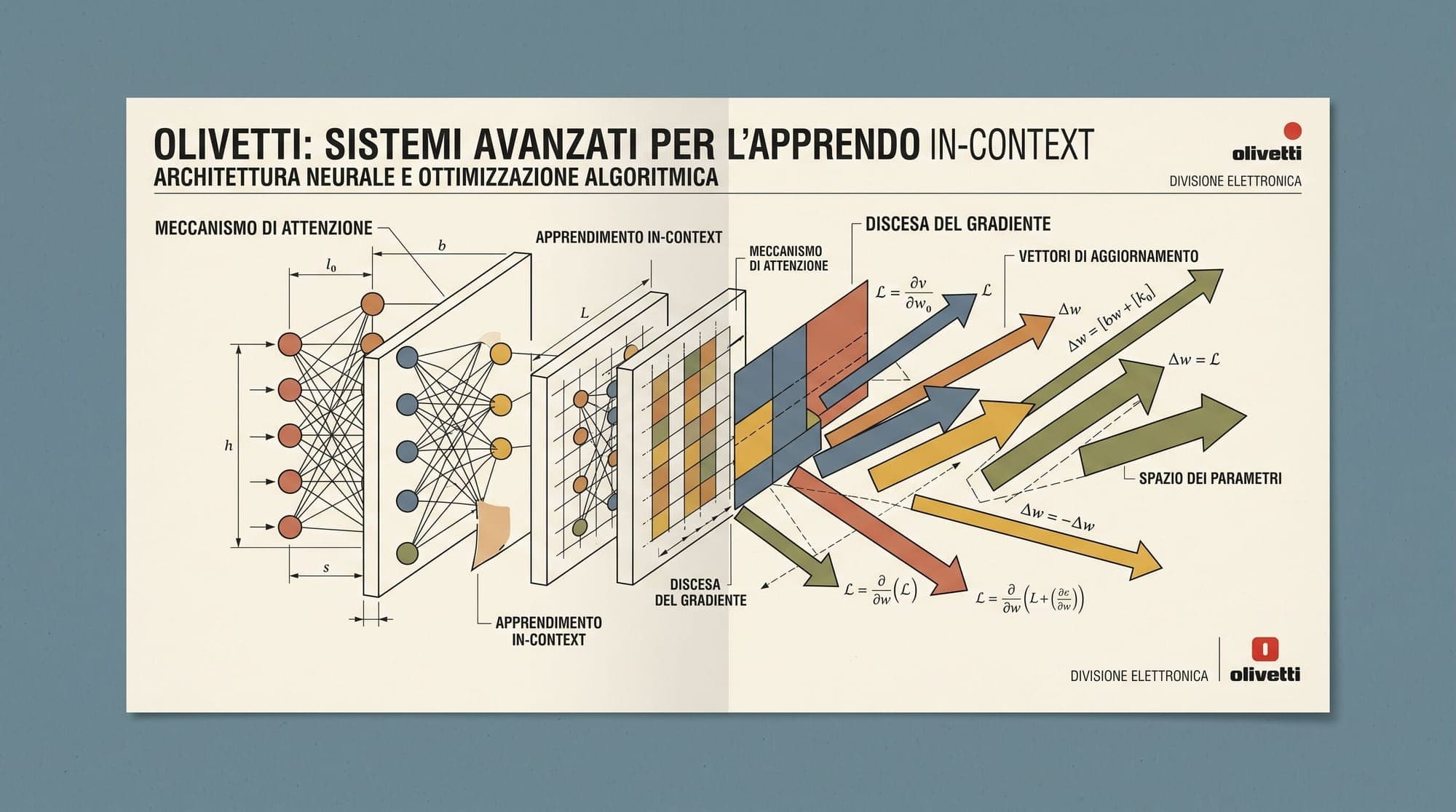
When large language models (LLMs) adapt to new tasks from a handful of prompt demonstrations, their static weights remain completely untouched. No backpropagation runs through the network, no optimizer updates parameters, and no gradients are calculated. Yet, the model’s predictions improve steadily as more input-output examples are added to the prompt context.
For years, this phenomenon (known as in-context learning, or ICL) was treated as an empirical black box. Recent theoretical and mechanistic research, however, reveals a concrete architectural reality: Transformers do not merely perform associative memory lookup. Instead, forward activations inside self-attention layers systematically execute optimization algorithms, implementing the mathematical equivalent of unrolled gradient descent, preconditioned optimization, and closed-form least-squares estimation entirely in activation space.
Understanding how self-attention constructs and executes these implicit optimization routines provides crucial insight into prompt engineering dynamics, context window saturation, and the boundary between in-context adaptation and weight-based fine-tuning.

The Meta-Learning Hypothesis
In-context learning emerged as an unintended capability of autoregressive pre-training on web-scale text corpora. When an autoregressive Transformer predicts the next token across long sequences containing structured patterns, code definitions, or question-answer pairs, standard cross-entropy loss forces the model to minimize error conditioned on prior tokens.
As formalized in foundational meta-learning literature and subsequent language modeling analyses such as Dai et al. (2023), this training process is mathematically analogous to meta-optimization. The model's outer loop updates the static weights during pre-training via stochastic gradient descent. In response, the network learns an inner loop: an execution program within its forward pass that processes in-context exemplars as training data and updates an implicit internal model encoded within intermediate activations.
To determine the exact mathematical mechanics of this inner loop, researchers isolated Transformer architectures on synthetic in-context tasks, specifically linear regression.
Linear Self-Attention as a Single Gradient Step
The theoretical link between attention and optimization was established independently by von Oswald et al. (2023) and Akyürek et al. (2023). Both groups demonstrated that a single linear self-attention layer can be constructed to execute an exact step of gradient descent on a least-squares objective.
Consider an in-context prompt containing demonstration pairs followed by a query input: where represents input features and represents the corresponding target scalar. The objective is to estimate a weight vector minimizing the mean squared error loss:
Starting from an initial weight estimate , one step of gradient descent with learning rate computes:
The prediction for the query token under the updated model is:
Now consider a standard linear self-attention (LSA) layer without softmax normalization. For an input sequence matrix containing token embeddings for the prompt pairs and query, the attention output is:
By setting the projection matrices and the output projection such that:
- extracts the query feature ,
- extracts the context inputs ,
- computes the current prediction residual ,
the linear attention mechanism calculates the inner products , scales them by the residuals , and aggregates them across all context tokens. When added to the residual stream containing the initial prediction , the resulting output vector at the query position matches identically.

Layer Stacking as Unrolled Iterative Optimization
In a multi-layer Transformer, attention layers and residual streams stack sequentially. Because each layer can read the state written by prior layers, a network with attention layers effectively unrolls sequential iterations of optimization:
- Layer 1: Computes initial residuals and applies gradient step 1, writing updated implicit weights and predictions into the residual stream.
- Layer 2: Reads , evaluates updated residuals , and executes gradient step 2 to produce .
- Layer : Produces the final prediction corresponding to steps of gradient descent:
The residual stream acts as an explicit parameter register. The Transformer does not require external memory or mutable weights; it stores intermediate model parameters directly within the activation vectors of the query and context tokens.
Higher-Order Optimizers in Transformer Attention
Transformers trained on linear regression benchmarks are not restricted to vanilla gradient descent. Research by Fu et al. (2023) and Mahankali et al. (2023) showed that deep Transformers automatically learn higher-order optimization algorithms:
- Preconditioned Gradient Descent: The projection matrices learn to approximate the inverse covariance matrix , scaling gradient updates according to input feature correlations.
- Iterative Newton-Raphson: On ill-conditioned problems where standard gradient descent exhibits slow convergence or oscillations, multi-layer Transformers implement second-order updates:
where the Hessian is computed in activation space.
- Closed-Form Ridge Regression: Multi-head attention architectures with sufficient head capacity can compute the exact Ordinary Least Squares (OLS) closed-form solution:
by allocating specific attention heads to matrix inversion approximations and projection operations.
Mechanistic Probing: Extracting Implicit Weights
To confirm that trained Transformers genuinely run optimization algorithms rather than alternate heuristics, researchers probed the hidden representations of models trained on in-context regression tasks.
By training linear probes on the intermediate residual streams of each layer , researchers like von Oswald et al. (2023) extracted the implicit parameter estimates . The findings confirmed three direct alignments:
- Trajectory Convergence: The sequence of implicit parameters follows the exact trajectory of an unrolled optimizer minimizing empirical risk on the prompt examples.
- Learning Rate Adaptation: When prompt dataset size changes, the effective step size implemented by attention layers scales inversely with , matching the theoretical normalization required for stable gradient descent.
- Out-of-Distribution Robustness: When tested on prompt distributions with shifted feature variances or rotated bases, the model’s internal parameter updates adapt dynamically, mirroring the behavior of an algorithmic optimizer rather than a memorized lookup table.
| Optimization Method | Architectural Mechanism | Convergence Behavior | Expressivity Requirement | | :--- | :--- | :--- | :--- | | Vanilla Gradient Descent | Single Linear Attention head per step | Linear reduction in MSE across layers | 1 Head / Layer | | Preconditioned GD | Linear Attention with learned covariance projection | Fast convergence on correlated inputs | 1 to 2 Heads / Layer | | Iterative Newton | Multi-layer attention estimating inverse Hessian | Quadratic convergence on ill-conditioned data | Multi-layer circuit | | Exact Ridge Regression | Multi-head attention computing | Single-step optimal closed-form estimation | Multiple heads with non-linear activation |
From Synthetic Regressors to Frontier LLMs
In full-scale autoregressive language models, two key differences separate production Transformers from toy linear regression architectures: the presence of softmax non-linearities in self-attention and the high dimensionality of natural language tokens.
Softmax Attention as Kernel Regression
Unlike linear self-attention, standard attention applies a row-wise softmax operation:
Mathematically, softmax attention acts as a non-parametric Nadaraya-Watson kernel regression estimator. When attention temperature is sharp (low entropy), the model acts as a nearest-neighbor interpolator, selecting the single most relevant in-context exemplar. When attention temperature is diffuse, the Taylor expansion of the exponential function approximates linear self-attention, allowing the attention head to perform distributed gradient-like parameter aggregation.
Induction Heads as Primitive Associative Optimizers
In language models, the primary circuit driving in-context learning is the induction head, detailed by Olsson et al. (2022). An induction head is a two-layer attention circuit:
- Layer 1 (Previous-Token Head): Writes information about token into the representation of token that immediately follows it ().
- Layer 2 (Induction Head): When token reappears later in the context, the head searches the sequence for prior occurrences of , retrieves the associated , and copies as the next-token prediction.
Induction heads represent a specialized, single-step associative optimizer: they calculate an empirical transition probability directly from context history and immediately apply that distribution to future token predictions without modifying network weights.
Task Learning vs. Task Retrieval
An ongoing debate in LLM interpretability is whether in-context learning represents genuine algorithm execution (Task Learning) or simply Bayesian inference over pre-existing training concepts (Task Retrieval).
Research demonstrates that both mechanisms operate simultaneously in frontier models:
- Task Retrieval (Concept Activation): When a prompt contains familiar tasks (such as translating English to French), the model uses early attention layers to identify the task identity and route information through pre-trained sub-networks in feed-forward layers. No complex in-context optimization is needed; the model simply selects an existing capability.
- Task Learning (Implicit Optimization): When presented with novel, counterfactual, or arbitrary mappings (such as inverted word classifications or synthetic symbol permutations), the model shifts from static retrieval to active in-context optimization. Attention layers iterate over the prompt pairs, computing residuals and updating the implicit representation until the novel mapping is learned.
Practical Implications and System Boundaries
Recognizing in-context learning as implicit forward-pass optimization has concrete implications for AI engineering and LLM system design:
- Prompt Ordering and Optimizer Noise: Because gradient descent is sensitive to batch composition and sample ordering, the sequence of few-shot examples directly influences the trajectory of implicit parameter updates. Shuffling prompt demonstrations changes intermediate residual vectors, explaining high variance in few-shot performance.
- Context Window Saturation: As the number of prompt exemplars grows, linear attention layers benefit from lower variance in gradient estimates. However, softmax attention mechanisms suffer from attention dispersion and entropy collapse over thousands of tokens, causing diminishing returns compared to explicit fine-tuning.
- Inference Latency vs. Fine-Tuning Economics: In-context learning incurs an or computational cost per inference call via the KV cache to continuously re-evaluate the inner optimization loop. Parameter-efficient fine-tuning methods like LoRA compile task updates directly into static model weights, eliminating the in-context optimization tax during production serving.
Sources
- von Oswald, J., Niklasson, E., Randazzo, E., Sacramento, J., Mordvintsev, A., Zhmoginov, A., & Vladymyrov, M. (2023). Transformers learn in-context by gradient descent. Proceedings of the 40th International Conference on Machine Learning (ICML).
- Akyürek, E., Schuurmans, D., Tenenbaum, J. B., & Andreas, J. (2023). What learning algorithm is in-context learning? Investigations with linear models. International Conference on Learning Representations (ICLR).
- Garg, S., Tsipras, D., Liang, P., & Valiant, G. (2022). What Can Transformers Learn In-Context? A Case Study of Simple Function Classes. Advances in Neural Information Processing Systems (NeurIPS).
- Fu, D., Chen, T., Jia, R., & Sharan, V. (2023). Transformers Learn Higher-Order Optimization Methods for In-Context Learning: A Study with Linear Models. arXiv preprint arXiv:2305.17066.
- Dai, D., Sun, Y., Dong, L., Hao, Y., Sui, Z., & Wei, F. (2023). Why Can GPT Learn In-Context? Language Modeling as Meta-Optimization. Findings of the Association for Computational Linguistics (ACL).
- Olsson, C., Elhage, N., Nanda, N., Joseph, N., DasSarma, N., Henighan, T., ... & Olah, C. (2022). In-context Learning and Induction Heads. Transformer Circuits Thread.



