Google Launches Gemini Student Hub with Interactive 3D Simulations and Background Research

Google has launched a dedicated suite of education tools across Google Search and the Gemini assistant, introducing an integrated student hub, interactive 3D simulations, multi-document synthesis, and asynchronous background research. The rollout is designed to centralize study workflows within Google's ecosystem while expanding the modal capabilities of Gemini for scientific and conceptual analysis. Integrated Student Hub and Study Notebooks The core of the update is a specialized hub withi

2 min
Google Launches Gemini Student Hub with Interactive 3D Simulations and Background Research

Google has launched a dedicated suite of education tools across Google Search and the Gemini assistant, introducing an integrated student hub, interactive 3D simulations, multi-document synthesis, and asynchronous background research.

The rollout is designed to centralize study workflows within Google's ecosystem while expanding the modal capabilities of Gemini for scientific and conceptual analysis.

Integrated Student Hub and Study Notebooks

The core of the update is a specialized hub within the Gemini application. The interface consolidates study notebooks, automated flashcards, and custom practice quizzes. Students can also upload course syllabi, which Gemini parses to automatically populate test dates and assignment deadlines into Google Calendar.

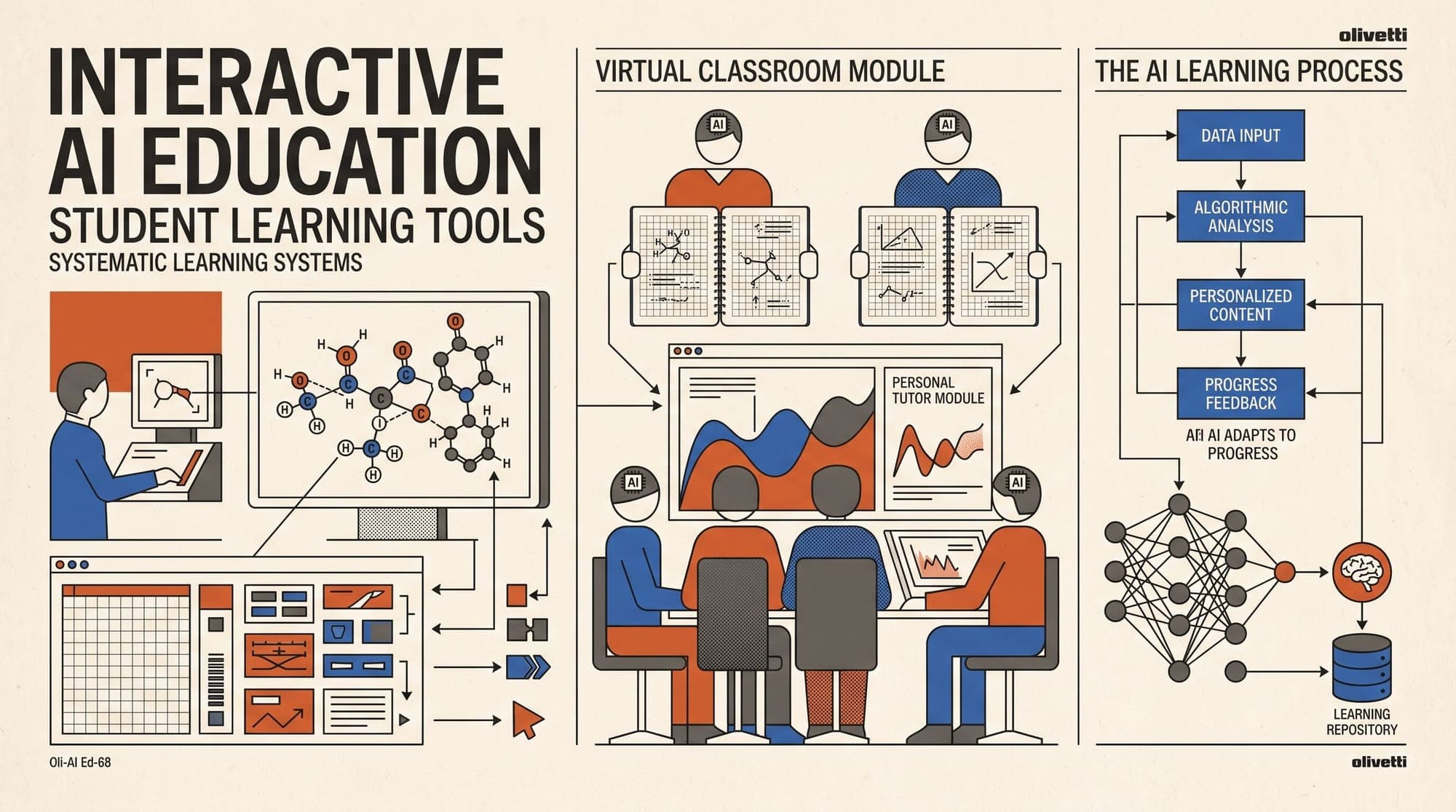
Alongside text-based summaries, Gemini can now generate functional, interactively rotatable 3D simulations directly in chat responses. For visual learning topics in biology, physics, and chemistry, such as DNA molecular structures or atomic lattices, users can manipulate models in three dimensions alongside structured data tables and conceptual grids.

Technical diagram illustrating automated background research synthesis and interactive educational study cards

Multi-File Synthesis and Background Deep Research

Google Search has also been updated to process multi-format document uploads. Users can submit lecture slides, textbook PDFs, and photographs of handwritten class notes simultaneously. Search analyzes the combined corpus to generate consolidated study documents and one-page topic summaries.

For complex academic inquiries, Google integrated Deep Research into Gemini Live. Users can prompt Gemini to run multi-step investigatory reports across web sources. The process runs asynchronously, allowing users to close the application or lock their device. Gemini notifies the user upon completion, enabling conversational review of findings via voice or text.

Visual Problem-Solving via Lens and Subscription Tiers

In the coming weeks, Google will roll out an interactive learning update to Google Lens in the mobile app. The tool allows students to photograph physical worksheets or handwritten math problems. Rather than returning raw answers, the system identifies calculation errors, provides conceptual explanations, and guides students step-by-step through problem remediation.

To drive adoption, Google is offering eligible higher education students in the United States one free year of Google AI Pro, which includes 5TB of cloud storage, elevated Gemini usage thresholds, and integration across Google Workspace. International students will have access to the Google AI Plus plan, which includes 400GB of storage and standard Gemini access limits.


Sources

Written by

More to read

  • Human-in-the-Loop Architectures for Production AI Agents: Interrupt Patterns, State Resumption, and Permission Escalation

    Deploying autonomous AI agents into production environments exposes a fundamental tension between system velocity and operational safety. While read-only tasks such as data extraction and document summarization carry minimal operational blast radius, agents equipped with write-access tools (database mutations, API transactions, cloud infrastructure provisioning, and outbound communications) introduce severe operational risks. Hallucinations, prompt injections, and logical drift can trigger irrev

    1 min
  • Machine Unlearning in Large Language Models: How Gradient Ascent, Representation Misdirection, and Negative Alignment Purge Neural Memory

    Large language models memorize massive amounts of training data, including copyrighted literature, personally identifiable information (PII), proprietary codebases, and dual-use knowledge spanning cyber exploits and biological hazards. When copyright holders, regulators, or safety researchers demand the removal of specific data, complete retraining from scratch is economically infeasible, often costing tens of millions of dollars in compute. Machine unlearning aims to remove the influence of ta

    1 min
  • Developers Deploy Open-Source Workarounds to Strip Claude's Statistical Text Watermark

    Days after Anthropic introduced global text watermarking for Claude to comply with the European Union's AI Act transparency requirements, open-source developers and independent researchers have released multiple tools and pipelines aimed at stripping or perturbing the embedded statistical signatures. The rapid emergence of evasion techniques underscores the structural challenges of applying robust watermarking to natural language generation without introducing perceptible latency, semantic dist

    1 min

