
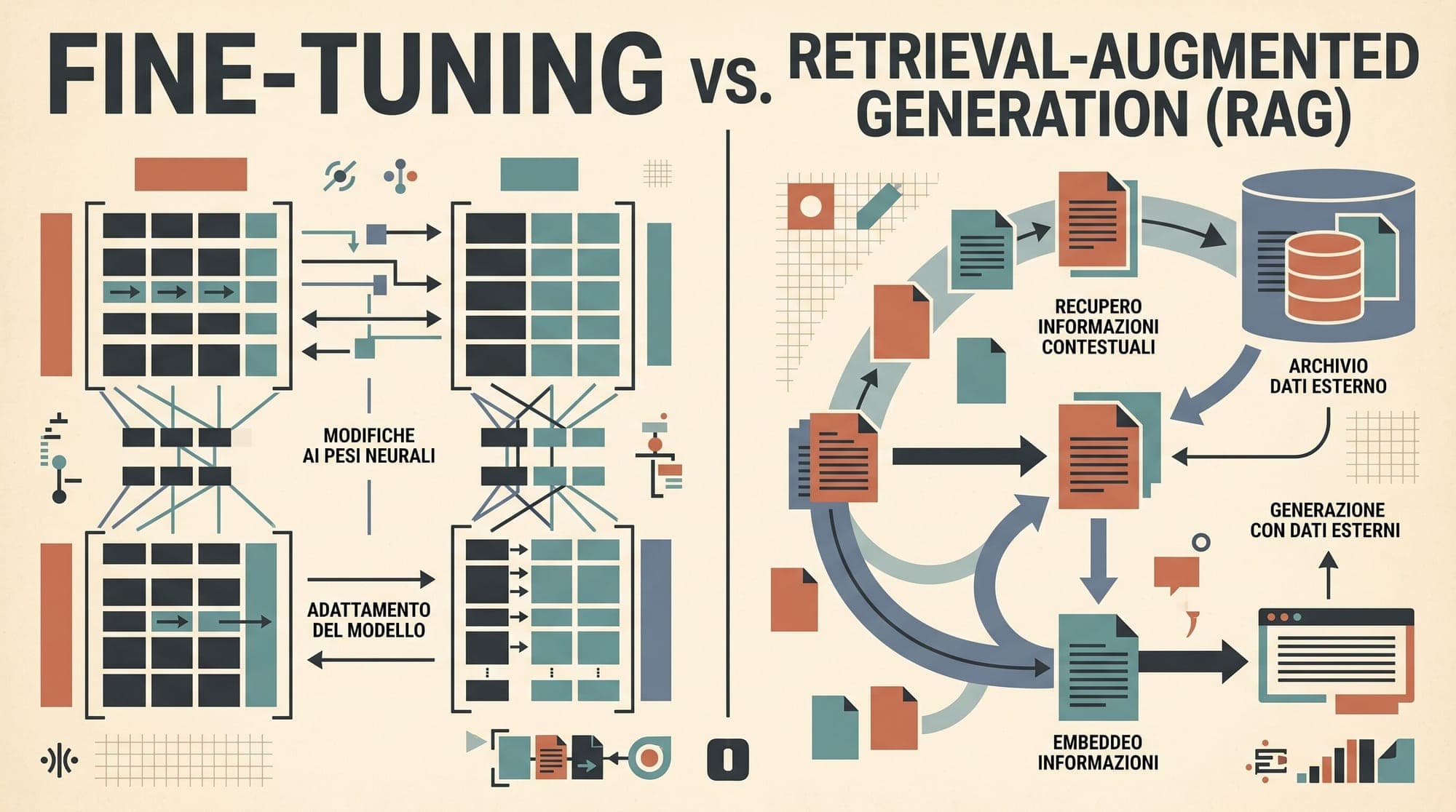
Fine-Tuning vs. RAG in Production: Knowledge Injection, Task Adaptation, Latency Economics, and Hybrid Architecture Trade-Offs
When adapting large language models to domain-specific enterprise workloads, engineering teams face a fundamental architectural choice: modify the model's parametric weights via fine-tuning, or supply dynamic context at inference time via Retrieval-Augmented Generation (RAG).
While early discussions often framed this decision as a binary trade-off, empirical evaluations demonstrate that fine-tuning and retrieval serve fundamentally different mathematical and operational functions. Fine-tuning excels at altering behavior, form, syntax, and task alignment, whereas RAG remains the necessary mechanism for injecting dynamic factual knowledge, enforcing access boundaries, and guaranteeing source verifiability.
1. Parametric Memory vs. Non-Parametric Context
The division between fine-tuning and retrieval rests on the distinction between parametric memory stored in transformer weights and non-parametric working memory provided in the context window.
+-------------------------------------------------------------------------------+
| PARAMETRIC ADAPTATION (Fine-Tuning)                                           |
| W_new = W_base + Delta_W (e.g., via LoRA Delta_W = B * A)                     |
| - Strengths: Tone, schema compliance, syntax, low TTFT, zero context bloat.   |
| - Weaknesses: Hallucination on tail facts, static knowledge, no access control.|
+-------------------------------------------------------------------------------+
                                      VS.
+-------------------------------------------------------------------------------+
| NON-PARAMETRIC CONTEXT (RAG)                                                  |
| P(y | x, D) where D = TopK(Query, VectorDB / BM25 Index)                      |
| - Strengths: Real-time freshness, deterministic attribution, granular RBAC.   |
| - Weaknesses: Retrieval latency, context window cost, distractor susceptibility.|
+-------------------------------------------------------------------------------+
Parametric Weight Adaptation
Techniques like Supervised Fine-Tuning (SFT) and parameter-efficient methods like LoRA (Hu et al., 2021) update the weight matrices of the network. This adjusts the model's output probability distribution over its token vocabulary.
Parametric updates excel at:
- Style and Persona Enforcement: Constraining verbosity, persona tone, and structural formatting.
- Complex Schema and Syntax Output: Ensuring strict adherence to domain DSLs, structured JSON schemas, and specialized function-calling protocols without lengthy few-shot prompts.
- Domain Reasoning Patterns: Training the model on specialized reasoning steps (such as legal case analysis or medical triage paths).
However, using parametric memory as a factual knowledge store exhibits severe degradation. Neural networks compress training data through loss minimization, leading to soft association rather than exact key-value retrieval. When queried on specific entity relationships or tail facts not heavily reinforced in the dataset, parametric models hallucinate plausible-sounding completions with high confidence.
Non-Parametric Retrieval
Retrieval-Augmented Generation (Lewis et al., 2020) externalizes knowledge storage into searchable indexes (dense vector stores, sparse inverted indexes, or knowledge graphs). At inference time, relevant document passages are retrieved and injected directly into the prompt.
RAG isolates factual knowledge from model weights, providing three core architectural properties:
- Zero-Latency Knowledge Updates: Updating corporate documentation or product catalogs requires re-indexing external storage, avoiding expensive multi-hour GPU training runs.
- Deterministic Attribution: Output assertions can be explicitly mapped to cited passage chunks with offset metadata.
- Granular Access Control: Fine-grained authorization models (such as Role-Based Access Control and Relationship-Based Access Control) can filter candidate documents prior to context injection.
2. Empirical Findings: Knowledge Injection vs. Factual QA
Multiple academic studies have benchmarked whether fine-tuning can replace retrieval for factual question answering.

In a systematic study titled Fine-Tuning or Retrieval? Comparing Knowledge Injection in LLMs, Ovadia et al. (2023) evaluated unsupervised fine-tuning, supervised fine-tuning, and RAG across diverse factual datasets. Their findings revealed several critical patterns:
- RAG Consistently Outperforms Fine-Tuning on Factual QA: Across multiple model scales and benchmark domains, baseline models equipped with standard RAG consistently scored higher in exact-match accuracy than models fine-tuned extensively on the target corpus without retrieval.
- Fine-Tuned Models Fail on Unseen Entity Variations: While fine-tuned models showed modest gains when tested on phrasing identical to their training set, performance dropped sharply when evaluated on paraphrase queries or multi-hop relationship extraction.
- Combining SFT with RAG Requires Careful Tuning: Naively applying standard RAG on top of a fine-tuned model often yielded marginal improvements over applying RAG directly to the pre-trained base model, unless the fine-tuning process specifically prepared the model for noisy in-context documents.
3. The Production Trade-Off Vectors
Choosing between fine-tuning, RAG, or a hybrid approach requires balancing five operational dimensions:
- Primary Objective: Fine-tuning optimizes form, style, syntax, and task behavior; RAG optimizes factual grounding and real-time knowledge; Hybrid architectures optimize task specialization with robust document extraction.
- Knowledge Freshness: Fine-tuning remains static at the training cutoff; RAG updates dynamically upon vector or document index re-indexing.
- Prompt Token Overhead & KV Cache: Fine-tuning maintains minimal prompt templates (low KV cache occupancy); RAG injects 500 to 4,000 context tokens per request, scaling memory pressure on serving infrastructure.
- Time to First Token (TTFT): Fine-tuning preserves low TTFT due to short prompt lengths; RAG incurs higher prefill latency due to attention computation over retrieved context chunks.
- Auditability and RBAC: Fine-tuning provides no document-level permissioning; RAG allows pre-retrieval authorization filtering and precise chunk citation.
- Upfront vs. Marginal Economics: Fine-tuning demands substantial upfront compute and dataset curation but yields lower per-query inference costs; RAG requires lower upfront engineering but incurs recurring retrieval, reranking, and input token costs.
Latency and Serving Economics
In high-throughput serving systems, RAG introduces significant prefill computational overhead. Ingesting 2,000 tokens of retrieved context across top-5 chunks increases prompt prefill latency and demands larger Key-Value (KV) cache allocations on GPU high-bandwidth memory (HBM).
Conversely, fine-tuning eliminates the need for large context preambles, reducing prompt size from thousands of tokens to tens of tokens. For latency-critical tasks such as real-time code completion, inline classification, or conversational routing, fine-tuned lightweight models (such as 3B to 8B parameter variants) deliver significantly lower TTFT and higher inter-token throughput than retrieval-heavy frontier pipelines.
4. Failure Modes and Operational Vulnerabilities
Both paradigms introduce distinct failure modes that production engineers must monitor.
Fine-Tuning Vulnerabilities
- Catastrophic Forgetting: Fine-tuning on a narrow enterprise dataset frequently degrades general reasoning capabilities, mathematical precision, and instruction-following robustness.
- Hallucination Persistence: A fine-tuned model does not recognize knowledge boundaries. When queried outside its training distribution, it generates plausible, syntactically perfect fabrications.
- Schema Fragility: Changes to API signatures or output JSON formats require generating new datasets and re-running alignment pipelines.
RAG Vulnerabilities
- Retrieval Misses and Semantic Drift: Dense bi-encoders can retrieve irrelevant or adversarial chunks if query embeddings drift from document representations.
- Attention Distraction ("Lost in the Middle"): As shown by Liu et al. (2023), transformer attention mechanisms exhibit reduced recall for critical facts located in the middle thirds of long prompt contexts.
- Indirect Prompt Injection: Malicious documents ingested into the vector database can execute jailbreaks or hijack model execution flow when injected into prompt context.
5. The Hybrid Convergence: Retrieval-Augmented Fine-Tuning (RAFT)
Rather than treating fine-tuning and RAG as mutually exclusive alternatives, modern enterprise architectures combine them through structured recipes.
                    +-----------------------------+
                    | Domain Training Corpus      |
                    +--------------+--------------+
                                   |
         +-------------------------+-------------------------+
         |                                                   |
         v                                                   v
+------------------------+                         +-------------------+
| Oracle Documents (P%)  |                         | Distractor Chunks |
| (Contains exact fact)  |                         | (Irrelevant docs) |
+-----------+------------+                         +---------+---------+
            |                                                |
            +-----------------------+------------------------+
                                    |
                                    v
                     +------------------------------+
                     | Chain-of-Thought Generation: |
                     | 1. Identify relevant passage |
                     | 2. Cite exact source string  |
                     | 3. Synthesize final answer   |
                     +--------------+---------------+
                                    |
                                    v
                     +------------------------------+
                     | Supervised Fine-Tuning Run   |
                     | (Produces RAFT Model)        |
                     +------------------------------+
To address the limitations of standard fine-tuning and zero-shot RAG, Zhang et al. (2024) introduced RAFT (Retrieval-Augmented Fine-Tuning).
RAFT trains language models specifically for the "open-book" retrieval setting:
- Oracle and Distractor Conditioning: During training, the model is presented with questions, golden "oracle" documents containing the ground-truth answer, and a set of non-relevant "distractor" documents.
- Verbatim Citation and Reasoning Chains: The training objective enforces chain-of-thought outputs that explicitly extract and cite relevant text fragments before generating the answer.
- Distractor Resistance: By learning to identify and disregard irrelevant context chunks during training, the model develops resilience against retrieval noise in production.
Empirical results across medical (PubMed), software engineering (TorchHub), and enterprise question answering demonstrate that RAFT-adapted models consistently outperform both pure supervised fine-tuning and zero-shot RAG on frontier models.
6. Architectural Decision Heuristic
To determine the appropriate architectural path for a given enterprise workload, engineers can apply the following systematic decision flow:
                  [Does the task require external/dynamic data?]
                                 /             \
                                /               \
                              [Yes]             [No]
                              /                   \
            [Does the data churn frequently     [Does the task require specialized
             or require document-level RBAC?]    syntax, formatting, or low TTFT?]
                     /             \                       /             \
                   [Yes]           [No]                  [Yes]           [No]
                   /                 \                   /                 \
            +------------+     +---------------+   +------------+   +---------------+
            | Standard   |     | Parametric    |   | LoRA / SFT |   | Few-Shot /    |
            | Hybrid RAG |     | Pre-Training  |   | Fine-Tune  |   | System Prompt |
            +-----+------+     +---------------+   +------------+   +---------------+
                  |
        [Is retrieval noisy or
         domain extraction complex?]
               /         \
             [Yes]       [No]
             /             \
      +------------+   +------------+
      | RAFT       |   | Standard   |
      | Fine-Tune  |   | RAG Pipeline|
+------------+ +------------+- Use Prompt Engineering and Few-Shot In-Context Learning when exploring new tasks, validating feasibility, and working with small context requirements where prompt overhead is negligible.
- Use Retrieval-Augmented Generation (RAG) when knowledge updates continuously, documents require role-based access filtering, exact audit citations are mandatory, or the underlying corpus exceeds working memory.
- Use Supervised Fine-Tuning (SFT / LoRA) when the task demands strict schema compliance, low latency (short prefill), domain vocabulary alignment, or specialized reasoning styles without dynamic factual requirements.
- Use Hybrid RAFT (Retrieval-Augmented Fine-Tuning) when deploying high-accuracy domain agents (such as legal, financial, or medical copilots) where both dynamic document retrieval and domain-specific extraction resilience are critical.
Sources
- Fine-Tuning or Retrieval? Comparing Knowledge Injection in LLMs (Ovadia et al., 2023 / 2024)
- RAFT: Adapting Language Model to Domain Specific RAG (Zhang et al., UC Berkeley, 2024)
- Retrieval-Augmented Generation for Knowledge-Intensive NLP Tasks (Lewis et al., 2020)
- LoRA: Low-Rank Adaptation of Large Language Models (Hu et al., 2021)
- Lost in the Middle: How Language Models Use Long Contexts (Liu et al., 2023)



