
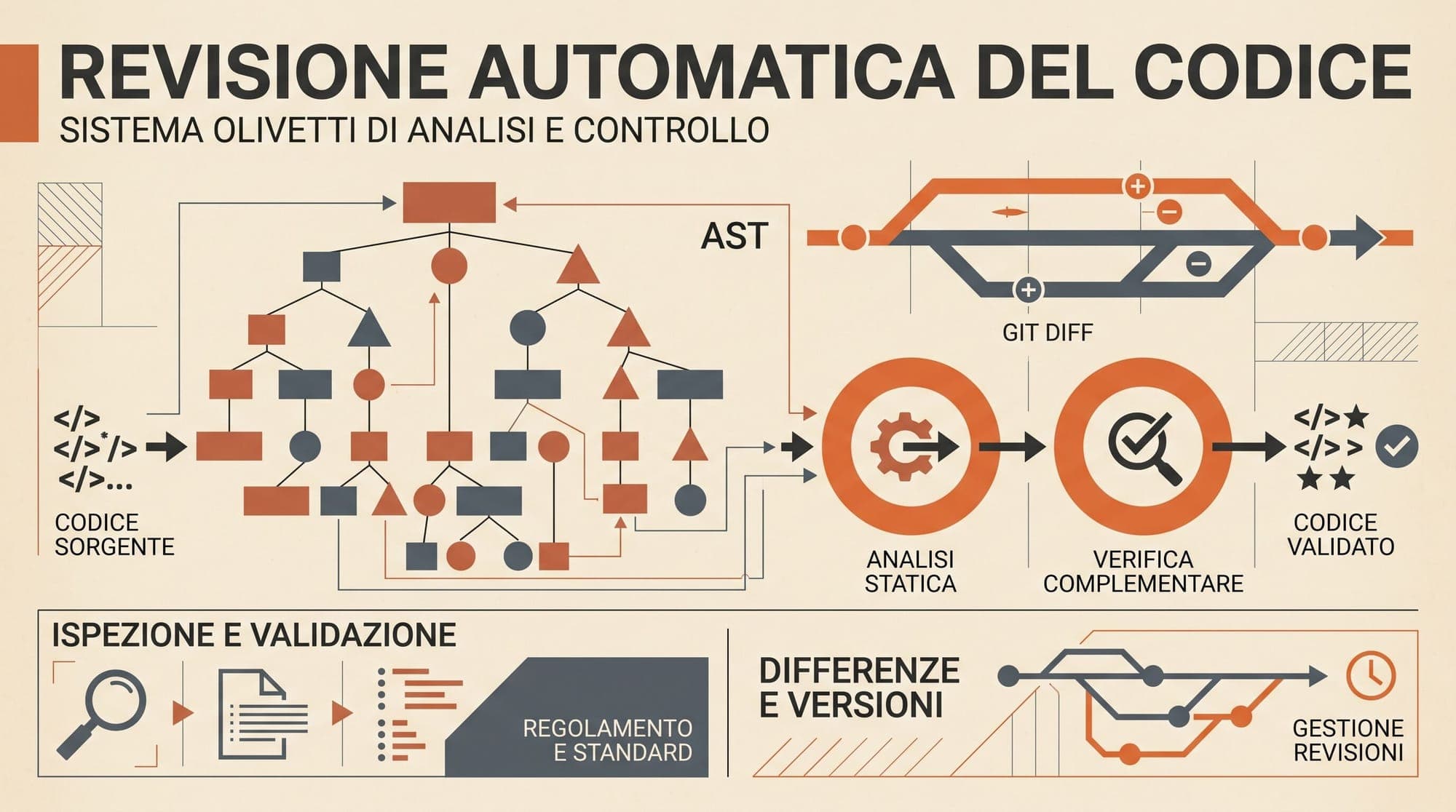
Naively piping unified git diffs into a large language model and posting the raw output to GitHub or Bitbucket is a reliable way to degrade engineering velocity. While frontier models demonstrate high zero-shot reasoning capabilities, unconstrained code review bots suffer from high false-positive rates, superficial formatting nitpicks, hallucinated API misuse, and context blindness. When an automated bot generates twenty low-value comments per pull request, developers suffer review fatigue and rapidly ignore all automated feedback.
Building a production-grade automated AI code review engine requires moving beyond simple diff prompting to an integrated pipeline. Modern production systems combine incremental Abstract Syntax Tree (AST) analysis, deterministic static analysis (linters and SAST), structured guideline enforcement, and multi-stage classification gates to ensure every posted comment is factually grounded, security-aware, and directly actionable.

The Production Review Dilemma: Noise vs. Resolution Rate
In typical engineering organizations, code review represents a critical bottleneck in the software development lifecycle. However, automated review systems face an asymmetric penalty for noise. If an automated reviewer flags a false positive, a developer must context-switch, analyze the comment, and dismiss it. If a bot outputs 5 to 15 percent false positives across dozens of daily pull requests, the cumulative cognitive overhead quickly exceeds the time saved.
Empirical data from enterprise deployments underscores this dynamic. In a 12-month production study across more than 1,900 repositories at Atlassian detailed in arXiv:2601.01129, unconstrained LLM comment generation frequently produced vague or non-actionable suggestions such as "consider refactoring" or cosmetic whitespace remarks. Implementing rigorous quality filtering increased the resolution rate (the proportion of automated comments that triggered subsequent code changes) to 38.70%, approaching the 44.45% resolution rate of human reviewers, while reducing median pull request cycle time by 30.8% and cutting human reviewer comment burdens by 35.6%.
Achieving these metrics requires an event-driven, multi-tier pipeline designed around four core architectural stages:
- Context-Aware Ingestion and AST Traversal: Mapping diff hunks to precise syntactic nodes and bounded call-graph dependencies.
- Deterministic Pre-Filtering: Running linters and AST-based rule checkers prior to LLM invocation to prune formatting and trivial syntax errors.
- Guideline-Constrained Generation: Prompting foundation models with explicit domain instructions, diff slices, and issue tracker metadata.
- Two-Stage Quality Gates: Filtering candidates through a factual correctness judge (LLM-as-a-Judge) and an encoder-based actionability classifier.
Step 1: Context Assembly via Tree-Sitter and Dependency Radius
Raw git diffs lack structural semantic context. A three-line modification inside a method body provides no information regarding parameter types, class inheritance, surrounding error handlers, or downstream callers. Conversely, loading every modified file in its entirety rapidly exhausts token budgets and introduces distracting context that degrades model focus.
Production architectures address this through incremental syntax tree parsers like Tree-sitter. When a pull request webhook triggers the review worker, the system constructs a scoped context window using syntactic boundary extraction:
[PR Webhook Event]
       │
       ▼
[Git Diff Extraction] ──► Identify Changed Line Intervals: [L_start, L_end]
       │
       ▼
[Tree-Sitter Parsing] ──► Ascend AST to Enclosing Scope (Function / Struct / Class)
       │
       ▼
[Symbol Table & LSP]  ──► Extract Imports, Type Signatures, and Direct Callers (Depth = 1)
       │
       ▼
[Context Assembly]    ──► Assemble Compact JSON Context Envelope for LLM
import tree_sitter_languages
from tree_sitter import Node
def extract_enclosing_ast_scope(tree, start_line: int, end_line: int) -> dict:
"""
Ascends the concrete syntax tree to find the minimum enclosing
functional boundary (function, method, class) containing the diff hunk.
"""
root = tree.root_node
def find_node(node: Node) -> Node:
for child in node.children:
if child.start_point[0] <= start_line and child.end_point[0] >= end_line:
# If child is a function or method definition, return it
if child.type in {"function_definition", "method_definition", "class_definition"}:
return child
return find_node(child)
return node
target_node = find_node(root)
return {
"scope_type": target_node.type,
"start_byte": target_node.start_byte,
"end_byte": target_node.end_byte,
"signature_text": target_node.text.decode("utf-8")[:300]
}Graph Radius Truncation
A common failure mode in repository-aware context generation is unbounded dependency expansion. Traversing callers and callees naively can cause a modification in a core utility function to pull thousands of transitive references into context.
Production pipelines enforce a strict call graph radius bound ():
- Included Context: The immediate enclosing function AST node, the parent class interface signature, local imports, and explicit types resolved via Language Server Protocol (LSP) or symbol index.
- Excluded Context: Transitive callers beyond depth 1, external package implementation internals, and unchanged sibling methods within the same file.
Step 2: Deterministic Pre-Filtering via Linter Hybridization
Foundation models are inefficient and noisy linters. Asking an LLM to check indentation, snake_case conventions, or unused variables wastes inference spend and introduces hallucinated stylistic complaints.
Production review engines enforce a strict separation of concerns:
| Review Category | Responsible Engine | Tooling / Implementation | Cost & Latency Profile | | :--- | :--- | :--- | :--- | | Formatting & Style | Deterministic Linters | Ruff, ESLint, Prettier, Clippy | Sub-100ms, zero token cost | | Known Vulnerabilities & SAST | Pattern-Matching Rules | Semgrep, Bandit, Gitleaks | Sub-500ms, deterministic AST rules | | Semantic Correctness & Logic | Foundation LLM | Claude 3.5 Sonnet, GPT-4o | 1-5s, high reasoning capacity | | Architecture & Scope Fit | Human Staff Engineers | Pull Request Discussions | Asynchronous, final decision authority |
Before constructing the LLM prompt, the system executes deterministic linters over the modified files. If a rule triggers on a line modified in the pull request, the issue is formatted directly into a standard CI check annotation. The LLM's system prompt is explicitly instructed to ignore all syntactic formatting, missing imports, and styling conventions handled by existing linter rulesets.
Step 3: Structured Prompting and Guideline Partitioning
When the AST context, diff hunks, and linked ticket metadata (e.g., Jira or Linear issue summaries) are assembled, the review request is dispatched to the generative model. To prevent generic feedback, the prompt partitions instructions into four discrete functional domains:
{
  "system_instructions": {
    "role": "Senior Security & Systems Engineer",
    "guidelines_code": [
      "Evaluate memory safety, concurrency race conditions, and error propagation.",
      "Check resource lifecycle management (open file descriptors, DB connections, HTTP clients).",
      "Do NOT comment on variable naming, code formatting, or missing docstrings."
    ],
    "guidelines_test": [
      "Verify edge-case handling in newly added test fixtures.",
      "Ensure mock assertions match the updated interface contracts."
    ],
    "guidelines_comment": [
      "Every comment must reference an exact line number within the added diff hunk (+ lines).",
      "Every comment must provide a concrete, copy-pasteable replacement code block.",
      "State the failure mode explicitly: 'If X occurs, Y will fail because Z'."
    ]
  },
  "pull_request": {
    "title": "feat(auth): migrate session token validation to distributed redis store",
    "description": "Replaces in-memory session cache with clustered Redis client and adds sliding window TTL.",
    "ticket_context": "JIRA-4821: Session state must support horizontal pod autoscaling without dropped sessions."
  }
}
The model is required to return a structured JSON schema containing candidate review items:
{
  "candidates": [
    {
      "file_path": "src/auth/session.py",
      "line_number": 142,
      "severity": "CRITICAL",
      "category": "CONCURRENCY",
      "issue_summary": "Unprotected pipeline execution creates a race condition during concurrent token refreshes.",
      "suggested_patch": "async with redis.pipeline(transaction=True) as pipe:\n    pipe.watch(session_key)\n    pipe.setex(session_key, ttl, token)\n    await pipe.execute()"
    }
  ]
}
Step 4: Multi-Stage Quality Gates and Hallucination Filtering
Candidate comments generated by the primary LLM cannot be posted directly. Even with strict system prompts, LLMs hallucinate non-existent API parameters, misinterpret surrounding variable lifetimes, or generate subjective advice.
Production review engines implement a two-stage quality verification pipeline before any webhook posts to the source control management (SCM) platform:
[Candidate Comments Generated by Primary LLM]
                     │
                     ▼
  ┌─────────────────────────────────────┐
  │ Stage 1: Factual Correctness Judge  │ ──► Drops Hallucinated / Misaligned Items
  │ (LLM-as-a-Judge / Binary Decision)  │     (False / Disagrees with AST Scope)
  └─────────────────────────────────────┘
                     │  (Passed = True)
                     ▼
  ┌─────────────────────────────────────┐
  │ Stage 2: Actionability Quality Gate │ ──► Drops Vague Nits / Low-Value Remarks
  │ (Fine-Tuned ModernBERT Classifier)  │     (P(Resolution) < Threshold \tau)
  └─────────────────────────────────────┘
                     │  (Passed = High Quality)
                     ▼
  [Post Inline Suggestion to GitHub / Bitbucket PR API]
Gate 1: Factual Correctness (LLM-as-a-Judge)
The first gate utilizes a lightweight, cost-effective reasoning model (such as gpt-4o-mini or Claude 3.5 Haiku) configured as a binary judge (). As demonstrated in HalluJudge, evaluating alignment between the suggested patch and the AST context eliminates context misalignment without requiring expensive manual thresholds:
def evaluate_factual_correctness(candidate: dict, file_ast_context: str) -> bool:
    """
    Executes a fast binary classification on candidate review comments.
    Verifies that the referenced variables and failure modes actually exist in context.
    """
    prompt = f"""
    You are an automated code review verification judge.
    Evaluate whether the following code review comment is factually accurate based ONLY on the provided code scope.

    Code Scope:
    {file_ast_context}

    Candidate Comment:
    Line: {candidate['line_number']}
    Issue: {candidate['issue_summary']}
    Patch: {candidate['suggested_patch']}

    Criteria:
    1. Does the code at line {candidate['line_number']} actually exhibit the described defect?
    2. Does the suggested patch introduce undefined variables or invalid method calls?

    Return ONLY a JSON object: {{"factually_correct": true | false, "rationale": "short explanation"}}
    """
    response = call_fast_judge(prompt)
    return response.get("factually_correct", False)
Gate 2: Actionability and Resolution Modeling (ModernBERT)
Even factually accurate comments may be unhelpful. Comments such as "Consider writing a helper function for this" or "This could potentially be made more modular" create cognitive friction without offering a concrete resolution path.
To enforce actionability, production pipelines deploy a fine-tuned sequence classification model based on ModernBERT. Trained on historical paired review comments and subsequent commit resolution traces (), the classifier evaluates the semantic structure of the comment text:
Any comment where (typically calibrated at ) is dropped. This eliminates vague opinions, ensuring only high-confidence defect detections and verified inline refactorings reach the pull request.
Step 5: Pull Request Ergonomics and Production Lifecycle
Once a comment clears both quality gates, the deployment orchestrator interacts with the SCM API. Developer experience considerations dictate several operational rules:
- Inline Suggestions with Multi-Line Range Support: Comments must be attached directly to the changed hunk lines (
commit_id,path,line,side="RIGHT") using GitHub's or Bitbucket's suggested change formatting. This allows engineers to apply the fix with a single click. - Comment Cap per Pull Request: Never exceed 3 to 5 total inline comments per pull request, regardless of how many candidates pass the quality gates. If multiple items trigger, rank them by severity (
SECURITY>CORRECTNESS>PERFORMANCE) and suppress the remainder into a collapsed summary overview. - Implicit and Explicit Feedback Loops: Track user reactions (), resolution commits, and manual dismissals. Feed these telemetry signals back into the ModernBERT training dataset and prompt guidelines to continuously suppress repetitive false positives.
+-------------------------------------------------------------------------------+
| AI Code Reviewer (Bot) - Line 142                                             |
+-------------------------------------------------------------------------------+
| [CONCURRENCY ISSUE DETECTED]                                                  |
| Unprotected pipeline execution creates a race condition during concurrent    |
| token refreshes. Use a WATCH transaction to ensure atomic execution.          |
|                                                                               |
| ```suggestion                                                                 |
| -    await redis.setex(session_key, ttl, token)                               |
| +    async with redis.pipeline(transaction=True) as pipe:                     |
| +        pipe.watch(session_key)                                              |
| +        pipe.setex(session_key, ttl, token)                                  |
| +        await pipe.execute()                                                 |
| ```                                                                           |
|                                                                               |
| [Apply Suggestion]  |  [Dismiss]  |  [Thumbs Up]  [Thumbs Down]              |
+-------------------------------------------------------------------------------+
Architecture Summary
Automating code review in production is fundamentally a problem of precision filtering rather than generative capacity. By bounding context with Tree-sitter AST traversal, offloading syntax and style to deterministic linters, guiding generation with structured quality checklists, and gating outputs through factual judges and ModernBERT actionability classifiers, engineering teams can slash pull request cycle times by over 30% while maintaining developer trust.
Sources
- RovoDev Code Reviewer: A Large-Scale Online Evaluation of LLM-based Code Review Automation at Atlassian (arXiv:2601.01129)
- HalluJudge: A Reference-Free Hallucination Detection for Context Misalignment in Code Review Automation (arXiv:2601.19072)
- SWE-PRBench: Benchmarking AI Code Review Quality Against Pull Request Feedback (arXiv:2603.26130)
- Code Review Agent Benchmark (arXiv:2603.23448)
- Tree-sitter: An Incremental Parsing System for Programming Tools
- ModernBERT: A Modernized Bidirectional Encoder Architecture (arXiv:2412.13663)



