
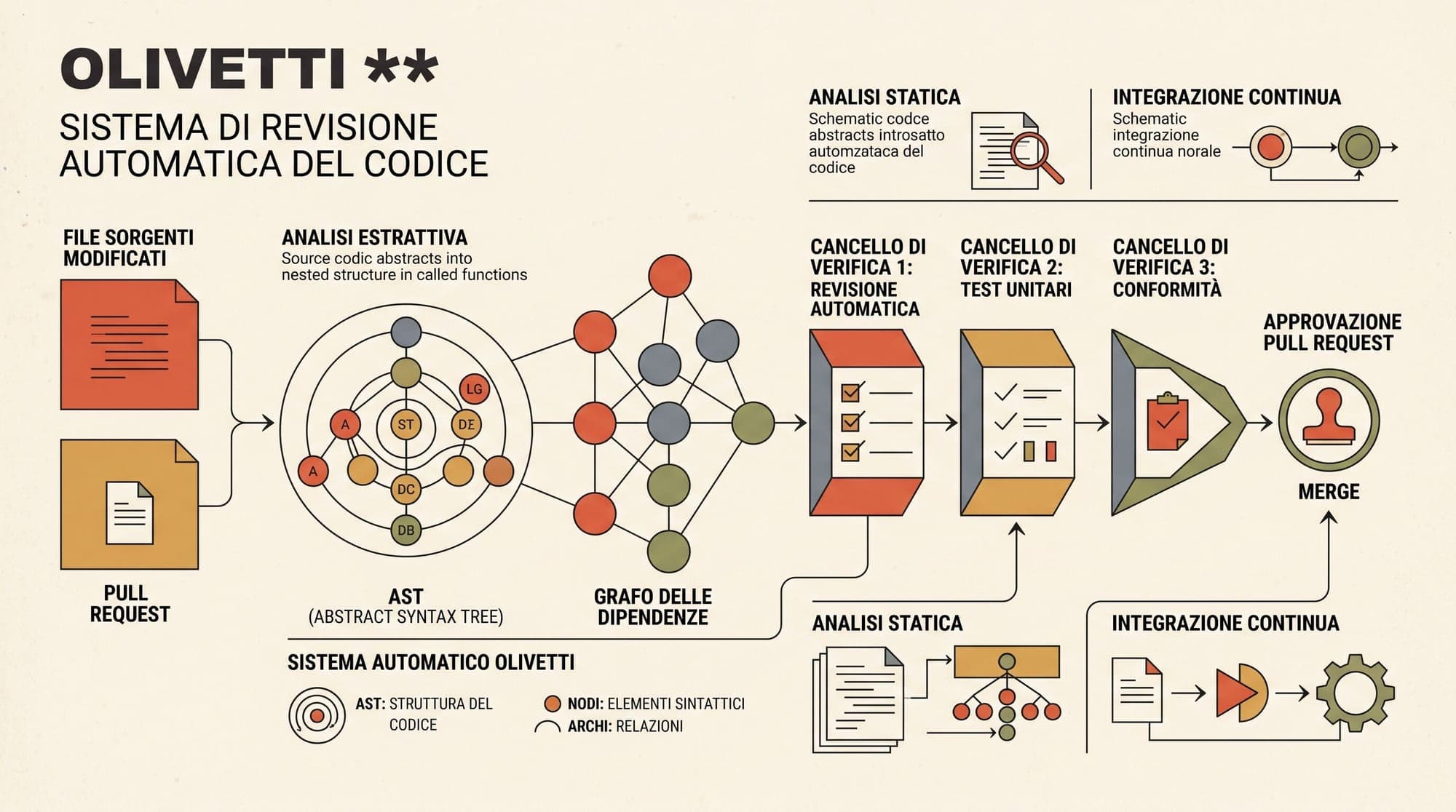
The surge in automated code generation has exposed a major structural bottleneck in software delivery: pull request review velocity. While AI coding tools accelerate the creation of multi-file diffs, human engineering review capacity remains fixed. Relying on naive large language model prompts over raw git diffs introduces severe failure modes, including hallucinated syntax rules, nitpicking noise, and inability to trace function modifications across distant caller and callee boundaries.
To solve this challenge, engineering teams are deploying dedicated AI code review platforms. Unlike single-turn diff analyzers, modern review engines construct structural codebase graphs, orchestrate specialized parallel evaluation agents, integrate static analysis tools, and filter false positives before posting comments.
This analysis compares the architectural foundations, context retrieval mechanics, false-positive mitigation pipelines, and operational economics of four leading production frameworks: CodeRabbit, Qodo (formerly CodiumAI and PR-Agent), Greptile, and GitHub Copilot Code Review.

1. CodeRabbit: On-Demand Live AST Graphs and Scoped Multi-Stage Pipelines
CodeRabbit approaches code review through scoped execution pipelines and on-demand abstract syntax tree (AST) graph construction. Rather than relying on pre-indexed vector embeddings that degrade as branches diverge, CodeRabbit builds a fresh structural dependency graph of the repository per pull request.
The CodeRabbit review lifecycle executes across five discrete stages:
- AST Parsing and Structural Dependency Mapping: CodeRabbit parses modified source files and their immediate dependencies using Tree-sitter AST parsers. It maps symbol references, function signatures, and call hierarchies to evaluate how edits impact uncommitted caller files.
- SAST and Linter Tool Integration: The engine runs 40+ static application security testing (SAST) tools and linters (such as ESLint, Ruff, Semgrep, and custom static rules) directly on the change set, feeding deterministic diagnostic signals into the LLM context.
- Contextual Heuristic Aggregation: The system aggregates historical PR context, user-configured instruction profiles (Quiet, Chill, Assertive), and Model Context Protocol (MCP) server inputs.
- Targeted LLM Review Generation: The model inspects the synthesized context packet to evaluate logic defects, security vulnerabilities, race conditions, and boundary violations.
- Confidence Gating and Output Deduplication: An automated filter suppresses low-confidence findings and style-only suggestions before publishing review comments to GitHub or GitLab.
By isolating the LLM within a constrained five-stage pipeline rather than granting open-ended agency, CodeRabbit maintains review turnaround times between 1 and 5 minutes per pull request while preventing unbounded token expansion.
2. Qodo: Multi-Agent Parallel Inspection and Institutional Memory Indexing
Qodo, which evolved from the open-source PR-Agent project into an enterprise merge-time verification platform, models pull request review as a multi-agent consensus system.
When a pull request triggers Qodo, a centralized Context Collector gathers diff chunks, related file definitions, and organizational history. The workload is then dispatched to specialized review agents in parallel:
- Correctness Agent: Focuses strictly on runtime exceptions, boundary conditions, logical inversions, and null reference risks.
- Security Agent: Evaluates injection risks, credential leaks, cryptographic vulnerabilities, and compliance violations against OWASP standards.
- Architecture and Standards Agent: Validates adherence to repository-specific coding standards, architectural boundaries, and naming conventions.
- Test Coverage Agent: Identifies missing test paths, unhandled error branches, and regression surfaces.
Once the parallel agents complete their independent evaluations, a central Judge Agent aggregates the findings. The Judge agent cross-references findings against confidence thresholds, removes duplicate feedback across agents, and filters out speculative comments.
A key architectural component in Qodo is Institutional Knowledge Integration. Qodo continuously indexes historical merged pull requests, review comment threads, and Architectural Decision Records (ADRs). When reviewing a new change, the context engine retrieves analogous historical review discussions, enabling the system to enforce implicit team preferences and avoid repeating previously rejected patterns.
3. Greptile: Pre-Indexed Knowledge Graphs and Swarm Traversal
Greptile centers its architecture on persistent, full-codebase knowledge graphs. While diff-only tools evaluate isolated code snippets, Greptile maintains an indexed graph representation of the entire repository structure, tracking files, functions, types, and cross-module dependencies.
Greptile's execution model operates through two main layers:
- Persistent Codebase Graph: The platform continuously ingests the repository, parsing call graphs, symbol references, and import hierarchies into a queryable graph store. When a function signature changes, Greptile traverses the graph edges to identify all transitive caller sites across the repository.
- Agent Swarm Review: An autonomous swarm of LLM agents queries the code graph to trace execution paths beyond the visible diff. The agents analyze multi-file side effects, data flow mutations, and broken interface contracts.
Greptile allows teams to configure analysis_depth between file-level and architectural modes. It also supports bidirectional developer interaction: engineers can chat with the review agent within PR comment threads, or route flagged issues directly into coding harnesses (such as Claude Code, Cursor, or Devin) via Model Context Protocol (MCP) servers and the /greploop iterative resolution command.
4. GitHub Copilot Code Review: Native Platform Integration and AST Codewalkers
GitHub Copilot Code Review integrates directly into GitHub's native pull request workflow. Unlike external webhook platforms that require separate authorization layers, Copilot operates inside GitHub's code intelligence infrastructure.
Copilot leverages GitHub's semantic code navigation stack, combining Tree-sitter parsers and symbol databases with fine-tuned code review models. Its pipeline emphasizes two primary mechanisms:
- AST Codewalking: The review engine traverses the abstract syntax tree to identify modified symbols and retrieve definitions and references across the repository without requiring full vector embeddings.
- Inline Fix Synthesis: When Copilot identifies an issue, it generates structured git suggestion blocks that developers can commit directly from the GitHub review interface with a single click.
Copilot Code Review focuses heavily on low-latency turnaround and tight developer friction reduction, prioritizing high-precision actionable comments over long-form architectural prose.
Architectural Trade-Offs and Design Dimensions
Choosing an AI code review framework requires evaluating four core engineering trade-offs:
Context Indexing: Live AST vs. Pre-Indexed Graph vs. Vector RAG
- Live AST (CodeRabbit): Parses only the modified files and their immediate dependencies at review time. Eliminates stale index drift and requires zero background database synchronization, but depth is bounded to direct dependency neighborhoods.
- Persistent Graph (Greptile): Maintains a global dependency graph across all files and functions. Enables transitive multi-hop impact analysis across large mono-repos, but requires continuous background graph maintenance as the main branch evolves.
- Organizational Indexing (Qodo): Supplements code parsing with semantic vector indexing of historical PR threads and merge discussions, capturing human intent and institutional norms.
False-Positive Filtering and Signal-to-Noise Management
The primary operational risk in automated code review is "reviewer fatigue" caused by excessive stylistic comments and hallucinated defects. Production frameworks implement distinct filtering layers:
- Heuristic & SAST Gating: Running deterministic linters and security scanners before invoking LLMs ensures that syntax and formatting rules are enforced deterministically without consuming token budget.
- Judge-Agent Arbitration: Multi-agent architectures (such as Qodo) use an auxiliary judge model with a high refusal threshold to discard speculative or non-critical comments.
- Configurable Review Profiles: Allowing teams to select strictness modes (e.g., CodeRabbit's Quiet vs. Assertive profiles) prevents junior-level style lecturing on mature codebases.
Latency vs. Analysis Depth
- Fast Merge-Time Gates (1 to 3 minutes): CodeRabbit and GitHub Copilot prioritize rapid CI execution, analyzing diffs and immediate dependencies to prevent blocking developer pipelines.
- Deep Multi-Agent Swarms (3 to 8 minutes): Qodo and Greptile execute multi-pass evaluations and transitive graph queries, trading execution speed for comprehensive multi-file impact detection.
Production Deployment and Serving Economics
Operating AI code review in production involves distinct cost and infrastructure trade-offs:
- Token Consumption per Pull Request: A standard diff review spanning 200 to 500 lines of code consumes between 15,000 and 60,000 input tokens when supplemented with AST dependency context. Multi-agent architectures with judge synthesis consume 80,000 to 200,000 tokens per review.
- Pricing Models: Platforms vary between per-seat subscriptions ($15 to $30 per developer monthly) and usage-based models based on reviewed lines of code or review execution count.
- CI/CD Enforcement: Automated reviews should be configured as non-blocking checks initially. Once false positive rates drop below 5%, teams can gate merge permissions on resolving high-severity security and correctness flags.
Summary Recommendations
- Select CodeRabbit for fast, reliable pull request reviews with integrated SAST tooling, live AST dependency checks, and low operational maintenance.
- Select Qodo for enterprise environments where multi-agent verification (security, correctness, test coverage) and institutional memory from past PRs are necessary.
- Select Greptile for large codebases requiring full graph-based transitive dependency tracing, architectural impact analysis, and deep agentic tool integration via MCP.
- Select GitHub Copilot Code Review for organizations seeking native GitHub integration with zero external infrastructure setup and frictionless one-click suggestions.
Sources
- CodeRabbit Documentation and Architecture: https://www.coderabbit.ai
- Qodo Code Review Platform and Multi-Agent Architecture: https://docs.qodo.ai/code-review
- Qodo PR-Agent Open Source Repository: https://github.com/The-PR-Agent/pr-agent
- Greptile Graph-Based Codebase Context: https://www.greptile.com/docs/how-greptile-works/graph-based-codebase-context
- Greptile Autonomous Code Review Agent: https://www.greptile.com/agent
- GitHub Copilot Code Review Documentation: https://docs.github.com/en/copilot/using-github-copilot/code-review



