
Deploying autonomous AI agents into complex environments reveals a persistent operational bottleneck: frozen model weights. When an agent fails at a non-trivial workflow, traditional engineering setups rely on humans to diagnose the failure, rewrite prompt templates, adjust few-shot exemplars, or add custom heuristic wrappers. This manual iteration loop fails to scale across diverse, long-horizon production environments where agents encounter thousands of unique edge cases daily.
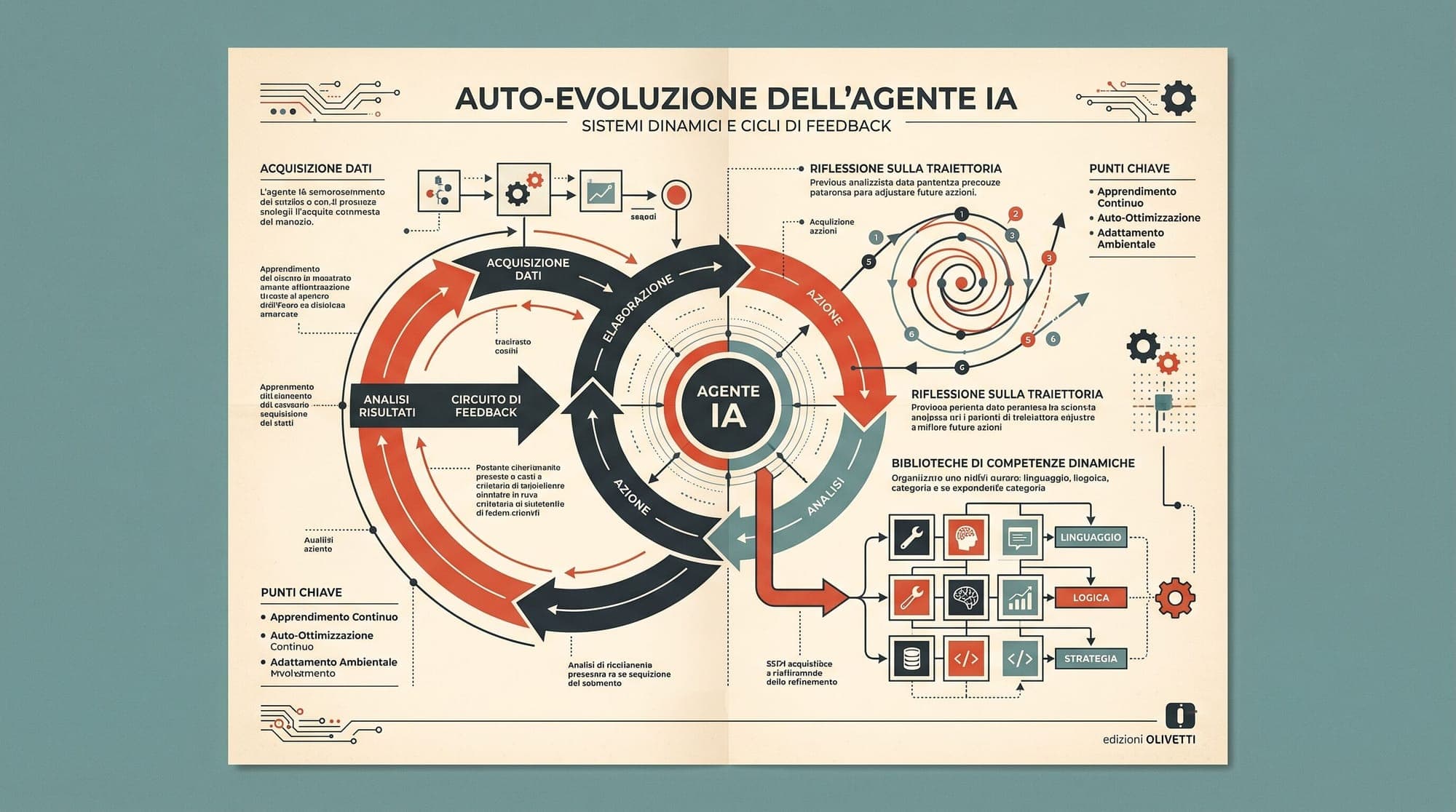
To break this bottleneck, production engineering is shifting toward self-evolving agent architectures. Rather than treating each execution run as an isolated, ephemeral session, experiential learning frameworks capture execution trajectories, generate verbal and code-level reflections, index reusable procedural skills, and periodically distill validated experiences into updated policy weights.
The Static Weight Dilemma
Standard agent frameworks execute tasks autoregressively: given a system prompt, a goal description, and tool definitions, the agent emits thoughts, actions, and observations until reaching a termination condition. If the agent makes a mistake (such as passing invalid schema parameters or misinterpreting an API error response), that error is forgotten as soon as the context window clears.
In production, this leads to three systemic inefficiencies:
- Repetitive Error Cycles: Agents repeatedly execute the same failed exploration paths across independent customer sessions, burning tokens and increasing task completion latency.
- Context Window Saturation: Injecting large static prompt libraries or extensive general documentation degrades attention quality, increases time-to-first-token (TTFT), and inflates inference costs.
- Slow Alignment Cycles: Updating agent behavior via manual dataset curation and supervised fine-tuning (SFT) introduces latency measured in weeks, preventing fast adaptation to dynamic third-party APIs and evolving tool interfaces.
Experiential learning treats agent interactions not as disposable inference calls, but as exploratory rollouts that produce structured training signal.

The Three-Tier Architecture of Experiential Learning
Modern self-improving agent architectures operate across three complementary feedback loops, categorized by temporal scope and state mutability.
1. Intra-Task Verbal Reflection
The fastest feedback loop operates within the bounds of a single task execution. Pioneered by frameworks like Reflexion (Shinn et al., 2023), this pattern introduces an explicit evaluator model and a self-reflection step before re-attempting a failed sub-task.
When an environment returns an error or fails a unit test, the agent pauses action execution and prompts an evaluator model to produce a verbal diagnostic:
{
  "trial_id": 1,
  "failed_action": "query_database(query='SELECT * FROM users WHERE signup_date > NOW() - INTERVAL 7 DAY')",
  "error_message": "SyntaxError: near '7': syntax error",
  "reflection": "The SQLite engine does not support MySQL interval syntax. Use date('now', '-7 days') instead.",
  "revised_plan": "Reformulate the query using SQLite date formatting functions and execute again."
}
This verbal reflection is appended to the working context buffer, allowing the agent to correct course on subsequent steps without external human intervention. Research demonstrates that multi-trial verbal reflection improves coding benchmark solve rates by over 20% compared to basic chain-of-thought prompting.
2. Cross-Task Episodic Consolidation
While intra-task reflection resolves localized errors, it discards insights once the session terminates. Cross-task learning frameworks, such as ExpeL (Zhao et al., 2023) and Experiential Reflective Learning (Allard et al., 2026), extend reflection across independent task lifetimes.
In this paradigm, completed execution traces (both successful and failed) are written to an episodic replay buffer. An offline reflection agent periodically processes pairs of contrasting trajectories:
- Failure Analysis: Identifying specific tool-call parameters, assumptions, or logic paths that caused task breakdown.
- Success Mining: Extracting generalized natural language heuristics and operational constraints.
- Rule Formulation: Condensing lessons into modular, declarative guidelines (for example: "When querying external search APIs with multi-word filters, quote exact phrases to avoid tokenization fragmentation").
Extracted rules are stored in a centralized vector index. During subsequent inference sessions, the agent queries the index with the incoming user intent, dynamically retrieving only the top-k most relevant operational rules and injecting them into the system prompt.
3. Procedural Code and Skill Repositories
Natural language heuristics guide high-level planning, but deterministic execution often requires reusable procedural code. Frameworks like Voyager (Wang et al., 2023) expand experiential learning into executable skill generation.
When an agent successfully completes a novel multi-step procedure (such as orchestrating an authentication handshake, parsing a proprietary file format, or recovering from a transient rate-limit cascade), it synthesizes an executable function representing that workflow. The synthesis pipeline involves:
- Parameter Generalization: Replacing session-specific variables with abstract function arguments.
- Deterministic Verification: Executing the synthesized function against isolated unit tests in a sandboxed runtime.
- Semantic Tagging: Generating structured docstrings describing inputs, outputs, prerequisites, and failure modes.
- Registry Ingestion: Saving the verified code into a searchable skill store.
When faced with analogous tasks in the future, the agent retrieves and executes the validated function directly as a tool call, bypassing multi-step LLM reasoning loops and reducing token consumption.
Skill Library Curation and Indexing Dynamics
Without rigorous lifecycle governance, an agent's experience pool quickly degenerates into an unmanageable repository of conflicting, redundant, and obsolete heuristics. Maintaining high retrieval precision requires three core indexing mechanisms:
Progressive Disclosure
Injecting full skill implementations into the prompt consumes context and introduces distraction. Production systems employ progressive disclosure:
- Index Layer: Only lightweight skill descriptors (name, one-line summary, parameter types) are indexed for retrieval.
- Selection Layer: The agent scans top-ranked descriptors and explicitly requests the full code or detailed rules for the subset it intends to use.
- Execution Layer: Full code runs within a sandboxed worker, returning only structured outputs to the main orchestrator.
Deduplication and Conflict Resolution
As agents generate hundreds of task reflections, semantic overlap occurs. Background consolidation jobs run periodic clustering over skill vectors:
- Cosine Merge: Skills with cosine similarity exceeding 0.88 are evaluated by an LLM curator to determine if one subsumes the other.
- Contradiction Auditing: When two heuristics propose conflicting actions for similar states, the curator evaluates empirical outcome records across both trajectories, pruning the lower-performing heuristic.
Decay Curves and Utility Scoring
Every skill in the library maintains an empirical utility score based on invocation frequency and subsequent task outcome:
Skills that repeatedly fail in production or remain uncalled past an expiration threshold () are automatically down-ranked, moved to cold storage, and ultimately purged.
Offline Policy Distillation and Weight Baking
While in-context skill retrieval enables rapid adaptation, managing dynamic prompt retrieval at massive scale incurs latency overhead and index maintenance costs. The final phase of agent self-evolution is policy distillation: converting transient experiential memories into permanent model weights.
Trajectory Curation and Alignment Pipelines
Offline distillation processes the accumulated experience store through rigorous filtering:
- Trajectory Verification: Filtering out non-deterministic or unverified traces, retaining only rollouts validated by unit test suites or programmatic execution oracles.
- Chain-of-Thought Purification: Stripping exploratory dead-ends, failed retries, and verbose hallucinated reasoning from the raw logs, leaving clean, canonical execution trajectories.
- Fine-Tuning Integration: Formatting verified traces into standard supervised fine-tuning (SFT) and Direct Preference Optimization (DPO) datasets, as detailed in recent research on reasoning model distillation and alignment.
Periodically fine-tuning smaller, specialized agent models on these curated rollouts allows organizations to graduate recurring task capabilities directly into base inference weights, slashing operational serving costs by 40% to 70%.
Production Failure Modes and Safety Boundaries
Automating an agent's ability to modify its own operational guidelines introduces acute safety and stability risks that require architectural guardrails:
- Experiential Drift: An agent that encounters a rare edge case may formulate an overly restrictive heuristic (for example, assuming an entire endpoint is permanently disabled after a single timeout). Strict minimum-observation thresholds must gate the creation of permanent rules.
- Poisoning and Prompt Injection: If an agent processes untrusted third-party web content, malicious input can craft adversarial failures designed to inject malicious heuristics into the shared skill registry. All extracted skills and reflections must pass independent semantic verification filters before registry ingestion.
- Sandbox Isolation: Executable code skills must never execute directly in the orchestrator environment. Code generated during self-improvement loops must run inside ephemeral, network-isolated microVMs or WebAssembly runtimes with strict CPU and memory limits.
Conclusion
Agent self-evolution shifts AI development from manual prompt engineering to automated experiential optimization. By combining intra-task reflection, cross-task episodic consolidation, executable skill libraries, and offline policy distillation, engineering teams can build autonomous agent systems that systematically improve with every execution trace.
Sources
- Shinn, N., et al. (2023). Reflexion: Language Agents with Verbal Reinforcement Learning. arXiv:2303.11366.
- Zhao, H., et al. (2023). ExpeL: LLM Agents Are Experiential Learners. arXiv:2308.10144.
- Allard, M., et al. (2026). Experiential Reflective Learning for Self-Improving LLM Agents. arXiv:2603.24639.
- Wang, G., et al. (2023). Voyager: An Open-Ended Embodied Agent with Large Language Models. arXiv:2305.16291.
- DeepSeek-AI. (2025). DeepSeek-R1: Incentivizing Reasoning Capability in LLMs via Reinforcement Learning. arXiv:2501.12948.



