Agent Memory Frameworks in Production: Comparing Mem0, Zep, Letta, and LangGraph Store Architecture, Fact Extraction Pipelines, Episodic Graphs, and Long-Term Retrieval Economics
As autonomous AI agents transition from single-session task executors to persistent systems operating across weeks or months, context window limits present a severe architectural bottleneck. While modern foundation models support context lengths exceeding one million tokens, feeding full conversation histories into every inference turn is economically unviable and degrades reasoning precision due to attention dispersion.
Standard retrieval-augmented generation (RAG) fails for agentic memory because it treats conversational history as static text chunks. Conversational state requires continuous updates, contradiction resolution, temporal awareness (such as distinguishing between a user's past and current employer), and granular isolation across users and execution scopes.
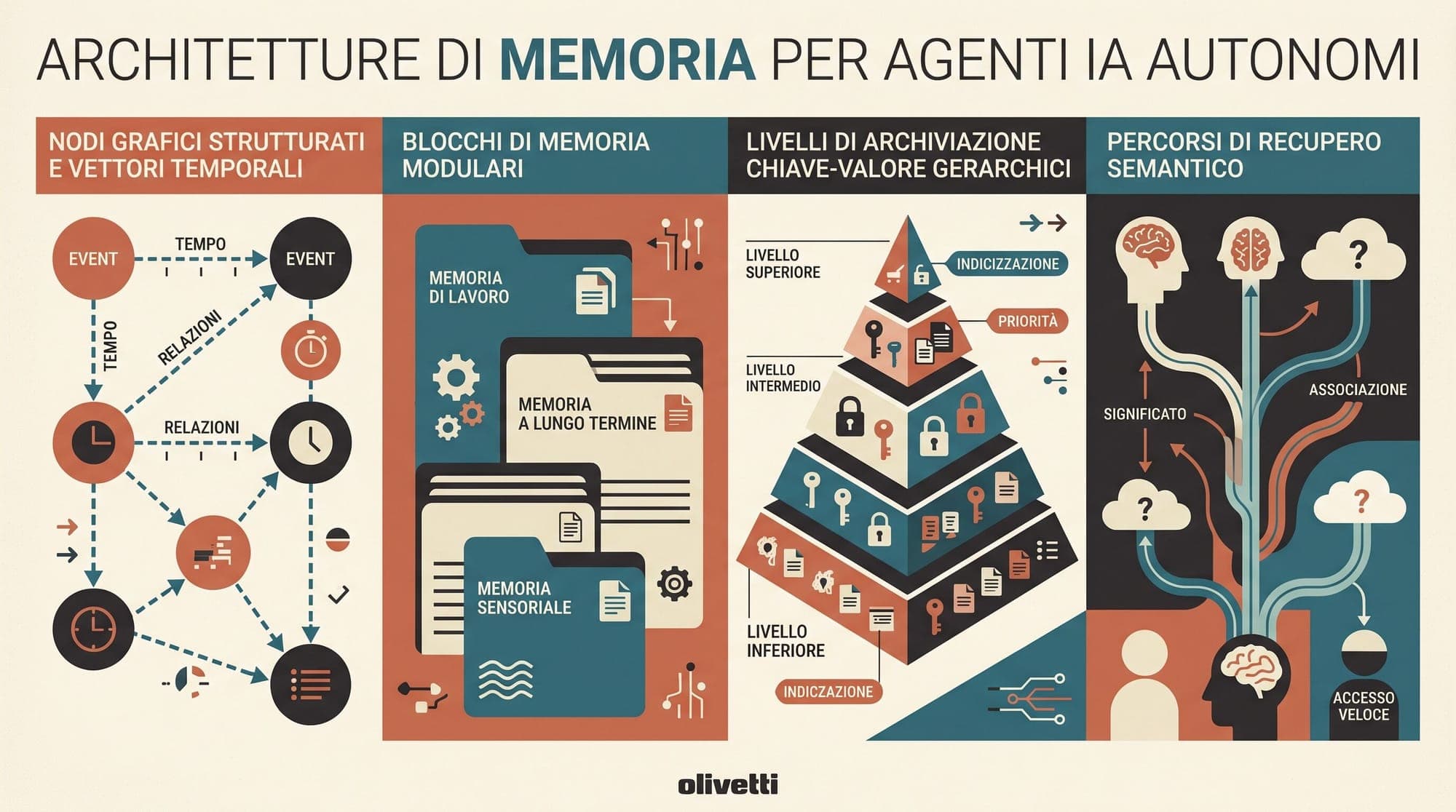
Four distinct agent memory architectures have emerged to address these requirements: Mem0, Zep (Graphiti), Letta (formerly MemGPT), and LangGraph Store (LangMem). This analysis examines their underlying data structures, extraction pipelines, temporal validity mechanisms, and production serving economics.

Architectural Comparison Overview
- Mem0: Hybrid Vector, Key-Value, and Graph data model. Updates occur via asynchronous LLM fact extraction and contradiction deduplication. Temporal modeling relies on timestamp metadata on atomic facts. Primary storage combines vector databases (such as Qdrant or Milvus) with key-value stores.
- Zep (Graphiti): Bitemporal Knowledge Graph data model. Updates occur via real-time incremental graph synthesis and edge resolution. Temporal modeling implements dual timestamps (event time and ingestion time) with valid-from and valid-to intervals. Primary storage combines graph databases (FalkorDB or Neo4j) with vector indices.
- Letta: Hierarchical Operating System Virtual Memory model. Updates occur via agent-directed tool calls (
core_memory_append,core_memory_replace). Temporal modeling uses a relational archival log with sequential paging. Primary storage combines in-context editable memory blocks with PostgreSQL archival storage. - LangGraph Store: Namespaced Document Store model. Updates occur via synchronous or asynchronous schema writes with semantic indexing. Temporal modeling uses user-defined metadata filtering. Primary storage runs on PostgreSQL (
PostgresStore), MongoDB Atlas, or in-memory backends.
Mem0: Semantic Fact Extraction and Multi-Store Hybridization
Mem0 operates as a drop-in memory layer designed to sit between the user interface and stateless LLM endpoints. Rather than storing conversational turns verbatim, Mem0 decomposes dialogue into discrete, atomic factual statements through an asynchronous extraction pipeline.
Fact Extraction and Contradiction Resolution
When a conversation turn concludes, Mem0 triggers an extraction prompt that parses the exchange for durable preferences, user attributes, entity relationships, and procedural state. Each candidate fact undergoes a deduplication and conflict-resolution check:
- Semantic Similarity Search: The candidate fact is embedded and queried against the user's existing vector index.
- Contradiction Evaluation: If a semantic neighbor is identified, a small language model evaluates whether the new fact complements, updates, or contradicts the existing memory.
- Atomic Mutation: Contradicted facts are either deleted or overwritten in place. Redundant entries are consolidated, preventing uncontrolled memory index expansion.
Storage and Retrieval
Mem0 integrates vector storage for similarity retrieval, key-value storage for rapid key-based lookups, and graph representations for entity associations. During inference, Mem0 performs a top-k vector search against the user's namespace, appending only the most relevant atomic facts into the system prompt. According to Mem0 benchmark disclosures, distilling raw sessions into atomic memories can reduce context token consumption by up to 90 percent compared to full-context injection.
Zep: Bitemporal Knowledge Graphs via Graphiti
Zep addresses the fundamental weakness of pure vector stores in modeling temporal evolution and relational multi-hop reasoning. Its architecture is powered by Graphiti, a dynamic, temporally aware knowledge graph engine that constructs a structured representation of memory across three interrelated subgraphs.
The Tripartite Subgraph Architecture
- Episode Subgraph: Stores raw conversational turns, transactional JSON payloads, and tool execution logs as immutable ground truth nodes annotated with original event timestamps.
- Semantic Entity Subgraph: Contains extracted entity nodes (such as individuals, software packages, and organizations) and directed relationship edges. Bidirectional pointers link semantic edges back to the source episode nodes, preserving full lineage for auditability.
- Community Subgraph: Clusters densely interconnected entity groups into higher-level semantic summaries, enabling hierarchical context synthesis during broad queries.
Bitemporal Invalidation and Fact Evolution
Standard vector databases suffer from recency blindness when past facts are superseded. Zep resolves this by implementing a dual-timestamp model:
- Event Time: When the real-world event occurred.
- Ingestion Time: When the memory engine recorded the event.
Relationships are bounded by validity intervals. When an agent receives an update (for example, "The production database moved from AWS RDS to Google Cloud Spanner"), Graphiti does not delete the prior record. Instead, it closes the validity interval of the AWS edge and creates a new edge for Google Cloud Spanner. This preserves complete temporal lineage, enabling the agent to reason accurately about historical system states.
Letta: Hierarchical Operating System Memory Virtualization
Originating from the MemGPT research project, Letta models LLM context management after operating system memory hierarchies. Instead of relying on external middleware to silently inject facts, Letta makes memory management an explicit, agent-controlled computational task.
The Memory Hierarchy
Letta structures memory into three tiers:
- In-Context Core Memory: A fixed block of text pinned directly inside the model's active context window, divided into sections such as
persona(agent behavioral constraints) andhuman(critical user attributes). The agent actively modifies these blocks at runtime using tool invocations such ascore_memory_appendandcore_memory_replace. - Recall Memory: A searchable database storing the chronological stream of past interactions, allowing the agent to inspect recent dialogue history through pagination tools.
- Archival Memory: An out-of-context vector and document database used for long-term knowledge retention. The agent executes explicit search queries (
archival_memory_search) and insertion operations (archival_memory_insert) when researching past events or saving detailed findings.
Self-Directed Eviction and Paging
When the agent's context window approaches capacity, Letta triggers an OS-style interrupt. The runtime compiles conversation turns into archival storage, trims the active context buffer, and notifies the agent via a system message. Because memory editing is exposed as a function-calling interface, the model autonomously curates what information remains in its immediate working memory.
LangGraph Store: Namespaced Key-Value Persistence with Semantic Search
LangGraph approaches memory through its long-term persistence layer, BaseStore (and the higher-level LangMem SDK). Rather than enforcing a specific ontology or cognitive model, LangGraph provides hierarchical state partitioning tailored for multi-agent graph topologies.
Namespace Isolation and Document Indexing
LangGraph Store organizes memories as JSON documents structured under tuple-based hierarchical namespaces:
# Hierarchical namespace schema
namespace = ("organizations", org_id, "users", user_id, "coding_preferences")
store.put(
    namespace=namespace,
    key="python_style",
    value={"framework": "FastAPI", "typing": "strict", "formatter": "ruff"}
)
This namespace hierarchy allows strict multi-tenant data isolation and role-based access control. An agent working on behalf of a support organization can access company-wide policy namespaces while querying user-specific preferences, without risk of cross-tenant data leakage.
Semantic Search over Structured Documents
LangGraph integrates semantic indexing directly into production stores such as PostgresStore (via pgvector) and MongoDB Atlas. When documents are inserted into a namespace, the store embeds specified text fields. Agents can execute exact key-value fetches (store.get), list keys within a hierarchical path (store.list_namespaces), or perform semantic vector searches (store.search(namespace, query="preferred API framework")).
Production Trade-Offs and Retrieval Economics
Deploying long-term memory in production introduces trade-offs between write latency, query complexity, operational overhead, and compute cost.
1. Write Path Overhead
- Mem0: Requires an auxiliary LLM extraction call on each conversation turn or batch. Write latency averages 400ms to 1,200ms depending on the extraction model (such as GPT-4o-mini or local Mistral-7B).
- Zep: Incurs graph entity resolution and edge verification overhead. Building the tripartite graph requires structured entity extraction and embedding generation, adding 500ms to 1,800ms to the background ingestion queue.
- Letta: Memory operations occur synchronously within the agent's generation loop as tool calls. Every memory update consumes generation tokens and requires a separate round-trip turn.
- LangGraph Store: Lowest write overhead when updating key-value documents directly (sub-50ms database write). If semantic embeddings are generated on write, latency is bounded by embedding API latency (typically 30ms to 100ms).
2. Query Precision and Multi-Hop Traversal
- Mem0 and LangGraph Store: Excellent for single-hop semantic recall (such as retrieving a user's API key configuration or preferred programming language). They struggle with multi-hop relational queries (for example, finding all microservices maintained by engineers who reported to a specific lead before a reorganization).
- Zep: Excels at multi-hop reasoning and temporal conflict resolution through graph traversal combined with vector similarity.
- Letta: Retrieval precision depends on the agent's reasoning capability to formulate accurate search queries and page through archival indices.
3. Infrastructure Complexity
- Mem0: Requires a vector database and an embedding provider. Managed cloud options minimize infrastructure management.
- Zep: Requires graph database infrastructure (FalkorDB or Neo4j) alongside vector indices and extraction models.
- Letta: Relies on relational storage (PostgreSQL) and an execution harness capable of handling recursive tool interrupts and state restoration.
- LangGraph Store: Minimal operational footprint for teams already operating PostgreSQL or MongoDB; leverages existing database clusters via native vector extensions.
Architectural Decision Framework
When architecting memory for production AI agents, framework selection should align with the required cognitive model and query patterns:
- Choose Mem0 for consumer-facing chat applications, personal assistants, or customer support bots where atomic user preferences and fast setup are paramount, and complex relational reasoning is not required.
- Choose Zep (Graphiti) for enterprise agents that interact with evolving business domains, complex entity relationship graphs, temporal compliance audits, and multi-session workflows where facts frequently change over time.
- Choose Letta for autonomous coding agents, research assistants, and long-running autonomous workers that require self-directed working memory management and explicit control over active context blocks.
- Choose LangGraph Store for multi-agent workflows built on LangGraph where fine-grained namespace isolation, multi-tenancy boundaries, and tight coupling between state machines and long-term key-value storage are essential.
Sources
- A Temporal Knowledge Graph Architecture for Agent Memory (Zep / Graphiti)
- MemGPT: Towards LLMs as Operating Systems (Letta)
- Mem0 Architectural Documentation and Platform
- Semantic Search for LangGraph Memory (LangChain)
- LangGraph Long-Term Memory and Persistence Concepts
- Neo4j: Graphiti Knowledge Graph Memory for an Agentic World