
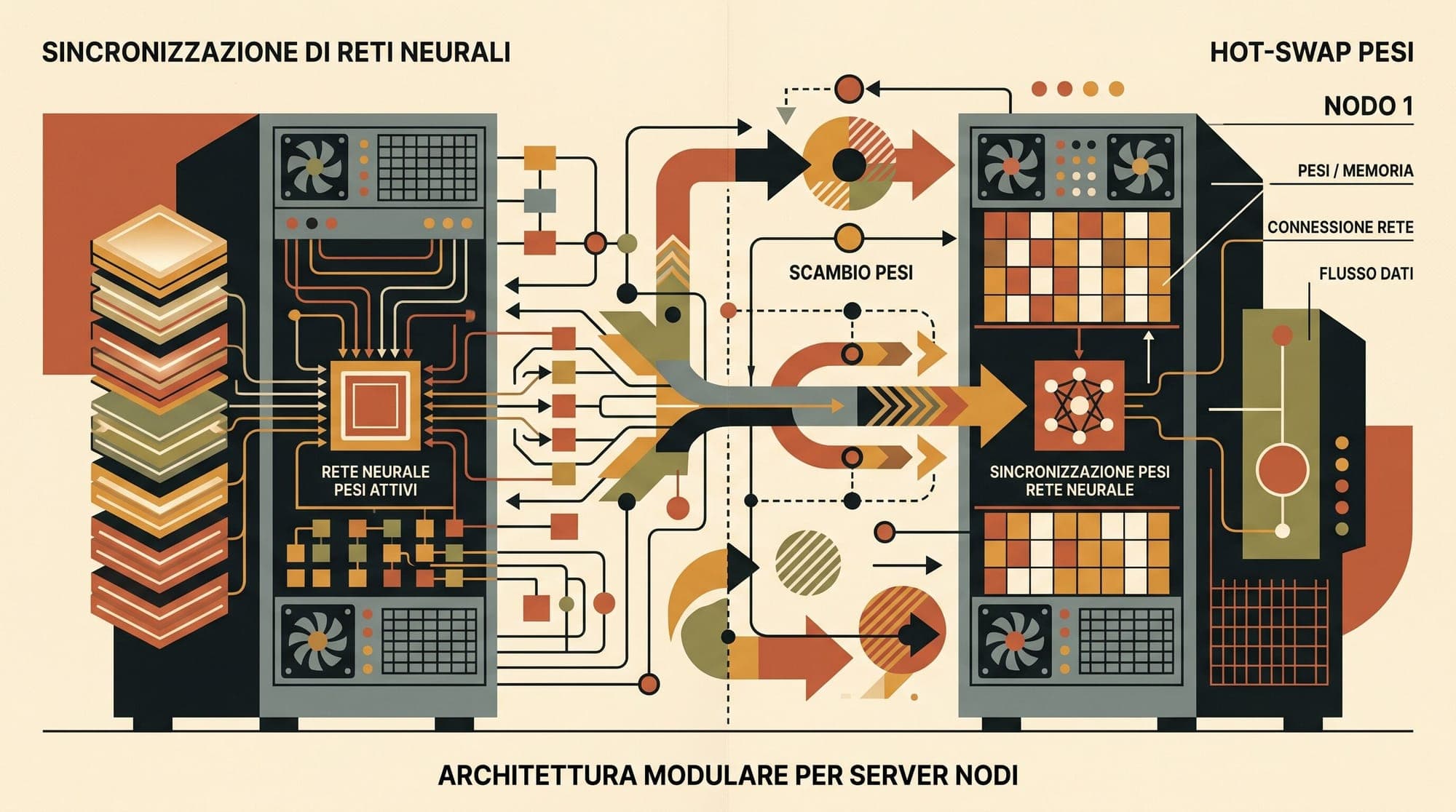
Zero-Downtime Model Updates in Production LLM Serving: In-Place Weight Transfer, CUDA IPC vs. NCCL Syncing, and Traffic Draining Architectures
In high-throughput LLM serving infrastructure, updating model checkpoints presents a severe operational dilemma. Traditional microservice deployment patterns such as blue-green deployments or rolling pod restarts fail to scale economically when applied to multi-GPU LLM clusters. Tearing down a serving instance to load a newly fine-tuned checkpoint or policy rollout triggers substantial GPU idle time: downloading dozens of gigabytes of SafeTensors weights, re-allocating unified CUDA memory pools, and re-capturing static CUDA graphs for continuous batching can take anywhere from 90 seconds to several minutes per replica. Furthermore, maintaining double the active GPU capacity for blue-green cutovers introduces massive idle infrastructure costs on high-end accelerator clusters.
To eliminate this cold-start overhead, modern inference engines including vLLM and SGLang have introduced in-place weight updating architectures. Rather than terminating the Python runtime or flushing the allocated Key-Value (KV) cache memory pools, these systems update tensor buffers directly in GPU memory while keeping the serving process alive. Understanding the trade-offs between disk-based reloading, CUDA Inter-Process Communication (IPC), and distributed NCCL synchronization is critical for engineering continuous model delivery pipelines.
The Cold-Start Penalty in Distributed Inference
Standard container recycling in Kubernetes or Ray Serve imposes multiple sequential bottlenecks when updating an LLM:
- CUDA Context and Framework Initialization: Initializing the PyTorch CUDA runtime, distributed process groups (NCCL/Gloo), and backend kernels across tensor-parallel ranks consumes 10 to 30 seconds.
- Weight Deserialization and Host-to-Device Copying: Loading a 70B parameter model in FP8 precision requires streaming approximately 70 GB of tensor data from local NVMe storage or network-attached volumes into High Bandwidth Memory (HBM).
- CUDA Graph Capture: Engines like vLLM and TensorRT-LLM capture fixed execution graphs across varying batch-size buckets (e.g., 1, 2, 4, 8, 16, 32, 64) during startup to eliminate CPU dispatch overhead during continuous batching. Graph compilation can take 30 to 120 seconds depending on tensor parallelism depth and model complexity.
- KV Cache Allocation: Pre-allocating the global KV cache pool (typically 80% to 90% of remaining GPU memory) pins the memory layout to prevent out-of-memory fragmentation.
When performing online reinforcement learning (RLHF, GRPO) or rolling out daily checkpoint iterations across an enterprise fleet, restarting workers every sync cycle degrades effective GPU utilization by 25% to 50%. In-place weight updating bypasses steps 1, 3, and 4 entirely by reusing the existing process memory layout, updating only the parameter tensors in place.
In-Place Weight Updating Architectures

An in-place weight update preserves the engine's memory allocations and tensor shape registries. The inference server exposes administrative RPC endpoints (or internal engine hooks) that coordinate parameter overwrites across all tensor-parallel (TP) and pipeline-parallel (PP) worker ranks.
Three primary transport mechanisms exist for delivering updated weights to the inference engine:
1. Disk-Based Weight Reloading
In disk-based updates, the training pipeline or deployment automation saves the updated SafeTensors checkpoint to a shared high-speed storage volume (such as local NVMe or high-IOPS cluster storage). The orchestrator then triggers an administrative endpoint such as SGLang's POST /update_weights_from_disk.
+-----------------------+       Save Checkpoint       +-----------------------+
|  Training / Storage   |  ========================>  |     Shared NVMe       |
+-----------------------+                             +-----------------------+
                                                                  |
                                                          Read Shards
                                                                  v
                                                      +-----------------------+
                                                      |  Inference Workers    |
                                                      |  (TP Ranks 0..N-1)    |
                                                      +-----------------------+
Each worker rank reads its corresponding tensor slice directly from disk and copies it into its existing pre-allocated parameter memory buffer via host-to-device DMA transfers.
- Advantages: Completely decouples the training infrastructure from the inference cluster; requires no network peering between trainer and server; supports asynchronous autoscaling where new worker pods load the exact same on-disk checkpoint.
- Trade-offs: Limited by disk read bandwidth and host-to-device PCIe throughput. Synchronizing an 8B model takes 2 to 5 seconds, whereas a 70B model requires 15 to 30 seconds.
2. CUDA Inter-Process Communication (IPC)
For co-located architectures where training rollout actors and inference engines share the same physical server (common in single-node RL environments), weights can be passed without traversing system RAM or storage disks.
Using PyTorch CUDA IPC, the trainer process creates shared memory handles (cudaIpcMemHandle_t) for its GPU parameter buffers and transmits these lightweight handles to the vLLM/SGLang worker processes over UNIX domain sockets or IPC queues. The inference engine maps the handle into its own virtual address space and executes a direct device-to-device memory copy (cudaMemcpyDtoDAsync).
- Advantages: Achieves intra-node GPU copy speeds exceeding 900 GB/s on NVLink interconnects, completing a parameter update in under 100 milliseconds for an 8B model.
- Trade-offs: Strictly confined to single-node deployments where processes share a common physical GPU topology.
3. Distributed NCCL Broadcast
For large-scale, disaggregated reinforcement learning systems where training clusters run separately from dedicated inference fleets, the vLLM Weight Transfer Engine establishes a dedicated NCCL communicator group bridging trainer ranks and inference worker ranks over InfiniBand or RoCEv2 fabrics.
# Synchronizing updated model weights via vLLM Weight Transfer Engine
from vllm.config import WeightTransferConfig
from vllm.distributed.weight_transfer.nccl_engine import (
    NCCLWeightTransferEngine,
    NCCLWeightTransferUpdateInfo,
)

# Inference engine initialization with NCCL backend
llm = LLM(
    model="meta-llama/Llama-3.1-70B-Instruct",
    tensor_parallel_size=8,
    weight_transfer_config=WeightTransferConfig(backend="nccl")
)

# Trainer initiates broadcast across distributed communicator
update_info = NCCLWeightTransferUpdateInfo(
    names=[name for name, _ in train_model.named_parameters()],
    dtype_names=[str(p.dtype).split(".")[-1] for _, p in train_model.named_parameters()],
    shapes=[p.shape for _, p in train_model.named_parameters()]
)
llm.update_weights(update_info)
The trainer acts as the broadcast root, streaming parameter tensors directly across the network fabric into the inference workers' GPU buffers.
- Advantages: Eliminates disk I/O bottlenecks across distributed nodes; enables sub-second policy synchronization during iterative online RL training.
- Trade-offs: Requires dedicated network coordination; worker ranks and trainer ranks must rendezvous synchronously inside the NCCL collective call to prevent communicator deadlocks.
Request Lifecycle and KV Cache Management During Weight Swaps
Executing an in-place weight update on an active inference engine introduces concurrency hazards. If an inference worker performs a forward pass while parameters are partially overwritten, generated tokens will be corrupted. Serving frameworks manage this transition through formal lifecycle states.
[ RUNNING ] ---> Admin /pause Hook ---> [ DRAINING / PAUSED ]
                                               |
                                        Execute Transfer
                                        (Disk / IPC / NCCL)
                                               |
                                               v
[ RUNNING ] <--- Admin /resume Hook <--- [ WEIGHTS UPDATED ]
Request Pausing vs. Request Draining
- Pause Mode (
/pauseand/resume): The scheduler stops dispatching new decode and prefill iterations to the execution queue. In-flight requests remain in the scheduling queue, and their allocated KV cache blocks are preserved in GPU memory. Once active GPU kernels complete the current step, the parameter overwrite executes. After weight synchronization finishes, the engine calls/resume, and existing requests resume generation under the updated weights. - Draining Mode: The gateway diverts new incoming traffic to alternative replicas while allowing active sequences to complete generation under the old weight version. Once the active request count reaches zero, the instance updates its weights and re-enters the active routing pool.
Prefix Cache Invalidation
When an engine utilizes RadixAttention or hash-based automatic prefix caching (APC), the KV cache stores precomputed key-value states indexed by prompt token sequences. Because KV representations depend directly on the transformer's attention projection matrices (), swapping model weights alters the underlying latent space:
- Full Checkpoint Updates: The engine must invalidate the entire prefix cache tree upon committing the weight update. Retaining old KV cache blocks causes severe semantic divergence and gibberish outputs.
- LoRA Adapter Updates: When switching dynamic LoRA adapters without modifying base model weights, the base prefix cache remains valid for shared system prompts, while adapter-specific activations are computed dynamically.
Production Deployment Patterns and Operational Best Practices
To maintain high availability during continuous model updates, engineering teams combine in-place updates with cluster-level traffic management:
| Strategy | Primary Mechanism | Update Latency | Extra GPU Overhead | Best Use Case | | :--- | :--- | :--- | :--- | :--- | | In-Place NCCL / IPC Sync | Engine memory overwrite | < 1 second | 0% | Online RL, GRPO policy rollouts | | In-Place Disk Reload | Engine SafeTensors reload | 5 to 30 seconds | 0% | Scheduled checkpoint iterations | | Rolling Pod Update (K8s) | Pod replacement (maxSurge=1) | 2 to 5 minutes | 10% to 25% | Major framework or CUDA updates | | Blue-Green Routing | Gateway traffic cutover | Instantaneous | 100% | Major architecture migrations |
Guardrails for In-Place Updates
- Weight Versioning and Metadata Auditing: Every weight update should register an explicit
weight_versionidentifier (such as a Git commit SHA or training step index). Inference engines should expose this version via health check endpoints (/weight_info), allowing upstream API gateways to verify version consistency before routing traffic. - Strict Shape and Dtype Validation: In-place weight swapping requires exact tensor dimension alignment. If an updated checkpoint changes layer counts, attention head counts, or quantization formats (e.g., transitioning from BF16 to FP8), the engine will fail. Structural architecture changes must go through standard rolling container updates.
- Memory Safety Buffers: When loading weights from disk, engines allocate temporary host staging buffers to stream SafeTensors shards. Ensure sufficient system RAM (typically 1.5x model parameter size) to prevent host-level out-of-memory (OOM) kernel kills during deserialization.
- Failure Recovery and Fallback: If an in-place update fails midway (e.g., corrupted checkpoint shard or NCCL network timeout), the engine process must transition to an unhealthy state and trigger an automated restart, rather than attempting to serve requests with partially updated parameters.
By leveraging native in-place weight transfer APIs, infrastructure teams can eliminate cold-start latencies and maintain sub-second model deployment cycles across production LLM clusters.
Sources
- vLLM Documentation: Weight Transfer Engine
- vLLM GitHub: Native Weight Syncing APIs RFC #31848
- SGLang Documentation: SGLang for RL Systems
- NVIDIA Dynamo Documentation: Kubernetes Rolling Updates
- PyTorch Documentation: CUDA Memory Management and IPC Handles
- NVIDIA Triton Inference Server: vLLM Deployment and Backend Guides



