
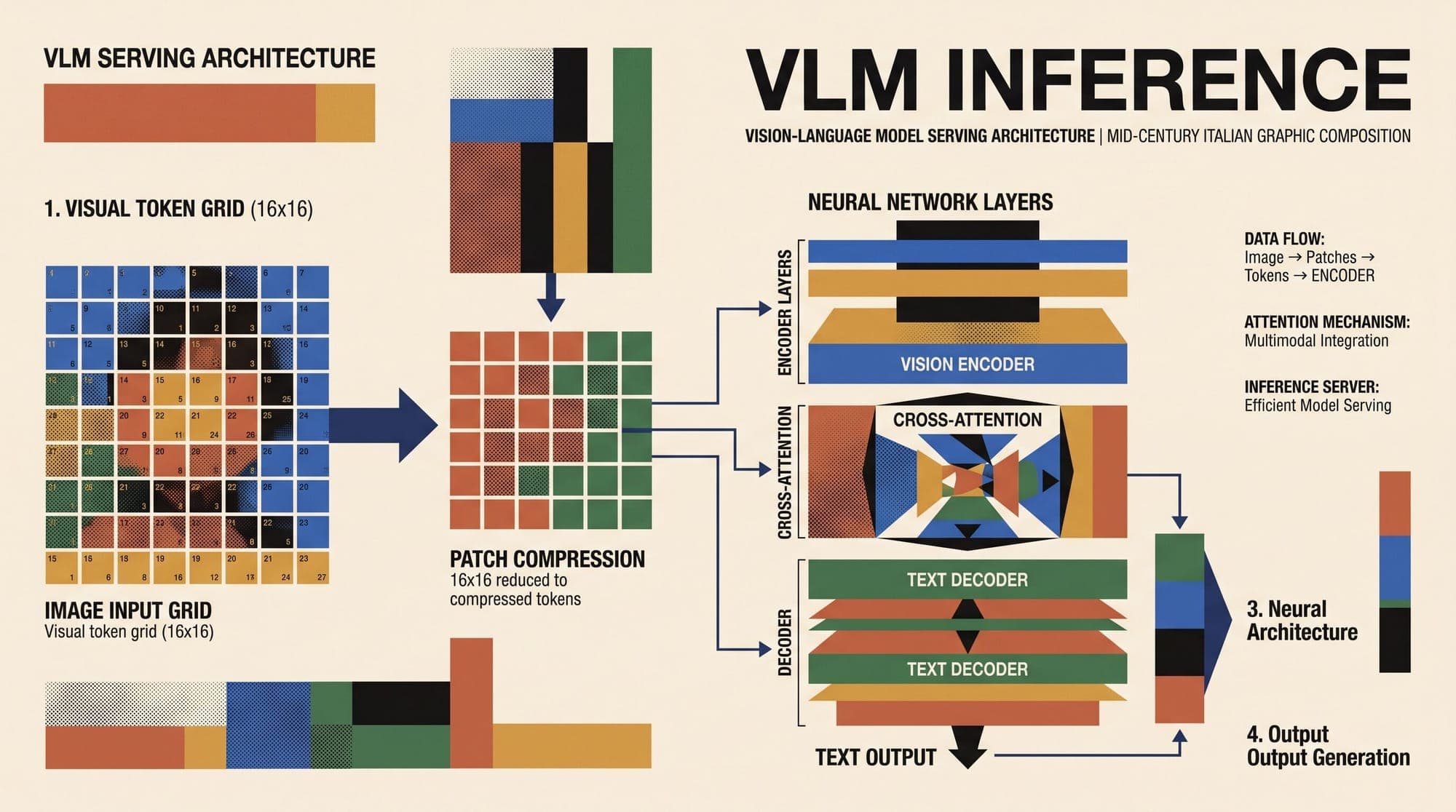
Deploying Vision-Language Models (VLMs) into high-concurrency production environments introduces a distinct set of systems bottlenecks that text-only large language models do not exhibit. While text models ingest prompts with compact token densities, visual inputs require processing high-dimensional pixel arrays through vision encoders, expanding a single image into hundreds or thousands of visual tokens before autoregressive generation begins.
In production architectures running models such as Qwen2.5-VL, LLaVA-NeXT, and InternVL, this token explosion saturates GPU compute during the prefill phase, inflates Key-Value (KV) cache memory footprint, and creates significant Time-to-First-Token (TTFT) latency spikes. Solving these challenges requires a layered serving stack combining visual token pruning, dynamic resolution tiling, vision encoder embedding caching, and multimodal prefix trees.

The Visual Prefill Bottleneck: Tokens, Memory Bandwidth, and KV Bloat
The primary bottleneck in multimodal inference stems from the sheer number of tokens generated by the vision encoder and projected into the LLM backbone.
In standard architectures using Vision Transformers (ViT) such as CLIP-ViT-L/14 or SigLIP-SO400M, an image resized to 336x336 pixels with a patch size of 14x14 generates 576 visual tokens. When modern dynamic resolution techniques like AnyRes are applied to preserve fine details for Optical Character Recognition (OCR) or document analysis, high-resolution images are partitioned into multi-tile grids (for instance, 4 to 6 tiles plus an overview thumbnail), producing between 2,304 and 3,456 tokens per image.
This token expansion impacts inference serving in three critical dimensions:
- Quadratic Prefill Compute: The self-attention operation across the combined prompt sequence scales with complexity. Injecting 2,500 visual tokens into a request alongside 200 text tokens increases the prefill FLOPs by more than an order of magnitude compared to text-only queries.
- KV Cache Memory Saturation: Every visual token reserves slots in GPU High Bandwidth Memory (HBM) for the entire duration of the request. For a 70B parameter model using 16-bit KV activations, storing 2,500 visual tokens consumes approximately 320 MB of HBM per single-image request. At a concurrency of 64 streams, visual KV caches alone consume over 20 GB of memory, severely restricting maximum batch sizes.
- Inter-Turn Redundancy in Visual Agents: In multi-turn dialogue, visual question answering (VQA), or autonomous GUI agents (such as browser automation bots), subsequent user queries repeatedly reference the same static image or screenshot. Naive serving engines re-encode the image through the vision tower and re-prefill the entire visual sequence on every turn, causing recurring TTFT penalties.
Visual Token Compression and Pruning: Encoder-Side vs. LLM-Side
To reduce compute and memory overhead without retraining foundation weights, engineering teams deploy training-free token reduction methods. These techniques operate at two distinct stages: inside the vision encoder or within the intermediate layers of the language model backbone.
Encoder-Side Token Compression
Encoder-side compression reduces the number of visual tokens before they are projected into the language model.
- Token Merging (ToMe): As detailed in research on Token Merging, bipartite matching identifies cosine similarity between visual patch representations in ViT layers. Highly similar background patches are merged into representative centroids, reducing patch counts by 30% to 50% with minimal loss in coarse semantic classification.
- Abstractor and Resampler Architectures: Architectures such as Perceiver Resamplers and C-Abstractors use a fixed set of learnable latent queries (typically 64 or 128 queries) with cross-attention to distill arbitrary image patch grids into a compact token sequence. While effective for general captioning, fixed query compression often degrades dense OCR and fine-grained spatial localization.
- SVD and Metric-Guided Pruning: Methods like SVD-Prune analyze singular value decomposition spectra across visual feature channels to discard non-informative patch embeddings prior to projection.
LLM-Side Token Pruning
LLM-side compression exploits an empirical observation in Transformer attention circuits: language models rapidly aggregate visual information in the first few layers, after which attention weights over background visual tokens drop to near zero.
- FastV: Introduced by Chen et al. (2024) in "An Image is Worth 1/2 Tokens After Layer 2", FastV computes the cumulative attention weight received by each visual token across the early layers (such as layer 2 or layer 3) of the LLM. The lowest-ranked 50% of visual tokens are pruned entirely from subsequent transformer layers and KV cache allocation, reducing inference FLOPs by up to 45% with negligible degradation on benchmarks like TextVQA and GQA.
- PyramidDrop: As demonstrated in PyramidDrop, visual redundancy is eliminated progressively across stages of the LLM backbone rather than in a single hard cutoff. By dropping 20% to 30% of remaining visual tokens at intervals (for example, at layers 8, 16, and 24), PyramidDrop achieves a 55% reduction in inference FLOPs and preserves fine-grained context necessary for complex reasoning tasks.
- SparseVLM: SparseVLM dynamically adjusts pruning ratios per token based on query text relevance, retaining dense patch representations only in regions explicitly queried by the prompt.
Dynamic Resolution, Tiling, and Spatial Packing
Modern VLMs process arbitrary aspect ratios and resolutions through dynamic tiling frameworks. Rather than resizing images to a low-resolution square (which blurs text and small objects), engines split high-resolution inputs into regular sub-grids.
In standard dynamic tiling implementations:
- Aspect Ratio Matching: The input image dimensions are mapped to the closest optimal grid configuration (such as , , or ) that preserves native pixel ratios.
- Sub-Image Extraction: The image is sliced into discrete tiles (for example, 336x336 or 448x448 patches), and a downscaled overview thumbnail is generated to provide global semantic context.
- Positional Coordinate Injection: Spatial position embeddings, such as Multimodal Rotary Position Embeddings (M-RoPE), assign 3D coordinates (temporal/frame index, vertical tile index, horizontal tile index) to ensure the attention mechanism correctly models spatial adjacency across tile boundaries.
- Selective Tile Pruning: In production serving, tiles that contain uniform background content (such as pure white document margins or solid backgrounds) can be filtered before vision encoding using lightweight pixel-entropy thresholds, cutting redundant tile processing by 15% to 25%.
Visual Encoder Activation Caching and Multimodal Prefix Trees
In production pipelines involving multi-turn agent interactions or multi-modal RAG, re-running the vision encoder on identical images is a primary source of wasteful GPU cycles.
+-------------------------------------------------------------+
|                     Incoming User Request                   |
|           [Image Bytes / URL + User Text Prompt]            |
+-------------------------------------------------------------+
                               |
                               v
               +-------------------------------+
               | Image Content SHA-256 Hashing |
               +-------------------------------+
                               |
              /---------------------------------\
             /                                   \
   [Cache Hit: Embedding Found]         [Cache Miss: Uncached]
            |                                      |
            v                                      v
+------------------------+             +------------------------+
| Retrieve Projected     |             | Execute Vision Encoder |
| Tensor from Host/GPU   |             | (ViT / SigLIP Forward) |
| Feature Cache          |             +------------------------+
+------------------------+                         |
            |                          +------------------------+
            |                          | Projector MLP & Write  |
            |                          | to Local Tensor Cache  |
            |                          +------------------------+
            |                                      |
            \------------------+-------------------/
                               |
                               v
               +-------------------------------+
               | Multimodal Radix Cache Match  |
               | (SGLang / vLLM Prefix Engine) |
               +-------------------------------+
                               |
              /---------------------------------\
             /                                   \
     [Prefix Cache Hit]                  [Prefix Cache Miss]
            |                                      |
            v                                      v
+------------------------+             +------------------------+
| Reuse Existing Visual  |             | Full Prefill Compute   |
| KV Cache Blocks in HBM |             | (Apply FastV / Prune)  |
+------------------------+             +------------------------+
            \                                      /
             \-----------------+------------------/
                               |
                               v
               +-------------------------------+
               | Autoregressive Token Decode   |
               +-------------------------------+
Two-Tier Embedding and KV Caching
High-throughput serving engines implement a two-tier caching architecture:
- Tier 1: Vision Feature Cache (Tensors): Raw image bytes are hashed via SHA-256 upon ingestion. If the hash matches an active entry in the in-memory tensor cache, the vision transformer forward pass ( on an NVIDIA L40S) is completely bypassed, and pre-computed projected tokens are fed directly into the LLM embedding layer.
- Tier 2: Radix Tree Multimodal Prefix Caching: Serving engines like SGLang and vLLM maintain LRU-managed radix trees where graph nodes store cached KV activations. When a multi-turn conversation continues with the same image prefix, the visual KV blocks are retained in GPU memory, reducing TTFT from hundreds of milliseconds to under 15 milliseconds.
Multimodal KV Cache Eviction (LOOK-M and VTW)
While retaining visual KV cache entries accelerates conversational turns, holding thousands of visual tokens in memory during long generation phases degrades serving capacity.
Techniques such as LOOK-M and Visual Token Windowing (VTW) analyze token migration dynamics. Once the LLM generates the initial synthesis tokens, visual attention settles on generated textual anchors. The engine can safely evict intermediate visual KV entries from HBM while retaining only text KV pairs and small visual boundary tokens, freeing up to 70% of KV cache memory without inducing hallucination.
Production Serving Architecture: Disaggregation and Scheduling
Serving VLMs at scale requires balancing compute-bound prefill workloads with memory-bandwidth-bound decode workloads across heterogeneous GPU clusters.
                    +------------------------------------+
                    |       API Gateway / Router         |
                    +------------------------------------+
                                      |
                 +--------------------+--------------------+
                 |                                         |
                 v                                         v
   +---------------------------+             +---------------------------+
   |  Vision Worker Pool (ViT) |             |  Vision Worker Pool (ViT) |
   |  [NVIDIA L40S / A10G]     |             |  [NVIDIA L40S / A10G]     |
   +---------------------------+             +---------------------------+
                 \                                         /
                  \---- Transmit Projected Embeddings ----/
                                      |
                                      v
                    +------------------------------------+
                    |     LLM Serving Cluster (vLLM)     |
                    |     Tensor Parallelism (4x H100)   |
                    |   Chunked Prefill + Radix Cache    |
                    +------------------------------------+
Disaggregated Vision Preprocessing
In standard monolithic serving, each GPU worker runs both the ViT encoder and the LLM backbone. However, ViT operations do not parallelize efficiently across large Tensor Parallel (TP) process groups due to small batch sizes and overhead from all-reduce communication in the vision tower.
In production deployments:
- Vision encoding is offloaded to lightweight, cost-effective GPUs (such as NVIDIA L40S or A10G instances) running dedicated Triton or TensorRT engines.
- Projected token tensors are transmitted via low-latency inter-node networking (such as NVLink or RoCEv2) directly to the high-memory LLM cluster (such as 4x or 8x H100/H200 nodes).
- This separation prevents ViT synchronization stalls from blocking the LLM tensor-parallel execution pipeline.
Chunked Prefill with Multimodal Inputs
When visual requests arrive alongside active decoding requests, injecting 2,500 visual tokens in a single iteration induces massive Inter-Token Latency (ITL) jitter for active streams.
Production engines utilize chunked prefill (such as --max-num-batched-tokens 2048 in vLLM or SGLang). The visual prefill is split across multiple scheduler iterations (for example, 512 tokens per step), interleaving prefill execution with decode steps. This bounds ITL spikes below 25 milliseconds while sustaining continuous batch throughput.
Practical Implementation and Configuration Playbook
To implement optimized VLM serving using modern open-source engines, teams configure prefix caching, chunked prefill, and dynamic memory allocations.
SGLang VLM Serving Configuration
python3 -m sglang.launch_server \
  --model-path Qwen/Qwen2.5-VL-7B-Instruct \
  --port 30000 \
  --tp-size 2 \
  --mem-fraction-static 0.85 \
  --chunked-prefill-size 2048 \
  --enable-multimodal-radix-cache \
  --max-running-requests 128
Key configuration flags:
--enable-multimodal-radix-cache: Enables automatic hashing and radix tree caching for visual tokens across repeated requests.--chunked-prefill-size 2048: Prevents large image prefills from starving ongoing token generation cycles.--mem-fraction-static 0.85: Reserves sufficient non-KV memory for dynamic ViT feature allocations.
vLLM Multimodal Serving Configuration
vllm serve Qwen/Qwen2.5-VL-7B-Instruct \
  --tensor-parallel-size 2 \
  --gpu-memory-utilization 0.90 \
  --max-model-len 32768 \
  --enable-chunked-prefill \
  --max-num-batched-tokens 2048 \
  --enable-prefix-caching \
  --limit-mm-per-prompt '{"image": 4, "video": 1}'
Key configuration flags:
--enable-prefix-caching: Enables block-level hash matching for visual and textual prefixes.--limit-mm-per-prompt: Imposes strict per-request bounds on multi-image inputs to prevent accidental OOM crashes from concurrent multi-image queries.
Hardware Footprint, Latency Trade-Offs, and Failure Modes
Balancing compression algorithms against accuracy requires careful calibration based on downstream task requirements.
Compression Strategy       TTFT Reduction   KV Cache Saved   Accuracy Impact (OCR/VQA)
--------------------------------------------------------------------------------------
Vanilla (No Compression)   0% (Baseline)    0% (Baseline)    100% (Baseline)
FastV (50% LLM Pruning)    35% - 45%        40% - 50%        98.5% - 99.2% of baseline
PyramidDrop (Gradual)      45% - 55%        50% - 60%        98.8% - 99.5% of baseline
ToMe (Encoder 50% Merging) 25% - 35%        50%              94.0% - 96.5% of baseline
LOOK-M (KV Eviction)       10% - 15%        65% - 75%        98.0% - 99.0% of baseline
Disaggregated ViT + Cache  60% - 80% (hits) 0% (Compute only)100% (Lossless)
Critical Operational Failure Modes
- OCR and Small Text Degradation Under Aggressive Pruning: Pruning visual tokens in encoder layers (such as via standard ToMe) frequently eliminates single-character patches in high-density tables or receipts. When serving document parsing or financial analysis workloads, teams should avoid encoder-level token merging and rely instead on deep LLM-layer pruning (such as FastV) or lossless prefix caching.
- Spatial Grounding Drift: Token reduction methods that do not preserve 2D coordinate embeddings cause bounding-box predictions (such as in object detection or UI coordinate clicking for GUI agents) to desynchronize. In agentic workflows requiring precise pixel coordinates, pruning must preserve spatial indices.
- KV Cache Fragmentation from Variable-Sized Tile Grids: Dynamic resolution generates non-uniform token counts across requests (for example, 576 tokens for a 1:1 image vs 2,880 tokens for a 16:9 panoramic image). Paged KV cache block managers must be configured with smaller page sizes (such as 16 tokens per block) to minimize internal memory fragmentation.
Sources
- FastV: An Image is Worth 1/2 Tokens After Layer 2 (arXiv:2403.06764)
- PyramidDrop: Accelerating Your Large Vision-Language Models via Pyramid Visual Redundancy Reduction (arXiv:2410.17247)
- Token Merging: Your ViT But Faster (arXiv:2210.09461)
- LOOK-M: Look-Once Optimization of KV Cache for Multimodal LLMs (arXiv:2406.16147)
- SGLang: Efficient Execution of Structured Language Model Programs (arXiv:2312.07104)
- vLLM: Efficient Memory Management for Large Language Models with PagedAttention (arXiv:2309.06180)
- Qwen2.5-VL Technical Overview and M-RoPE Architecture
- SVD-Prune: Training-Free Token Pruning for Efficient Vision-Language Models (arXiv:2604.11530)



