Upgrading large language model pipelines in production presents an operational challenge distinct from traditional software deployments. In microservice architectures, canary deployments rely on deterministic signals: HTTP 5xx error rates, unhandled runtime exceptions, CPU saturation, and latency percentiles. When updating an LLM system (whether swapping a base model checkpoint, updating a system prompt, tweaking sampling hyperparameters, or attaching a newly fine-tuned LoRA adapter), the service rarely throws an HTTP error.
Instead, model regressions manifest semantically. A candidate model may return valid HTTP 200 responses while subtly drifting in tone, dropping required keys from structured JSON outputs, hallucinating parameters during tool calling, or increasing refusal rates on benign enterprise queries. Because static benchmark suites and pre-deployment evaluation sets fail to capture the long-tail distribution of real-world user queries, production teams are adopting a dual-stage release strategy: asynchronous traffic shadowing followed by statistically gated canary rollouts with automated rollback circuit breakers.

Data Plane Architecture: Asynchronous Traffic Mirroring
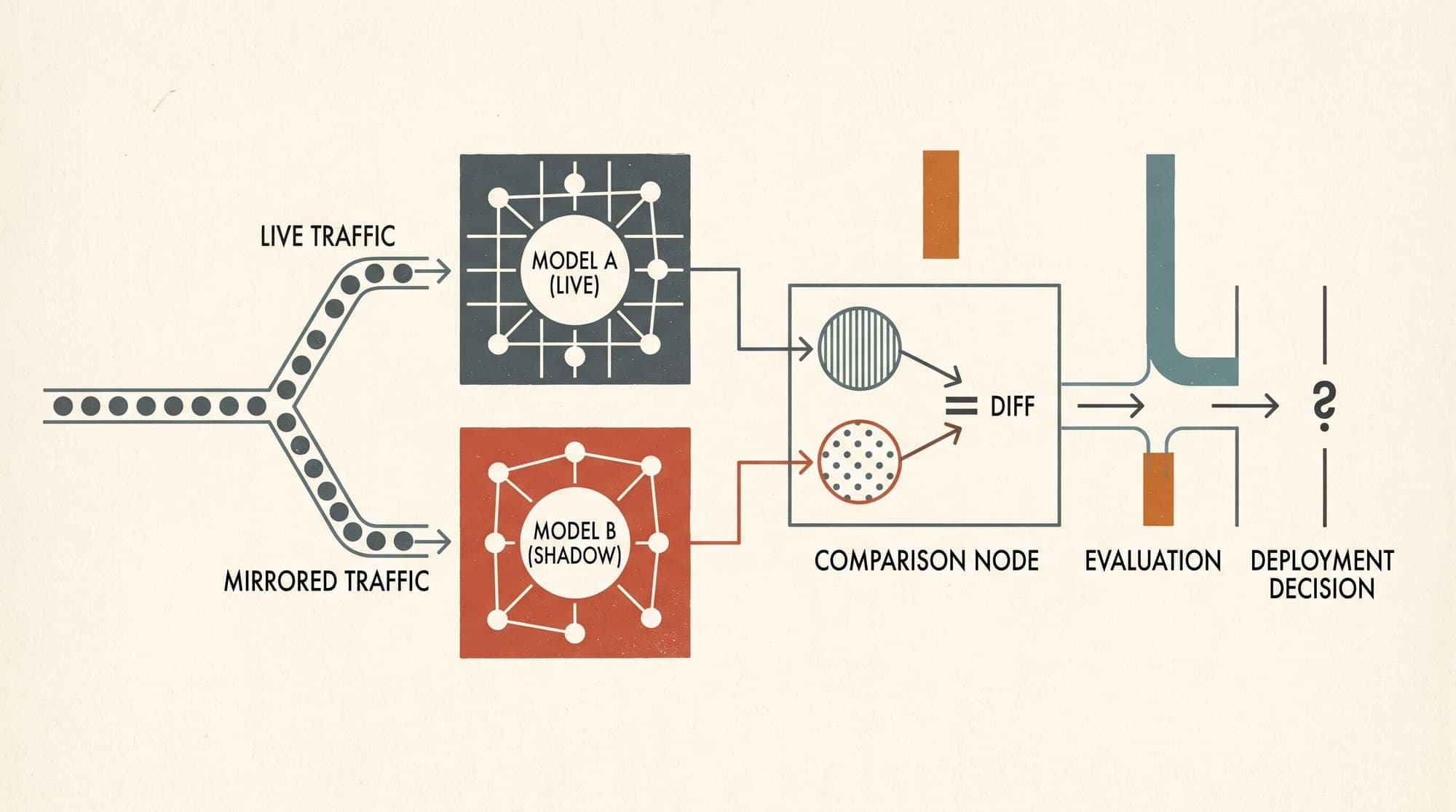
Traffic shadowing duplicates live incoming production traffic, routing the primary request to the current stable model (control) while forwarding a mirrored copy to the candidate model (treatment) with zero user impact. The control response is returned to the client, while the candidate response is captured, timestamped, and routed to an offline evaluation pipeline.
Modern LLM traffic shadowing relies on two primary data plane topologies:
1. Gateway-Level Traffic Shadowing
Layer 7 reverse proxies and API gateways such as Envoy Gateway and Emissary-Ingress provide native request mirroring. When an ingress controller receives an inference request, it forks the TCP/HTTP payload asynchronously. The proxy forwards the primary stream to the production inference cluster and dispatches an asynchronous copy to the shadow cluster.
                  ┌──────────────────────┐
                  │    Client Request    │
                  └──────────┬───────────┘
                             │
                             ▼
                  ┌──────────────────────┐
                  │   L7 / API Gateway   │
                  └─────┬──────────┬─────┘
           Primary Path │          │ Async Shadow (0% user exposure)
                        ▼          ▼
        ┌──────────────────┐    ┌──────────────────┐
        │  Stable Model    │    │ Candidate Model  │
        │  (Control v1)    │    │ (Treatment v2)   │
        └───────┬──────────┘    └────────┬─────────┘
                │                        │
         Live Response                   ▼
                │               ┌──────────────────┐
                ▼               │  Side-Effect     │
        ┌──────────────┐        │  Isolation       │
        │ Client / App │        └────────┬─────────┘
        └──────────────┘                 │
                                         ▼
                                ┌──────────────────┐
                                │ Paired Log Store │
                                │ (Trace Diffing)  │
                                └──────────────────┘
Gateway mirroring provides minimal application overhead, but it introduces network bandwidth duplication at the ingress layer. For long-context payloads (such as 128k-token document prompts) or multi-modal inputs, gateway-level mirroring can saturate network interfaces.
2. Asynchronous Message Broker Decoupling
For high-throughput or payload-heavy pipelines, teams decouple traffic shadowing from the ingress gateway using distributed log brokers like Apache Kafka or Redis Streams. The primary serving application writes the incoming request payload and the resulting generation trace to a streaming topic. Distributed worker pools consume from the stream and replay the inputs against the candidate model asynchronously. This topology isolates the candidate infrastructure entirely from live traffic latency budgets and allows teams to schedule shadow evaluations on lower-cost spot compute instances.
The Side-Effect Isolation Problem in Agentic Workflows
When shadowing LLMs deployed as autonomous agents, models do not merely generate text; they emit tool calls that trigger database writes, external API webhooks, or file mutations. If a shadowed candidate executes these actions directly, it causes duplicate mutations and data corruption in production environments.
To neutralize side effects during shadow execution, teams implement three isolation patterns:
- Mock Tool Dispatchers: Intercept tool calls generated by the shadow model and return predefined mock payloads or synthetic fixtures without executing real I/O operations.
- Ephemeral Sandbox Clones: Route shadow tool execution to isolated database read-replicas, copy-on-write file systems, or ephemeral container sandboxes that are torn down after trace completion.
- Dry-Run Decorators: Enforce execution flags where tools run validation logic and syntax checking but bypass external network dispatch.
Quantifying Output Divergence: Multi-Tier Scoring
Evaluating candidate outputs against control outputs cannot rely on traditional NLP string overlap metrics like BLEU or ROUGE. These metrics penalize candidate models that generate semantically accurate, higher-quality responses that happen to use alternative phrasing. Production architectures implement a hierarchical evaluation pipeline to score semantic divergence.
┌─────────────────────────────────────────────────────────┐
│              Paired Generation Outputs                  │
└────────────────────────────┬────────────────────────────┘
                             │
                             ▼
┌─────────────────────────────────────────────────────────┐
│ Tier 1: Deterministic Structural Verification           │
│ • JSON Schema validation (Pydantic / Zod)               │
│ • Regex syntax checks & AST parsing for code            │
└────────────────────────────┬────────────────────────────┘
                             │
                             ▼
┌─────────────────────────────────────────────────────────┐
│ Tier 2: Embedding Drift & Semantic Distance             │
│ • Bi-encoder cosine distance (BGE / text-embedding-3)   │
│ • Refusal signature detection                           │
└────────────────────────────┬────────────────────────────┘
                             │
                             ▼
┌─────────────────────────────────────────────────────────┐
│ Tier 3: Asynchronous LLM-as-a-Judge Rubric Scoring      │
│ • Pairwise win-rate comparison                          │
│ • Faithfulness, conciseness, instruction adherence      │
└─────────────────────────────────────────────────────────┘
1. Deterministic Structural Verification
The first evaluation layer tests syntactic constraints. If an application requires structured JSON output, the candidate response is validated against the defined schema using deterministic parsers. For code-generation tasks, the output is passed through Abstract Syntax Tree (AST) linters. If a candidate model exhibits a structural validation failure rate above a defined threshold (such as 0.1%), it fails the shadow evaluation immediately.
2. Semantic Embedding Drift
To detect broad conceptual divergence without incurring significant LLM inference costs, outputs from both models are embedded using a dense bi-encoder model. The cosine distance between the control embedding and candidate embedding is computed:
Pairs with cosine distance exceeding an empirical threshold (typically 0.15 to 0.20) are flagged as divergent clusters. This step quickly surfaces queries where the candidate model shifted topic, omitted key instructions, or changed output structure.
3. Refusal and Policy Classification
Model upgrades frequently alter safety alignment boundaries. A candidate model may become over-refusal prone, rejecting benign user prompts with standard disclaimer text. Regex pattern matchers and lightweight classification heads scan candidate outputs for refusal signatures. A positive drift in refusal rate indicates an alignment regression.
4. Asynchronous LLM-as-a-Judge Pairwise Comparison
For open-ended generation, a sampled subset of divergent pairs is routed to an independent critique model. The evaluator assesses both completions side-by-side using structured rubrics covering factual consistency, relevance, instruction adherence, and hallucination rate. The evaluator outputs pairwise preferences: control win, candidate win, or tie.
Statistical Gating and Canary Progression
Once shadow traffic confirms that the candidate model meets baseline quality and latency standards across hundreds of thousands of production requests, the system transitions to a live canary rollout. A canary deployment exposes a small, controlled percentage of real users to the candidate model while keeping the majority on the stable baseline.
   Shadow Phase               Canary Progression Phase
  [0% Exposure]       [1% Slice]  ──>  [5% Slice]  ──>  [25% Slice]  ──>  [100% Full]
 (Async Mirroring)        │                 │                 │                │
                          ▼                 ▼                 ▼                ▼
                     Gate 1 Eval       Gate 2 Eval       Gate 3 Eval       Production
                   (Bootstrap CIs)   (McNemar Tests)   (Rolling Win Rate)   Complete
Canary progression must not rely on subjective inspection. Teams configure statistical gating state machines using defined mathematical thresholds:
- Paired Bootstrap Resampling: Generates empirical confidence intervals (typically 95%) on continuous quality metrics across paired request trajectories. The candidate must demonstrate non-inferiority within the confidence bounds before advancing traffic stages.
- McNemar's Test: Used for paired nominal data (such as binary pass/fail outcomes on automated test assertions). McNemar's test determines whether the discordance between control successes and candidate failures is statistically significant ().
- Rolling Win Rate Thresholds: Canary traffic advances incrementally (e.g., 1% -> 5% -> 25% -> 100%). Each transition requires maintaining a minimum rolling win rate (such as >= 50% with non-inferiority bounds) over a minimum sample size (e.g., 10,000 requests per stage).
Automated Rollback Circuit Breakers
In high-throughput environments serving hundreds or thousands of requests per second, manual intervention is too slow to prevent widespread user impact. Production gateways integrate automated circuit breakers that evaluate telemetry over sliding time windows and trigger instantaneous rollbacks when anomalies occur.
Rollback triggers operate across two distinct time horizons:
Fast Circuit Breakers (Sub-Second Gateway Reversion)
Hard performance and infrastructure degradation triggers evaluate metrics directly at the reverse proxy or API gateway:
- Latency Breaches: Candidate P99 Time to First Token (TTFT) or Inter-Token Latency (ITL) degrades by more than 25% relative to the control baseline.
- Schema Failures: Structural JSON validation failures exceed 0.5% over a 60-second sliding window.
- Inference Errors: Provider HTTP 5xx error rates, HTTP 429 rate limit breaches, or engine crash rates exceed 0.1%.
When a fast circuit breaker fires, the routing engine resets candidate traffic weight to 0% within milliseconds, falling back entirely to the stable control deployment without requiring code redeployments or container restarts.
Semantic Circuit Breakers (Windowed Evaluator Reversion)
Semantic degradation triggers evaluate rolling quality indicators over longer observation windows:
- Refusal Drift: Refusal rates on the candidate cohort increase by more than 0.2 percentage points over a 500-request window.
- Win-Rate Collapse: The rolling LLM-as-a-judge win rate drops below 48% with statistical significance.
- Guardrail Spikes: Upstream or downstream safety guardrails trigger at a rate 10% higher than baseline.
When a semantic circuit breaker triggers, the system automatically halts traffic expansion, notifies the engineering team via automated alerts, and attaches the specific failure clusters and trace IDs to the incident log.
Operational Considerations: Cost and Distributed Tracing
Deploying shadow and canary pipelines introduces operational trade-offs that teams must balance:
Compute and Token Cost Management
Mirroring 100% of live production traffic temporarily doubles model inference spend. For self-hosted GPU clusters, shadowing can require doubling provisioned accelerator capacity. Teams manage these costs by:
- Implementing dynamic shadow sampling: Mirroring a representative 5% to 10% slice of traffic rather than 100%.
- Asynchronous batch execution: Accumulating mirrored requests and processing them in offline batches during off-peak hours using spot GPU instances.
Distributed Tracing with OpenTelemetry
To correlate paired executions across distributed systems, platforms implement the OpenTelemetry GenAI Semantic Conventions. The ingress gateway injects a shared root trace_id and tags child spans with explicit execution metadata:
{
  "trace_id": "4bf92f3577b34da6a3ce929d0e0e4736",
  "gen_ai.deployment.type": "shadow",
  "gen_ai.request.model": "candidate-model-v2",
  "gen_ai.control.model": "stable-model-v1",
  "gen_ai.evaluation.divergence_score": 0.042,
  "gen_ai.evaluation.schema_valid": true
}
This standardized metadata allows observability platforms to automatically index divergent output pairs, track latency regressions across model versions, and provide actionable diffs when an automated circuit breaker trips.
Sources
- Emissary-Ingress: Traffic Shadowing
- FutureAGI: LLM Eval with Shadow Traffic and Canary Deployment in 2026
- Bards.ai: Canary and Shadow Rollouts for LLM Updates
- CodeAnt AI: How to Roll Out New LLMs Safely Using Shadow Testing
- ValueStream AI: Production AI Rollback Strategies
- Envoy Gateway Documentation
- OpenTelemetry: Generative AI Observability and Semantic Conventions