Sentence Transformers 6.0 Adds MultiVectorEncoder for ColBERT Late-Interaction Training

Hugging Face has released Sentence Transformers v6.0, adding native architecture and training workflows for multi-vector late-interaction retrieval models. The update introduces MultiVectorEncoder, bringing ColBERT-style token-level representations directly into the library alongside existing dense embedding, sparse embedding, and cross-encoder reranker classes. While traditional dense retrieval compresses an entire document into a single fixed-dimension vector, multi-vector models preserve ind

2 min
Sentence Transformers 6.0 Adds MultiVectorEncoder for ColBERT Late-Interaction Training

Hugging Face has released Sentence Transformers v6.0, adding native architecture and training workflows for multi-vector late-interaction retrieval models. The update introduces MultiVectorEncoder, bringing ColBERT-style token-level representations directly into the library alongside existing dense embedding, sparse embedding, and cross-encoder reranker classes.

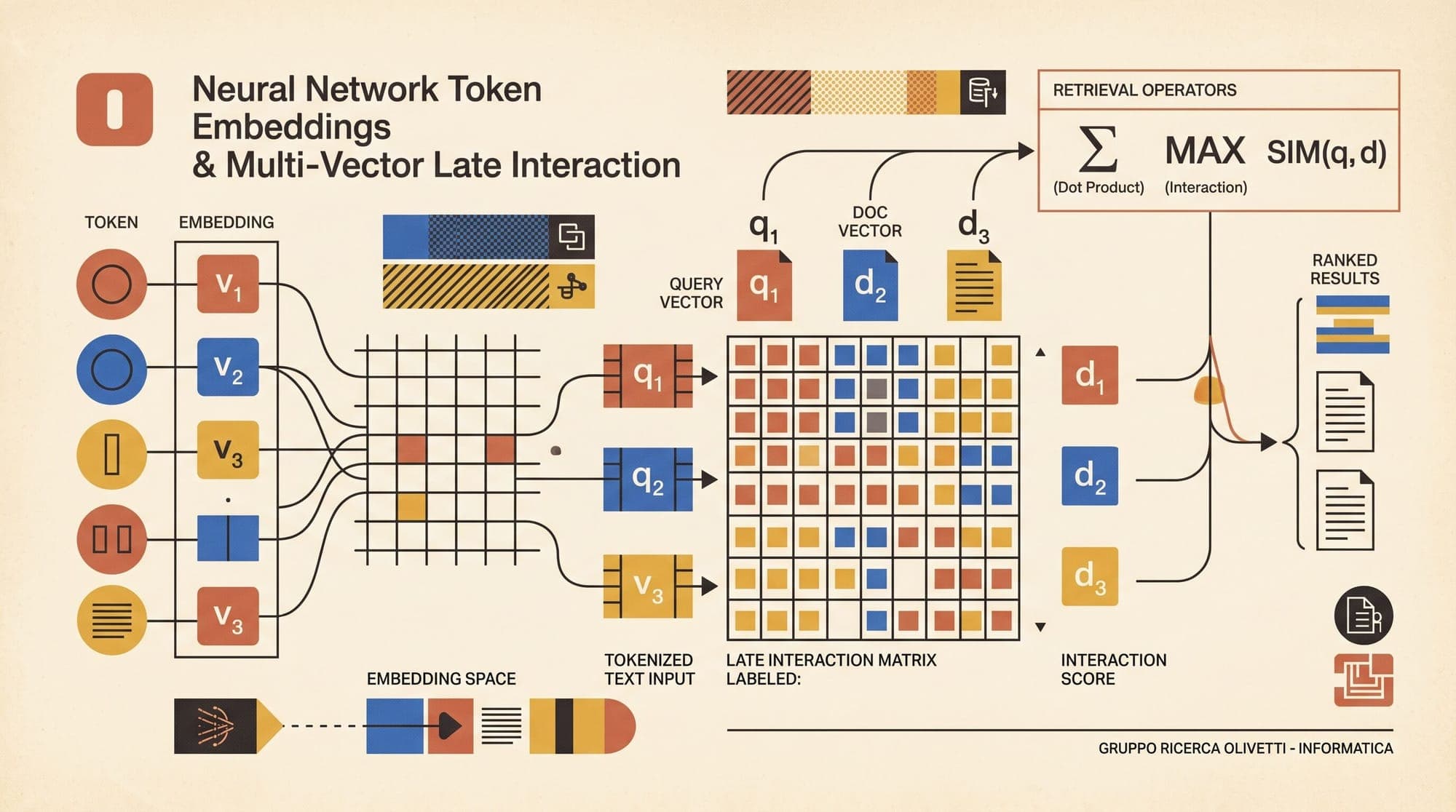
While traditional dense retrieval compresses an entire document into a single fixed-dimension vector, multi-vector models preserve individual embedding vectors for every token in a passage. Query-document scoring executes via the MaxSim operator, which computes the sum of maximal cosine similarities between each query token and all document tokens. This token-level alignment avoids the information loss inherent in single-vector pooling while maintaining faster query latency than cross-encoders.

Addressing Document Truncation Bottlenecks

Early ColBERT checkpoints frequently relied on passage truncation limits between 180 and 300 tokens due to constraints in MS MARCO training sets. In specialized domains such as legal discovery, clinical documentation, and technical manuals, standard chunk limits often discard substantial context prior to scoring.

Dense Embeddings versus Multi-Vector Late Interaction

Sentence Transformers v6.0 enables developers to configure arbitrary token sequence lengths, extending up to 8,192 tokens depending on base transformer architecture. In benchmark evaluations conducted by maintainer Tom Aarsen, resolving document truncation on long-form medical retrieval passages (averaging 941 tokens) yielded improvements of up to 0.24 NDCG@10 compared to truncated baselines.

Training Pipelines on Consumer Hardware

The new release integrates multi-vector model training into the standard SentenceTransformerTrainer workflow. Users can initialize models from existing checkpoints (such as LightOn's mLateOn-unsupervised) or build fresh architectures on top of base transformer backbones with linear projection layers.

Supported training loss functions include MultipleNegativesRankingLoss adapted for late-interaction matrices. In a reference implementation, fine-tuning an mLateOn-medical model on a single NVIDIA RTX 3090 GPU required 14.5 hours of training time, outperforming general-purpose dense, sparse, and multi-vector baselines on domain-specific retrieval benchmarks.

The feature is available in Sentence Transformers v6.0 via pip install -U "sentence-transformers[train]".


Sources

Written by

More to read

  • SandboxAQ Launches Switch to Coordinate Multi-Framework AI Agents in Slack, Teams, and Discord

    SandboxAQ has launched Switch, a framework-agnostic coordination layer designed to connect AI agents into existing enterprise chat environments, including Slack, Microsoft Teams, and Discord. The software is publicly available at no cost for self-hosted deployment on internal infrastructure. Switch addresses the operational fragmentation caused by disparate agent development frameworks. Rather than isolating autonomous assistants within bespoke web interfaces or terminal windows, the platform e

    1 min
  • AWS and NVIDIA Expand AI Partnership to Deploy 2 Million Additional Blackwell Ultra and Rubin GPUs

    Amazon Web Services (AWS) and NVIDIA have announced a major expansion of their cloud infrastructure partnership, committing to deploy two million additional high-end NVIDIA GPUs across AWS global data centers in 2027 and 2028. The deployment expands on AWS's previous commitment from GTC 2026 to add one million GPUs starting in 2026, bringing total forward allocations across the multi-year cycle to three million units. The upcoming capacity will comprise NVIDIA Blackwell Ultra, Rubin, and Rubin

    1 min
  • LLM Evaluation Frameworks and CI/CD Quality Gates in Production: Comparing DeepEval, Ragas, Promptfoo, and TruLens

    Moving large language model applications from exploratory prototypes to production systems requires automated quality validation. Relying on manual inspection or unstructured testing introduces regression risk across model updates, prompt edits, and retrieval modifications. Automated evaluation frameworks address this by converting probabilistic model outputs into measurable, repeatable software assertions. While traditional unit testing relies on deterministic assertions, production LLM testin

    1 min

