
Self-Play Fine-Tuning (SPIN): How Iterative Games Against Historical Checkpoints Eliminate Preference Labels
Supervised fine-tuning (SFT) remains the standard entry point for adapting foundation language models to downstream instructions. By training on curated prompt-response pairs via token-level cross-entropy loss, SFT forces a model to mirror reference demonstrations. However, standard maximum likelihood estimation (MLE) suffers from exposure bias and covariate shift. During inference, the model generates sequences conditioned on its own previously predicted tokens rather than ground-truth prefixes. Minor sampling deviations accumulate over autoregressive rollouts, pushing the model into out-of-distribution states that standard SFT loss never penalizes.
Traditional alignment pipelines address this limitation through Reinforcement Learning from Human Feedback (RLHF) or Direct Preference Optimization (DPO). Both frameworks require pairwise preference data, where human annotators or proprietary frontier models score competing responses. Collecting thousands of high-quality preference pairs introduces substantial labor costs, human annotation noise, and synthetic bias from external judge models.
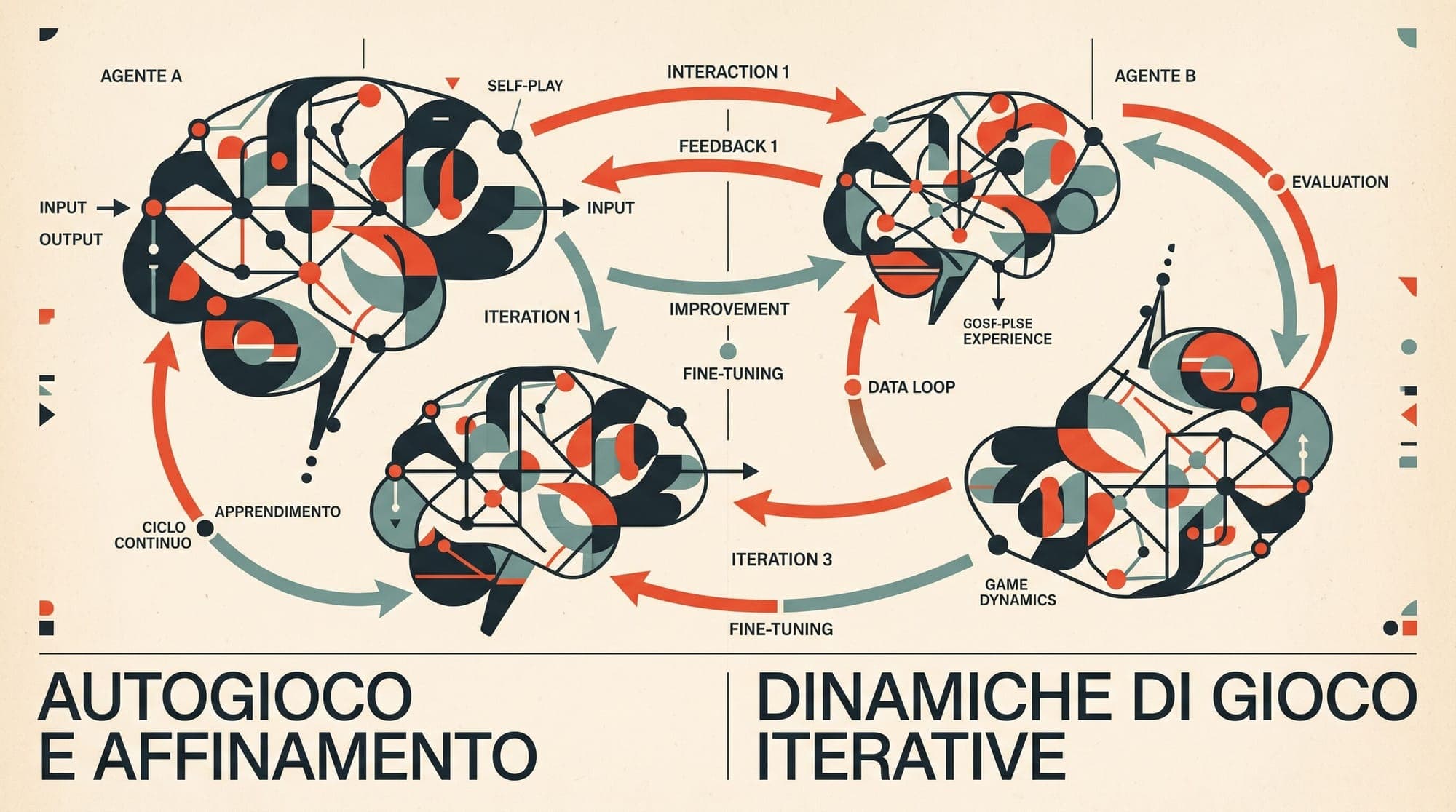
Self-Play Fine-Tuning (SPIN), introduced by researchers at UCLA and Stanford, eliminates the requirement for external preference datasets. By framing post-training alignment as a two-player zero-sum game, SPIN enables an SFT model to act as its own opponent, iteratively generating candidate responses, pitting them against human demonstrations, and refining its parameters across discrete rounds.

The Self-Play Game Formulation
SPIN recasts language model alignment from a static optimization problem into a dynamic game between two entities:
- The Active Student Policy (): The main player seeking to maximize an alignment objective that assigns higher implicit probability to ground-truth human demonstrations than to synthetic completions.
- The Opponent Policy (): The frozen checkpoint from the preceding iteration , tasked with generating candidate responses that mimic the ground-truth distribution closely enough to fool the active policy.
Let denote the true target distribution of human demonstration responses given a prompt . The goal is to drive the model distribution toward .
Instead of comparing two candidate generations scored by an external reward model, SPIN constructs a discriminator that distinguishes real human responses from synthetic samples produced by the model itself:
- Positive sample: (the original SFT demonstration).
- Negative sample: (the sequence generated autoregressively by the frozen checkpoint from iteration ).
In each iteration , the opponent generates a synthetic response for every prompt in the SFT training corpus. The active policy is then trained to assign higher value to the human response relative to .
Mathematical Objective and the DPO Connection
The optimization objective in SPIN builds upon the implicit reward formulation established by DPO and energy-based ranking models. At iteration , the loss function for updating parameters to is:
Where:
- is the logistic loss function.
- is a regularization parameter controlling the KL divergence penalty between the active policy and the reference policy (equivalent to in standard DPO literature).
- serves as the reference model for iteration .
Structural Comparison: Standard DPO vs. SPIN
- Preference Source: Standard DPO requires external pairwise datasets generated via human or AI feedback. SPIN relies strictly on the existing SFT ground-truth demonstrations compared against self-generated rollouts.
- Negative Response Construction: In standard DPO, the negative response is a static rejected completion from the dataset. In SPIN, is dynamically sampled from the prior checkpoint .
- Reference Model Management: Standard DPO keeps the initial SFT checkpoint fixed as throughout training. SPIN employs a rolling reference checkpoint updated at each discrete round.
- Optimization Horizon: Standard DPO performs single-pass offline training. SPIN runs as a multi-iteration discrete game across sequential rounds ().
- Data Annotation Budget: Standard DPO requires a triplet corpus . SPIN operates solely on the initial demonstration corpus .
Because the logistic loss penalizes the log-ratio difference between positive and negative sequences, minimizing increases the probability of human demonstration tokens while explicitly depressing the specific error paths, hallucinations, and repetitive structures present in the opponent's rollouts.
Theoretical Guarantees and Convergence
The theoretical core of SPIN rests on showing that the iterative self-play game converges to the true data distribution without requiring external reward signals.
Chen et al. proved that when the function class is sufficiently expressive, the global minimum of the SPIN objective at each iteration satisfies:
When , the update simplifies directly to in a single ideal step. In practical finite-sample settings with parameter constraints, setting (or ) enforces conservative gradient steps.
Across successive iterations , the total variation distance and reverse KL divergence monotonically decrease. The game reaches its unique Nash equilibrium when:
At this point, the opponent generates responses that are statistically indistinguishable from the human training demonstrations. The active player can no longer gain a discriminatory advantage, and parameter updates stabilize.
Empirical Performance and Iteration Dynamics
In empirical evaluations conducted on the Hugging Face Open LLM Leaderboard, SPIN was evaluated starting from zephyr-7b-sft-full (a Mistral-7B model fine-tuned on the UltraChat-200k corpus).
Open LLM Leaderboard Benchmark Progression
- Zephyr-7B-SFT (Baseline): ARC 60.41, TruthfulQA 43.73, Winogrande 74.19, GSM8K 26.76, HellaSwag 82.85, MMLU 60.92, Average: 58.14
- SPIN Iteration 0: ARC 63.40, TruthfulQA 49.18, Winogrande 72.69, GSM8K 35.10, HellaSwag 84.38, MMLU 60.03, Average: 60.80 (+2.66)
- SPIN Iteration 1: ARC 65.19, TruthfulQA 55.17, Winogrande 72.30, GSM8K 35.78, HellaSwag 84.96, MMLU 59.34, Average: 62.12 (+1.32)
- SPIN Iteration 2: ARC 65.53, TruthfulQA 57.34, Winogrande 72.85, GSM8K 35.86, HellaSwag 85.08, MMLU 59.20, Average: 62.64 (+0.52)
- SPIN Iteration 3: ARC 65.61, TruthfulQA 57.73, Winogrande 72.77, GSM8K 35.63, HellaSwag 85.12, MMLU 59.08, Average: 62.49 (-0.15)
- Zephyr-7B-Beta (Supervised DPO on 62k GPT-4 pairs): ARC 62.03, TruthfulQA 57.39, Winogrande 74.51, GSM8K 34.42, HellaSwag 84.53, MMLU 61.44, Average: 62.39
Three key patterns emerge from the empirical results:
- Substantial Early-Round Gains: Iteration 0 alone delivers a +2.66 point gain across the benchmark suite. TruthfulQA jumps by +5.45 points (from 43.73 to 49.18) and GSM8K surges by +8.34 points (from 26.76 to 35.10).
- Matching Supervised DPO: By Iteration 2, SPIN reaches an average score of 62.64, surpassing
zephyr-7b-beta(62.39), which had been trained using standard DPO on 62,000 preference pairs scored by GPT-4 via the UltraFeedback dataset. - Diminishing Returns and Saturation: Performance gains taper off after Iteration 2. By Iteration 3, the average score plateaus at 62.49. As the model's self-generated completions approach the quality and style of the SFT demonstrations, the gradient signal diminishes, and continued training risks overfitting to demonstration artifacts.
Practical Implementation and System Design
Implementing SPIN in production fine-tuning pipelines requires a staged orchestration workflow:
[SFT Training Set (X, Y)]
           │
           ▼
   ┌──────────────┐
   │ Iteration t  │ ◄───────────────────────────┐
   └──────┬───────┘                             │
          │                                     │
          ▼                                     │
┌────────────────────┐                          │
│ Generate Rollouts  │                          │
│ Y' ~ p_θt(·|X)     │                          │
└─────────┬──────────┘                          │
          │                                     │
          ▼                                     │
┌────────────────────┐                          │
│ Assemble Pairs     │                          │
│ (X, Y_real, Y'_syn)│                          │
└─────────┬──────────┘                          │
          │                                     │
          ▼                                     │
┌────────────────────┐                          │
│ DPO Step           │                          │
│ Policy: θ_{t+1}    │                          │
│ Ref: θ_t (Frozen)  │                          │
└─────────┬──────────┘                          │
          │                                     │
          ▼                                     │
┌────────────────────┐                          │
│ Checkpoint θ_{t+1} ├────── If t < Max_Iter ───┘
└────────────────────┘
1. Generation Phase
For each prompt in the SFT dataset, generate a single completion using the current checkpoint . Standard greedy decoding or low-temperature nucleus sampling (, ) is typically used. Sampling with high temperature introduces excessive noise, whereas pure greedy decoding can reduce diversity in multi-iteration training.
2. Dataset Assembly
Construct an unranked preference dataset where the chosen response is always the ground-truth target , and the rejected response is the synthetic rollout . Unlike standard DPO datasets, this dataset changes completely between iterations.
3. Policy Optimization
Train the active policy using the DPO objective with the frozen checkpoint as the reference policy. Standard hyperparameter choices include (corresponding to ), learning rates between and with cosine decay, and a per-iteration epoch budget of 1 to 2 passes over the dataset.
Strengths, Failure Modes, and Modern Descendants
Strengths
- Zero Annotation Overhead: Eliminates the need to generate multi-candidate completions, run LLM-as-a-judge pipelines, or contract human evaluators.
- Dynamic Error Correction: Because negative samples reflect the exact distribution errors of the current model checkpoint, gradient updates target real behavioral flaws rather than outdated artifacts.
- Compute Efficiency: Unlike online RL with PPO, which requires running policy, value, reward, and reference models concurrently during gradient updates, SPIN separates generation and optimization into alternating discrete phases.
Failure Modes and Limitations
- Ceiling Tied to Demonstration Quality: SPIN cannot discover knowledge or reasoning pathways not implicit in the pre-training weights or SFT demonstrations. If the SFT data contains systematic factual errors or formatting flaws, SPIN reinforces them.
- Overfitting and Length Drift: Without length normalization or margin penalties, the active policy can exploit superficial differences between human demonstrations and synthetic generations (such as response length or bullet-point density).
- Plateau at High Iterations: Because the target distribution is fixed, once , the preference delta collapses to noise.
Descendants and Evolution
The self-play paradigm introduced by SPIN has evolved into several modern post-training frameworks:
- Self-Rewarding Language Models (SRLM): Combines self-play with an LLM-as-a-judge prompt, allowing the model to generate both candidate responses and their reward ratings iteratively.
- Self-Play Preference Optimization (SPPO): Extends self-play from binary demonstration discrimination to continuous minimax games over general preference distributions, proving convergence to the von Neumann-Morgenstern game-theoretic solution.
- Iterative DPO with Rule-Based Verification: Adapts the SPIN loop for verifiable reasoning domains (mathematics, code execution), replacing fixed SFT targets with dynamic programmatic verification.
Sources
- Chen, Z., Deng, Y., Yuan, H., Ji, K., & Gu, Q. (2024). Self-Play Fine-Tuning Converts Weak Language Models to Strong Language Models. arXiv preprint arXiv:2401.01335. Accepted at ICML 2024.
- Rafailov, R., Sharma, A., Mitchell, E., Ermon, S., Manning, C. D., & Finn, C. (2023). Direct Preference Optimization: Your Language Model Is Secretly a Reward Model. arXiv preprint arXiv:2305.18290. Accepted at NeurIPS 2023.
- Tunstall, L., Beeching, E., Lambert, N., Rajani, N., Rasul, K., Belkada, Y., Huang, S., von Werra, L., Fourrier, C., Habib, N., et al. (2023). Zephyr: Direct Distillation of LM Alignment. arXiv preprint arXiv:2310.16944.
- Cui, G., Yuan, L., Ding, N., Yao, Y., Zhu, B., Ni, J., Xie, B., Liu, Z., & Sun, M. (2023). UltraFeedback: Boosting Language Models with High-quality Feedback. arXiv preprint arXiv:2310.01377.
- Yuan, W., Pang, R. Y., Cho, K., Sukhbaatar, S., Xu, J., & Weston, J. (2024). Self-Rewarding Language Models. arXiv preprint arXiv:2401.10020.
- Wu, Y., Sun, Z., Yuan, H., Ji, K., Yang, Y., & Gu, Q. (2024). Self-Play Preference Optimization for Language Model Alignment. arXiv preprint arXiv:2405.00675.



