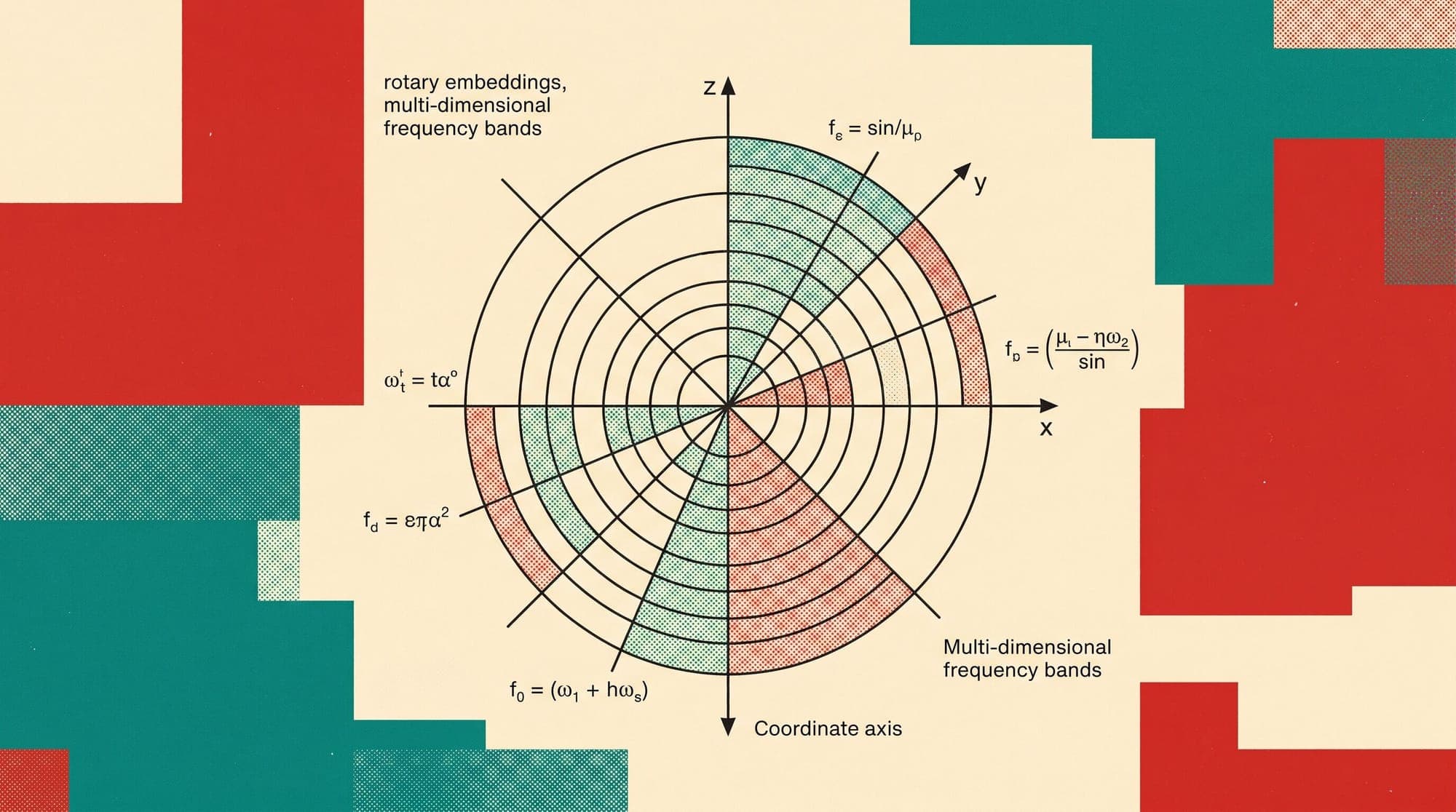
Transformer architectures lack inherent awareness of token order due to the permutation equivalence of standard self-attention operations. Early sequence models addressed this structural limitation through absolute additive positional embeddings or learned lookup tables. However, additive positional encodings do not naturally capture relative token distances and degrade severely when evaluating sequence lengths beyond the training horizon.
RoFormer: Enhanced Transformer with Rotary Position Embedding by Jianlin Su et al. introduced Rotary Position Embedding (RoPE). RoPE unifies absolute positional encoding and relative positional representation by rotating query and key representations in complex vector spaces. Today, RoPE forms the standard positional encoding framework across open-weight and frontier LLM families, including Llama, Mistral, Qwen, and DeepSeek.
Here is an analysis of the mathematical formulation of RoPE, its geometric mechanics, the long-term relative decay property, and the mathematical modifications used to extend context windows.
1. The Positional Representation Problem
In standard dot-product attention as formulated by Vaswani et al. (2017), the attention score between query vector at index and key vector at index is defined as:
For an input sequence , linear projections produce and . Because matrix multiplication and inner products distribute over summation, additive positional embeddings yield:
This additive expansion entangles content-content, content-position, and position-position interactions across four separate terms. More critically, the inner product does not guarantee invariance under translation: shifting both tokens by an offset () does not preserve the resulting score.
2. Derivation of Rotary Position Embeddings
The objective of RoPE is to construct transformation functions and that inject absolute position information while constraining their inner product to depend strictly on relative displacement :
The 2D Complex Plane Solution
To derive the functional form, consider a two-dimensional vector space mapped to the complex plane . A 2D vector is represented as a complex scalar .
We define the transformation as a position-dependent complex multiplication:
Taking the complex inner product (defined as $\text{Re}[\mathbf{u} \mathbf{v}^]$ where $$ denotes the complex conjugate):
The spatial index variables and appear solely through their difference . This satisfies the relative position condition exactly.
Generalization to -Dimensional Space
To generalize to a -dimensional embedding space (where is even), the vector space is decomposed into orthogonal two-dimensional subspaces. Each subspace is assigned a fixed base frequency :
The full -dimensional transformation is represented by a block-diagonal orthogonal rotation matrix :
where each block is the standard planar rotation matrix:
The self-attention score between rotated query and key vectors becomes:
This relies on the group homomorphism of planar rotations: $\mathbf{R}_{\theta, m}^T \mathbf{R}_{\theta, n} = \mathbf{R}_{\theta, -m} \mathbf{R}_{\theta, n} = \mathbf{R}_{\theta, n-m}$.
Standard Dot-Product Attention vs. Rotary Position Embedding:

[Additive Embedding]
Input x_m ---> Linear Projection ---> q_m + p_m ---\
                                                    \---> Score = (q_m + p_m)^T (k_n + p_n)
Input x_n ---> Linear Projection ---> k_n + p_n ---/     (4 entangled cross-terms)

[Rotary Position Embedding]
Input x_m ---> Linear Projection ---> q_m ---> Rot(m * theta) ---\
                                                                  \---> Score = q_m^T Rot((n-m) * theta) k_n
Input x_n ---> Linear Projection ---> k_n ---> Rot(n * theta) ---/     (Preserves relative offset n-m)
3. Computation and Memory Efficiency
Instantiating full rotation matrices introduces unnecessary computation per token. Because is block-diagonal with blocks, the vector rotation is computed in time via elementwise operations.
Let . Define the permuted orthogonal vector :
The rotation of vector at position is equivalent to:
where $\boldsymbol{\theta} = (\theta_1, \theta_1, \theta_2, \theta_2, \dots, \theta_{d/2}, \theta_{d/2})^T$ repeats each frequency across paired coordinate channels.
This formulation requires no auxiliary KV cache overhead for positional states: keys are rotated prior to cache insertion, allowing subsequent attention queries to evaluate directly against cached rotated keys.
4. The Long-Term Decay Property
A foundational property established in the RoFormer paper is the long-term decay of the attention inner product as spatial separation increases.

Assuming isotropic distributions for query and key coordinates, the expectation of the inner product scales with the average cosine sum across all subspace channels:
Because , the frequencies form a geometric sequence ranging from (fast rotation, short wavelength) to (slow rotation, long wavelength).
When the relative distance is small, the cosine terms across all frequency bands remain in phase, resulting in a high scalar product. As grows:
- High-frequency dimensions oscillate rapidly and cancel out through destructive interference.
- Low-frequency dimensions maintain slow-varying phase differences, preserving coarse directional orientation.
- The overall expected magnitude of the inner product decays monotonically over moderate distances, imposing a soft inductive bias favoring local context without explicit masking.
5. Long-Context Scaling and RoPE Extension
While RoPE naturally handles variable sequence lengths, standard models degrade when evaluating context lengths exceeding the pre-training window . This occurs because the model encounters unseen phase angles in low-frequency bands.
Several mathematical extensions have been developed to scale context windows up to 128K, 1M, and beyond.
| Context Extension Method | Formulation / Frequency Modification | Advantages | Trade-offs | | :--- | :--- | :--- | :--- | | Position Interpolation (PI) | (or ) | Simple linear mapping; preserves bounded phase angles | Compresses high frequencies; degrades fine-grained local syntax | | NTK-Aware Scaled RoPE | | Preserves high-frequency local resolution while scaling low frequencies | Suboptimal extrapolation without continued fine-tuning | | YaRN (Nous Research) | Multiband ramp interpolation + attention temperature scale | SOTA length generalization with 0.1% pre-training data; no local loss | Requires tuning wavelength threshold hyperparameters | | LongRoPE / Base Tuning | Non-uniform evolutionary search per dimension + | Scales sequences to 1M+ tokens without catastrophic perplexity spikes | Higher pre-training base calibration required |
Position Interpolation (PI)
Introduced by Chen et al. (Meta, 2023), Position Interpolation replaces position index extrapolation with interpolation by downscaling indices:
where is the context extension ratio.
While PI restricts all rotational angles to the domain observed during training , it uniformly compresses all frequencies. In high-frequency channels, where wavelengths are on the order of several tokens, downscaling reduces spatial discriminability between neighboring tokens.
NTK-Aware Scaled RoPE
NTK-Aware RoPE applies insights from the Neural Tangent Kernel (NTK) literature, which shows that deep neural networks struggle to learn high-frequency functions from low-frequency representations. Instead of scaling position indices uniformly, NTK-Aware RoPE modifies the base frequency :
Under this transformation:
- For (highest frequency): , preserving exact local positional resolution.
- For (lowest frequency): , applying full linear interpolation to long-range channels.
YaRN (Yet another RoPE extensioN)
Developed by Peng et al. at Nous Research (2023), YaRN partitions the frequency spectrum into three distinct regimes based on token wavelength :
- High-Frequency Regime (): Wavelengths are short enough that the model has observed multiple full cycles during pre-training. No interpolation is applied ().
- Low-Frequency Regime (): Wavelengths exceed the training window. Full linear interpolation is applied ().
- Transition Regime (): A smooth piecewise linear ramp function interpolates between exact extrapolation and linear interpolation:
Additionally, YaRN addresses attention entropy dilution. As context length increases by factor , the softmax distribution in self-attention flattens, increasing perplexity. YaRN scales the post-attention logits by a temperature multiplier:
This restores the sharpness of the original attention distribution over long contexts.
6. Architectural Implications
Rotary Position Embedding has become the standard positional scheme in modern language models due to three concrete engineering advantages:
- Translation Invariance: Relative distance is directly preserved in attention dot products without requiring dedicated relative bias matrices (such as T5 or ALiBi).
- Zero In-Memory KV Bloat: Positional rotations are applied to queries and keys in-place during kernel execution. KV cache entries store rotated representations directly, adding zero tensor allocations to serving memory.
- Continuous Interpolation: Rotational mechanics allow mathematical adjustments (NTK-aware, YaRN) to scale pre-trained sequence limits from 4K/8K tokens to 128K and 1M tokens with minimal continued pre-training.
Sources
- RoFormer: Enhanced Transformer with Rotary Position Embedding (Su et al., 2021)
- Extending Context Window of Large Language Models via Positional Interpolation (Chen et al., Meta, 2023)
- YaRN: Efficient Context Window Extension of Large Language Models (Peng et al., Nous Research, 2023)
- LongRoPE: Extending LLM Context Window Beyond 2 Million Tokens (Ding et al., 2024)
- Attention Is All You Need (Vaswani et al., 2017)