
In distributed computing, tail latency—the 95th, 99th, and 99.9th percentiles—dictates overall user experience, service-level agreements (SLAs), and multi-step agent execution reliability. While median response times (P50) in large language model (LLM) serving often appear acceptable, tail latencies frequently degrade by 4x to 10x. In multi-turn chat applications, real-time voice agents, and multi-agent DAG pipelines, a single straggler request stalls entire execution chains.
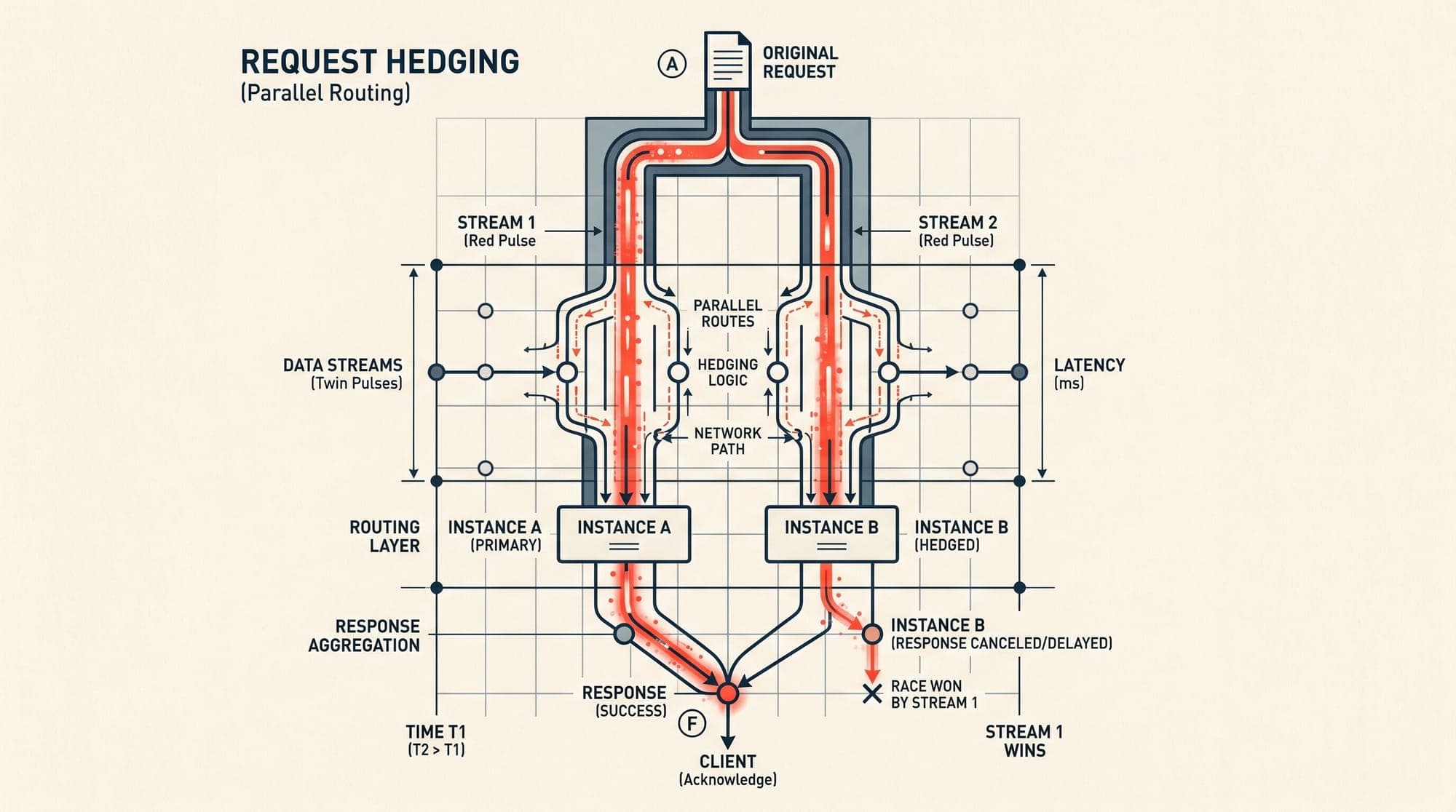
Request hedging, an architectural pattern introduced by Jeffrey Dean and Luiz André Barroso in their 2013 paper 'The Tail at Scale', offers a systematic mechanism to truncate the latency tail. By issuing duplicate requests to alternate replicas or provider endpoints after an empirically derived delay, systems eliminate stragglers with modest compute overhead.
Adapting request hedging to generative LLMs requires specialized engineering. Unlike traditional stateless key-value lookups or static database queries, autoregressive model serving separates into two distinct phases: prefill (prompt ingestion) and autoregressive token decode. Designing production hedging for LLM gateways requires managing streaming event loops, time-to-first-token (TTFT) racing, stream cancellation protocols, and token billing constraints.
Anatomy of the LLM Tail Latency Problem
In standard microservice architectures, request processing latency correlates tightly with payload size and CPU execution time. In GPU-accelerated LLM inference runtimes such as vLLM and SGLang, tail latency stems from dynamic runtime phenomena:
- Chunked Prefill Scheduling Contention: Continuous batching engines interleave compute-heavy prefill phases of new requests with memory-bandwidth-bound decode steps of existing requests. When a large prompt (e.g., 32k tokens) enters the scheduling queue, existing requests in decode phase experience multi-step stalls, causing sudden spikes in inter-token latency (ITL).
- GPU Memory Fragmentation and Eviction: Dynamic KV cache allocators managing high concurrency can trigger memory compaction, swapping KV blocks to host CPU memory or evicting non-prefix blocks, introducing latency anomalies.
- Multi-Tenant Cloud Throttling and Gateway Queuing: Managed API providers (such as OpenAI, Anthropic, or cloud hyperscalers) experience transient internal node queuing, garbage collection pauses, and hidden cold starts.
- Network Jitter and Connection Overhead: Establishing TLS handshakes, HTTP/2 multiplexing limits, and proxy buffer stalls across geo-distributed regions degrade edge responsiveness.
When a pipeline executes 10 sequential LLM calls, the probability that at least one call hits the P99 latency is 1 - (0.99)^10 ≈ 9.56%. For a complex 50-step agent loop, that probability climbs to nearly 40%. Truncating the tail is therefore essential for practical agent deployment.
Hedging vs. Retries vs. Blind Duplication
System designers commonly evaluate three concurrency strategies for tail mitigation:
Strategy Comparison:

1. Sequential Retries
   Client ----[ Request 1 ]--------------------X (Timeout @ 800ms)
                                                \---[ Request 2 ]---> Success @ 1100ms
   Latency: High (Timeout + Retry Latency) | Cost Overhead: Low | Tail Reduction: Poor

2. Blind Speculative Duplication (0ms Delay)
   Client ----[ Request 1 ]-----------------------------------------> (Aborted)
          \---[ Request 2 ]-----------------------------------------> Success @ 180ms
   Latency: Lowest | Cost Overhead: +100% | Tail Reduction: High (Risk of Cluster Overload)

3. Adaptive Request Hedging (Delay = P90/P95 TTFT)
   Client ----[ Request 1 ]--------------------... (Slow)
                 \--(Wait P90 = 150ms)---> [ Request 2 ]-----------> Success @ 310ms
Latency: Low | Cost Overhead: +5% to +10% | Tail Reduction: 75% to 90%- Sequential Retries: The client sets an aggressive timeout, aborts the initial request upon expiration, and issues a fresh attempt. In LLM inference, waiting for a hard timeout extends total latency well beyond the P99 threshold.
- Blind Duplication (Dual Dispatch): The proxy broadcasts every request simultaneously to two distinct backends and returns whichever finishes first. While this minimizes latency, it doubles infrastructure costs and GPU cluster load, cutting effective system capacity in half.
- Adaptive Request Hedging: The proxy dispatches the primary request to an optimal backend. If the backend fails to emit its first token within an established latency percentile (typically the rolling P90 or P95 TTFT), the proxy issues a secondary request to an alternate replica or provider. As soon as one stream returns valid output, the losing stream is cancelled.

TTFT-Centric Racing Architecture
In standard HTTP services, request hedging waits for full response headers or complete bodies. In streaming autoregressive generation, hedging must race on Time to First Token (TTFT).
Once a model generates its initial token, prompt prefill has completed, KV cache blocks are allocated, and decode latency becomes highly deterministic. Stalls almost exclusively occur during the queueing and prefill phase prior to token generation.
Percentile Tracking with DDSketch
Static hedging delays fail under shifting traffic loads. A production LLM gateway maintains rolling statistical histograms of TTFT per model, per deployment region, and per provider.
Using quantile sketch algorithms like DDSketch, gateways compute dynamic P90/P95 thresholds across sliding 5-minute windows with bounded memory and predictable CPU overhead. If the rolling P90 TTFT for a local vLLM cluster is 140ms, the hedge timer arms at exactly 140ms after dispatch.
Asynchronous Dual-Stream Race Implementation
A simplified asynchronous Python implementation illustrating TTFT racing and cancellation:
import asyncio
import time
from typing import AsyncGenerator, Optional

class HedgedLLMClient:
    def __init__(self, primary_pool, secondary_pool, quantile_tracker):
        self.primary_pool = primary_pool
        self.secondary_pool = secondary_pool
        self.quantiles = quantile_tracker

    async def generate_stream(self, prompt: str, model: str) -> AsyncGenerator[str, None]:
        # Determine dynamic hedge delay from rolling P90 TTFT
        hedge_delay = self.quantiles.get_p90_ttft(model, default=0.200)

        primary_task = asyncio.create_task(self._fetch_stream(self.primary_pool, prompt, model))
        hedged_task: Optional[asyncio.Task] = None

        # Wait for either the primary stream to start or the hedge timeout to expire
        start_time = time.monotonic()
        done, _ = await asyncio.wait(
            [primary_task],
            timeout=hedge_delay,
            return_when=asyncio.FIRST_COMPLETED
        )

        active_stream = None
        losing_task = None

        if primary_task in done and not primary_task.cancelled() and not primary_task.exception():
            active_stream = primary_task.result()
            self.quantiles.record_ttft(model, time.monotonic() - start_time)
        else:
            # Primary exceeded P90 TTFT threshold: spawn hedged request
            hedged_task = asyncio.create_task(self._fetch_stream(self.secondary_pool, prompt, model))

            # Race whichever emits the first token first
            race_done, _ = await asyncio.wait(
                [t for t in [primary_task, hedged_task] if not t.done()],
                return_when=asyncio.FIRST_COMPLETED
            )

            winner = list(race_done)[0]
            if winner == primary_task and not primary_task.exception():
                active_stream = primary_task.result()
                losing_task = hedged_task
                self.quantiles.record_ttft(model, time.monotonic() - start_time)
            elif hedged_task and winner == hedged_task and not hedged_task.exception():
                active_stream = hedged_task.result()
                losing_task = primary_task
                self.quantiles.record_hedge_win(model)
            else:
                # Fallback to remaining task if winner raised an error
                active_stream = (primary_task if winner == hedged_task else hedged_task).result()

        # Immediately cancel losing connection to release GPU resources
        if losing_task and not losing_task.done():
            losing_task.cancel()

        # Stream tokens to caller
        async for token in active_stream:
            yield token

    async def _fetch_stream(self, pool, prompt: str, model: str):
        # Dispatches HTTP/2 or gRPC streaming call to target backend
        return await pool.stream_generate(prompt=prompt, model=model)
Stream Cancellation Protocols and Upstream Teardown
Launching redundant inference calls without rapid cancellation causes resource exhaustion across serving backends. When a losing request is abandoned by the gateway client, the cancellation must propagate immediately to the serving engine.
Transport-Level Teardown
- HTTP/2 and HTTP/3: Gateways issue an
RST_STREAMframe (error codeCANCELorREFUSED_STREAM) per RFC 9113. This terminates the multiplexed stream without tearing down the underlying TCP/TLS connection pool. - gRPC: Clients invoke context cancellation, transmitting a
CANCELLEDstatus code over the wire.
Inference Engine KV Cache Reclamation
Under continuous batching engines, receipt of a client cancellation signal prompts the scheduler to immediately drop the sequence from the running batch. In vLLM and SGLang, this triggers asynchronous reclamation of physical memory blocks in the PagedAttention memory manager, freeing KV cache slots for incoming requests.
Cancellation Propagation Flow:

Gateway (Hedge Winner Decided)
   |
   |-- [ RST_STREAM / gRPC CANCELLED ] ---> Upstream Inference Server
                                                 |
                                                 |-- Continuous Batch Scheduler
                                                 |   (Drop Sequence ID)
                                                 |
                                                 |-- Block Memory Manager
                                                     (Free Paged KV Cache Slots)
The Prefill Commitment vs. Decode Savings
When a hedge request is issued, upstream engines begin prompt processing. If cancellation arrives:
- During Prefill: If the prompt is already executing on tensor cores, the compute for that batch chunk is consumed, but subsequent decode iterations are avoided.
- In Queue: If the request is waiting in the engine's scheduling backlog, cancellation prevents GPU kernel execution entirely.
- During Decode: Dropping the request frees subsequent autoregressive forward passes, avoiding hundreds of memory-bandwidth-bound steps.
Cross-Provider and Multi-Region Hedging Topologies
Production LLM gateways implement request hedging across three topological layers:
Hedging Topologies:

1. Intra-Cluster Replica Hedging
   Gateway ---> [ Worker 1 (GPU Node A) ] (Primary)
           \--> [ Worker 2 (GPU Node B) ] (Hedge @ P90)
   Characteristics: Zero schema divergence, shared model weights, low network variance.

2. Cross-Region Hedging
   Gateway ---> [ Region us-east-1 ] (Primary)
           \--> [ Region us-west-2 ] (Hedge @ P95)
   Characteristics: Shields against regional cloud outages and localized network congestion.

3. Cross-Provider Speculative Hedging
   Gateway ---> [ Provider A: Anthropic Claude ] (Primary)
           \--> [ Provider B: AWS Bedrock Claude ] (Hedge @ P95)
   Characteristics: Preserves exact model parity while hedging against upstream API gateway outages.
Schema Normalization Across Heterogeneous Providers
When hedging across different providers (for example, hedging an OpenAI GPT-4o request against an Azure OpenAI endpoint or open-weights vLLM deployment), gateways enforce strict schema normalization:
- Structured JSON Outputs: Gateways ensure schema constraints and JSON response schemas match identically across targets.
- Tool Calling Syntax: Normalized internal representations prevent disparate tool-call formatting from breaking agent state machines.
- Determinism Settings: Setting identical temperature, top_p, and seed parameters ensures semantic parity between winning candidates.
Safety Guardrails and Failure Modes
Improperly configured request hedging introduces systemic risks into distributed inference clusters. Production architectures incorporate explicit operational constraints:
1. The Cascading Saturation Anti-Pattern
When an inference cluster experiences sustained hardware saturation, queue lengths increase across all replicas. Issuing duplicate requests during a cluster-wide slowdown exacerbates GPU queuing, converting a minor performance degradation into a catastrophic outage.
Mitigation: Gateways enforce a dynamic hedge circuit breaker. If overall cluster utilization exceeds 80% or error rates rise above 2%, request hedging is automatically disabled.
Cluster State Circuit Breaker:
- Normal (Load < 80%, Error < 1%): Hedging Active (P90 TTFT Delay)
- Elevated (80% <= Load < 90%): Constrained Hedging (P98 TTFT Delay)
- Overloaded (Load >= 90% or Errors > 2%): Hedging Disabled (Strict Single Dispatch)
2. Token Budget and Hedging Caps
To prevent runaway billing in commercial API environments, gateways enforce an extra-attempt budget. For example, hedged requests may be capped at no more than 5% of total ingress volume across a rolling 60-minute window.
3. Non-Idempotent Tool Call Isolation
Request hedging is safe for pure inference and read-only retrieval queries. However, if an agent pipeline executes side-effecting operations (such as database writes, payment processing, or webhook triggers), duplicate speculative execution can lead to double-execution bugs.
Rule: Speculative and hedged execution must be strictly barred on execution paths containing non-idempotent tool invocations.
Production Telemetry and Observability
To evaluate hedging efficacy and optimize threshold parameters, production LLM gateways monitor five key operational metrics:
- Hedge Dispatch Rate:
(Hedged Requests Issued / Total Requests) * 100. Target: 5% to 10%. - Hedge Win Rate:
(Hedge Wins / Hedged Requests Issued) * 100. A healthy system demonstrates a win rate between 60% and 80%. A win rate near 50% suggests the hedge delay is too aggressive; a win rate below 20% indicates correlated cluster-wide delays. - P99 TTFT Delta: Pre-hedging vs. post-hedging P99 latency comparison. Typical production deployments observe a 60% to 80% drop in P99 TTFT.
- Wasted Token Overhead: Number of prompt prefill and decode tokens billed or computed on losing streams before cancellation takes effect.
- Upstream Cancellation Latency: Elapsed time between the gateway issuing an
RST_STREAMframe and the GPU scheduler reclaiming the associated KV cache blocks.
By combining empirical quantile tracking, streaming first-token racing, and aggressive upstream connection cancellation, request hedging transforms highly variable inference pipelines into deterministic, low-latency foundations for production AI systems.
Sources
- The Tail at Scale (Jeffrey Dean, Luiz André Barroso, Communications of the ACM, 2013)
- DDSketch: Fast and Fully Mergeable Quantile Sketches for Streaming Data (Charles Masson, Jee E. Rim, Homin K. Lee, 2019)
- vLLM: Efficient Memory Management for Large Language Model Serving with PagedAttention (Woosuk Kwon et al., 2023)
- SGLang: Fast Serving Framework for Large Language Models and Multimodal Models (Lianmin Zheng et al., 2023)
- RFC 9113: HTTP/2 Stream Cancellation and Management
- Envoy Proxy Architecture: Request Hedging Protocols



