
Prompt Management and Registry Architectures in Production: GitOps, Dynamic Registries, Template Typing, and CI/CD Quality Gates
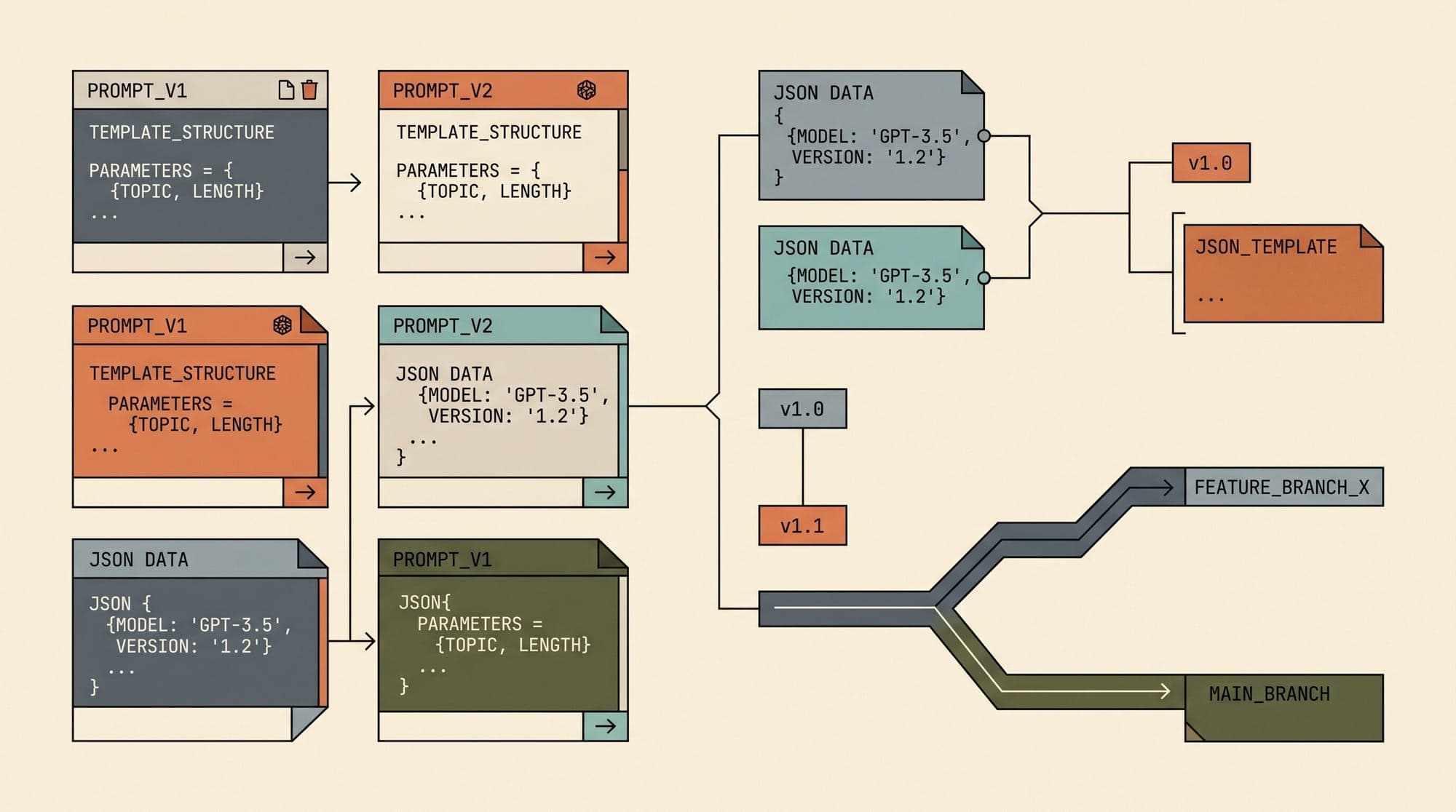
As language model applications evolve from single-file scripts into distributed systems, managing prompt templates becomes an infrastructure challenge. In early prototypes, prompts are frequently embedded as raw multi-line string literals directly inside application business logic. While sufficient for proof-of-concept demonstrations, hardcoding prompts in application source code introduces severe operational bottlenecks: non-technical domain experts cannot refine instructions without engineering deployments, modifying a single prompt requires a full application release cycle, and tracing which prompt version generated a degraded response in production becomes impossible.
In production engineering, prompts are not static strings; they are composite software artifacts. A production prompt bundle consists of natural language instructions, dynamic variable parameter slots, model hyperparameters (such as temperature, top-p sampling bounds, and reasoning token limits), structured output schema definitions, and automated evaluation assertions. Treating prompts with software engineering rigor requires structured versioning, dynamic templating, type-safe validation, and automated CI/CD quality gates.
GitOps vs. Dynamic Remote Registries
Production teams typically adopt one of two primary architectural paradigms for prompt management: repository-native GitOps or centralized dynamic registries.
1. Repository-Native GitOps (In-Repo Prompts)
In a pure GitOps architecture, prompt templates are treated strictly as code assets. Prompts are stored in structured files (such as .prompt, YAML, or Jinja2 templates) within the application codebase.
- Versioning Mechanism: Every prompt version is immutably tied to a Git commit SHA or semantic release tag.
- Change Management: Modifications follow standard software engineering workflows: branching, pull request reviews, automated CI regression suites, and atomic deployments.
- Advantages: Perfect synchronization between application code and prompt schemas; zero runtime network dependency or external latency overhead; complete audit trails backed by Git history.
- Trade-offs: High friction for prompt engineers and domain experts who do not work in code repositories; deploying a simple wording adjustment requires a full build, test, and container deployment pipeline.
2. Centralized Dynamic Registries
Dynamic prompt registries (provided by tools such as Langfuse Prompt Management, MLflow Prompt Registry, Braintrust, and Portkey) decouple prompt storage from application runtimes. Prompts are hosted in a centralized control plane and retrieved over an API at runtime.
- Versioning Mechanism: The registry assigns an auto-incrementing integer or UUID to each prompt revision, while environment pointers (such as
production,staging, orcanary-v2) act as mutable labels pointing to specific versions. - Change Management: Prompt engineers modify, test, and label prompt versions via web consoles or dedicated SDKs without touching application code.
- Advantages: Near-instantaneous iteration cycles; live prompt swapping without redeploying microservices; centralized visibility across multiple backend services sharing common prompt directives.
- Trade-offs: Runtime dependency on registry availability; added network latency on cold starts; the risk of runtime schema drift if a newly published prompt introduces variables or output expectations that running application instances cannot process.
3. The Hybrid Production Pattern
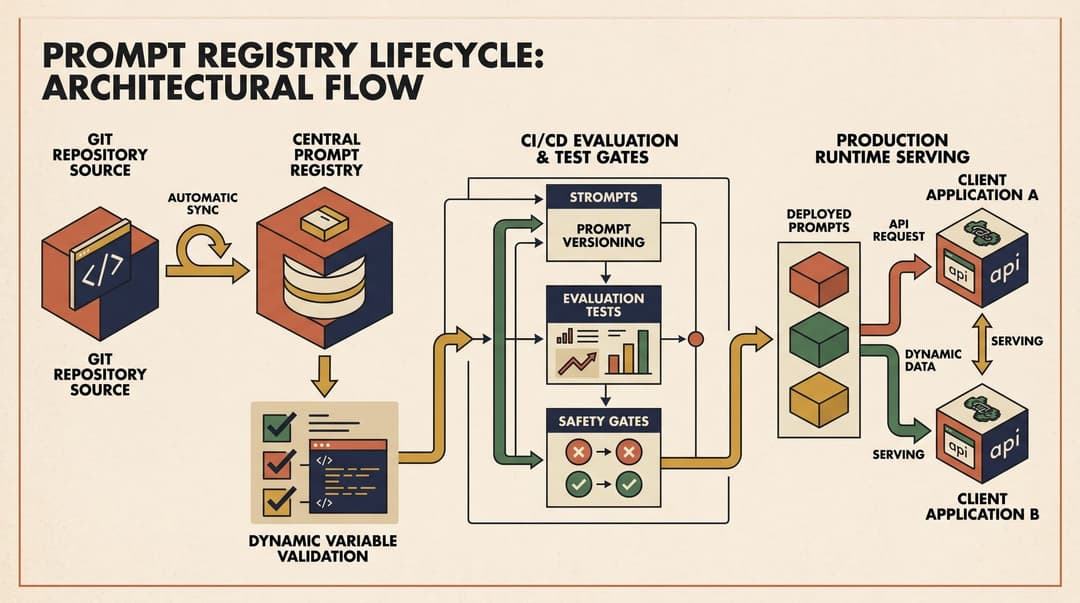
To resolve the tension between agility and reliability, leading engineering teams implement a hybrid pattern:
- Git as the Source of Truth: Prompts are authored, reviewed, and versioned in a dedicated Git repository.
- Automated Registry Sync: CI/CD pipelines automatically publish validated templates to the remote prompt registry upon merge.
- Local Fallback Bundles: Applications fetch prompts from the registry with an in-memory cache (e.g., 60-second Time-To-Live with stale-while-revalidate semantics), falling back to bundled in-repo templates if the registry becomes unreachable.
Template Syntax and Type-Safe Variable Interpolation
Prompt templates rely on variable interpolation to dynamically inject runtime context, user inputs, retrieved document chunks, and tool outputs. Common templating formats include:
- Mustache / Double-Curly Syntax (
{{variable}}): Minimalist, logic-less interpolation supported natively across tools like Langfuse and LiteLLM Prompt Management. - Jinja2: Advanced templating supporting loops, conditional branches, and custom filters, essential for dynamically formatting variable-length lists of few-shot examples or structured database rows.
- DotPrompt Frontmatter: A format introduced by Google Genkit that pairs YAML frontmatter metadata (model name, temperature, input schemas) with a Markdown body.
The Pitfall of Untyped String Interpolation
Untyped string interpolation represents a major operational vulnerability in production AI pipelines. If an application supplies a null value, a missing dictionary key, or an unexpected data type to a prompt template, the rendering engine may fail silently, emit empty brackets, or inject stringified representations (e.g., "None" or "[object Object]") into the context window.
Furthermore, unescaped user inputs can inadvertently trigger prompt injection attacks or break structured delimiters within the prompt structure.
Type-Safe Contracts
To mitigate these risks, production systems enforce strict type validation prior to prompt rendering. Modern frameworks such as BAML (Basically A Made-Up Language) and Pydantic-based wrappers validate variable types and output schemas against formal type definitions at compile time and runtime:
from pydantic import BaseModel, Field
from typing import List

class UserContext(BaseModel):
    user_id: str
    organization_tier: str
    feature_flags: List[str] = Field(default_factory=list)

class DocumentSnippet(BaseModel):
    doc_id: str
    relevance_score: float
    content: str

class SummarizerPromptPayload(BaseModel):
    user: UserContext
    documents: List[DocumentSnippet]
    max_summary_length: int = Field(ge=50, le=1000)
Enforcing strict schemas ensures that rendering errors are caught in application code before an incomplete or malformed payload is dispatched to the model API.
KV Cache Prefix Alignment: The Prompt Structuring Rule
A critical architectural consideration in prompt management is hardware-level KV cache utilization. Modern inference engines (such as vLLM Automatic Prefix Caching and SGLang RadixAttention) and hosted provider endpoints (including Anthropic and OpenAI) reuse key-value attention tensors across requests by hashing token sequences starting from the initial token.
When consecutive requests share an identical token prefix, the engine skips prefill computation for the cached prefix, reducing Time-To-First-Token (TTFT) by up to 80% and slashing input token inference costs by 50% to 90%.
[Cache-Aligned Prompt Structure]
┌────────────────────────────────────────────────────────┐
│ 1. Static System Directives (Global, 100% Shared)      │ ──► Cached across ALL users
├────────────────────────────────────────────────────────┤
│ 2. Few-Shot Demonstration Examples (Static)            │ ──► Cached across ALL users
├────────────────────────────────────────────────────────┤
│ 3. Retrieved RAG Context / Knowledge Base (Semi-Static)│ ──► Cached within session/topic
├────────────────────────────────────────────────────────┤
│ 4. User-Specific Conversation History                  │ ──► Cached per user session
├────────────────────────────────────────────────────────┤
│ 5. Volatile Variables (Timestamp, Request ID, Query)   │ ──► Evaluated on-demand
└────────────────────────────────────────────────────────┘
The Invalidation Anti-Pattern
If dynamic variables (such as timestamps, user identifiers, or volatile session IDs) are injected at the beginning of the system prompt, every single request produces a distinct initial token sequence. This completely invalidates prefix caching across the fleet, driving cache hit rates from >80% down to 0%.
Production prompt registries must structure prompt blocks hierarchically:
- Static System Instructions: Core role definitions, guardrails, and behavioral boundaries placed at the very top.
- Static Few-Shot Examples: Standard input/output exemplars.
- Domain Knowledge / Shared Context: High-volume reference data that remains constant across multiple requests.
- Dynamic User Inputs and Ephemeral Parameters: User queries, timestamps, and transient variables positioned strictly at the end of the context payload.
CI/CD Quality Gates and Automated Evaluation
Modifying prompt wording can introduce unintended regressions in accuracy, tool invocation correctness, and safety boundaries. Consequently, prompt updates must pass through automated evaluation gates in CI/CD pipelines before promotion to production.
[Developer PR] ──► [CI Pipeline] ──► [Golden Dataset Eval] ──► [Score Gating] ──► [Registry Sync]
                                             │
                                     (Promptfoo / DeepEval)
                                             │
                                   ├── Accuracy >= 95%
                                   ├── Schema Validity = 100%
                                   └── Latency < 1.2s
1. Pre-Merge Golden Dataset Testing
When a pull request alters a prompt template, automated testing workflows execute the prompt across a curated "golden dataset" of representative test cases using tools like Promptfoo or DeepEval. The pipeline scores:
- Output Schema Conformance: Percentage of outputs that successfully parse against the expected JSON schema (target: 100%).
- Semantic Similarity / Exact Match: Regression testing against known factual baselines.
- LLM-as-a-Judge Assertions: Automated grading on criteria such as conciseness, adherence to negative constraints, and tone.
- Safety and Red-Teaming Probes: Verifying that instruction revisions have not created jailbreak vulnerabilities.
2. Canary Deployments and Shadow Routing
Rather than switching 100% of live traffic immediately to a new prompt version, prompt registries support canary routing. A specified percentage of production traffic (e.g., 5%) is routed to the new prompt label (canary-v2), while the remaining 95% uses production.
Telemetry pipelines track real-time metrics across both cohorts:
- Error rates and schema parsing failures.
- Downstream tool call completion rates.
- User feedback signals (thumbs up/down, retry rates, session abandonments).
- Token usage and TTFT latency distributions.
If the canary cohort triggers an anomaly or exceeds error thresholds, the routing pointer automatically rolls back to the previous stable release.
3. OpenTelemetry Trace Binding
To maintain full observability, applications must link runtime traces to exact prompt versions. Following the OpenTelemetry Semantic Conventions for Generative AI, client libraries inject metadata attributes into span contexts:
gen_ai.prompt.name: Identifier of the prompt template (e.g.,customer-support-agent).gen_ai.prompt.version: Immutable revision number or commit SHA (e.g.,v1.4.2).gen_ai.prompt.label: Active environment label (e.g.,production).
This metadata enables engineering teams to filter production logs, isolate anomalous model behaviors, and correlate performance regressions directly to specific prompt revisions.
Production Implementation Blueprint
The following Python example demonstrates a resilient client architecture incorporating prompt retrieval, in-memory caching with background revalidation, local file fallback, and structured variable validation.
import time
import json
import logging
from typing import Dict, Any, Optional
from pydantic import BaseModel, Field

logger = logging.getLogger("prompt_registry")

class PromptTemplate(BaseModel):
    name: str
    version: str
    system_template: str
    user_template: str
    model: str
    temperature: float = Field(default=0.7, ge=0.0, le=2.0)
    max_tokens: int = Field(default=1024, gt=0)

class PromptClient:
    def __init__(self, fallback_dir: str = "./prompts", cache_ttl_seconds: int = 60):
        self.fallback_dir = fallback_dir
        self.cache_ttl = cache_ttl_seconds
        self._cache: Dict[str, Dict[str, Any]] = {}

    def _fetch_from_remote_registry(self, prompt_name: str, label: str) -> Optional[PromptTemplate]:
        """Simulates fetching prompt artifact from remote registry API."""
        try:
            # Remote API call simulation (e.g., Langfuse / MLflow SDK)
            # Response includes immutable version and structured message templates
            return PromptTemplate(
                name=prompt_name,
                version="v2.1.0",
                system_template="You are a technical support assistant. Follow schema requirements strictly.",
                user_template="Query: {{user_query}}\nContext: {{context_docs}}",
                model="gpt-4o",
                temperature=0.2,
                max_tokens=500
            )
        except Exception as exc:
            logger.warning(f"Failed to fetch prompt {prompt_name} from registry: {exc}")
            return None

    def _load_from_local_fallback(self, prompt_name: str) -> PromptTemplate:
        """Loads prompt artifact from in-repo fallback bundle if registry is down."""
        file_path = f"{self.fallback_dir}/{prompt_name}.json"
        with open(file_path, "r", encoding="utf-8") as f:
            data = json.load(f)
        return PromptTemplate(**data)

    def get_prompt(self, prompt_name: str, label: str = "production") -> PromptTemplate:
        now = time.time()
        cache_key = f"{prompt_name}:{label}"

        # In-memory cache lookup
        if cache_key in self._cache:
            entry = self._cache[cache_key]
            if now - entry["timestamp"] < self.cache_ttl:
                return entry["template"]

        # Fetch from remote registry with fallback
        template = self._fetch_from_remote_registry(prompt_name, label)
        if template is None:
            if cache_key in self._cache:
                logger.warning(f"Using stale cached prompt for {cache_key}")
                return self._cache[cache_key]["template"]
            logger.warning(f"Using local file fallback for {prompt_name}")
            template = self._load_from_local_fallback(prompt_name)

        # Update cache
        self._cache[cache_key] = {"template": template, "timestamp": now}
        return template

    def render(self, template: PromptTemplate, variables: Dict[str, Any]) -> Dict[str, Any]:
        """Renders prompt messages while enforcing strict variable interpolation."""
        system_content = template.system_template
        user_content = template.user_template

        for key, val in variables.items():
            placeholder = f"{{{{{key}}}}}"
            if placeholder in user_content:
                user_content = user_content.replace(placeholder, str(val))

        # Check for unrendered placeholders
        if "{{" in user_content or "}}" in user_content:
            raise ValueError(f"Unrendered variable placeholders detected in prompt {template.name}")

        return {
            "model": template.model,
            "temperature": template.temperature,
            "max_tokens": template.max_tokens,
            "messages": [
                {"role": "system", "content": system_content},
                {"role": "user", "content": user_content}
            ],
            "metadata": {
                "prompt_name": template.name,
                "prompt_version": template.version
            }
        }
Architectural Decision Matrix
| Dimension | In-Repo GitOps | Managed Dynamic Registry | Hybrid Pattern |
|---|---|---|---|
| Primary Source of Truth | Git Repository | Centralized Database / Cloud API | Git Repository |
| Deployment Speed | Minutes (tied to code release) | Seconds (metadata label update) | Seconds (automated CI sync) |
| Runtime Dependencies | None (embedded in application) | High (registry API availability) | Low (in-memory cache + fallback) |
| Type Safety & Schema Sync | Compile-Time / PR Gates | Runtime Validation Required | Compile-Time + Runtime Checks |
| Collaboration Interface | Code Editor / Git PRs | Web UI / No-Code Playground | Web UI synced via Git Webhooks |
| Observability Binding | Git SHA injected at build | Dynamic Version Tag / UUID | Git SHA + Registry Version UUID |
| Recommended Use Case | Highly regulated, strict CI teams | Rapid prototyping & growth teams | Enterprise production systems |
Summary
Treating prompts as production software infrastructure transforms ad-hoc prompt engineering into a reliable, observable discipline. By pairing Git-backed version control with dynamic runtime registries, enforcing type-safe variable contracts, structuring templates to maximize KV cache prefix alignment, and gating deployments behind automated evaluation suites, engineering teams can maintain rapid iteration cycles without compromising production stability.
Sources
- Langfuse Prompt Management Documentation
- MLflow Prompt Registry
- vLLM Automatic Prefix Caching Architecture
- Braintrust: What is Prompt Management?
- BAML Type-Safe Prompt Engineering Framework
- LiteLLM Prompt Management Integration
- OpenTelemetry Semantic Conventions for Generative AI
- Promptfoo LLM Evaluation Suite
